∙
Cooper
∙
Reading time:
25 min

Employees spend up to 30% of their week searching for information across disconnected tools, costing enterprises millions annually in lost productivity. AI-driven knowledge retrieval systems solve this by consolidating data from platforms like Google Drive, Zendesk, and Confluence into one searchable hub. Using natural language processing, these tools understand intent, provide accurate answers, and respect existing security permissions.
Key benefits include:
Faster answers: Employees query once and get results from all connected platforms.
Improved accuracy: AI retrieves verified information from trusted sources.
Streamlined workflows: No more toggling between apps - answers appear in tools like Slack.
Reduced repetition: AI handles repetitive queries, freeing experts to focus on complex tasks.
For example, Question Base integrates with Slack, answering 35% of repetitive questions in seconds, saving over 6 hours per week per expert. By bridging fragmented systems, AI transforms how teams access and use knowledge, driving efficiency while maintaining strong security protocols.
Foundry IQ for Multi-Source AI Knowledge Bases
How AI Improves Knowledge Retrieval Across Platforms
Traditional keyword-based search systems often leave employees frustrated, forcing them to guess the exact terms used in company documentation. For instance, searching for "time off" might yield no results if the document refers to the policy as "paid leave." AI reshapes this experience by focusing on the intent behind a query rather than the specific words typed.
Understanding Context with Natural Language Processing
Natural Language Processing (NLP) has revolutionized how employees engage with enterprise knowledge systems. Instead of merely matching keywords, AI interprets the deeper meaning of queries - considering synonyms, related ideas, and user intent shaped by factors like job role, department, and search history.
For example, when someone searches for "time off policies", AI recognizes a broader scope of related information, such as PTO guidelines, vacation procedures, and absence management protocols. It also tailors results based on context, like the employee's department or ongoing projects, ensuring the answers are relevant and actionable.
Semantic indexing plays a vital role by mapping connections between concepts and documents. This approach ensures that even if an exact keyword match is missing, the system surfaces related and meaningful information. Machine learning further refines this process by analyzing user behavior and past interactions, continuously improving search precision. The result? Employees spend far less time hunting for answers and can trust the information they find.
Retrieving Verified Knowledge from Trusted Sources
Accuracy is non-negotiable when it comes to enterprise knowledge retrieval. An AI system that generates plausible but incorrect answers can create more harm than good. To address this, advanced systems rely exclusively on verified, trusted sources.
Modern AI platforms use Retrieval-Augmented Generation (RAG) to access real-time, up-to-date information from an organization’s knowledge bases. For example, when an employee asks a question, the system pulls data from repositories like Google Drive or Zendesk, ensuring responses reflect the latest policies and procedures.
This method anchors answers in current, approved documentation. Tools like Question Base enhance transparency by providing precise quotes and source annotations[1], allowing employees to verify the information and understand its context.
Organizations also maintain strict control over what the AI can access through permission management and content governance. Knowledge managers can define trusted sources for each channel, refine answer accuracy, and ensure only appropriate, verified information is shared. For queries the AI can’t confidently resolve, the system escalates them to human experts, ensuring that misinformation never spreads.
This approach is especially critical in compliance-heavy industries, where inaccuracies can lead to legal issues, and in customer-facing roles, where trust hinges on delivering correct answers.
Connecting Multiple Platforms for Unified Knowledge Access
AI doesn’t just understand context - it also bridges the gap between fragmented data systems. When HR policies are stored in Google Drive, customer support files in Zendesk, project templates in Notion, and technical specs in Confluence, employees often waste time toggling between platforms to find what they need.
AI-powered systems solve this by consolidating these scattered resources into a single, searchable hub. Employees can ask one question and instantly access information across all connected platforms, offering a seamless and comprehensive view.
Top enterprise search tools integrate with over 100 SaaS applications and data repositories, centralizing content from diverse sources. Question Base, for example, connects to trusted repositories via pre-built connectors and API integrations. When a query is submitted, the system searches all linked sources in real time, adhering to strict access permissions and security protocols.
This unified approach transforms collaboration, giving teams instant access to critical information and enabling faster, more informed decisions. AI also bridges terminology gaps across departments - whether engineers use technical jargon or customer service teams rely on plain language, the system understands and adapts to these differences.
Imagine a project manager starting a new initiative. Instead of manually locating resources, the AI system could automatically retrieve templates from Notion, past notes from Slack, technical specs from Confluence, and relevant expertise profiles from HR systems. This streamlined access eliminates unnecessary back-and-forth communication, enabling smoother workflows and greater efficiency. By breaking down data silos, AI empowers organizations to build a cohesive, well-organized knowledge ecosystem.
Integrating AI with Enterprise Tools
The dream of seamless knowledge access often falters when integration becomes a maze of complexity. Enterprises need AI systems that connect effortlessly with their existing tools - without requiring months of development or specialized engineering teams. Today’s AI-powered knowledge retrieval tools address this hurdle with pre-built connectors and standardized APIs, cutting implementation time from months to just days. These integrations not only simplify setup but also ensure secure connections to legacy systems, reinforcing the earlier point about the importance of unified search.
Using Pre-Built Connectors and API Integrations
Pre-built connectors are game-changers when it comes to overcoming technical barriers. Instead of developing custom code for each platform, organizations can rely on standardized integrations that come ready with features like authentication, data mapping, and error handling. This approach streamlines the process, allowing teams to focus on using the tools rather than building them.
What sets enterprise-grade solutions apart from basic search tools is their ability to unify data across multiple specialized applications without the need for custom middleware. For example, an AI system integrated with Google Drive can access documents, spreadsheets, and presentations. Similarly, a connection with Zendesk brings in Help Center articles and support tickets, while Salesforce integrations allow access to CRM data like accounts, cases, and contacts.
Question Base exemplifies this plug-and-play philosophy by offering integrations with platforms like Notion, Google Drive, Confluence, Zendesk, Intercom, Salesforce, Dropbox, Freshdesk, HubSpot, OneDrive, and Jira. The process is straightforward: install the app from the Slack App Marketplace, invite the bot with /invite @questionbase, and connect your documentation sources. Within moments, the system delivers instant answers in Slack using natural language.
While custom APIs provide flexibility for unique use cases, they demand more resources and ongoing maintenance. For most enterprises, pre-built connectors strike the perfect balance between speed and functionality, enabling deployment in days rather than months.
Maintaining Permissions and Security During Integration
Integrating multiple platforms introduces a critical challenge: how to unify access to knowledge without undermining the security measures in place. When an employee queries an AI system, the platform must verify their identity, check permissions across all connected data sources, and ensure they only access what they’re authorized to see. The AI essentially acts as a gatekeeper, filtering responses based on the user’s access level[2].
Advanced systems address this with role-based access control (RBAC), which syncs with enterprise directory services like Active Directory or Okta. This ensures permissions automatically update as employees change roles, departments, or leave the organization, eliminating the risks of manual oversight.
Security doesn’t stop at permissions. Enterprises dealing with sensitive data should prioritize solutions that meet SOC 2 Type II compliance, a certification that confirms rigorous third-party audits of security protocols. Encryption - both at rest and in transit - further safeguards data, whether it’s being stored or transferred between platforms. For industries with strict regulatory requirements, on-premise deployment options provide an added layer of control.
Question Base meets these security demands with enterprise-grade features, including SOC 2 Type II compliance, end-to-end encryption, and on-premise deployment options. Administrators have full control over which content sources are accessible, enabling them to define trusted repositories for each channel. Regular audits ensure any security gaps are promptly addressed. This commitment to secure integration is particularly evident in Question Base’s Slack deployment.
Case Example: Question Base's Integration with Slack
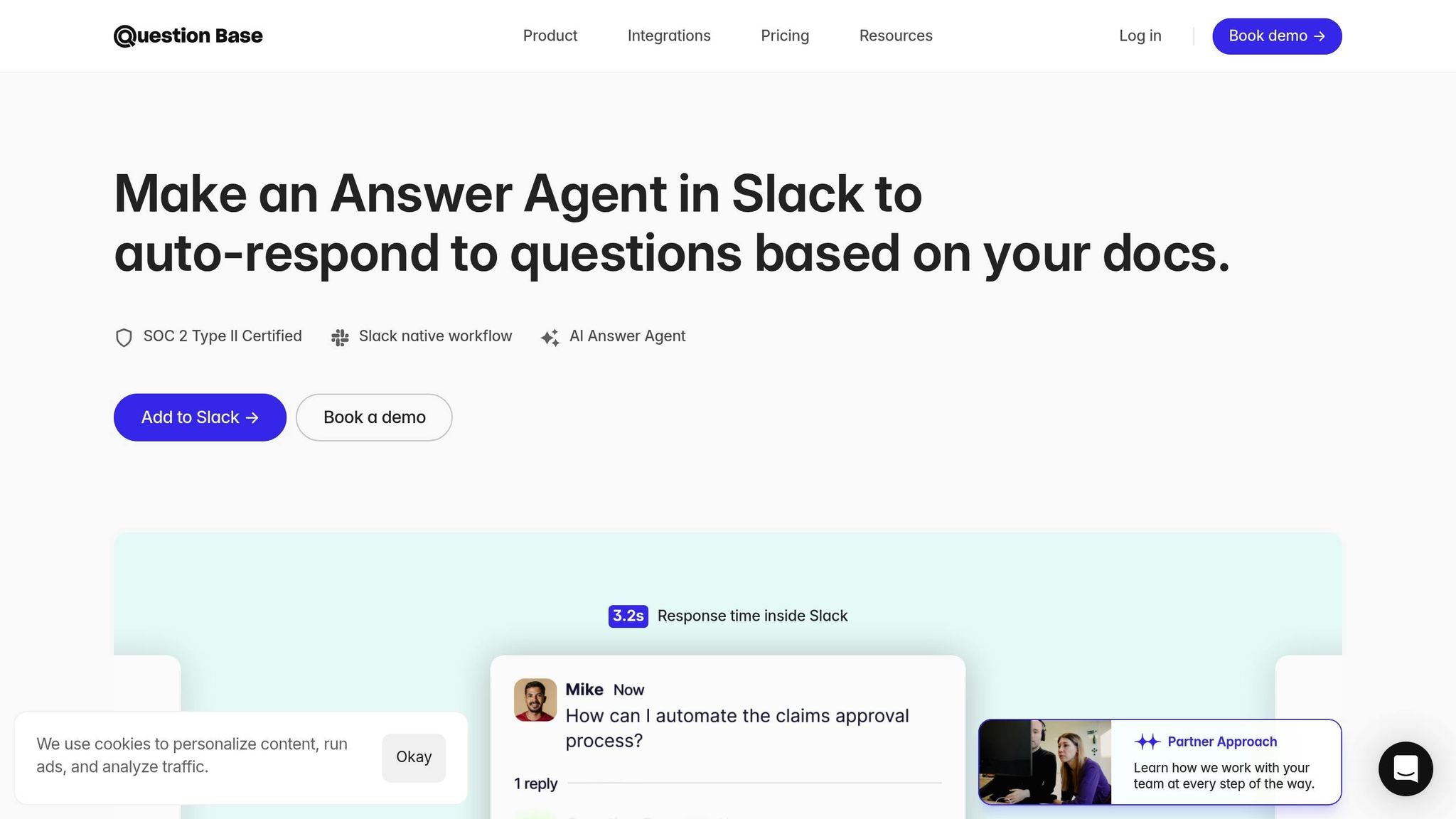
By combining simple integration with robust security, Question Base turns Slack into a powerful internal knowledge hub. Slack has become the backbone of communication for many organizations, serving as the go-to platform for collaboration and information sharing. Embedding AI knowledge retrieval directly into Slack eliminates the need to switch between tools, allowing employees to find answers where they’re already working.
Question Base operates as a customizable AI agent, tackling a major pain point for large organizations: up to 40% of internal questions are repetitive[1]. For a 1,000-person company, the productivity loss from repeatedly answering the same questions in Slack can exceed $2 million annually[1].
The results speak for themselves. Question Base automatically answers 35% of repetitive questions in an average of 3.2 seconds, saving internal experts more than 6 hours per week and achieving a 4.8 answer accuracy score[1]. These numbers highlight how effective integrations can turn knowledge access into a productivity booster rather than a drain.
The system connects directly to platforms like Notion, Confluence, Google Drive, Zendesk, and Intercom. Employees can ask questions in Slack using natural language, and Question Base retrieves precise, contextually relevant answers from connected sources. Each response includes quotations and source annotations, making it easy for users to verify the information and understand its context.
What sets this approach apart is its ability to transform fleeting Slack conversations into structured, searchable documentation. The system captures valuable insights shared in threads, building a living FAQ that evolves with the organization’s needs. Knowledge managers can review and refine AI-generated answers, ensuring both accuracy and relevance.
The integration works seamlessly across public and private Slack channels, as well as direct messages. Administrators can customize tone, behavior, and source settings for each channel. For complex queries that the AI can’t handle, escalation workflows direct them to the appropriate human experts. This hybrid model combines the speed of automation with the reliability of human oversight, delivering both efficiency and accuracy in knowledge management.
Setting Up AI-Powered Knowledge Retrieval in Slack
Implementing AI-powered knowledge retrieval in Slack can revolutionize how teams access information, offering a user-friendly system that’s up and running in just a few days.
Installing and Configuring AI Retrieval Tools
To get started, organizations can visit the Slack App Marketplace and search for their preferred AI tool. Once they find the app, they simply click "Install", grant the necessary permissions, and follow the setup instructions. After installation, the bot is activated in Slack channels with the command /invite @[botname].
For Question Base users, the process is even more straightforward: install the app from the Slack App Marketplace, activate it with /invite @questionbase, and link your documentation sources. From there, the system delivers immediate, natural language responses directly within Slack.
Before diving into installation, organizations should take a few preparatory steps:
Catalog your information repositories: Identify where your key information is stored, such as Google Drive, Confluence, Notion, or Zendesk.
Assign a knowledge management owner or team: This group will oversee setup and ensure the system stays up-to-date.
Confirm admin permissions: Ensure your Slack workspace allows third-party app installations and that your knowledge sources are organized and accessible.
Connecting these knowledge sources is simple. Using the AI tool’s settings dashboard, you can link platforms like Google Drive, Zendesk, or Salesforce via OAuth or API keys. Once connected, the system automatically indexes and retrieves data in real time. Question Base supports integrations with platforms like Notion, Confluence, Intercom, and Dropbox, among others.
Permission management is a critical part of the setup. Organizations should define clear rules about what content the AI can access and which employees can query specific information. The AI respects existing permissions from source platforms, ensuring users only access content they’re authorized to see. It’s also a good idea to configure audit logs and enforce role-based access controls (RBAC) to track queries and maintain compliance.
Another key step is reviewing the quality of your content. Teams should audit their knowledge bases to decide which documents and resources should be indexed. This might involve removing outdated files, consolidating duplicates, and creating consistent naming conventions. For instance, files in Google Drive could be organized into clear folder structures with descriptive metadata, while Zendesk articles should be properly tagged and regularly updated.
To ensure accuracy, the AI should prioritize recently updated content while de-emphasizing older, archived material. Establishing a content governance process - where knowledge owners periodically review and update their areas - helps maintain a reliable and up-to-date system. This approach ensures all connected sources work together seamlessly to provide accurate, comprehensive answers.
Once the system is installed and connected to your knowledge sources, the next step is to fine-tune the AI so it aligns with your organization’s needs.
Customizing AI Behavior and Tone
After setting up the basics, customizing the AI ensures it not only retrieves information but also communicates in a way that matches your company’s personality. You can adjust the AI’s tone - whether formal, conversational, technical, or approachable - to reflect your organization’s values and style.
Channel-specific customization can further refine how the AI operates. For example, in a #sales channel, the AI might pull data from CRM tools and sales materials, while in an #engineering channel, it would rely heavily on technical documentation. Question Base allows organizations to define workflows that guide the AI’s behavior, ensuring responses are precise and relevant. The tool works across public and private channels, as well as in direct messages, offering flexible access while maintaining control.
Escalation workflows are also essential for handling complex queries. For instance, compliance-related questions could be directed to the legal team, while bug reports might be routed to engineering. These workflows ensure that nuanced or sensitive questions are handled by the right people.
Additionally, organizations can set custom instructions to prioritize certain information types or include disclaimers for sensitive topics. As employees use the AI, knowledge managers can refine its tone, adjust escalation rules, and update source priorities to keep the system aligned with evolving needs.
With these customizations in place, employees can immediately benefit from a more intuitive and efficient way to access knowledge.
Helping Employees Access Knowledge Faster
Once everything is configured, employees can retrieve information effortlessly using natural language queries. Instead of relying on technical search terms like "onboarding process documentation", they can simply ask, "How do I onboard a new team member?" The AI understands the context and intent behind the question, tailoring responses based on the user’s role, department, and past interactions.
For the best results, employees should provide some context in their queries. For example, saying, "I’m in sales and need to know our discount approval process", will yield more precise answers than a generic question. The AI also supports follow-up queries, maintaining the context of the conversation to refine its responses.
Employees no longer need to navigate multiple tools or remember where specific information is stored. The AI scans all connected sources - Google Drive, Zendesk, Confluence, and more - in real time, eliminating the need for manual searches across platforms.
The system delivers verified and traceable answers, combining retrieval from trusted sources with natural language generation. This transparency builds trust and minimizes the risk of misinformation. User feedback further improves the AI’s accuracy over time.
Question Base has been shown to answer 35% of repetitive questions in an average of 3.2 seconds, saving internal experts more than 6 hours per week. For a 1,000-person company, this can prevent productivity losses exceeding $2 million annually[1].
Beyond answering questions, the AI turns Slack conversations into structured, searchable documentation. This ensures valuable insights remain accessible long after a discussion ends. By emphasizing that the AI is a tool to enhance employee efficiency - not replace human expertise - organizations can strike the right balance between automation and personal support.
Security, Compliance, and Governance in AI Knowledge Retrieval
When AI systems tap into platforms like Google Drive, Zendesk, and Confluence, ensuring security becomes non-negotiable. Organizations must strike a balance - allowing employees to quickly access the knowledge they need while safeguarding sensitive data and adhering to compliance standards. The challenge lies in making information accessible to the right people without exposing what should remain private.
Permission Management and Content Governance
At the heart of secure AI knowledge retrieval lies permission enforcement. This ensures that AI systems respect the existing access controls of every connected platform, so users only see information they are authorized to access. For example, when an employee poses a question in Slack, the AI does not bypass security protocols to reveal restricted content. Instead, it enforces the same access boundaries set in systems like Google Drive, Salesforce, or Confluence.
Modern AI platforms take this further by verifying user permissions in real-time across integrated systems. If a sales representative queries customer contracts stored in Salesforce, the AI retrieves only the documents they are allowed to view. Similarly, an HR document restricted to the People Operations team in Google Drive remains inaccessible to others, even if indexed by the AI.
This permission-aware model stands apart from older knowledge management systems, which often create a unified permission structure. Today’s AI tools maintain the distinct access controls of individual platforms, a necessity when integrating with hundreds of SaaS applications and enterprise repositories.
Beyond permissions, content governance plays a critical role. Organizations need workflows to ensure the AI pulls from accurate, verified sources rather than outdated or incorrect information. For instance, businesses can designate specific documents as "verified" or "authoritative", while flagging others for review or removal. Regular audits of indexed content help ensure the AI prioritizes up-to-date, reliable sources. Some platforms even implement trust scoring systems, ranking information based on factors like recency, verification, and usage patterns to enhance answer reliability.
To evaluate governance effectiveness, organizations can monitor source diversity in answers - tracking how often the AI pulls data from multiple systems. This metric not only highlights proper integration but also confirms that security boundaries remain intact. These governance measures lay the groundwork for advanced enterprise-grade security features.
Enterprise-Ready Security and Compliance Features
AI knowledge retrieval platforms must go beyond permissions to address broader security and compliance needs. A key standard to look for is SOC 2 Type II compliance, which verifies that a platform has undergone rigorous audits of its security controls and data handling practices.
Encryption at rest and in transit is another essential feature. Whether the AI interacts with Google Drive, Zendesk, or Confluence, encryption ensures data remains protected throughout the retrieval process. This is especially critical for industries managing sensitive information, such as healthcare, finance, or legal sectors.
For compliance and security investigations, audit trails and logs are indispensable. These tools track who asked specific questions, which documents the AI accessed, and when. In regulated industries, such logs are vital for demonstrating compliance during audits or investigations.
Certain industries may also benefit from optional on-premise deployment, which allows organizations to host the AI system entirely within their own infrastructure. This ensures full control over data location and access, meeting strict residency requirements or handling classified information.
Additional enterprise-grade features include role-based access control (RBAC), single sign-on (SSO) integration, strict data retention policies, and tools for rapid incident resolution. When evaluating platforms, organizations should also prioritize how the AI handles data privacy across integrations. Leading solutions, like Glean, avoid creating insecure copies of sensitive data and maintain robust security frameworks across integrations with platforms like Slack, Microsoft Teams, and Google Workspace.
Example: Question Base's Security-First Approach
Question Base embodies a security-first philosophy, building enterprise-grade protections directly into its AI knowledge retrieval system. The platform is SOC 2 Type II Certified, offering organizations assurance that their data is managed according to stringent industry standards.
For businesses with heightened security needs, Question Base provides an optional on-premise deployment. This feature allows companies to host the system within their infrastructure, giving them complete control over data and ensuring compliance with strict residency and sovereignty requirements. This is particularly beneficial for industries like finance, healthcare, and government.
The platform also allows for customization of accessible content, enabling knowledge managers to define which documents, channels, and sources the AI can access. This granular control ensures sensitive information is handled appropriately, with escalation flows to human support for complex or restricted queries.
When employees ask questions, Question Base enforces real-time permission checks across integrated platforms like Google Drive, Confluence, Zendesk, and Salesforce. Only content the user is authorized to view is retrieved, preventing unauthorized access to restricted documents.
For compliance and governance, Question Base includes comprehensive audit capabilities. These logs track queries, responses, and system usage, supporting compliance efforts and helping organizations identify patterns or investigate potential security concerns.
With features like SOC 2 certification, encryption, on-premise options, and robust permission controls, Question Base ensures enterprises can securely manage knowledge retrieval. These capabilities align with the broader goal of providing fast, accurate answers within Slack while maintaining the highest security standards.
Measuring the Impact of AI Knowledge Retrieval
Evaluating the performance of AI-powered knowledge retrieval systems is crucial for demonstrating ROI, identifying areas for improvement, and enhancing productivity across teams.
Key Metrics for Evaluating Performance
Several metrics can help gauge the effectiveness of AI knowledge retrieval systems:
Resolution rate: The percentage of queries resolved without needing human intervention. High rates suggest a well-rounded knowledge base and effective AI capabilities.
Automation rate: The proportion of questions handled entirely by AI. This reflects the system's ability to reduce the burden on human support teams.
Response time: The speed at which answers are delivered. Faster responses help maintain workflow momentum.
Usage patterns: Adoption rates across various departments and roles. These patterns highlight how well the system is integrated into daily operations.
Tracking unanswered questions is equally important. Gaps in documentation can slow down teams, but tools like Question Base offer case tracking for unresolved queries. This allows knowledge managers to address specific content needs rather than guessing what to create next.
Answer quality scores, derived from user feedback, provide insight into the trustworthiness and accuracy of responses. Monitoring unhelpful answers helps pinpoint areas where the system may need refinement.
System utilization rates reveal how widely the AI tool is being used across the organization. If certain teams aren’t engaging with the system, it may indicate training gaps, integration challenges, or a mismatch in capabilities.
While general Slack metrics can track chat activity, platforms like Question Base go further by offering detailed analytics on resolution rates, automation rates, and areas where responses fall short. These insights empower knowledge managers to make informed decisions about content updates and system adjustments.
Identifying Knowledge Gaps and Improving Content
Measuring AI performance with precision enables organizations to fine-tune their knowledge bases and address content gaps proactively. Failed searches and unanswered queries highlight areas where additional or updated content is needed, turning guesswork into strategic planning.
Question Base supports this process by providing detailed reports on content gaps and enabling regular content audits. Instead of waiting for annual reviews, knowledge managers can align updates with sprint cycles or quarterly planning, addressing emerging needs before they disrupt productivity.
Search pattern analysis helps identify whether the language used in documentation matches how employees phrase their questions. For example, if employees frequently search for "PTO policy" but the system refers to it as "paid time off guidelines", analytics can flag this disconnect, prompting a content update.
Organizations can also implement content health monitoring to automatically identify outdated or underused documentation. For instance, a help article that hasn’t been accessed in six months may no longer be relevant, while one generating frequent follow-up questions might need clarification or expansion.
Escalation pattern analysis is another powerful tool. If certain queries consistently require human support, it signals that the topic is too complex or insufficiently covered, allowing teams to prioritize improvements.
Some AI systems, like Question Base, can even learn from expert interactions in Slack. When an expert provides a detailed response, the system can capture that information with a single click, turning casual conversations into structured, reusable documentation. This ensures valuable insights aren’t lost and can benefit future employees.
Setting up alerts for frequently unanswered questions also helps maintain a dynamic FAQ section, ensuring the knowledge base evolves alongside organizational needs.
Improving Employee Productivity and Collaboration
The benefits of these improvements extend beyond metrics, directly enhancing daily productivity and collaboration.
Reduced search time is a key advantage. When employees can find answers in seconds instead of minutes, they conserve mental energy for higher-level tasks like strategic planning and problem-solving.
Question Base’s rapid, automated responses also free up expert time. For example, if 50 subject matter experts each save six hours weekly, that translates to 300 hours saved - roughly equivalent to the workload of 7.5 full-time employees.
Lower support ticket volumes are another tangible benefit. By enabling employees to self-serve through AI, support teams can focus on complex issues that truly require human expertise.
Employees also gain more time to refine their work. For instance, a sales representative who quickly retrieves product details can spend more time crafting a tailored proposal, improving overall work quality.
Faster decision-making is another outcome of immediate access to accurate, context-specific information. Whether it’s a product manager reviewing customer feedback or an HR specialist double-checking a policy, quick access reduces bottlenecks and speeds up workflows.
IBM Watson Discovery offers a compelling example of these benefits. The platform has been shown to cut legal review cycles by 50% by automating compliance checks and identifying sensitive data within massive datasets[3]. While not every organization operates on this scale, the underlying principle holds true: AI retrieval systems significantly reduce the time it takes to find answers.
To measure these gains, organizations should establish baseline metrics before implementing AI systems. Tracking current support ticket volumes, average resolution times, and employee perceptions of information accessibility will provide a clear benchmark for evaluating the system’s impact and demonstrating ROI to stakeholders.
Conclusion
AI-powered cross-platform knowledge retrieval is reshaping how enterprises access and use their collective knowledge. By connecting data from various platforms, teams can locate accurate answers faster and focus on getting work done.
This approach changes the game for organizational operations. When employees can pull information from tools like Notion, Confluence, Google Drive, and Zendesk through a single interface, they spend less time hunting for details and more time solving problems. The frustration of jumping between apps disappears, and the mental strain of remembering where everything is stored is reduced.
The best solutions integrate knowledge directly into workflows, enhancing collaboration and driving meaningful results. For companies that rely on Slack as their primary workspace, this means embedding knowledge retrieval right into daily conversations. Tools like Question Base make this possible, turning Slack into more than just a chat tool - it becomes a smart internal assistant with enterprise-grade security, SOC 2 Type II compliance, and seamless connections to tools teams already use.
Organizations adopting AI knowledge retrieval often see quick wins in areas like knowledge management, employee onboarding, customer support, and decision-making. It’s essential to choose tools designed specifically for these needs - ones that ensure accuracy, maintain strong security protocols, and adapt over time. While general-purpose AI can summarize conversations, enterprise teams need systems that retrieve verified information from trusted sources, enforce strict permissions, and highlight gaps in knowledge. These capabilities lay the groundwork for even greater advancements as AI evolves.
As these tools grow smarter, they’re beginning to recommend actions based on organizational insights, helping teams work more effectively. By investing in a centralized AI search system, your company can transform its collective knowledge into a powerful, ever-improving resource.
FAQs
How does AI ensure accurate and reliable knowledge retrieval across platforms?
Question Base prioritizes accuracy by integrating directly with dependable documentation platforms such as Notion, Confluence, and Salesforce. Instead of depending primarily on chat history, it pulls verified answers straight from these trusted sources, ensuring the information your team accesses is both reliable and current.
On top of that, it provides robust customization options, enabling teams to decide what content is accessible and how the AI engages with users. This blend of trusted integrations and tailored settings ensures precise knowledge retrieval that aligns with your organization's unique requirements.
How can I set up an AI-powered knowledge retrieval system in Slack, and how does it connect with existing tools?
Setting up an AI-driven knowledge retrieval system such as Question Base in Slack is a simple process. Start by installing the app directly from the Slack App Marketplace. Once that’s done, bring the bot into your active channels by typing /invite @questionbase.
After installation, Question Base connects smoothly with the tools your team already relies on, like Notion, Confluence, Google Drive, Zendesk, and others. This integration ensures it can access trusted, up-to-date information from your documentation systems, providing your team with accurate and reliable answers whenever they need them.
How does AI improve knowledge retrieval to boost employee productivity and teamwork?
AI simplifies knowledge retrieval by giving employees fast and precise access to the information they need - right within platforms they already use, like Slack. Tools such as Question Base link directly to reliable sources like Notion, Confluence, and Google Drive, ensuring employees get verified answers. This reduces the time spent hunting for information and cuts down on repetitive questions.
Unlike generic tools that depend on chat history, Question Base connects with enterprise documentation to maintain both accuracy and traceability. This efficient knowledge access keeps HR, IT, and operations teams on the same page, enabling quicker issue resolution and freeing up time for more impactful work. The result? Better collaboration and a noticeable boost in productivity across the board.