∙
Cooper
∙
Reading time:
30 min

Repetitive questions slow teams down. If your Slack channels are filled with the same "how do I" questions, it's time to rethink how your team accesses knowledge. AI-powered tools like Question Base connect Slack to platforms like Notion, Confluence, and Google Drive, delivering accurate answers directly in chat - no tabs, no searches, no delays.
Here’s what this integration does:
Saves time: Automates 35% of repetitive questions, with answers delivered in 3.2 seconds.
Keeps answers accurate: Syncs with the latest updates from your documentation tools.
Improves workflows: Provides permission-aware access, ensuring users only see what they’re authorized to view.
Boosts productivity: Frees up experts by reducing internal ticket volumes.
This article breaks down how AI transforms Slack into a knowledge hub, compares tools like Question Base and Slack AI, and outlines steps to set up and manage AI sync for your team.
Build a Slack AI Agent That Answers Questions (Step-by-Step Tutorial)
What AI Knowledge Sync Does in Slack
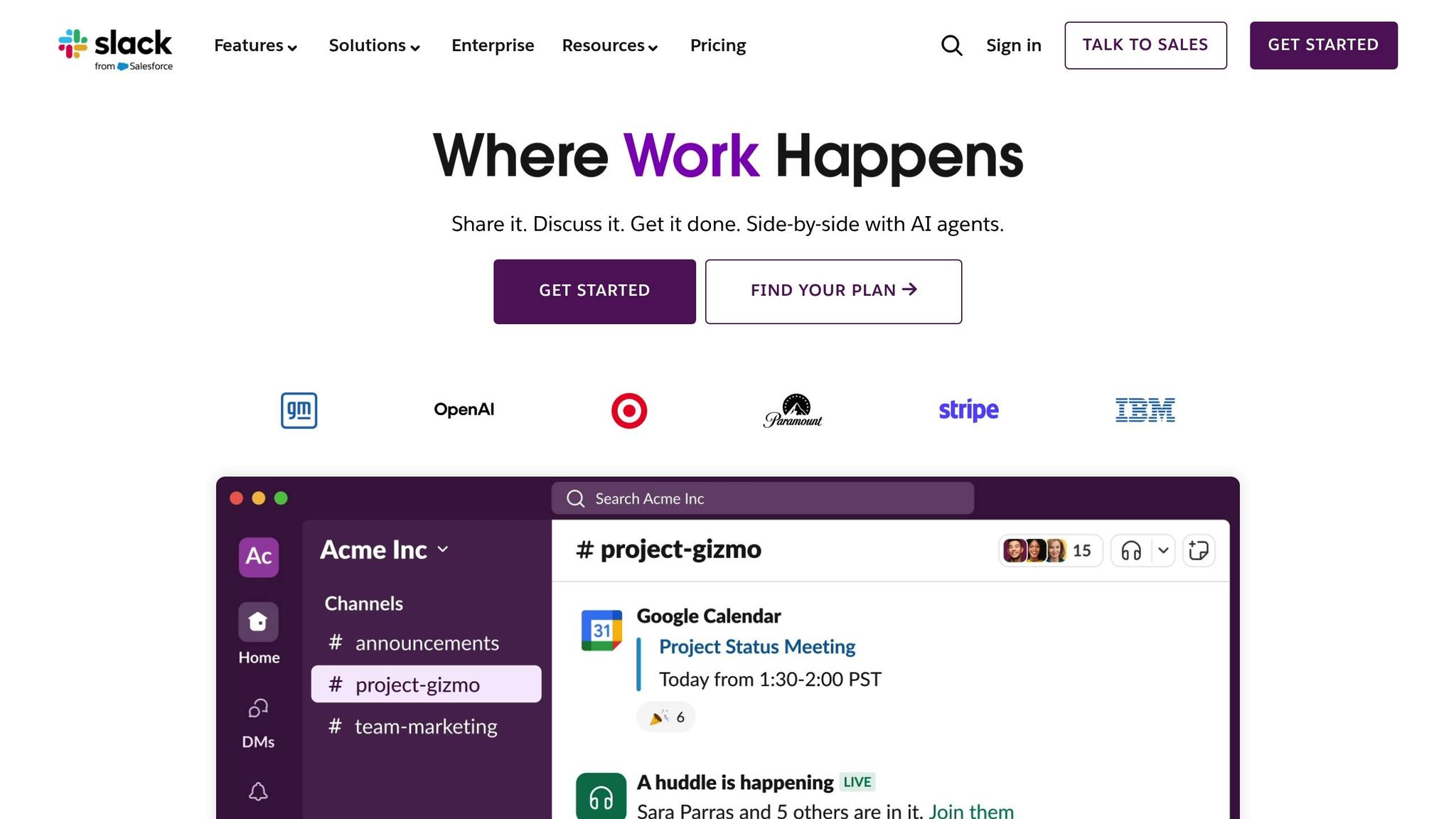
AI knowledge sync bridges Slack with your company’s documentation platforms - like Notion, Confluence, Google Drive, Salesforce, and more. This connection allows employees to ask questions and receive accurate answers directly within Slack, eliminating the need to switch between tabs. The AI works by indexing your documentation, understanding natural-language queries, and delivering precise answers in Slack channels or direct messages.
This integration turns Slack into a centralized knowledge hub that operates in real time. For example, when someone asks, “What’s our parental leave policy?” or “How do I configure SSO for new hires?” the AI scans connected sources, retrieves the relevant information, and responds with a cited answer - typically in under five seconds. Each response includes links to the original documents, enabling users to verify details or explore further.
For U.S.-based teams handling compliance, security, and audit requirements, permission-aware access is a key feature. The AI respects the permission models of your connected tools, ensuring employees only see content they’re authorized to access. When a question is asked, the system cross-checks the user’s Slack identity against their access rights, filtering out restricted content. This safeguards sensitive information like HR policies, financial data, or customer details while still enabling seamless self-service knowledge access. This functionality underscores how AI not only enhances Slack’s capabilities but also highlights the specialized advantages of tools like Question Base.
How AI Extends Slack's Capabilities
Without AI, Slack is a robust communication tool but not a reliable system for retrieving knowledge. Employees often scroll through endless threads, search for keywords, or rely on colleagues for answers - processes that waste time and disrupt workflows. AI changes this by introducing intelligent search capabilities that understand intent, not just keywords.
When integrated with Question Base, the AI securely indexes selected workspaces while respecting existing permission settings. It parses natural-language queries, conducts semantic searches across connected repositories, ranks the most relevant results, and delivers a synthesized answer with references. These enhancements create a more efficient, enterprise-ready knowledge management solution.
For internal support teams, this means common IT, HR, and operations questions are resolved directly in Slack, cutting down on repetitive tickets and speeding up response times. For onboarding and project work, new hires and team members can quickly access playbooks, architecture diagrams, or policy documents by asking natural-language questions - no need to wait on subject-matter experts.
Question Base integrates effortlessly with tools like Google Drive, Confluence, Notion, Zendesk, Intercom, Salesforce, and Dropbox. Setup is straightforward: simply invite Question Base to Slack, with no engineering effort required. The AI can also be customized for tone, workflows, and answer style, and you can tailor content sources for specific Slack channels.
"Question Base helps you deliver answers to the team as they're asked (goodbye bottlenecks) and integrates with a lot of the popular platforms used for SOPs, so you can sync information across platforms." – Brigitte Lyons
Consider this example: a mid-size U.S. SaaS company uses AI sync to handle repetitive "how do I" questions about benefits, security, or product features. By automating responses, they cut average resolution times from hours to seconds, significantly reducing internal ticket volumes for IT and HR teams. This frees up specialists to focus on more strategic tasks.
AI knowledge sync doesn’t just answer questions - it also captures valuable insights shared in Slack threads. For instance, when an expert provides an answer in a channel, the AI can log that response with a single click, adding it to the knowledge base for future use. This ensures that critical knowledge doesn’t get lost in Slack threads but becomes part of a living, searchable FAQ for the organization.
Slack AI vs. Dedicated Answer Agents
Slack AI is built for general productivity. It excels at summarizing long threads, highlighting action items, and helping users catch up on unread channels. For teams on Slack’s Business+ and Enterprise plans, Slack AI also offers search capabilities across Slack history and other tools, as well as a Channel Expert AI agent powered by Agentforce.
However, Slack AI mainly works with Slack content - messages, threads, and huddles. While it can search external tools at higher subscription tiers, it’s not specifically optimized for retrieving knowledge from structured documentation. This can be a limitation for teams that need precise, auditable answers tied to trusted sources like Notion pages, Confluence spaces, or Google Drive folders.
Dedicated answer agents like Question Base are designed for this exact purpose. They pull information exclusively from trusted sources that you configure, provide clear citations for each answer, and allow admins to designate specific collections as the "source of truth." These agents also maintain audit trails, track which answers are given in which channels, and support compliance reviews - all while continuously improving the quality of knowledge over time. These features make them the preferred choice for enterprise teams that require verified and traceable answers.
Feature | Question Base | Slack AI |
|---|---|---|
Accuracy | Verified answers from trusted sources | AI-generated from Slack messages |
Data Sources | Notion, Confluence, Salesforce, OneDrive, Google Drive, Zendesk, Intercom, and more | Primarily Slack chat; limited external tools on higher plans |
Knowledge Management | Case tracking, per-channel settings, duplicate detection, AI learning from gaps | None |
Analytics | Tracks resolution rates, unhelpful answers, and automation | Basic usage stats |
Enterprise Focus | Built for HR, IT, Ops - SOC 2 compliant, customizable | General-purpose AI tool |
Slack AI is a great tool for helping individuals work faster by summarizing past activity. In contrast, Question Base helps entire teams stay aligned and unblocked by transforming knowledge into actionable, verified insights. While Slack AI supports general productivity, dedicated answer agents excel at delivering reliable, scalable knowledge where every answer is backed by a trusted source and can be refined over time.
"Question Base has exceeded our expectations - it's easy to use, intuitive and a massive time saver. We now have a reliable and useful knowledge base, making it easy to share knowledge across the team." – Monica Limanto, CEO, Petsy
For organizations that rely on Slack as their primary collaboration tool, adding a dedicated AI answer agent elevates it into a dynamic internal knowledge assistant. This assistant scales effortlessly across large teams, supports enterprise-level security, and evolves as your documentation grows.
Selecting the Right AI Tool for Enterprise Knowledge Management
Choosing the right AI tool for syncing Slack with your knowledge platforms is crucial. It needs to provide accurate, secure, scalable, and controlled integration to transform Slack into an effective knowledge hub for your enterprise. For U.S.-based organizations managing sensitive data, regulatory compliance, and large teams, the wrong tool can lead to issues like incorrect answers, security vulnerabilities, or a lack of scalability as your organization grows.
Enterprises often invest heavily in platforms like Notion, Confluence, and Google Drive to build robust knowledge repositories. Any AI tool you adopt must respect and enhance that investment by delivering trustworthy, traceable answers that employees can rely on. It should integrate seamlessly with your existing tools, meet enterprise-grade security standards, and offer analytics to continuously refine your documentation.
What Enterprise Teams Should Consider
When evaluating AI tools for Slack knowledge management, there are several critical factors to assess. These considerations help ensure the solution meets the needs of large organizations juggling complex data, compliance requirements, and diverse teams.
Security and compliance take top priority. Enterprises need tools that are SOC 2 Type II–certified, encrypt data both at rest and in transit, and undergo rigorous testing and incident response protocols. For industries with stricter regulations, features like on-premise deployment, regional data residency, and detailed audit logs for every AI interaction are essential. Question Base meets these needs with SOC 2 Type II compliance and optional on-premise deployment for heightened security.
Access controls should align with the permission models of your existing platforms. The AI must respect access levels from tools like Notion or Google Drive, ensuring employees only see content they’re authorized to view. Features like single sign-on (SSO), SCIM provisioning, and fine-grained access settings are critical. Testing the tool on a subset of spaces can confirm that permission updates are accurately reflected in AI responses.
Accuracy and verification are key differentiators. Enterprises need tools that provide verified answers backed by trusted sources, not just interpretations of Slack conversations. Look for solutions that cite sources, allow admins to define a “source of truth,” and support human review. Question Base employs a human-verified content model, enabling teams to review and refine AI-generated answers before they’re shared, ensuring alignment with company policies.
Integration capabilities determine how well the AI connects with your knowledge platforms. The tool should offer native integrations with platforms like Confluence, Notion, and Google Drive, and index attachments like PDFs or presentations. It should also support searches across multiple workspaces.
Customization and governance controls allow the AI to adapt to different teams and channels. The tool should let admins configure tone, answer styles, data sources, and workflows. For example, a #hr-benefits channel might pull from different sources than an #engineering-onboarding channel. Question Base provides these controls, along with features like case tracking, duplicate detection, and the ability to capture new knowledge directly from Slack conversations.
Analytics and performance monitoring are essential for improving documentation over time. The tool should track metrics like the number of questions asked, resolution rates, automation rates, and unhelpful responses. These insights help identify knowledge gaps - situations where the AI couldn’t provide an answer due to missing or outdated documentation - and guide updates to optimize content.
Cost-effectiveness is a practical consideration, especially for large-scale deployments. Repeated searches can become expensive, so an effective AI tool should demonstrate a strong return on investment. Compare pricing models and assess the cost per user against the features offered.
Knowledge ownership and data governance ensure you retain control over your content. The tool should allow you to maintain ownership of all ingested data and restrict the vendor’s use of proprietary information. Features like configurable retention policies, detailed admin dashboards, and comprehensive audit logs are also important.
These factors set the foundation for comparing Question Base with Slack AI.
Question Base vs. Slack AI Comparison
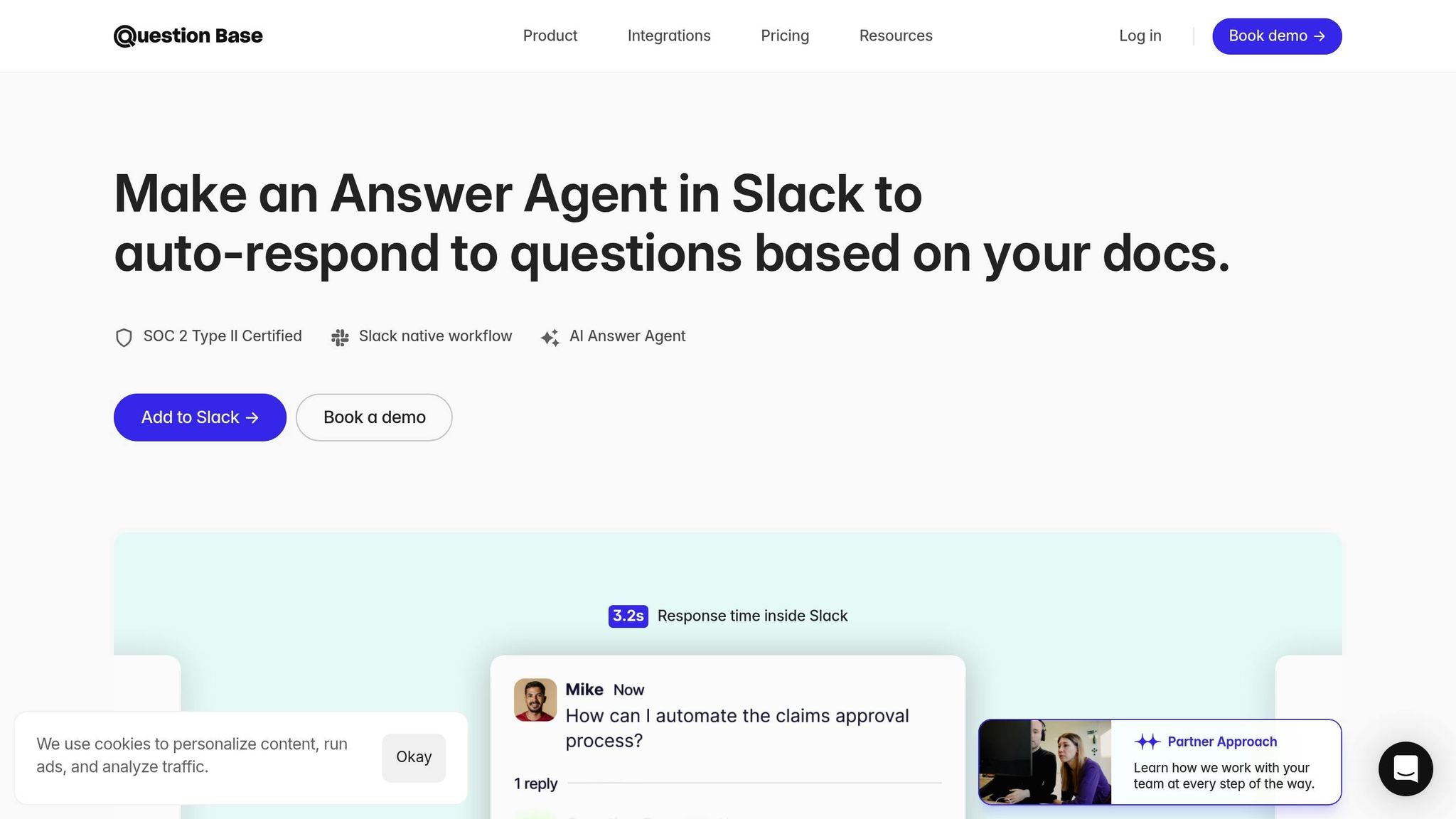
When it comes to meeting enterprise needs, Question Base and Slack AI serve different purposes. Slack AI is excellent for general productivity tasks like summarizing threads and highlighting action items. For teams that require verified, accurate knowledge management at scale, Question Base offers specialized features designed for this purpose.
Here’s a side-by-side comparison:
Feature | Question Base | Slack AI |
|---|---|---|
Price | $8/user/month | $18/user/month |
Accuracy | Human-verified AI answers | AI-generated |
Data Sources | Notion, Confluence, Google Drive, Zendesk, Intercom, Salesforce, Dropbox, Freshdesk, HubSpot, OneDrive, Jira, SharePoint | Primarily Slack chat; external tool support available only on Business+ and Enterprise plans |
Knowledge Management | Per-channel settings, case tracking, duplicate detection, and new knowledge capture | Channel Expert (pre-built AI agent powered by Agentforce, available on Business+ and Enterprise plans) |
Analytics | Tracks questions asked, resolution rates, automation rates, unhelpful answers, and content gap reports | Basic usage statistics based on chat interactions |
AI Summaries | Analyzes common answers in threads to integrate into company documentation | Summarizes channel threads and huddles |
Security | SOC 2 Type II Certified; encryption at rest and in transit; optional on-premise deployment | Not specified in available documentation |
Accuracy is a standout difference. Question Base uses a human-verified content model, allowing subject-matter experts to review and refine AI-generated answers. This ensures responses are accurate and policy-compliant. Slack AI, on the other hand, generates answers based on Slack messages and connected tools, with no built-in verification layer - making it less reliable for scenarios where traceability is crucial.
Data sources further separate the two. Question Base directly connects to your trusted documentation platforms, pulling answers exclusively from sources you configure. Slack AI primarily relies on Slack content, with external tool access limited to higher-tier plans.
Knowledge management features also highlight the gap. Question Base offers advanced tools like per-channel settings, case tracking, and duplicate detection, which transform Slack into a dynamic knowledge assistant. Slack AI’s Channel Expert agent provides some functionality but lacks the depth and customization offered by Question Base.
Analytics from Question Base go beyond basic usage stats, offering insights into resolution rates, automation rates, and unhelpful responses. These metrics help knowledge managers identify gaps and refine documentation, ensuring the AI delivers accurate and helpful answers over time.
How to Set Up AI Sync with Notion, Confluence, and Google Drive
Integrating AI sync between Slack and your knowledge platforms can streamline workflows, especially for U.S.-based enterprises juggling sensitive data across multiple tools. By connecting Slack to platforms like Notion, Confluence, and Google Drive, employees can access verified answers instantly, all without leaving their conversations. Here's how to set it up.
Before diving in, ensure you have the necessary admin rights in Slack and each documentation platform. Typically, this means holding Workspace or Org Admin roles in Slack, along with admin privileges in tools like Notion, Confluence, and Google Drive. Take time to audit your existing workspaces, spaces, and folders. Identify authoritative sources while excluding drafts or sensitive materials to ensure the AI indexes only trusted content and avoids outdated or confidential information.[1][2]
Installing and Configuring the AI Agent
Start by visiting the Slack App Marketplace. Search for your chosen AI answer agent, such as Question Base, and click Add to Slack. You'll need to authorize the app, granting it access to read messages in designated channels and post responses. This uses standard OAuth authorization, limiting access to the channels you specify.
Once installed, activate the AI by typing /invite @questionbase in any Slack channel where you want it to operate. For larger deployments, you can use Slack's admin console to invite the bot to multiple channels simultaneously - ideal for rolling it out across departments like HR, IT, or customer support.
Next, integrate your documentation platforms. Open the Question Base dashboard (accessible via Slack or online) and navigate to the Integrations section. To connect Notion, click Connect Notion, authenticate using your credentials, and select the workspaces containing key documents like employee handbooks or internal FAQs. Similarly, for Confluence, log in with your Atlassian account and choose the spaces to sync. For Google Drive, grant access to shared drives or specific folders, ensuring you review permissions to avoid access issues. If any tokens expire, you'll receive a notification in Slack to re-authenticate through the dashboard.[7]
Once connected, the AI begins indexing your content. For moderate volumes, this process typically takes under an hour. You'll receive a Slack confirmation when indexing is complete, signaling that the AI is ready to answer questions. At this stage, it's crucial to set up access controls to ensure the AI respects your organization's security protocols.
Setting Up Knowledge Access and Permissions
Properly configuring access permissions ensures the AI aligns with your existing security framework, showing employees only the content they're authorized to view. This is especially critical for teams handling sensitive materials like HR records, financial data, or legal documents.
Begin by mapping your current access controls to the AI's indexing rules. For example, if certain Confluence spaces are restricted to specific teams - like an Engineering space visible only to developers - the AI should honor these permissions. This way, an engineer asking a question in Slack will only see answers from spaces they can access.[2]
When you integrate tools like Confluence, Notion, or Google Drive, Question Base automatically applies the source platform's permissions, ensuring seamless alignment. For additional customization, you can create team- or role-based access profiles within the AI's settings. For instance, a #sales-enablement channel might pull content exclusively from Notion sales playbooks and CRM documentation, while an #engineering-onboarding channel could draw from technical wikis in Confluence and code repositories in Google Drive.[3] Sensitive areas, such as a "Legal – Confidential" folder in Google Drive, can also be excluded entirely to protect private data.
To confirm everything is working as intended, test the permissions setup by creating test users with varying access levels. Have them ask questions in Slack and verify that the AI only provides answers from content they're authorized to view. If a user with limited Confluence access asks a question, the AI should either respond with accessible information or escalate the query to a human expert. Testing ensures the AI remains secure and aligned with your enterprise's knowledge-sharing strategy.
Testing AI Responses for Accuracy
Once the AI is installed and permissions are configured, testing its responses is essential to ensure it provides accurate, policy-compliant answers. This step is particularly important in industries where incorrect information could lead to compliance or operational risks.
Start by compiling a list of common questions from each department. For HR, this might include queries like "What is our parental leave policy?" or "How do I submit a reimbursement?" IT questions might range from "How do I reset my VPN password?" to "What software is approved for installation?" Post these questions in Slack channels where the AI is active and evaluate the responses.
Question Base boasts a 4.8 answer accuracy score, reflecting its reliance on human-verified content.[6] Each response includes a citation, such as a specific Notion page or Confluence article, allowing you to verify the information's source. If the AI provides a correct answer, you can approve it with a thumbs-up reaction or the feedback button. If the response is incomplete or incorrect, simply reply in Slack with the corrected information - this trains the AI to update its knowledge base.
"This is sick, especially how you can update the answer to a question by simply replying in Slack! This is a pretty cool way of solving the tough problem of knowledge base being hard to maintain." – Tony Han[6]
For questions where the AI lacks sufficient information, set up escalation rules in its settings. For example, if the AI's confidence level is below 70% for a niche legal policy question, it can tag the legal team in a #legal-support channel instead of providing an uncertain answer.[8]
Additionally, track unanswered questions through the AI's analytics dashboard. These gaps highlight areas where the AI couldn't find relevant content. Address these gaps by adding missing documentation to Notion, Confluence, or Google Drive. For instance, if multiple employees ask, "How do I access the new project management tool?" consider creating a guide to address this recurring query.
"We now have a reliable and useful knowledge base, making it easy to share knowledge across the team. We no longer have staff waiting on busy managers for an answer. Question Base is there in seconds, plus it's easy to verify answers as new questions come along." – Monica Limanto, CEO, Petsy[6]
Establish a feedback loop where users can rate AI responses directly in Slack using thumbs-up or thumbs-down reactions. Admins can review this feedback to identify issues and update source content as needed. This continuous cycle of refinement ensures the AI adapts to your organization's evolving needs while maintaining high levels of accuracy as your documentation grows.[1]
Maintaining Knowledge Updates Across Platforms
As mentioned earlier, integrating Slack as a knowledge hub is just the beginning - keeping it reliable requires regular updates. Once your AI sync is live, the real challenge lies in ensuring that answers stay accurate and current. Achieving this depends on automating updates, analyzing data, and streamlining how knowledge is captured.
Outdated information can be costly. Employees often spend 20–30% of their time searching for answers, and up to 40% of questions are repeated. This inefficiency can cost a 1,000-person company over $2 million annually.[6] Without a system to keep Slack answers updated, your AI risks becoming a problem instead of a solution - providing outdated policies, broken links, or conflicting answers that erode trust.
Automating Knowledge Capture and Updates
The best way to ensure your Slack answers stay current is to treat Slack itself as a live source of truth. When employees ask questions that the AI can’t answer or when experts clarify details in threads, that information needs to be captured and synced back to your documentation tools.
Question Base simplifies this process with continuous indexing. It connects directly to platforms like Notion, Confluence, Google Drive, Zendesk, and Intercom, making sure Slack answers always pull from the most recent version of your content - without requiring manual updates or retraining.[3] When documents are edited or new resources are added, Question Base automatically refreshes its index, updates links in Slack answers, and even alerts content owners if outdated pages are still in use.[3]
Here’s how it works in practice: unresolved questions are logged, experts are notified, and once they provide an answer, the AI indexes the new content to update future responses. This transforms Slack into a living FAQ that evolves as new questions arise and workflows change. For example, during rapid transitions like rolling out new software, updating benefits policies, or onboarding employees, automated knowledge capture ensures your AI stays accurate without adding extra admin work.
To manage this effectively at scale, assign ownership of specific knowledge domains. For instance, an HR lead could review unresolved benefits-related questions weekly, while an IT manager updates VPN documentation as new issues arise. Align these reviews with existing processes like sprint retrospectives or quarterly audits so that keeping knowledge updated becomes part of your team’s routine.[3]
Leaders should think of knowledge as a product, assigning clear ownership, setting measurable goals - such as improving automation rates or reducing unresolved questions - and incorporating AI analytics into regular planning cycles.[2][3] They should also link AI workflows to change-management processes, ensuring that major updates to products or policies trigger coordinated documentation updates, which then feed into updated AI responses in Slack.[3][4]
Using Analytics to Find Knowledge Gaps
While automation handles updates, analytics provide the insights needed to refine your knowledge base further. Even the best systems need visibility into where they fall short. Analytics dashboards help pinpoint missing or unclear documentation, prioritize updates, and measure the impact of your AI sync on internal support operations.
Question Base offers dashboards that highlight topics with the highest volumes of unresolved questions or the lowest automation rates, signaling areas that need attention.[3] Leaders can assign these gaps to team members, track how automation rates improve after updates, and adjust Slack workflows to guide employees toward reliable AI-powered answers.[3]
Key metrics to monitor include the number of questions, resolution rates, automation rates, and flagged responses.[6][5] For example:
Resolution rate: Shows the percentage of questions the AI answers without human help.
Automation rate: Tracks time saved by deflecting repetitive queries. Question Base can auto-answer 35% of repetitive questions, saving 6+ hours per week per internal expert.[6]
Flagged responses: Highlights incorrect or incomplete answers, guiding teams to refine documentation.
Let’s say analytics reveal that 15 employees asked, “How do I access the new project management tool?” last month, but the AI didn’t have an answer. That’s a clear signal to create a guide in Notion or Confluence. Once published, the AI automatically indexes it, ensuring future queries get an instant, accurate response.
By analyzing these metrics, teams can identify frequently asked but poorly answered questions. This reveals where documentation in tools like Notion, Confluence, or Google Drive is missing, outdated, or hard to find.[6][5] Instead of guessing what content to create, you can address employee needs directly.
To maintain security, enterprises should rely on the AI’s ability to respect existing permissions, ensuring Slack users only see content they’re authorized to access in platforms like Notion or Google Drive.[1][3] Admins should segment workspaces by team or sensitivity level, audit access logs regularly, and use role-based access controls to prevent sensitive information from appearing in AI responses.[1][4] This governance ensures that as your knowledge sync scales, confidential data remains protected.
For large teams, these analytics also support agility by identifying gaps proactively. Instead of waiting for complaints, you can address missing information before it becomes a bottleneck. This continuous cycle - question, escalate, document, index, and measure - turns your AI sync into a strategic tool that evolves alongside your organization.
Managing Governance, Security, and Compliance
Once your AI sync is up and running, the next priority is ensuring secure governance. When an AI agent connects Slack with platforms like Notion, Confluence, or Google Drive, it interacts with sensitive internal data - ranging from HR policies and financial records to customer details and intellectual property. Without the right security measures, there’s a risk of unauthorized access or data leaks.
Start by defining your safety and compliance goals to safeguard sensitive information. This involves identifying applicable regulations, such as SOC 2, HIPAA, or GDPR, and determining which data should never be accessible in Slack or via an external AI. Clear goals often include restricting access to sensitive data to specific users or workspaces, ensuring all AI actions are auditable, and limiting AI responses to pre-approved sources vetted by your security and legal teams. These objectives will guide the creation of policies dictating which repositories can be connected, which Slack channels the bot can access, and what types of queries are allowed or blocked. A solid compliance framework and clear governance responsibilities are essential for success.
Many organizations treat AI knowledge agents as "privileged apps" within Slack, requiring them to undergo rigorous vendor risk assessments and data-processing agreements. These apps often have access to chat histories and external documentation at scale, making it critical for security teams to evaluate their security posture just as they would for any other essential business system.
Enterprise-Grade Security Features
When selecting an AI agent that integrates Slack with your documentation platforms, security teams should prioritize features like encryption in transit and at rest, robust identity and access management (e.g., SSO via SAML or SCIM group sync), detailed access logs, and support for data residency where necessary. For enterprise deployments, advanced options such as IP allowlisting, customer-managed encryption keys, and strict tenant isolation ensure that the AI tool aligns with the security standards of other critical SaaS platforms.
For SaaS vendors serving mid-market and enterprise customers in the U.S., SOC 2 Type II certification has become a standard requirement. In 2025, Question Base achieved SOC 2 Type II Certification, meeting stringent criteria for security, availability, processing integrity, confidentiality, and privacy. This certification, combined with internal security reviews and data-processing agreements, provides a robust framework for mapping the AI agent’s behavior to an organization’s risk management policies and control systems.
For organizations in regulated industries like healthcare, finance, or defense - or those with strict data sovereignty requirements - on-premise deployment is often a necessity. Question Base offers this option as part of its Enterprise tier, enabling these organizations to maintain full control over AI infrastructure. Governance in these cases must address not only access controls but also infrastructure maintenance, model updates, and log management. Security and platform teams should collaborate to create detailed runbooks for upgrades, incident response, and decommissioning, ensuring the AI stack is managed with the same rigor as other critical internal systems.
Question Base ensures that customers retain control over their data, reinforcing governance while keeping complexity to a minimum.
Setting Up Governance and Access Controls
Security features are only effective when properly configured. Once the integration is set up, it’s vital to manage access consistently across Slack and connected platforms. Admins should implement access controls that ensure the AI agent only surfaces answers users are authorized to see. This means enforcing existing permissions from Notion, Confluence, and Google Drive, as well as Slack channel visibility, rather than creating a separate access control system.
In practice, this involves configuring the AI to operate "as the user" or using role-based access control (RBAC) and group mappings. This setup ensures that private spaces in Confluence, restricted folders in Google Drive, or confidential Notion databases remain inaccessible to unauthorized users. Question Base supports per-channel settings and allows admins to control which documents and workspaces are connected, ensuring the bot is deployed only in approved channels and is restricted from accessing highly sensitive areas like Legal, HR, or M&A without explicit approval. Automated role-based tests can help maintain consistent access alignment.
Beyond technical controls, it’s important to define the scope of content the AI can handle - such as product FAQs, internal IT guidance, or HR policies - while flagging topics that require human review, like legal advice, performance evaluations, or high-stakes financial decisions. Question Base enables admins to set up escalation workflows so that when the AI has low confidence or detects a sensitive topic, it routes the query to a designated Slack channel or human expert instead of generating a potentially risky response. This approach ensures AI drafts answers from approved sources, but final decisions remain in the hands of qualified professionals.
Governance should also include retention policies, redaction practices, and audit trails that track who queried what, ensuring all actions are traceable. Best practices for data lifecycle management include aligning AI data retention with corporate policies, ensuring that deleted messages or documents from Slack or source systems are also removed or marked as non-indexable in the AI’s knowledge base. Automated deletion of outdated training data, masking or minimizing sensitive information like PII, and respecting backup policies for deletion requests are key steps. Regular reviews - such as quarterly audits of connected workspaces and repositories - help prevent the AI from retaining outdated or overshared information that no longer meets compliance standards.
Question Base provides analytics and logging for metrics like question resolution, automation rates, and unhelpful answers. These logs can be exported to SIEM or observability platforms, enabling security teams to monitor for unusual activity. Regular reviews of these logs by security, compliance, and product teams help ensure the AI operates within approved boundaries and adheres to internal and external regulations.
To evaluate the effectiveness of governance and security measures, teams can track metrics such as the percentage of AI answers linked to approved sources, the success rate of escalations for sensitive topics, the frequency of access-denied events, and reductions in manual permission violations. Combining this data with internal audit results - such as evidence showing that Question Base did not surface restricted content to unauthorized users - provides a comprehensive view of the system’s performance. Metrics like mean time to resolution (MTTR) for security incidents involving AI can further demonstrate improvements and guide policy refinements as adoption expands.
Finally, employee training is crucial to ensure governance controls are followed. Security awareness programs should focus on practical guidance, such as avoiding the inclusion of production secrets, customer PII, or regulated financial data in AI conversations, and understanding when to escalate issues rather than relying solely on AI. Short, scenario-based training sessions can help employees adopt safe practices while keeping workflows efficient.
Conclusion
AI-driven knowledge synchronization is transforming how teams manage information across platforms like Slack, Notion, Confluence, and Google Drive. By cutting down the time spent searching for answers or waiting on experts, organizations can deploy an AI-powered answer agent to deliver precise, real-time responses directly from their trusted documentation. This approach not only reduces repetitive questions but also accelerates onboarding and allows internal support, HR, and operations teams to focus on more strategic tasks.
The right AI tool plays a critical role in ensuring accuracy and control. While Slack AI enhances conversation summaries and search capabilities within chat history, specialized solutions like Question Base go a step further. By connecting directly to verified knowledge sources, Question Base ensures responses are always current and reliable. It also offers enterprise-grade features such as analytics to track automation rates, tools to identify content gaps, granular access controls, and compliance with SOC 2 Type II standards through encryption in transit and at rest.
Before scaling up, it's worth assessing how much time your team loses to repetitive questions in Slack. Start with a 30-day pilot in high-impact channels like #it-helpdesk or #product-questions, linking only your most reliable documentation. Track measurable results - such as the percentage of auto-answered questions, average response times, and hours saved per expert. Use these insights to determine which additional repositories to sync and what workflows to automate next. At just $8 per user per month for the Pro tier, Question Base offers an accessible way to test how an AI answer agent can streamline internal support, reduce Slack noise, and keep your knowledge consistently up to date across everyday tools.
For enterprises requiring advanced control and security, a tailored solution is essential. Organizations with strict data sovereignty requirements or the need for multi-workspace support can turn to Question Base's Enterprise and Custom tiers. These options provide the flexibility and security needed to satisfy legal, compliance, and IT demands. By combining instant AI responses with human oversight, escalation workflows, and continuous knowledge updates from Slack threads, Question Base transforms Slack into a dynamic knowledge hub that grows alongside your organization.
FAQs
How does Question Base provide accurate and reliable answers in Slack?
Question Base stands out by linking directly to reliable documentation platforms such as Notion, Confluence, and Salesforce. Unlike Slack AI, which primarily pulls information from chat history, Question Base provides expert-approved answers sourced from your organization's established knowledge repositories.
By drawing from trusted resources, it ensures the shared information is dependable and aligns with your team's existing knowledge. This makes it a perfect fit for enterprise settings where precision and credibility are non-negotiable.
How does Question Base compare to Slack AI for integrating with tools like Notion and Confluence?
Question Base integrates effortlessly with trusted documentation tools like Notion, Confluence, and more, pulling answers directly from verified sources. This ensures that the information your team relies on is accurate and based on the most dependable content available.
On the other hand, Slack AI primarily leans on chat history to generate responses, which can sometimes lack the precision or depth needed for critical tasks. For teams prioritizing consistent and up-to-date knowledge from external platforms, Question Base provides a direct connection to your most trusted resources, ensuring every answer is well-informed.
How can companies keep sensitive information secure when using AI to connect Slack with tools like Notion or Confluence?
Protecting sensitive information is a top priority for businesses, and Question Base delivers with robust enterprise-grade security features. It adheres to SOC 2 Type II compliance, ensuring stringent data protection standards. Data is encrypted both when stored and during transmission, safeguarding it from unauthorized access. For added flexibility, on-premise deployment is available, giving organizations more control over their setup. Furthermore, companies retain complete authority over what content can be accessed, guaranteeing that only verified information circulates within Slack.