∙
Cooper
∙
Reading time:
17 min

AI-powered agents are reshaping how businesses work. At Dreamforce 2025, Salesforce introduced the concept of the "agentic enterprise", where AI agents handle repetitive tasks, streamline workflows, and allow teams to focus on higher-value work. Key highlights include:
Agentforce 360: Salesforce's new platform integrates with Slack, Customer 360, and Data 360 to create smarter, more efficient operations. Features like hybrid reasoning and voice interactions make it highly versatile for industries like healthcare, retail, and finance.
Efficiency Gains: Companies like Dell and Williams-Sonoma have cut support costs, reduced response times, and improved satisfaction by adopting AI agents.
Knowledge Management: AI agents transform Slack conversations into structured, reusable knowledge, solving common support challenges.
Governance and Trust:Strong data governance ensures accuracy, compliance, and accountability, especially in regulated industries.
The shift to enterprise-specific AI tools like Question Base emphasizes accuracy, compliance, and tailored support over general productivity enhancements. Salesforce’s vision for AI isn’t just about technology - it’s about enabling smarter, faster, and more integrated operations.
Want to streamline your internal support and knowledge management? Learn how Question Base can help your team work smarter inside Slack.
Building an Agentic Enterprise: The Dreamforce 2025 Keynote in Under 6 Minutes
Major Announcements from Dreamforce 2025
Dreamforce 2025 brought a wave of exciting developments, reshaping how enterprises operate. Leading the charge was Agentforce 360, Salesforce's all-in-one AI agent platform designed to revolutionize the way businesses create, deploy, and manage intelligent agents. Building on themes introduced earlier at the event, this announcement set the tone for success stories across various industries.
Agentforce 360: A New Era of AI Integration
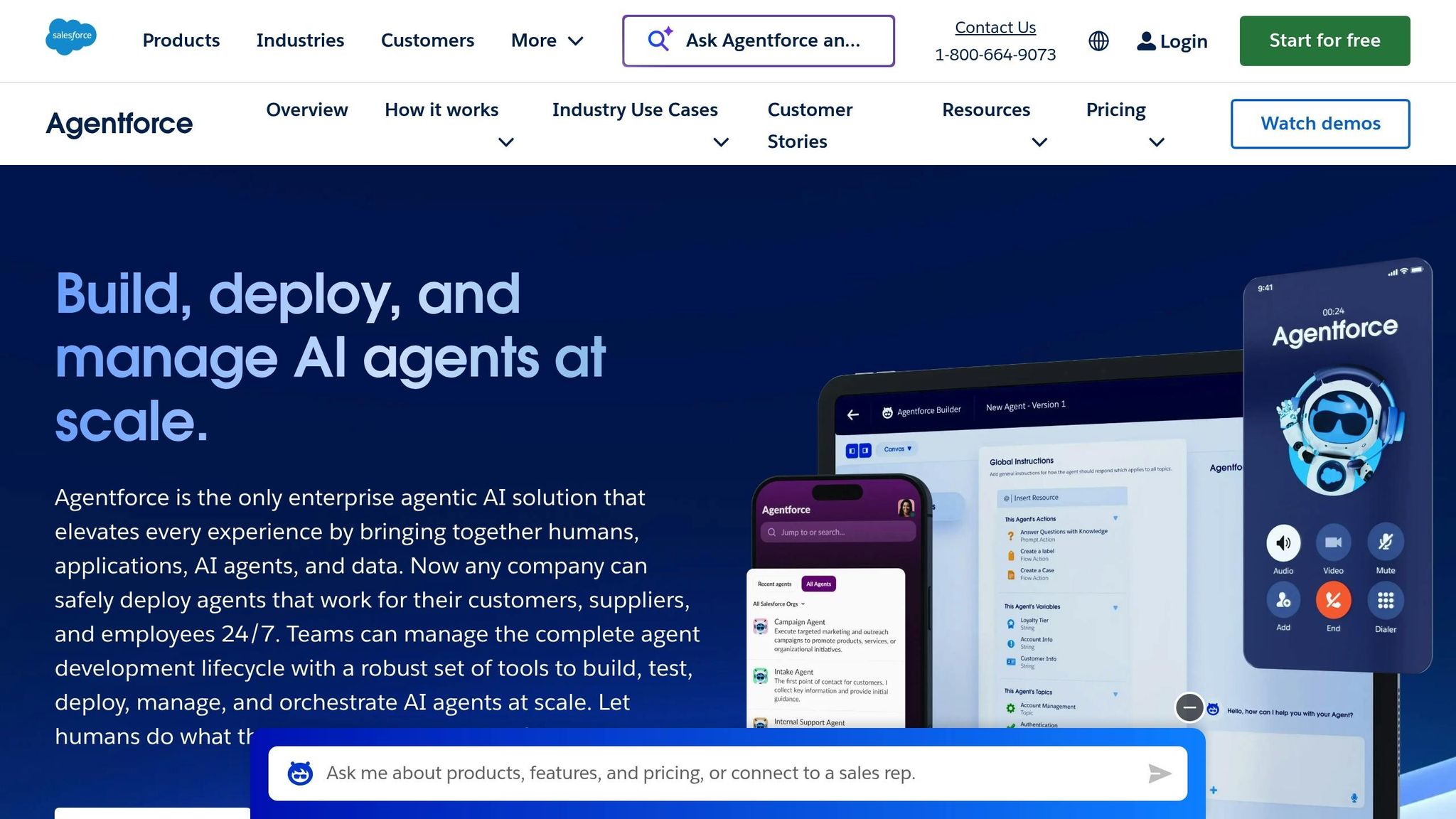
Agentforce 360 represents Salesforce’s latest leap in AI innovation. The platform seamlessly integrates with Slack, Customer 360, and Data 360, creating a unified ecosystem where AI agents can access live data, understand intricate workflows, and collaborate directly with human teams.
Some standout features include hybrid reasoning, a conversational builder for non-technical users, and Agentforce Voice for natural voice interactions. Hybrid reasoning allows agents to toggle between creative, conversational responses and precise, rule-based actions, handling everything from routine inquiries to complex problem-solving. The conversational builder empowers teams in HR, IT, and customer support to design sophisticated AI agents without requiring deep coding expertise. Meanwhile, Agentforce Voice enables seamless voice interactions across phone systems, websites, and mobile apps. This feature will be available starting October 21, 2025, with hybrid reasoning entering beta in November 2025. Additionally, emotional intelligence modules enable agents to interpret sentiment and deliver contextually relevant insights when paired with Data 360’s unified data layer.
These tools tackle the persistent challenges of fragmented workflows and disconnected data sources, offering a more cohesive solution.
"You have got to get your data right. You have got to get to more integrated solutions. You have got to get the priorities right. You have to get the governance right", emphasized Marc Benioff, CEO of Salesforce, highlighting the importance of integrated data and governance in achieving AI success.
The results are already evident. Salesforce’s own SDR agent now manages 50,000 customer interactions weekly, enabling the company to reduce its support staff by 4,000 while enhancing service capacity and customer satisfaction [2] [3].
Real-World Applications of Agentforce 360
Several industries are already showcasing how Agentforce 360 is delivering measurable results.
In healthcare, companies like Takeda Pharmaceuticals and Immunexis are using Agentforce 360 to simplify clinical trial management and streamline patient onboarding. For instance, Takeda Pharmaceuticals implemented the platform in September 2025, reducing administrative workloads by 27% and improving patient satisfaction by 19% [5].
The retail sector is also seeing benefits. Williams-Sonoma adopted Agentforce 360 in October 2025 to automate customer service and order tracking through Slack and Sales Cloud. According to their VP of Customer Experience, this reduced average response times from 2.4 hours to just 18 minutes, while increasing their Net Promoter Score by 15 points [5].
Technology companies are finding similar efficiencies. Dell Technologies integrated Slack-native agents with Data 360 to optimize IT support ticketing, resulting in a 32% decrease in ticket resolution times and a 22% drop in support costs during Q3 2025 [5]. In the finance sector, AI agents are transforming customer service and compliance by automating routine tasks while maintaining strict governance and audit trails [5]. Additionally, companies like PepsiCo and Pandora have demonstrated how AI agents can enhance efficiency across diverse operations while ensuring brand consistency and customer satisfaction [5].
These examples highlight a critical takeaway: AI agents deliver the most value when they’re integrated into broader workflows and paired with human expertise. Businesses that treat AI agents as standalone tools miss the opportunity to unlock their full potential. The most successful implementations focus on automating repetitive tasks, freeing up employees to engage in strategic and creative work that drives innovation and growth.
How AI Agents Transform Internal Support
AI-powered agents are reshaping how organizations manage knowledge - capturing, organizing, and sharing it seamlessly. While Dreamforce 2025 showcased impressive technical advancements, the real game-changer lies in how these agents tackle persistent challenges in internal support.
Traditional internal support often struggles with inconsistency and inefficiency. Critical knowledge can remain locked in individual minds, scattered across chat threads, or buried in hard-to-navigate documentation. AI agents flip this script, creating a proactive system that learns, organizes, and delivers answers instantly. This shift bridges the gap between chaotic, reactive support and a structured, knowledge-rich environment.
Turning Chat History into Actionable Knowledge
One of the most impactful advancements in internal support is the ability of AI agents to transform Slack conversations into structured, reusable knowledge. Take Agentforce 360, for example - it uses Data 360's "Intelligent Context" feature to capture insights directly from Slack chats [3]. When employees share solutions or expertise in conversations, the AI identifies key details, extracts them, and organizes them into a knowledge base for future use.
This capability solves a major problem: critical insights in Slack threads often disappear without a structured way to capture them. With features like hybrid reasoning - set to launch in November 2025 - these agents go beyond simple archiving. They can differentiate between casual exchanges and verified solutions, ensuring the knowledge base remains accurate and actionable [1].
The benefits are clear. Imagine a new employee needing guidance on expense report procedures. Instead of relying on memory or sifting through scattered documents, they receive an immediate, verified answer from the AI agent. When integrated with other data sources, these agents can even cross-reference customer records, transaction histories, and institutional knowledge, delivering context-rich responses that would otherwise require human support teams to dig through multiple systems [3].
Building Trust Through Governance in AI
The ability to capture knowledge accurately must be matched by strong governance to ensure trust and compliance. For AI agents to succeed, organizations need frameworks that guarantee accuracy, accountability, and adherence to policies. As Marc Benioff highlighted during his Dreamforce 2025 keynote, four key factors are essential: data governance, integrated solutions, clear priorities, and governance structures [3].
Hybrid reasoning plays a central role in building trust at the enterprise level. Salesforce Executive VP Adam Evans described the balance it provides:
"You can have the creativity and fluidity when you want it, or you can have the rigidity, consistency and scale when you don't. It's your choice on a job-by-job basis" [1].
This flexibility is critical for internal support, where AI agents must blend natural language understanding with strict policy compliance.
Governance extends beyond individual interactions to the entire knowledge system. Data 360, for instance, acts as a unified data layer, ensuring that AI agents pull information from verified, up-to-date sources [3]. This integration ensures responses about customer accounts or internal processes are accurate and complete, avoiding outdated or incomplete data.
In regulated industries like healthcare and finance, compliance is non-negotiable. AI agents equipped with proper governance frameworks can log interactions, maintain audit trails, and restrict sensitive information to authorized personnel. Thoughtful security measures strike a balance between protection and usability - for example, sharing general policy details broadly while limiting access to confidential data.
When implemented effectively, governance isn’t a roadblock - it’s a foundation for scaling AI. With trustworthy agents, employees can rely on accurate, compliant information, boosting adoption and ensuring that the knowledge ecosystem evolves alongside organizational needs.
Slack AI vs Question Base: Enterprise Solution Comparison
While Slack AI enhances general productivity, enterprise support teams often need tools tailored to their specific challenges. This was a key takeaway from Dreamforce 2025, which highlighted the importance of aligning platform choices with business requirements. Below, we break down how Slack AI and Question Base compare in features and focus areas.
Slack AI excels at summarizing conversations and retrieving chat history, making it a good fit for teams seeking quick access to discussions and smoother day-to-day workflows within Slack. For organizations already embedded in Slack’s ecosystem, the integration feels seamless and requires little to no learning curve.
Question Base, on the other hand, zeroes in on the structured knowledge management needs of HR, IT, and operations teams. It pulls information directly from trusted sources like Notion, Confluence, Salesforce, and OneDrive, ensuring that answers are accurate and up-to-date.
Feature Comparison Table
Feature | Question Base | Slack AI |
|---|---|---|
Accuracy | AI-generated → Human-verified content | AI-generated |
Data Sources | FAQs from Slack channels, help centers, and enterprise docs (e.g., Salesforce, Confluence, OneDrive) | AI search across Slack history and other tools (Business+ plans only) |
Knowledge Management | Per-channel settings, case tracking, duplicate detection, new knowledge capture | None |
Analytics | Resolution rate, automation rate, unhelpful answers tracking | Basic usage statistics |
Enterprise Focus | Purpose-built for HR, IT, Ops with SOC 2 compliance | General productivity tool |
Pricing | $8/user/month | $18/user/month |
This table highlights how these tools cater to distinct needs.
Different Tools for Different Business Needs
The differences between Slack AI and Question Base mirror the broader Dreamforce vision of improving internal support through specialized AI solutions. The choice often hinges on your organization’s support framework and how much emphasis you place on accuracy and structured knowledge.
Slack AI works well for enhancing conversations and speeding up day-to-day tasks. It’s designed for broad, informal collaboration, making it ideal for teams focused on quick productivity boosts rather than formal knowledge management.
In contrast, Question Base is built to scale institutional knowledge with a focus on quality control. It’s particularly effective for handling recurring IT or HR inquiries. By capturing and verifying interactions, Question Base transforms them into searchable knowledge while flagging unresolved queries. This helps teams prioritize what needs documentation.
One standout feature of Question Base is its human-in-the-loop verification process, which ensures accuracy - critical in industries where compliance errors can have serious consequences.
The analytics capabilities further reflect their different purposes. Slack AI offers basic usage metrics aimed at individual productivity, while Question Base provides deeper operational insights for team leaders. Metrics like resolution rates and automation percentages help managers gauge how well their knowledge base is working and identify areas where human input is still needed.
For organizations managing large teams across multiple departments, Question Base’s per-channel customization is a game-changer. It allows teams to tailor AI behavior to fit their workflows. For example, HR channels can enforce formal, policy-compliant responses, while general discussion channels can remain more casual.
Pricing is another key factor. At $8/user/month, Question Base offers a lower entry point compared to Slack AI’s $18/user/month. However, the real value lies in the operational efficiencies gained - fewer support tickets and faster employee self-service can translate into significant cost savings over time.
How to Implement AI Agents Like Question Base
Building on the insights shared at Dreamforce 2025, successfully implementing AI agents requires careful planning, a structured rollout, and continuous monitoring. Without proper preparation, organizations risk running into issues like low adoption rates or inaccuracies. As Marc Benioff noted during his keynote, "just making our own models or rolling it ourselves, or DIYing it, isn't going to do it" [3]. This highlights the complexity of implementing enterprise AI and the need to choose integrated, well-supported solutions instead of fragmented, one-off projects. To get started, it’s essential to evaluate your organization’s data, integration capabilities, and governance frameworks to ensure a smooth deployment.
Assessing Your Organization's Readiness
Before deploying an AI agent, it’s critical to evaluate three foundational areas: data quality, integration readiness, and governance frameworks. These factors determine whether the implementation will succeed or end up as just another unused tool.
Data Quality: AI agents rely on clean, well-organized data to perform effectively. Whether your data lives in Notion, Confluence, Salesforce, or help desk systems, it needs to be accurate, consistently formatted, and easy to integrate. Conduct an audit of your documentation to uncover gaps, outdated content, or conflicting information. This process often reveals how scattered institutional knowledge can be across teams and systems.
Integration Readiness: Seamless integration is essential for AI agents like Question Base, which pull insights from multiple sources to deliver accurate answers. Review your current tech stack and identify potential connection points. Consider whether your IT team has the capacity to handle integrations or if you need a platform with pre-built connectors to simplify the process.
Governance Frameworks: In industries where compliance is critical, such as finance or healthcare, governance becomes even more important. Establish clear policies for data privacy, security, and oversight before rolling out AI agents. Define who will approve AI-generated responses and how sensitive information will be managed to maintain trust and accountability.
Some organizations, like financial services firms highlighted at Dreamforce 2025, have taken a phased approach by starting with small pilot programs. They used targeted use cases - such as employee onboarding or IT support requests - to test their readiness, refine data quality, and address integration challenges before scaling up [6].
Tracking Success with Performance Metrics
Once the groundwork is in place, monitoring your AI agent’s performance is key to maximizing its impact. Focus on operational metrics rather than surface-level usage stats to measure effectiveness. Some of the most valuable metrics include:
Automation Rate: The percentage of queries resolved without human intervention.
Resolution Rate: The overall success rate of the agent in addressing user issues.
Knowledge Gaps: Instances where the agent escalates queries due to insufficient information, providing insight into areas where documentation or training needs improvement.
For internal support teams, resolution and automation rates are often top priorities. However, response time is equally critical - if the AI agent processes queries too slowly, employees may revert to traditional methods for assistance.
Different platforms offer varying levels of analytics. While Slack AI provides basic usage stats, Question Base goes deeper, offering insights like tracking unhelpful answers and analyzing performance across different Slack channels. These features help managers not only identify what’s happening but also understand the underlying reasons behind certain trends.
Companies like Williams-Sonoma, Pandora, and Dell Technologies showcased their AI agent implementations at Dreamforce 2025, highlighting the importance of combining quantitative metrics with qualitative feedback [5]. Regularly reviewing these metrics - whether it’s identifying knowledge gaps or refining integration strategies - enables continuous improvement and ensures organizations get the most out of their AI investments.
To calculate ROI, compare the operational costs of the AI agent against the savings in employee time and the reduction in support ticket volumes. This approach ties directly back to the pricing comparisons discussed earlier, offering a clear picture of the value delivered.
Conclusion: The Future of Enterprise AI After Dreamforce 2025
Dreamforce 2025 marked a turning point for enterprise AI, shifting AI agents from experimental concepts to essential tools for business transformation. The rise of the "Agentic Enterprise" model highlights a new era where autonomous agents are seamlessly integrated across technology stacks to deliver what Salesforce describes as "boundless capacity, precision, and speed" [3][4].
The numbers back up this shift: over 12,000 customers are actively testing or deploying Agentforce [7], and Salesforce aims to hit $60 billion in revenue by FY2030, with AI playing a pivotal role in this growth [8]. Companies like Dell Technologies are already reaping the rewards, slashing supplier onboarding times from 60 days to just 20 through automation [7].
Marc Benioff underscored the significance of this evolution, stating that AI is now the foundation of every Salesforce product, and adopting the Agentic Enterprise model represents a fundamental transformation rather than a simple upgrade [2][3].
Purpose-specific solutions like Question Base are stepping up to meet the growing demands of enterprise knowledge management, focusing on verified, compliant data. This shift moves beyond general productivity improvements, addressing the need for tools that prioritize accuracy, governance, and operational efficiency. While platforms like Slack AI handle broad productivity tasks, enterprises increasingly require specialized agents capable of managing mission-critical knowledge with precision and compliance. This distinction sets the stage for a deeper evaluation of general versus specialized AI tools.
The success stories shared at Dreamforce 2025 illustrate the strategic advantages of choosing integrated, well-supported solutions over disjointed approaches. For instance, Williams-Sonoma's "Olive" agent and Pandora's "Gemma" voice agent showcase how unified platforms can enhance customer experiences while delivering measurable operational improvements [7]. Similarly, PepsiCo's deployment of agentic tools within Slack has streamlined field operations and boosted sales support simultaneously [7].
Looking ahead, the path forward for enterprise AI is clear. As previously discussed, the critical factors for successful AI agent deployment include governance, data quality, and integration readiness. Anthropic CEO Dario Amodei highlighted this potential, noting that AI can make teams up to ten times more productive by allowing human workers to focus on complex, high-value tasks while AI handles routine operations [2].
The real power of AI agents lies in their ability to amplify human expertise rather than replace it. Acting as force multipliers, these tools transform scattered knowledge into verified, accessible insights that drive consistent efficiency across teams and departments. Solutions like Question Base embody this evolution, turning disorganized conversations and documents into actionable knowledge that fuels operational excellence.
The question isn't whether AI agents will become a staple in enterprise operations - it’s how quickly organizations can implement the right tools with robust governance to remain competitive in this rapidly evolving landscape.
FAQs
How does Agentforce 360 improve efficiency across industries?
It seems there isn’t specific information available here about Agentforce 360. However, if you're interested in AI-driven tools that can boost business efficiency, consider exploring platforms like Question Base. These enterprise-focused AI solutions are built to optimize internal support and knowledge management, helping teams streamline their workflows and operate more effectively.
How do Slack AI and Question Base differ in knowledge management and accuracy?
While Slack AI shines in boosting general productivity and summarizing conversations, Question Base is tailored for teams that rely on verified, precise knowledge at scale. The key difference lies in how they source answers: Slack AI pulls responses from Slack chat history, while Question Base taps into trusted platforms like Notion, Confluence, and Salesforce to deliver expert-approved information every time.
When it comes to managing knowledge effectively, Question Base steps up with advanced tools like case tracking, per-channel settings, duplicate detection, and AI that identifies and learns from knowledge gaps. These features go beyond what Slack AI offers. For HR, IT, or operations teams, Question Base guarantees accuracy, audit trails, and workflows built specifically for enterprise-level demands.
What steps can companies take to successfully implement and manage AI agents like Question Base in their operations?
To get the most out of AI agents like Question Base, companies should focus on harnessing what sets it apart. While tools like Slack AI mainly depend on chat history, Question Base takes a different approach by connecting directly to reliable sources such as Notion, Confluence, and Salesforce. This connection ensures expert-approved answers, which boosts accuracy, allows for easy auditing, and reinforces ownership of knowledge.
Implementing Question Base can help teams simplify workflows, cut down on repetitive questions, and keep HR, IT, and operations aligned. To ensure its success, it's important to involve subject matter experts during the setup process, track key metrics like resolution rates, and keep the knowledge base updated to reflect the latest practices. Following this strategy helps ensure the AI agent remains a dependable and scalable tool for enterprise operations.