∙
Cooper
∙
Reading time:
19 min

Slack is transforming into more than just a chat tool - it’s becoming a central hub for enterprise collaboration. During the Agentforce sessions, three major trends stood out:
Shift to Specialized AI Agents: General-purpose chatbots are losing ground to department-specific AI tools. These agents, like Slack's Agentforce 360 suite, address unique workflows in HR, IT, and sales, delivering measurable productivity gains and verified knowledge.
Hybrid Collaboration Models: Companies are moving away from solely real-time tools, adopting platforms that blend asynchronous workflows, synchronous collaboration, and AI-driven automation for better team efficiency.
Demand for Verified Knowledge: Businesses are prioritizing tools like Question Base, which provide expert-verified answers by connecting directly to trusted systems (e.g., Salesforce, Confluence). This ensures accuracy and compliance, especially in regulated industries.
Key Insight: Specialized tools like Question Base ($8/user/month) outperform broader solutions like Slack AI ($18/user/month) by focusing on tailored, reliable knowledge management and advanced analytics. Early adopters report higher productivity and employee satisfaction.
Want to streamline workflows and improve team productivity? Read on for practical strategies and comparisons.
What Is Agentforce and How Businesses Use AI Agents | Dreamforce 2024
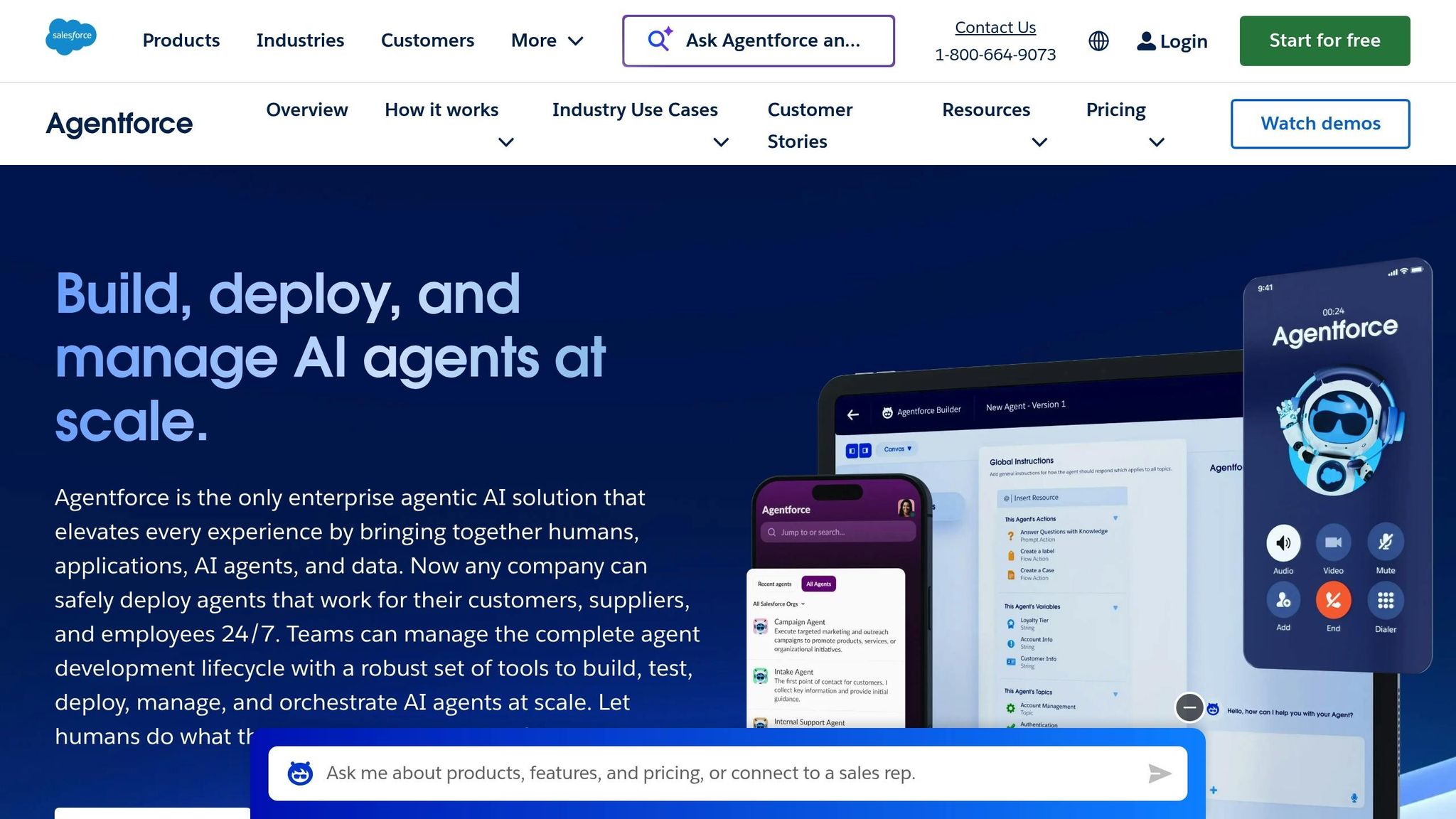
Purpose-Built AI Agents for Different Departments
Enterprises are moving away from generic AI solutions and embracing department-specific agents that simplify workflows and provide reliable, verified knowledge. These tailored tools are proving their worth by automating internal processes and delivering instant, trustworthy information.
Moving from General AI to Department-Specific Agents
Slack's Agentforce 360 is a prime example of this shift, offering specialized agents like Agentforce Sales, IT Service, HR Service, Tableau Next, and Channel Expert. While Slack AI focuses on summarizing conversations and general productivity, purpose-built tools such as Question Base deliver verified, on-demand knowledge for teams in HR, IT, and sales.
Mel Brue, Vice President at Moor Insights & Strategy, remarked that this evolution enables teams to integrate conversations, enterprise data, and automation, turning Slack into the "front door" for business operations [1].
This trend reflects a more nuanced understanding of how departments operate. General AI tools might offer broad search capabilities across platforms, but they often lack the integration and verified knowledge essential for specific workflows. On the other hand, department-specific agents prioritize capturing, organizing, and verifying knowledge within their respective domains.
Take knowledge management, for instance. Question Base offers features like per-channel settings, case tracking, duplicate detection, and analytics focused on resolution rates and automation metrics. These capabilities are crucial for support, HR, and IT teams aiming to measure their effectiveness and pinpoint knowledge gaps. General AI tools might provide basic usage data, but they don’t deliver the operational insights needed to refine departmental processes.
This shift doesn’t just improve functionality - it drives measurable productivity improvements across organizations.
How This Affects Enterprise Productivity
Specialized agents represent a broader industry trend toward operationalizing enterprise knowledge. These tools connect directly to trusted sources like Salesforce, Confluence, and internal help centers, delivering expert-verified answers rather than AI-generated summaries of chat histories.
At Dreamforce 2025, companies like Box demonstrated how Agentforce in Slack centralizes support, automates routine queries, and seamlessly connects employees to both human and AI expertise - all within a single conversational interface [1] [2]. By eliminating the need for employees to search through multiple systems or wait for responses to routine questions, these agents address a major productivity drain.
Survey data backs this up: Over 20,000 knowledge workers across 15 countries reported measurable productivity gains from department-specific AI agents, while adoption of general-purpose chatbots has slowed [2]. Early adopters also highlighted increased employee satisfaction alongside the productivity boost.
Department | Agent Focus | Key Productivity Gains |
|---|---|---|
HR | Policy questions, onboarding automation | Quick access to HR policies and streamlined onboarding |
IT | Troubleshooting, ticket management | Faster issue resolution and improved support workflows |
Sales | Data access, automated reporting | Real-time sales insights and reduced manual reporting |
Analytics | Visualizations, real-time data | Instant access to business intelligence within Slack |
Cost also highlights the appeal of these specialized solutions. For example, Question Base is priced at $8 per user/month, compared to Slack AI's $18 per user/month. This makes department-specific agents more accessible for teams needing focused functionality rather than broad, generalized AI capabilities.
This trend is particularly relevant in today’s hybrid work environments. Modern teams rely on platforms that combine asynchronous workflows, real-time collaboration, and AI-driven automation. Department-specific agents thrive in this setting because they’re built around the unique workflows of specific teams, rather than generic productivity needs.
Expert-Verified Knowledge vs AI-Generated Summaries
As organizations continue adopting purpose-built agents, a key evolution is the shift from AI-generated summaries to expert-verified knowledge. This distinction is crucial for enterprise knowledge management. While Slack AI is excellent at summarizing conversations and offering general productivity tools, businesses increasingly require verified, auditable answers that directly tie into their trusted documentation systems.
This shift is particularly important because AI-generated content often struggles to meet the accuracy standards necessary for enterprise-level operations. Industries like healthcare, finance, and insurance, which are highly regulated, face significant risks when making critical decisions based solely on AI's interpretation of chat history.
Question Base vs Slack AI Feature Comparison

The differences between Question Base and Slack AI highlight two distinct approaches to managing knowledge. Slack AI focuses on generating summaries from channel threads and providing search capabilities within Slack's history. In contrast, Question Base prioritizes an expert-verified process to ensure accuracy and maintain enterprise control over the quality of knowledge.
Feature | Question Base | Slack AI |
|---|---|---|
Accuracy | AI-generated → Human-verified content | AI-generated only |
Data Sources | Slack channels, help centers, Salesforce, Confluence, OneDrive, and other enterprise tools | AI search across Slack history and other tools (Business Plan & Enterprise only) |
Knowledge Management | Per-channel settings, case tracking, duplicate checks, new knowledge capture | None |
Analytics | Tracks questions asked, resolution rates, automation rates, and unhelpful answers | Basic chat usage data |
Price | $8 per user/month | $18 per user/month |
At just $8 per user/month, Question Base offers a more affordable solution compared to Slack AI's $18 per user/month. This makes it an attractive choice for teams seeking targeted knowledge management features instead of broad AI functionality.
One standout feature of Question Base is its ability to analyze common answers from Slack threads and integrate them into official company documentation. This creates a feedback loop that transforms Slack conversations into a permanent, actionable knowledge base, rather than leaving valuable insights buried in chat history.
Why Verified Knowledge Matters for Large Organizations
The feature differences between these tools emphasize why verified knowledge is a top priority for large organizations. Teams operating in regulated industries cannot rely on unverified AI responses due to the risks they pose. Expert-verified knowledge ensures the accuracy and auditability needed for compliance and informed decision-making.
Experts from companies like IBM, Deloitte, and Box stress the importance of blending human expertise with AI automation to maintain accuracy, trust, and compliance [2]. They advocate for deploying autonomous agents with access to verified documentation and clear audit trails to support regulatory needs and strategic goals.
This distinction is particularly evident in real-world applications. For instance, if an HR team needs to provide accurate information about employee benefits, Question Base pulls verified answers from systems like Confluence or Salesforce, ensuring alignment with official policies. Meanwhile, Slack AI might summarize past conversations about benefits, but it cannot guarantee the accuracy or relevance of the information discussed.
Question Base goes beyond providing answers by tracking resolution rates, identifying unhelpful responses, and highlighting knowledge gaps. This allows organizations to pinpoint areas where expert input is needed, continuously improving their knowledge operations. In contrast, Slack AI's analytics are limited to basic chat usage data, offering fewer actionable insights for refining knowledge management.
For enterprises managing thousands of employees across multiple departments, maintaining ownership and control over knowledge is critical. Question Base enables organizations to set per-channel behaviors, track cases, and ensure AI-generated responses meet internal standards. This level of control is especially valuable for companies aiming to deliver consistent messaging across diverse teams and regions.
The move toward verified knowledge addresses the challenge of turning institutional knowledge into actionable information. While Slack AI helps individuals work more efficiently by summarizing past conversations, Question Base ensures teams stay aligned by connecting them to the organization's authoritative knowledge sources. This expertise-driven approach demonstrates why tools like Question Base are essential for keeping teams on the same page and removing operational roadblocks.
Deep Integration and Enterprise Customization
The Agentforce sessions highlighted a growing demand among enterprises: moving beyond simple AI tools to solutions that deeply integrate with their existing knowledge ecosystems. Companies are no longer content with standalone AI tools. Instead, they want AI agents embedded as core components of their operational workflows.
This shift signals a broader change in how businesses perceive AI. Rather than being seen as add-ons, AI agents are now viewed as the backbone of enterprise infrastructure, centralizing and streamlining operations. In fact, Slack's dominance in enterprise research in 2025 underscored its role as the go-to platform for work collaboration [1]. This evolution paves the way for tighter integrations that bring corporate knowledge together in one place.
Connecting AI Agents to Your Knowledge Systems
To ensure effective deployment, AI agents must seamlessly connect with a company’s existing tools and systems. Question Base exemplifies this level of integration by working with platforms like Notion, Confluence, Google Drive, Salesforce, Zendesk, Intercom, and Dropbox. These connections create a unified dashboard that simplifies knowledge access.
This integration is critical because modern enterprises store essential information across a range of tools. Without a unified system, employees waste valuable time jumping between platforms to find what they need. Question Base solves this by not only integrating with these tools but also extracting key insights from Slack conversations and incorporating them into official company documentation. This process ensures that valuable institutional knowledge, often created in day-to-day conversations, is preserved for future use.
The introduction of the Real-Time Search (RTS) API and Model Context Protocol (MCP) server further enhances these capabilities. These tools allow AI agents to securely access and utilize context from documentation and chat history across multiple systems within Slack [1]. By breaking down information silos, these integrations enable AI agents to deliver instant, context-aware answers.
Enterprise Security and Compliance Features
While integration is essential, security and compliance remain top priorities, especially for organizations in heavily regulated industries. During the sessions, leaders stressed that AI agents must meet the same rigorous security standards as other critical business applications. Question Base addresses these concerns with SOC 2 Type II compliance, encryption for data both at rest and in transit, and optional on-premise deployment. These measures ensure that sensitive knowledge is protected and accessible only to authorized users.
This level of compliance is particularly vital for industries like healthcare, finance, and insurance, where strict audit trails and robust data governance are non-negotiable. Question Base also offers per-channel security settings and customizable AI behavior, allowing organizations to tailor security controls to the specific needs of each department. These features ensure compliance without compromising functionality. For large enterprises, white-labeling options and multi-workspace support provide the flexibility to adapt AI agents to unique workflows and organizational structures.
The move toward department-specific AI agents with defined roles has proven more effective in driving adoption and productivity than one-size-fits-all chatbots [2]. This approach allows organizations to implement specialized security measures that align with each department's risk profile. Additionally, advanced analytics and reporting tools provide insights into compliance metrics, knowledge access trends, and potential security risks. These capabilities not only strengthen security but also enhance knowledge management practices, enabling continuous improvement across the organization.
Using Analytics to Improve Knowledge Operations
Agentforce sessions highlight a critical shift in knowledge management: analytics now play a central role in identifying challenges, measuring progress, and driving continuous improvement. While specialized AI tools remain essential, analytics have emerged as the backbone of refining these systems. Organizations that excel with AI-powered support systems consistently rely on analytics to pinpoint issues, track performance, and optimize their operations.
Though Slack AI provides basic usage statistics, such as interaction frequency, enterprises need more robust insights to address deeper operational challenges. These advanced analytics enable teams to systematically identify and resolve knowledge gaps, setting the stage for smarter and more effective knowledge operations.
Finding and Fixing Knowledge Gaps with Data
Advanced analytics go beyond surface-level metrics to uncover weaknesses in knowledge systems. Question Base enhances basic statistics by offering detailed insights like resolution rates, automation success, and analyses of unhelpful responses. This data reveals where documentation falls short and highlights areas that demand immediate attention.
For example, low resolution rates and ineffective automation often signal gaps in existing resources or automated workflows. Question Base’s analysis of unhelpful responses tackles a critical challenge in AI-powered support: maintaining accuracy at scale. By identifying where AI-generated answers or existing knowledge fail, teams can address these shortcomings before they escalate. Additionally, the system monitors chat threads for new recurring answers and suggests incorporating them into official documentation, proactively closing emerging knowledge gaps.
This approach stands apart from general analytics that merely track chat usage. Teams need more than just interaction data - they need to evaluate how well their AI performs and where improvements are necessary.
How Large Teams Use Reporting to Get Better Results
Armed with these insights, large organizations use analytics to refine workflows, prioritize updates, and align efforts across departments. The data often reveals patterns that individual team members might miss but become apparent when analyzing hundreds or thousands of interactions.
Mel Brue, Vice President and Principal Analyst at Moor Insights & Strategy, observes that Slack’s evolution into a hub for data, conversations, and AI automation enables teams to combine analytics with collaboration, fostering ongoing improvements in support and knowledge management [1].
Analytics also guide resource allocation and workflow adjustments. For instance, if data shows that certain departments generate more unresolved questions, organizations can direct additional resources to those areas. Similarly, tracking resolution rates helps teams focus on updating documentation where it’s most needed.
The rise of department-specific AI agents has made analytics even more indispensable. Different teams have unique needs, and analytics ensure that each department’s approach is tailored appropriately. For example, HR teams might prioritize accuracy for policy-related questions, while IT teams focus on troubleshooting workflows with an emphasis on quick resolutions.
Tim Banting from Techtelligence notes that buyers increasingly expect platforms to deliver actionable data for optimizing workflows [1].
Analytics also play a vital role in compliance, particularly in regulated industries. Tracking who accessed specific information and when is crucial for meeting legal and regulatory standards. Question Base’s detailed reporting supports these compliance requirements while simultaneously offering insights for operational improvement.
The most effective implementations involve regular review cycles where teams analyze analytics data and make informed updates. This might include revising documentation for frequently asked but poorly resolved questions, fine-tuning AI responses based on accuracy metrics, or reorganizing knowledge sources to align with usage trends. By treating analytics as a tool for continuous optimization, rather than just a reporting mechanism, organizations achieve lasting improvements in their support operations.
Best Practices for AI-Powered Slack Knowledge Management
To truly make the most of AI-powered Slack knowledge management, it’s not just about setting up the system - it’s about keeping it effective and relevant over time. By focusing on strategies that emphasize accuracy, trust, and adaptability, organizations can ensure their knowledge systems remain impactful.
Building a Knowledge Base That Evolves with Your Team
An effective Slack knowledge system doesn’t just pull from chat history - it connects with a variety of enterprise tools. Solutions like Question Base lead the way by integrating with trusted platforms such as Notion, Confluence, Salesforce, and Google Drive. This approach ensures that Slack conversations can be transformed into verified, reliable entries in your knowledge base.
It’s also crucial to establish clear roles and processes across departments. For example, HR teams might need precise and carefully worded responses to policy-related questions, while IT teams could focus on quick troubleshooting. By tailoring settings to meet the needs of each department, you can ensure that responses are both relevant and easy for subject matter experts to review and refine.
Once your knowledge base is up and running, the work isn’t over. Regular updates and improvements are key to keeping it accurate and useful as your organization grows.
Leveraging AI to Continuously Improve
AI systems thrive when they’re actively refined. Regular expert reviews, audits, and data analysis can identify gaps in documentation and improve response quality. For instance, Box demonstrated the power of this approach by centralizing their knowledge within Slack. This move led to fewer support tickets and faster onboarding for new employees [2].
“Companies like Box have demonstrated measurable results from these approaches, achieving significant reductions in support ticket volume and faster employee onboarding by centralizing knowledge access within Slack [2]. Their success comes from treating AI as a tool that enhances human expertise rather than replacing it entirely.”
Advanced systems can also monitor unanswered questions, track patterns in failed responses, and highlight areas where documentation needs improvement. By addressing these gaps, your knowledge base becomes a dynamic resource that adapts to your team’s evolving needs.
For enterprise deployments, it’s essential to include features like role-based permissions, audit trails, and integration with identity management systems. These measures not only meet compliance requirements but also prevent expensive fixes down the road [1] [2].
As organizations move toward department-specific autonomous agents, improvement strategies must align with the unique challenges and goals of each team [2].
“Early adopters of autonomous agents in Slack have reported not only productivity gains but also improved talent attraction and retention [2]. This suggests that well-implemented AI knowledge systems can offer benefits beyond operational efficiency, including enhanced workplace satisfaction and a competitive edge in hiring.”
Conclusion: What's Next for Slack-Native AI Agents
Agentforce sessions reveal a clear shift among enterprises: moving away from generic AI tools toward specialized agents that provide verified answers instead of simply generating summaries from chat logs. This marks a significant evolution in how organizations are leveraging AI within Slack.
Slack continues to solidify its role as the central hub for enterprise operations, particularly in collaboration and knowledge management. With its widespread adoption, Slack is perfectly positioned to support the next wave of AI agents - tools that seamlessly combine communication, knowledge sharing, and workflow automation.
Solutions like Question Base are at the forefront of this transformation. They deliver human-verified answers by directly connecting to trusted documentation systems such as Notion, Confluence, Salesforce, and OneDrive. This ensures that HR, IT, and operations teams receive accurate and traceable information. While Slack AI enhances productivity with features like conversation summaries, enterprises require agents that can reliably tap into verified sources for critical answers.
The importance of deep integration cannot be overstated. Slack's Real-Time Search API and Model Context Protocol enable third-party agents to securely access conversational data while adhering to strict enterprise security standards. These capabilities make it possible for advanced agents to offer features like case tracking, duplicate detection, channel-specific customization, and detailed analytics - tools that are essential for effective knowledge management.
"Industry analysts such as Mel Brue (Moor Insights & Strategy) and Tim Banting (Techtelligence) emphasize that Slack is evolving into the 'front door' of enterprise work, where AI agents, data, and people converge for unified operations" [1].
Another critical piece of the puzzle is analytics. By focusing on metrics like resolution rates, automation performance, and knowledge gap analysis, organizations can transform their AI systems into dynamic tools that continuously improve. These insights allow enterprises to refine their processes, ensuring that AI agents adapt and grow alongside their needs.
Gartner's 2025 strategic technology trends underscore the importance of agentic AI, predicting that these tools will bring new levels of decision-making and operational efficiency [3]. Early adopters are already reaping the benefits, not just in terms of productivity but also in attracting and retaining top talent through well-executed AI knowledge systems [2].
Looking ahead, it’s clear that enterprises must prioritize specialized AI agents that integrate deeply with their existing systems, provide verified knowledge, and harness analytics for ongoing improvement. By doing so, organizations can position themselves for success in an era where AI-powered hybrid collaboration becomes the norm. Those who act now will gain a significant edge in productivity, innovation, and talent retention [1][2].
FAQs
How can department-specific AI tools like Question Base boost team productivity compared to general-purpose AI chatbots?
While tools like Slack AI are great for boosting personal productivity and summarizing conversations, Question Base takes things a step further for teams in support, HR, IT, and operations. It connects seamlessly with trusted platforms like Notion, Confluence, and Salesforce to deliver expert-approved answers, ensuring responses are both accurate and dependable.
What sets Question Base apart is its focus on empowering entire teams. Unlike Slack AI, which mainly relies on chat history, Question Base provides auditability, knowledge ownership, and advanced capabilities such as case tracking, duplicate detection, and analytics on resolution rates. For teams that value precision, alignment, and smooth operations, Question Base is specifically designed to keep workflows efficient and everyone on the same page.
What security and compliance features make Question Base ideal for regulated industries?
Question Base is built to meet the strict security and compliance demands of regulated industries. It is SOC 2 compliant, adhering to stringent protocols for data security, availability, and confidentiality. Moreover, the platform emphasizes knowledge ownership and auditability, allowing teams to maintain full control over their data while also tracking answer accuracy and access history.
Thanks to its strong security measures and flexible configuration options, Question Base serves as a reliable choice for organizations where safeguarding data and ensuring compliance are top priorities.
How does Question Base deliver accurate and reliable knowledge for enterprise teams?
Question Base stands out by delivering expert-verified answers pulled directly from your trusted platforms, such as Notion, Confluence, Salesforce, and OneDrive. Unlike other AI tools that mainly draw insights from past Slack conversations, Question Base taps into your established knowledge bases to provide precise and dependable information.
This setup ensures enterprise teams have access to consistent and audit-ready answers, all while retaining full control over their knowledge. It's specifically designed for HR, IT, and operations teams, where precision and accountability are non-negotiable.