∙
Cooper
∙
Reading time:
20 min

AI tools are no longer just buzzwords - they’re solving real problems for enterprises in 2025. But getting from hype to results hasn’t been easy. Despite billions invested in generative AI, most projects fail due to unclear goals and poor integration. Companies are now focusing on AI solutions that deliver measurable outcomes like saving time, cutting costs, and boosting productivity.
Key takeaways from successful AI adoption:
Targeted use cases win: Tools like Sandvik’s Manufacturing Copilot and Toshiba’s Microsoft 365 Copilot save time and reduce inefficiencies, with productivity gains of 30% or more.
Pre-built solutions work better: Pre-built AI tools have a 67% success rate compared to custom-built systems.
Knowledge management matters:AI-powered tools help teams access critical information faster, breaking down silos and automating repetitive tasks.
Security and compliance are essential: SOC 2 compliance and integration with trusted systems ensure secure and reliable operations.
The shift is clear: enterprises are prioritizing practical, high-impact applications that integrate seamlessly into workflows. Tools like Question Base stand out by offering cost-effective, human-verified AI answers that connect with platforms like Slack, Salesforce, and Confluence, helping teams work smarter and faster.
Enterprise AI Adoption in 2025: What Actually Works
Key Drivers of AI Adoption in 2025
As businesses increasingly demand measurable outcomes, several forces are pushing AI from a buzzword into a practical tool that delivers real results. These drivers are reshaping how companies operate and proving that AI investments can yield substantial returns when applied effectively.
The Shift Toward Practical AI Applications
AI has moved beyond experimental phases, stepping into roles that address specific business challenges. Companies are finding success by focusing on AI solutions that tackle clear, operational problems rather than abstract possibilities.
One standout area is workflow automation, where AI is transforming repetitive tasks into streamlined processes. For instance, NTT DATA leveraged tools like Microsoft Copilot Studio and Azure AI Foundry to achieve 65% automation in IT service desks and fully automate certain workflows[1]. This shift allows employees to redirect their efforts toward strategic initiatives, leaving routine tasks to AI.
In manufacturing, AI-driven tools are proving their worth as well. A Michigan-based automotive parts manufacturer reduced production planning time by 60%, saving $2.3 million through predictive scheduling[2]. These kinds of results highlight how AI-powered analytics can sharpen competitive edges in industries where efficiency is critical.
Another compelling example comes from Sandvik, whose Manufacturing Copilot dismantles knowledge silos by granting instant access to years of documentation. This innovation has boosted productivity by 30%, improved support processes, and accelerated employee training[1]. When workers can quickly retrieve the information they need, the benefits ripple across the organization, amplifying efficiency and effectiveness.
With over 80% of companies using or exploring AI in 2025[4], early adopters are sharing their successes, making it easier for others to identify and implement high-impact applications. These practical examples demonstrate the tangible value AI can bring, but they also underscore the importance of addressing security and compliance concerns.
Balancing Security, Compliance, and Accuracy
While AI’s practical benefits are clear, its adoption hinges on meeting strict standards for security, compliance, and accuracy - especially in handling sensitive data and supporting critical workflows.
For enterprise adoption, SOC 2 compliance has become a must-have. Organizations need assurance that their AI tools adhere to rigorous standards for data security, privacy, and operational integrity[4][5]. This is especially vital for solutions that interact with diverse data sources, such as Salesforce, Confluence, OneDrive, and internal documentation systems.
Lessons from early AI deployments have also highlighted the risks of unchecked automation. AI-generated content without human oversight can lead to costly errors, particularly in customer-facing or compliance-sensitive contexts. As a result, enterprises are prioritizing tools that combine AI’s efficiency with human review to ensure accuracy and reliability.
Another critical factor is integration. Companies demand AI solutions that seamlessly connect with existing data systems, avoiding the creation of new silos while maintaining robust access controls. For example, Topsoe achieved an 85% adoption rate for office AI within seven months by deploying tools that met stringent security requirements while enhancing productivity[1]. When employees trust that AI tools are both secure and accurate, they’re more likely to use them consistently in their daily tasks.
AI-Powered Knowledge Management: Solving Enterprise Challenges
Managing knowledge effectively is a cornerstone of enterprise productivity. While businesses have poured resources into collaboration tools and documentation platforms, the real hurdle is ensuring employees can access the right information when they need it most. AI-powered solutions are stepping in to address this issue, turning scattered data into actionable insights that enhance daily operations. These tools don’t just retrieve information - they help transform it into results that drive business success.
The Challenge of Knowledge Silos in Enterprises
In many organizations, knowledge is scattered across platforms like Notion, Confluence, Slack, Salesforce, and more. This fragmentation creates inefficiencies that often go unnoticed until they’re measured.
The problem isn’t just about convenience. When employees can’t easily find the information they need, they spend hours searching through disconnected systems or interrupt colleagues with repetitive questions. Support teams repeatedly answer the same inquiries. HR departments field identical policy questions. IT teams troubleshoot recurring issues that have already been solved but aren’t documented in an accessible way.
Take Persol Career, for example. Their HR team faced a daunting challenge: critical workforce data was spread across 70 different systems. Before adopting AI-powered knowledge management tools, their analysts spent weeks gathering data that should have been readily available. The lack of centralized access forced teams to redo work unnecessarily because previous insights couldn’t be easily found[3].
Another major hurdle is "implicit knowledge" - the crucial information stored in employees’ minds or buried in chat threads. When team members leave or switch roles, this knowledge often disappears, leaving organizations to rediscover solutions to problems they’ve already solved.
The financial toll of these knowledge silos is significant. Teams waste time duplicating efforts, make decisions based on incomplete information, and spend hours searching for answers that should be at their fingertips. This constant struggle not only impacts productivity but also frustrates employees, leading to dissatisfaction and slower workflows across the board.
Benefits of AI-Integrated Knowledge Tools
AI-powered tools tackle these silos by delivering a centralized, intelligent system that adapts to users’ needs. Instead of requiring employees to remember where information is stored, these tools bring relevant insights directly into their workflow - often within platforms they already use daily.
The automation potential is substantial. For instance, NTT DATA achieved 65% automation in IT service desk tasks, with certain workflows reaching 100% automation[1]. This doesn’t replace human expertise; instead, it enhances it by automating routine tasks and freeing up specialists to focus on more complex issues.
Another example is Wisesight, which slashed research and content creation time from two days to just 30 minutes by leveraging AI to analyze and compile data from multiple sources[3]. These are not abstract benefits - they represent real, measurable improvements in how quickly teams can find and act on critical information.
AI tools also create a continuous improvement cycle for organizational knowledge. They identify gaps in existing documentation, track frequently asked questions, and highlight opportunities to create new resources. New employees can access institutional knowledge immediately, reducing their reliance on colleagues and speeding up their onboarding process.
To ensure accuracy, these tools often include workflows for expert review. While AI manages the initial retrieval and response, human experts refine and validate the information over time. This combination of automation and human oversight ensures responses are both reliable and aligned with company standards. The result? A system employees can trust, with reduced manual effort for subject matter experts.
Comparing Leading Slack-Integrated AI Solutions
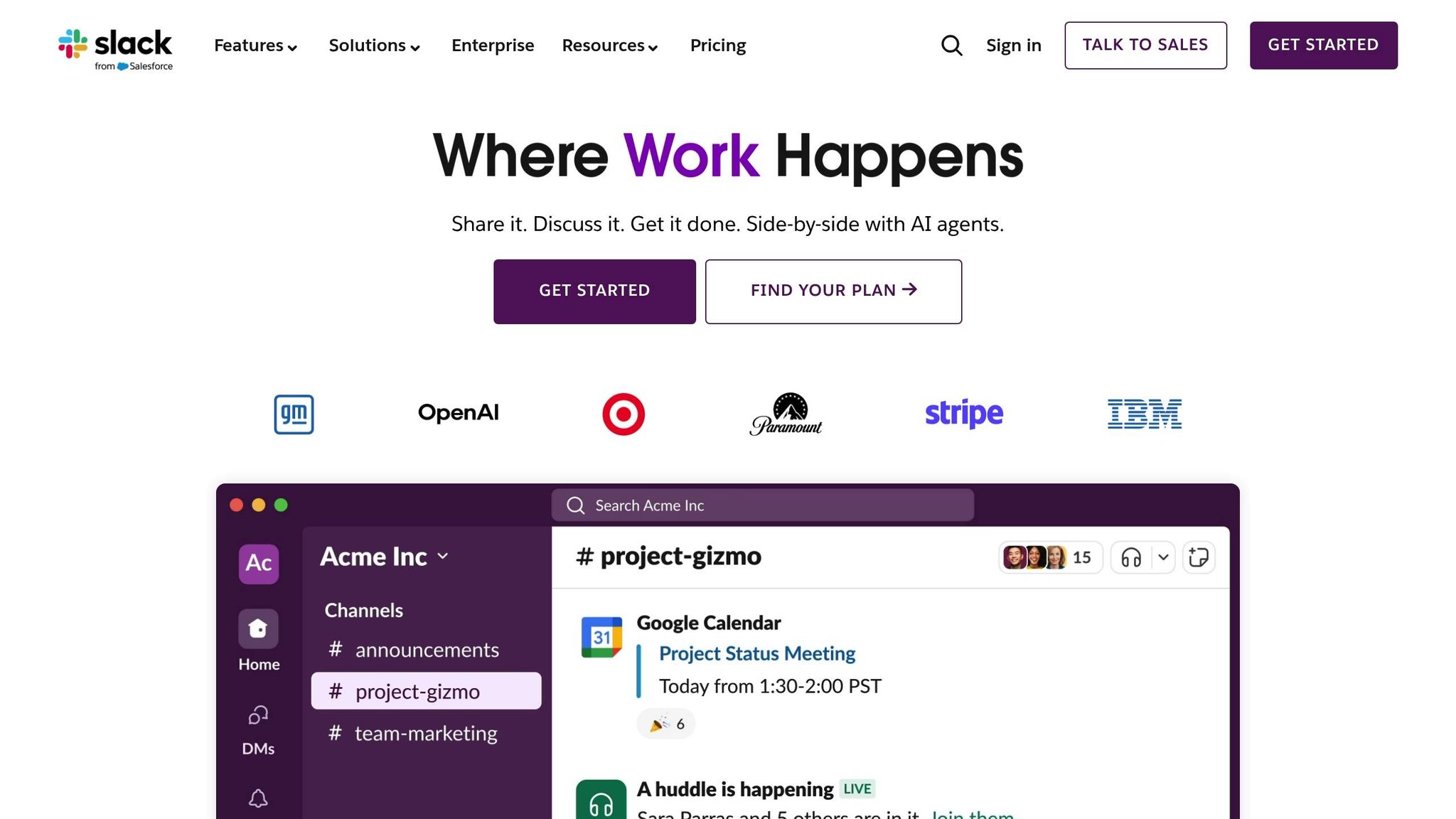
When enterprises set out to evaluate AI-powered knowledge management tools, two key players often dominate the conversation: Question Base and Slack AI. Both integrate seamlessly into Slack workflows, yet they cater to different needs and deliver value through unique approaches. For organizations aiming to transition from AI experimentation to real-world implementation, understanding these differences is essential.
Feature Comparison Between Question Base and Slack AI
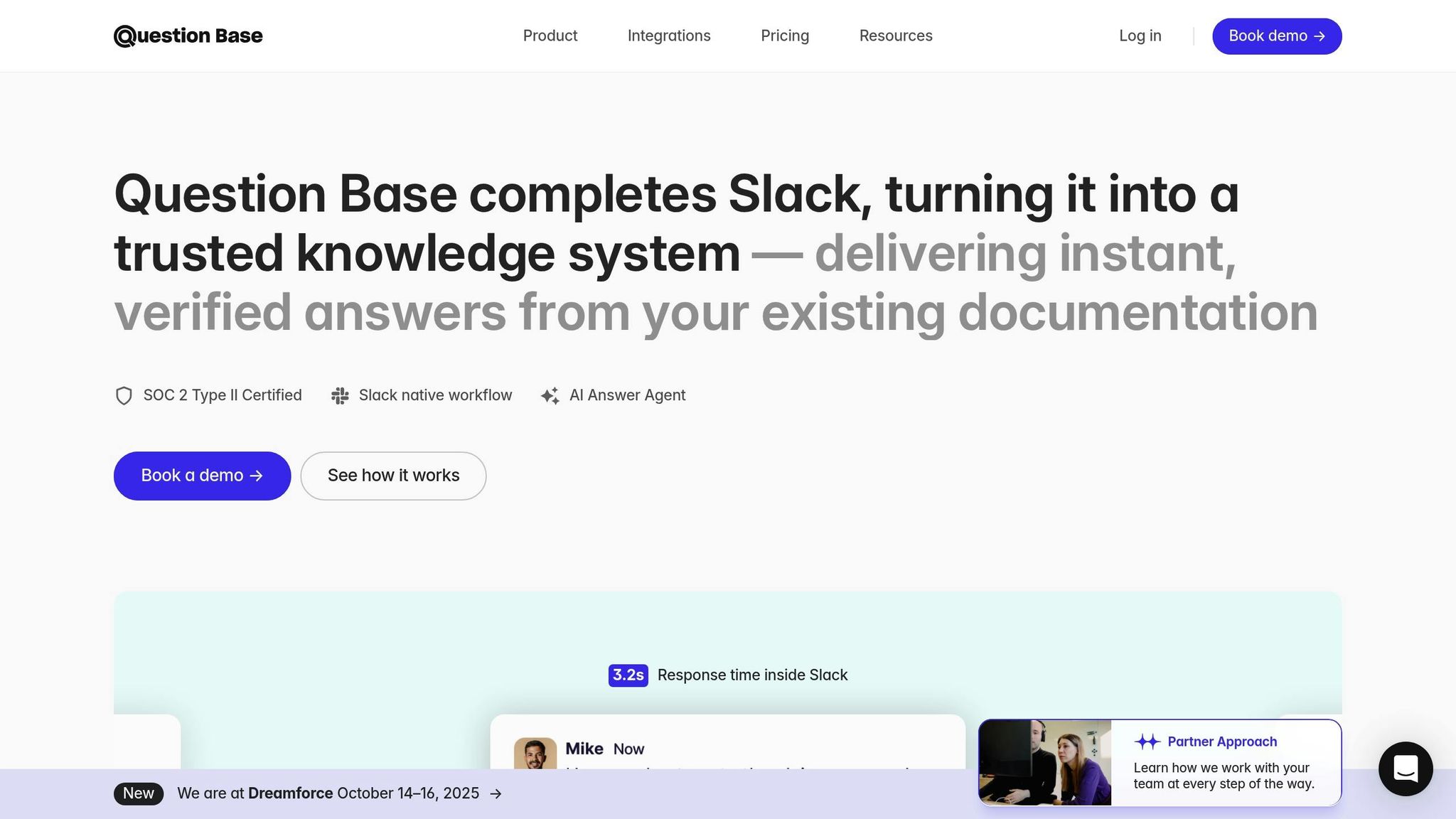
The clearest way to grasp the strengths of these platforms is by directly comparing their core features. Each tool is designed with a specific focus, which shapes its capabilities and ideal use cases.
Feature | Question Base | Slack AI |
|---|---|---|
Accuracy | Human-verified AI responses | AI-generated responses |
Data Sources | Pulls from Slack channels, help centers, Salesforce, Confluence, Notion, OneDrive, and other enterprise tools | Primarily uses Slack history (broader integrations on higher-tier plans) |
Knowledge Management | Offers per-channel settings, AI customization, case tracking, duplicate checks, and new knowledge capture | None |
Analytics | Tracks questions asked, resolution rates, automation rates, and unhelpful answers | Basic chat usage data |
Enterprise Focus | SOC 2 Type II compliance, on-premise deployment, white-labeling, multi-workspace support | Standard Slack security features |
Pricing | $8 per user per month | $18 per user per month |
Accuracy is a cornerstone for enterprise operations, where misinformation can lead to costly mistakes. Here, Question Base stands out with its human-verified AI responses, ensuring reliability.
Another key distinction lies in data source integration. Question Base connects to a wide array of enterprise platforms, from documentation tools like Confluence and Notion to CRM systems like Salesforce. Slack AI, on the other hand, primarily pulls from Slack’s internal ecosystem, with expanded integrations available only on higher-tier plans.
These differences highlight why enterprises often lean toward one solution over the other, depending on their specific needs.
Why Enterprises Choose Question Base
Given these technical distinctions, enterprises frequently turn to Question Base for its ability to deliver reliable and auditable knowledge management at scale. The platform is tailored to address challenges that general-purpose tools often cannot manage effectively.
Security is a major factor driving adoption. Question Base offers SOC 2 Type II compliance and robust encryption, with an option for on-premise deployment. These features are critical for organizations in regulated industries or those with stringent data governance requirements.
Its advanced knowledge management features further set it apart. Tools like case tracking, duplicate detection, and new knowledge capture create a feedback loop for continuous improvement. For example, when employees ask questions that expose gaps in existing documentation, Question Base identifies these gaps and helps teams address them systematically.
The platform’s analytics capabilities are another standout. By tracking metrics such as resolution rates, automation percentages, and unhelpful answers, Question Base provides actionable insights. These help knowledge managers identify which resources need updates or where expert input could make the biggest difference.
At $8 per user per month, Question Base offers a cost-effective solution compared to Slack AI’s $18 price point, making it an economical choice for specialized knowledge management.
Positioning Slack AI as a Complementary Tool
Slack AI shines in its role as a tool designed to boost productivity and streamline communication within Slack. Its features are particularly useful for summarizing conversations, extracting insights from chat history, and supporting routine collaboration workflows.
One of Slack AI’s standout features is chat summarization. Whether teams need a quick recap of lengthy discussions or an overview of missed conversations, Slack AI provides instant value. This is especially helpful for project updates, meeting summaries, or general team coordination.
The key takeaway is that Slack AI and Question Base are not competitors - they complement each other. Slack AI helps individuals navigate daily communication more efficiently, while Question Base ensures teams stay aligned by providing verified answers sourced from trusted platforms.
When used together, Slack AI handles conversational insights, while Question Base anchors institutional knowledge. This dual approach reflects a growing trend in enterprise AI: specialized tools often outperform general-purpose solutions for critical use cases. While Slack AI offers broad utility for communication workflows, Question Base excels in delivering accurate, auditable knowledge management - areas where precision and oversight are indispensable.
Next, we’ll dive into best practices for integrating these specialized tools into your operations.
Best Practices for Implementing AI Knowledge Tools
To move from AI buzzwords to practical results, enterprises need strategies that connect reliable data sources, incorporate expert oversight, and leverage analytics to refine performance. A successful implementation starts with ensuring your AI tools integrate seamlessly with your most trusted information hubs.
Connecting Trusted Sources for Verified Answers
A dependable AI knowledge system begins with linking it to trusted data sources. Instead of relying on fragmented or siloed information, companies should focus on creating a unified system that connects key platforms like Notion, Confluence, Salesforce, and secure cloud services.
Sandvik offers a standout example. In 2025, this global manufacturing leader launched their Manufacturing Copilot using Azure OpenAI and Azure AI Search. By integrating their extensive product documentation repositories, they achieved a 30% boost in productivity, enhanced customer service, and streamlined employee training[1].
The process starts with an audit of current knowledge repositories. Identify the sources that employees trust and use the most, and prioritize integrating those first. This isn’t about connecting every platform - it’s about focusing on the ones that hold the most accurate and relevant information.
It’s also critical to maintain robust data security. Ensure that data mapping and access controls align with existing security protocols, so you’re improving access without creating vulnerabilities.
Toshiba illustrates the impact of strategic integration. By rolling out Microsoft 365 Copilot to 10,000 employees, they combined usage data with productivity insights, uncovering opportunities for process improvements. This effort saved 5.6 hours per employee each month, thanks to connections with their most trusted knowledge sources[1].
Establishing Expert Review Workflows
While AI excels at retrieving information, human experts are essential for ensuring accuracy. The best systems combine AI efficiency with expert oversight, creating workflows where subject matter experts can validate and refine AI-generated responses.
NTT DATA highlights the benefits of this balanced approach. Their conversational AI tools achieved 65% automation in IT service desks and 100% automation in specific order workflows, while experts oversaw more complex or sensitive queries[1]. This hybrid model allowed them to scale operations while maintaining high-quality support.
To implement this effectively, organizations should establish approval processes for high-impact content and include feedback mechanisms for users to flag inaccuracies. When employees encounter errors, there should be a clear path for experts to review and correct the information, fostering continuous improvement.
Assigning subject matter experts to specific domains is key. For instance, HR specialists should review people-related content, while IT experts handle technical queries. This domain-specific approach ensures that the right expertise is applied to refine the knowledge base.
Question Base simplifies this process by enabling teams to review, edit, and refine AI-generated answers before they’re widely shared. The platform can analyze recurring questions in chat threads and prompt their integration into official documentation. Once experts validate the content, analytics can further optimize the knowledge base.
Using Analytics to Drive Continuous Improvement
Analytics are essential for identifying strengths and weaknesses in your AI knowledge tools. Metrics like resolution rates, response times, and unanswered queries provide actionable insights to improve system performance.
Some key metrics to monitor include:
Resolution rates: Identify which queries the AI resolves effectively and which require human intervention.
Unanswered queries: Highlight gaps in the knowledge base by tracking questions the AI cannot answer.
User satisfaction scores: Gauge employee confidence in the system.
Knowledge base coverage: Understand how well your sources address common queries.
For example, tracking resolution rates can reveal areas where the AI struggles, signaling the need for updated content or expert review. Similarly, analyzing unanswered queries helps pinpoint missing information, offering a roadmap for expanding the knowledge base.
Softchoice demonstrates the value of continuous improvement. After adopting Microsoft 365 Copilot, they tracked productivity metrics and achieved a 97% reduction in time spent summarizing technical meetings and cut content creation time by up to 70%[1]. These gains came from ongoing analysis and refinement of their AI workflows.
Regularly reviewing analytics helps organizations make targeted updates, such as refreshing outdated documentation, adding new sources, or retraining the AI based on evolving query patterns. Tracking user adoption trends also reveals which teams benefit most, enabling businesses to replicate successful use cases across departments for broader impact.
Measuring Enterprise Impact: Key Metrics
Turning AI concepts into measurable results means focusing on the right metrics. By combining integration efforts with expert reviews, businesses can effectively measure the operational impact of AI tools. Enterprises that implement AI-driven knowledge platforms often center their evaluation on three main areas: efficiency gains, productivity improvements, and knowledge coverage growth. These metrics not only provide a clear picture of operational value but also inform ongoing improvements, reinforcing the importance of verified answers and continuous refinement - principles that Question Base emphasizes.
Efficiency Gains
One of the clearest indicators of AI's value is how it improves process efficiency. Metrics like query resolution times and automation rates help showcase how AI tools remove bottlenecks and reduce the need for manual intervention in daily operations.
PGP Glass offers an excellent example. After adopting Microsoft 365 Copilot in 2025, the company reported a daily productivity increase of 30 to 40 minutes per employee. This improvement stemmed from automating repetitive tasks, allowing employees to focus on strategic initiatives[1].
NTT DATA achieved up to 65% automation in IT service desks, with some workflows reaching 100% automation. These figures highlight how AI can significantly cut down on human involvement in routine support tasks[1].
Contract analysis is another area where efficiency gains are clear. Contraktor reduced contract review times by up to 75%, directly lowering costs and speeding up operations through AI-powered document processing[3].
For organizations using Question Base, tracking metrics like resolution rate and automation rate offers similar insights. These analytics reveal how effectively the AI agent is managing queries and lightening the workload for human experts. Beyond just saving time, these improvements contribute to a more productive team overall.
Employee and Team Productivity
Productivity metrics focus on faster access to accurate information, shorter onboarding times, and better employee satisfaction. These metrics highlight how AI tools enhance both individual and organizational performance.
Sandvik reported a 30% productivity boost in 2025 after deploying its Manufacturing Copilot, powered by Azure OpenAI and Azure AI Search. By connecting vast product documentation resources, the company not only improved employee productivity but also delivered better customer service and streamlined training[1].
In research and content creation, the impact can be even more dramatic. Wisesight slashed research and content development time from two days to just 30 minutes using AI-powered analytics. This acceleration made insights more accessible to non-technical users and sped up decision-making processes[3].
These examples underline a common trend across industries: AI helps free up employees from routine tasks, enabling them to focus on more meaningful, high-value work.
Improving Knowledge Coverage Over Time
Efficiency and productivity gains are just part of the equation. Expanding and refining the knowledge base over time ensures sustained operational success. Enterprises that excel in this area use analytics to track unanswered queries, locate knowledge gaps, and measure content growth, creating a feedback loop for continuous improvement.
Noventiq illustrates the benefits of knowledge optimization. Within just four weeks of implementing Microsoft 365 Copilot, the company saved 989 hours on routine tasks. These savings increased over time as the system became more refined and effective[1].
Question Base addresses this challenge with its unhelpful answers investigation feature. This tool helps organizations identify areas where the AI agent falls short, providing actionable insights to improve the knowledge base and ensure ongoing optimization.
To enhance knowledge coverage, businesses should focus on systematic gap analysis. This involves tracking metrics such as the percentage of questions answered automatically, the number of escalations to human experts, and the rate of new knowledge being added. These insights help identify patterns in user needs and prioritize content development.
Croud achieved 4-5X productivity improvements for repeatable tasks by continuously refining their custom AI tools for data analysis and workflow automation. This progress was driven by iterative updates based on analytics and user feedback[3].
Successful enterprises make regular reviews a priority, analyzing metrics to adjust their knowledge management strategies. Dashboards that visualize trends in query types, resolution rates, and user satisfaction provide a data-driven foundation for expanding and refining the knowledge base effectively.
Conclusion: Realizing AI's Potential in Enterprises
The divide between the promise of AI and its practical application is shrinking, but only for businesses that invest wisely in technology. Today’s operational demands call for AI tools that integrate effortlessly into existing workflows and deliver tangible results from the outset.
Forward-thinking enterprises are embracing tailored AI tools to tackle specific challenges, achieving measurable efficiency gains in the process. These successes highlight the importance of selecting the right tools to meet operational needs.
This is where Question Base shines. While Slack AI is excellent for general productivity tasks like summarizing conversations, Question Base focuses on enterprise knowledge management. It connects directly to trusted platforms like Notion, Confluence, and Salesforce, ensuring answers are sourced from verified data rather than relying solely on chat history interpretations. At just $8 per user per month - compared to Slack AI's $18 - it offers enterprise-grade functionality at a more accessible price.
What sets Question Base apart is its commitment to accuracy and accountability. By using human-verified content, it ensures AI-generated responses meet strict compliance and reliability standards. Features like case tracking, duplicate detection, and monitoring of unhelpful answers create a feedback loop that continuously improves the quality of knowledge over time.
This approach reflects a broader trend: AI as a strategic operational tool. Analytics play a key role here, tracking metrics like resolution rates, automation levels, and knowledge base growth. These insights not only highlight immediate efficiency gains but also drive long-term improvements through ongoing measurement and refinement.
For enterprises ready to move beyond AI experimentation, the path forward is clear: adopt tools designed for your specific needs, integrate them with trusted data sources, and track everything. The companies turning AI potential into operational success aren’t necessarily using the most cutting-edge technology - they’re using the most practical and well-implemented solutions.
FAQs
What drives successful AI adoption in enterprises?
Successful AI adoption in enterprises hinges on a few core principles. The first is prioritizing practical, results-oriented applications. Whether it's automating repetitive workflows, streamlining internal support, or organizing institutional knowledge, these focused use cases ensure that AI investments translate into tangible operational improvements instead of abstract ideas.
Next, the importance of reliable data sources cannot be overstated. Integrating with platforms like Notion, Confluence, or Salesforce improves both the accuracy and dependability of AI outputs. Solutions like Question Base shine in this area by directly connecting to these trusted systems, delivering verified answers instead of relying solely on Slack chat history or incomplete data.
Lastly, enterprises thrive with customizable, enterprise-grade AI solutions that address crucial needs like security, compliance, and scalability. Tailoring these tools to specific departments - whether HR, IT, or operations - encourages adoption across teams and sets the stage for sustainable, long-term success.
How can AI-powered knowledge management tools break down knowledge silos in organizations?
AI-powered knowledge management tools break down barriers to information by connecting and organizing data across platforms like Notion, Confluence, and Salesforce. With direct integration into Slack, they allow users to find accurate, verified answers without the hassle of jumping between different apps. This streamlines how teams retrieve information, making the process faster and more efficient.
By creating a unified search experience, these tools ensure teams can quickly locate the information they need when they need it. The result? Better collaboration, stronger retention of institutional knowledge, and fewer duplicated efforts across the board.
Why is SOC 2 compliance essential for AI tools in enterprise environments?
SOC 2 compliance plays a key role for AI tools in enterprise environments, as it confirms that the tool adheres to strict standards for security, data privacy, and operational reliability. This is particularly vital for businesses managing sensitive data, showcasing a strong commitment to safeguarding information and upholding trust.
For enterprise teams, tools like Question Base offer reassurance by being SOC 2 compliant. This ensures that their knowledge management workflows remain secure, traceable, and in line with industry standards. As a result, it’s an excellent fit for HR, IT, and operations teams that value precision and accountability.