∙
Cooper
∙
Reading time:
24 min

Repetitive workflows and scattered knowledge in Slack can slow down enterprise teams. For large organizations, the default Slack setup often struggles to handle complex data routing, compliance requirements, and cross-department communication. Customizing Slack’s data flow solves these challenges by automating message routing, integrating external tools like CRMs and ticketing systems, and ensuring regulatory compliance.
Here’s what you need to know:
Why Customize Slack Data Flow? Default Slack configurations don’t scale well for enterprises. Tailored workflows streamline approvals, reduce manual errors, and improve communication across teams.
Key Tools for Customization: Use Slack’s Workflow Builder for automation, APIs for advanced integrations, and Enterprise Grid for multi-workspace management.
Common Challenges: Issues like duplicate data, buried information, and limited compliance controls can disrupt workflows and create inefficiencies.
Security and Compliance: Enforce role-based access, encryption, and audit logs to meet standards like HIPAA, GDPR, and SOC 2.
AI for Knowledge Management: Tools like Question Base enhance Slack by delivering verified answers from connected documentation systems, saving time and reducing repetitive questions.
Customizing Slack transforms it into a centralized hub for efficient workflows, secure data handling, and smarter knowledge sharing. Whether it’s automating approvals or integrating with enterprise tools, the right setup can keep teams focused on what matters most.
n8n at Scale - Episode 1: Unlocking Slack's Potential with n8n Automation
Slack Data Flow and Integration Basics
Slack serves as a powerful communication tool, enabling teams to message, share files, and collaborate efficiently. But as organizations grow, the need to integrate Slack with tools like CRMs, documentation platforms, ticketing systems, and cloud storage becomes critical. These integrations transform Slack into a centralized hub where data flows smoothly across the tech stack. To design effective data flows that address enterprise needs, it’s essential to understand how Slack connects with external systems.
Slack's integration capabilities rely on several connection methods, each suited to specific data exchange and automation scenarios.
How Slack Connects to External Tools
APIs provide developers with the ability to build custom applications that link Slack to other platforms. This method offers full control over data flow but requires technical expertise and ongoing maintenance[4].
Webhooks act as event-driven links, automatically triggering actions when specific events occur. For instance, a webhook can send a Slack message to another platform, like Microsoft Teams, whenever it’s posted in a channel[1]. These connections operate in real time, making them ideal for situations where immediate updates are necessary.
Pre-built apps from the Slack App Marketplace offer ready-to-use integrations with popular tools, eliminating the need for custom coding[4]. For example, Slack’s integration with Microsoft SharePoint and OneDrive allows teams to search, share, and preview files directly within Slack, complete with automatic notifications[7]. These apps are a quick solution for teams needing standard functionality without customization.
For enterprise-scale organizations managing multiple workspaces, Slack's Enterprise Grid enables apps to function across an entire organization. Here, enterprise_id values group data, ensuring consistent management across all connected workspaces[5]. This setup is particularly useful for managing user provisioning and access control. For example, Microsoft Entra ID (formerly Azure AD) can automatically handle user account provisioning and deprovisioning in Slack, keeping group and user details synchronized[10].
Additionally, rule-based workflows introduce conditional logic, automating how data is processed and transferred between platforms. These workflows ensure that changes in one system are reflected across others, maintaining consistency and reducing manual effort[1][4].
Common Problems with Default Slack Data Flow
While Slack’s integration methods are versatile, they often reveal limitations in large-scale, complex environments. The default setup works well for small teams but struggles to meet the demands of enterprise operations involving hundreds of channels, multiple workspaces, and intricate workflows.
Scalability issues arise when organizations manage data across multiple workspaces or integrate with numerous external systems simultaneously. Standard configurations often lack the infrastructure to handle high message volumes or complex data transformations efficiently[1].
Knowledge management challenges are another major hurdle. Important information often gets buried in Slack threads, making it difficult to locate and capture[8].
Ethan Laub, Principal Product Manager at OfficeRnD, observed: "There's documentation, but people keep asking in chat"[8].
This inefficiency is costly. Experts spend an average of 6 hours per week answering repetitive questions, while employees dedicate 20–30% of their week - up to 12 hours - searching for information[8]. For large organizations, 40% of internal questions are repeats, leading to productivity losses that can cost a 1,000-person company more than $2 million annually[8].
Duplicate data issues occur when messages are copied across platforms without proper deduplication processes, creating confusion and inefficiencies[1]. Slack’s default settings often lack real-time synchronization, causing delays in data updates between systems[4]. For teams juggling multiple communication platforms like Slack and Microsoft Teams, the absence of a unified inbox forces manual platform switching, increasing the chances of missed messages and duplicated efforts[1].
Limited customization options are another drawback. Teams with unique workflows often find that default configurations don’t meet their needs without custom development[6]. Additionally, standard setups may lack the granular permission controls necessary to restrict sensitive information to authorized users[1]. Without clear data schemas and standardized definitions across platforms, organizations risk inconsistent metrics, duplicate reporting, and general confusion[3].
Accuracy and compliance concerns are especially pressing for industries like finance, healthcare, and government. Slack’s default setup doesn’t inherently verify the accuracy of shared information or ensure compliance with regulations like HIPAA, FINRA, or GDPR.
Brigitte Lyons remarked, "Slack is where documentation goes to die, brought up once in passing, and never to be found again"[8].
For teams managing customer support workflows, these limitations create additional friction. Without specialized tools, there’s no central way to route customer requests from various platforms into a single triage channel. This makes it hard to assign, track, and resolve issues effectively[4]. Moreover, standard Slack configurations lack built-in notification bots and alerts, which are essential for maintaining data consistency and ensuring that no critical information is overlooked[1].
These challenges highlight why enterprises must move beyond default Slack settings and implement tailored solutions to meet their operational, security, and workflow complexities.
Customizing Data Flow with Slack's Built-In Tools
Slack's built-in tools take the platform beyond simple messaging, enabling enterprises to automate and streamline their workflows without heavy development efforts. These features ensure consistent and efficient data management across teams, aligning with the tailored workflows discussed earlier.
Using Workflow Builder for Data Transformation
Slack's Workflow Builder is a no-code solution designed to automate data routing and transformation. With its visual interface, even non-technical team members can create rule-based workflows, eliminating the need for developer involvement[1].
This tool supports conditional routing and field mapping, allowing teams to decide what data - such as sender names, timestamps, message content, links, or custom metadata - gets transferred between channels or platforms. For example, you can set up filters to route specific messages from one Slack channel to another based on their content or priority.
Workflow Builder also simplifies task approvals and follow-ups. Imagine a scenario where a team member submits a request for a schema change or a record merge. The workflow can automatically forward the request to the right approvers and trigger actions once it’s approved. A practical use case would be IT support. Incoming requests can be categorized by priority: high-priority issues might be routed to an urgent-support channel with immediate notifications to on-call staff, while medium-priority tasks go to a general queue, and low-priority items are logged for later review. This ensures essential details - like requester name, timestamp, issue description, and priority level - are always captured and managed consistently.
Organizations can also set up alerts for issues like data freshness failures, ingestion errors, or match-rate dips, sending them directly into Slack channels[3]. Paired with on-call routing tools, these alerts can automatically notify the right team members, keeping the context visible and actionable in Slack. This turns Slack into an operational hub where teams can respond immediately to critical events.
The real strength of Workflow Builder lies in its ease of use and quick deployment. Teams can adapt workflows as business needs change, without waiting on technical resources. However, for more complex scenarios involving intricate business logic or advanced system integrations, custom solutions may still be required.
To complement these automation capabilities, Slack also supports custom slash commands and bot actions for real-time control over tasks and data queries.
Creating Custom Slash Commands and Bot Actions
Custom slash commands and bots add another layer of functionality, enabling teams to handle more sophisticated tasks like approvals, data queries, and automated reporting[4]. Slash commands act as shortcuts to trigger specific actions directly within Slack. For instance, a command like /approve-request could initiate a process to capture request details, route them to the right approvers, and update statuses in connected systems. Similarly, /generate-report might query a database and deliver a formatted report to a Slack channel.
Custom bots and applications can connect Slack's API with backend systems, managing tasks like authentication and data transformation[4]. Slack Enterprise Grid’s integration with over 2,600 third-party tools - including Asana, Jira, Salesforce, and Zendesk - makes this even more powerful[2]. For example, a bot could automatically create Jira tickets from Slack messages, sync Salesforce data for added context, or route Zendesk support requests based on urgency.
Notification bots are another valuable tool. They monitor specific channels or keywords and send alerts to relevant teams when critical updates are posted. This ensures that important messages don’t get buried in busy channels.
While custom solutions offer unmatched flexibility, they do require technical expertise and ongoing maintenance. To manage this effectively, it's important to establish clear governance, such as defining who can trigger workflows, maintaining audit logs, and using role-based access controls to protect sensitive information. Additionally, automation should include observability measures - monitoring key metrics like data accuracy and freshness, with service level agreements in place to catch and address issues before they escalate.
Connecting Slack to Enterprise Data Sources
Transforming Slack into a central hub for vital information starts with integrating the tools your teams rely on every day. Customizing these integrations ensures that Slack supports your enterprise's specific workflows while keeping data flow streamlined and consistent. Here's how to choose the right integrations and manage them effectively to maintain data accuracy across your organization.
Choosing the Right Integrations for Your Team
Before diving into integrations, take stock of the tools your teams use most frequently. Popular options for enterprises include CRM systems like Salesforce, documentation platforms such as Confluence and Notion, ticketing tools like Zendesk and Freshdesk, analytics software such as Tableau, and cloud storage services like OneDrive and Google Drive. The key isn’t to connect every tool - just the ones that are critical to your workflows.
For example, finance teams using Salesforce often deploy custom Slack bots to pull CRM data, populate templates, and notify stakeholders. This reduces the need for endless email threads and ensures everyone stays on the same page.
When integrating, you have three main options: native Slack apps, third-party platforms, and custom API solutions. Each comes with its own setup and maintenance considerations, so choose based on your team's technical expertise and long-term needs.
Security is another crucial factor. Ensure any integration aligns with compliance requirements like HIPAA, FINRA, or FedRAMP. Additionally, verify that connected tools meet your organization's authentication standards, whether through Okta, Google, Azure, or another provider.
Think about how each integration fits into your broader data ecosystem. Tools like Zendesk or Intercom, when linked to Slack, create a unified space where internal knowledge and customer communications coexist. This reduces missed updates and provides a clear view of ongoing projects or support issues.
Employees spend 20–30% of their workweek searching for information across tools like Slack - that’s as much as 12 hours lost per week [8].
Once you’ve chosen the right integrations, the next step is ensuring your data stays accurate and up-to-date.
Keeping Data Consistent Across Connected Tools
Poorly managed integrations can lead to duplicate records, outdated information, or conflicting updates. To avoid these issues, take a structured approach to data management.
Start by standardizing data schemas and definitions across systems. Misaligned field names or inconsistent definitions between teams can create confusion and duplicate reporting. Clearly outline required fields, acceptable formats, and the exact meaning of metrics to keep everyone aligned.
Design your system to handle updates based on their urgency. High-priority changes, like escalations or system alerts, should update in real time, while less critical updates - such as routine reports - can process in batches to save resources.
Two-way synchronization is another essential feature. For example, if someone updates a document in Confluence, that change should automatically reflect in Slack. Similarly, resolving a Zendesk ticket should trigger an update in the appropriate Slack channel without manual input.
Map Slack channels strategically to support different workflows. A single enterprise tool might connect to several channels for tasks like triaging issues, managing client escalations, or coordinating internal collaboration. Be clear about which fields transfer - such as sender name, timestamp, and message content - and consider adding static text to clarify the origin of synced messages.
Automated alerts can help maintain data accuracy. Set up notifications for issues like data freshness failures or ingestion errors, and integrate on-call routing to ensure anomalies are flagged and addressed promptly. Notification bots can also forward critical updates, such as escalations or outages, so no one misses urgent information, even during busy periods.
Finally, document how different platforms handle communication. For example, Slack might be used for internal chats, Microsoft Teams for partner-facing discussions, and email for formal documentation. This clarity reduces confusion and keeps communication consistent across your organization.
For teams looking to improve knowledge management, Question Base offers a seamless Slack integration. It connects to tools like Notion, Confluence, Google Drive, Salesforce, Zendesk, and Intercom to create a centralized knowledge system. This turns ephemeral Slack conversations into structured, searchable documentation, addressing a common challenge: up to 40% of internal questions in large organizations are repeats, with experts spending an average of 6 hours weekly answering the same queries [8].
Question Base automatically resolves 35% of repetitive questions in just 3.2 seconds on average, saving experts over 6 hours per week while maintaining a 4.8 answer score accuracy [8].
With SOC 2 Type II certification, encryption for both data at rest and in transit, and optional on-premise deployment, Question Base meets enterprise-grade security standards without requiring additional engineering resources.
Security and Compliance for Enterprise Slack Integrations
Tailoring Slack data flows can significantly improve operational efficiency, but it also comes with a responsibility to enforce strict security and compliance measures. When sensitive data moves across platforms, as it often does in industries like healthcare, finance, and education, the stakes are high. Missteps in configuring integrations can lead to data exposure, regulatory violations, and hefty penalties. The challenge lies in achieving a balance between robust security measures and the flexibility teams need to perform effectively. Below, we explore how strong data governance and security practices help meet enterprise standards.
Data Governance and Access Control
Managing access to Slack integrations effectively requires a combination of automation and well-defined permissions. Relying on manual processes for user provisioning can create vulnerabilities, such as former employees retaining access or delays in granting permissions to new hires.
Microsoft Entra ID (formerly Azure AD) simplifies this process by automating user provisioning and deprovisioning in Slack. For instance, administrators can enable the "Synchronize Microsoft Entra groups to Slack" option in the Mappings section, ensuring that user access is granted or revoked automatically based on attributes like displayName or group membership. This approach minimizes manual errors and creates an audit trail - an essential asset during compliance reviews [10].
To further secure access, implement role-based access control (RBAC) by organizing users into job-specific groups. For example, a "Finance Team" group could handle financial workflows, while a "Healthcare Compliance" group oversees protected health information (PHI). Slack's API offers endpoints like usergroups.create, usergroups.update, and usergroups.users.update to manage these groups programmatically [5]. Clearly document access rules, specifying which teams can view, edit, or delete messages in particular channels. Use Slack's reporting tools to monitor access patterns and swiftly address any irregularities during audits [1].
Additionally, set up automated alerts for unusual activity, such as failed login attempts or permission changes outside standard business hours. Route these alerts to on-call tools to ensure rapid incident response [3].
Security Best Practices for Slack Integrations
Access control determines who can interact with data, but technical safeguards ensure that data remains protected during transmission and storage. For organizations in regulated industries, achieving compliance often requires going beyond Slack’s default configurations.
Slack Enterprise offers HIPAA-compliant settings for safeguarding PHI in both messages and files - a key requirement for healthcare organizations [11]. Moreover, both Slack Enterprise and Question Base meet SOC 2 Type II standards, providing an additional layer of assurance for data security [8][9].
Slack Enterprise encrypts data both in transit and at rest [4]. When developing custom API solutions or integrating third-party tools, ensure webhook endpoints and authentication tokens are secured with TLS 1.2 or higher [6]. For highly sensitive data transfers, such as those involving financial or health information, implement end-to-end encryption.
To prevent data leaks, Slack Enterprise includes data loss prevention (DLP) features that scan messages and files for unauthorized sharing of sensitive information [11]. Additionally, it supports 12 single sign-on (SSO) options, including Okta, Google, and Azure, enabling seamless integration with centralized identity management systems. For organizations requiring maximum control, on-premise deployment options provide an alternative to cloud-based storage [4].
For mobile security, Enterprise Mobility Management (EMM) tools like VMware, AirWatch, or Ivanti MobileIron ensure consistent security policies across all endpoints [11]. When building custom API solutions, adopt security measures equivalent to those in managed solutions. This includes using OAuth 2.0 for authentication, enforcing HTTPS/TLS for all endpoints, validating webhook signatures, and securing API keys through environment variables or secrets management tools [6].
Comprehensive audit logging is another critical component. Slack’s Events API tracks key activities - such as message edits, deletions, and user provisioning changes - across workspaces [5]. Store these logs securely and in an immutable format for the duration required by industry regulations (typically three to seven years). Regularly generate compliance reports to document access patterns and any security incidents, demonstrating adherence to regulatory standards.
For teams integrating AI-driven knowledge tools into Slack, Question Base offers SOC 2 Type II–certified, encrypted integration with optional on-premise deployment. It emphasizes a process of "AI generated → Human verified content", ensuring responses meet the accuracy and reliability standards required in regulated industries. With channel-specific settings and configurable AI behavior, security teams can control how sensitive data - such as HIPAA-protected health information - is accessed and shared. These measures make it easier to segregate sensitive workflows from general communications, reinforcing the security of enterprise data across integrated tools.
Adding AI-Powered Knowledge Tools to Slack
With security controls in place, Slack can shift from being just a workflow automation platform to becoming a hub for smarter knowledge management. While Slack is great at centralizing alerts, routing workflows, and linking enterprise systems, it falls short when it comes to tackling the issue of employees spending 20–30% of their workweek searching for information across scattered documentation systems [8]. This is where tools like Question Base step in, transforming Slack into a proactive knowledge resource that minimizes repetitive questions and delivers verified information exactly when teams need it.
What Is Question Base and How Does It Work?
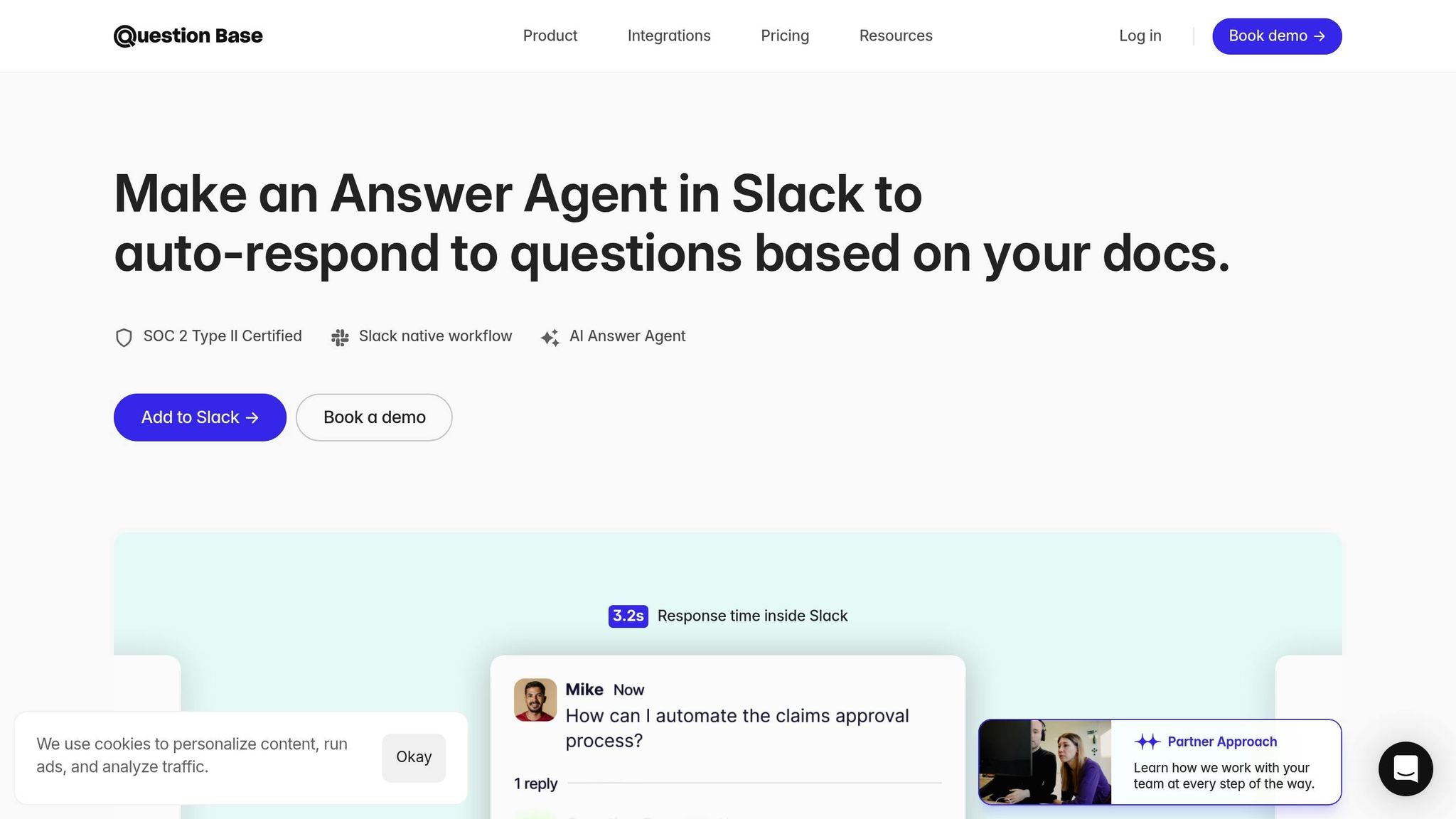
Question Base is an AI-driven answer agent built specifically for Slack. You can install it directly from the Slack App Marketplace, connect it to your existing documentation platforms - such as Notion, Confluence, Google Drive, Zendesk, Intercom, Salesforce, Dropbox, or SharePoint - and activate it with the simple command /invite @questionbase. Once active, it starts delivering instant, verified answers straight from your current documentation, with no extra engineering required.
Unlike traditional knowledge bases that force employees to leave Slack and hunt for information across multiple systems, Question Base keeps everything within the conversation flow. When someone asks a question in a linked Slack channel, the AI pulls relevant details from your documentation and provides a clear, sourced response. This solves a common workplace reality: 80% of employees prefer asking questions in chat instead of searching a wiki [8], yet experts still lose an average of 6 hours each week answering repetitive queries [8].
Question Base creates a "living FAQ" that evolves as employees ask new questions, ensuring your documentation stays up-to-date. If the AI encounters a question it can’t confidently answer, it flags the inquiry and escalates it to a designated human expert. Once the expert provides an answer in Slack, Question Base logs it for future use. This creates a self-improving system where every interaction strengthens the overall knowledge base without adding extra documentation tasks.
The tool also offers flexible customization to meet enterprise needs. Organizations can define which documentation sources the AI can access, adjust the tone and behavior of responses to align with company communication standards, and set up escalation workflows that route complex questions to the right teams based on topic or urgency. For industries with strict compliance or data residency requirements, the Enterprise tier includes on-premise deployment, white-labeling, multi-workspace support, and SOC 2 Type II certification with encryption for data at rest and in transit.
Additionally, analytics provide insights into automation performance, resolution rates, and unanswered questions, helping teams identify content gaps and refine their knowledge systems. By seamlessly integrating with Slack workflows, Question Base enhances operational efficiency while streamlining knowledge management.
Question Base vs. Slack AI: A Comparison
To understand the strengths of Question Base, it’s helpful to compare it with Slack AI.
Slack AI is designed to summarize conversations and highlight key decisions, making it a general-purpose tool for individual productivity. For teams, however, that need reliable, expert-verified knowledge - particularly in support, HR, IT, and operations - Question Base offers a tailored solution. It focuses on delivering accurate answers sourced from trusted documentation.
The primary distinction lies in how each tool accesses and verifies data. Slack AI relies on Slack’s chat history, generating responses based on past messages. While this works for recalling discussions or summarizing activity, it doesn’t connect to the authoritative documentation stored in platforms like Notion, Confluence, or Salesforce. Question Base, on the other hand, integrates directly with these external tools, ensuring responses are drawn from verified sources rather than chat-based interpretations.
For industries where accuracy, compliance, and auditability are critical - such as healthcare managing HIPAA-protected data, financial services handling regulatory documents, or tech companies maintaining technical specs - this difference is crucial. Question Base delivers AI-generated answers that are backed by expert validation and include source attribution, ensuring reliability and enabling audit trails.
Feature | Question Base | Slack AI |
|---|---|---|
Accuracy | Expert-verified answers from trusted sources | AI-generated based on Slack messages |
Data Sources | Notion, Confluence, Salesforce, Google Drive, Zendesk, Intercom, OneDrive, Jira, SharePoint, Dropbox | Primarily Slack chat; external sources limited to enterprise plans |
Knowledge Management | Case tracking, channel-specific settings, duplicate detection, AI learning from gaps, living FAQ | None |
Analytics | Tracks resolution rates, unhelpful answers, automation performance, and content gaps | Basic usage stats |
Enterprise Focus | SOC 2 Type II compliant, customizable escalation flows, built for HR, IT, Ops | General-purpose AI tool |
Customization | Control over accessible content, response tone, and escalation workflows | Limited to Slack’s native settings |
Deployment Options | Cloud or on-premise deployment, white-labeling available | Cloud-based only |
Where Slack AI helps individuals by summarizing past conversations, Question Base empowers entire teams by operationalizing organizational knowledge for the future. If your team often hears phrases like, "It’s in Notion - go look it up", or "Check the Confluence page", Question Base eliminates the need for those searches, surfacing the right information directly within Slack.
Question Base also integrates seamlessly with Slack workflows. For example, while Slack’s Workflow Builder handles tagging, routing, and escalations, Question Base adds an intelligent knowledge layer to these processes. When a support workflow routes a customer query to a Slack channel, Question Base can simultaneously provide relevant documentation, reducing the time agents spend researching and allowing them to focus on more complex issues.
For organizations using Slack Enterprise Grid with interconnected workspaces, Question Base ensures consistent knowledge delivery across departments and locations. Its white-labeling feature allows large enterprises to brand the AI agent as an internal tool, maintaining a cohesive corporate identity.
Where Slack AI stops at search and summarization, Question Base goes further, building a system that keeps experts involved, captures institutional knowledge buried in chat threads, and transforms Slack into a scalable knowledge hub that grows alongside your organization.
Conclusion: Building a Custom Slack System for Your Enterprise
Customizing Slack’s data flow transforms it into a centralized hub where automation, data, and verified information align with your enterprise’s specific workflows, security protocols, and knowledge management goals.
Start by evaluating your organizational requirements. Identify the security standards you need to comply with - whether it’s HIPAA, FINRA, FedRAMP, or GDPR. Pinpoint external systems that need integration, such as Salesforce, Zendesk, Confluence, or SharePoint, and map out workflows that currently rely on manual effort. For enterprises managing multiple departments or locations, Slack Enterprise Grid offers centralized admin controls while allowing teams the flexibility to tailor their individual workspaces. These initial steps lay the groundwork for effective automation and consistent data practices.
Focus on automating workflows that tend to create bottlenecks. Automation simplifies critical processes by managing approvals, routing requests, and triggering follow-up actions automatically, eliminating the need to manually track tasks across multiple tools.
Data standardization is key to keeping everyone on the same page. By implementing standardized schemas and clear business definitions, you can ensure pipeline alerts - like freshness issues or match-rate drops - are sent directly into Slack channels. This reduces confusion and prevents redundant reporting.
Security should be a priority at every stage. Integrate single sign-on (SSO) with identity providers like Okta, Google, or Azure. Use data loss prevention tools to scan messages and files, and enforce strict access controls over data flows. For industries dealing with sensitive information, encryption (both at rest and in transit) and regular security audits are non-negotiable. These measures strengthen your system’s integrity while supporting custom integrations.
To address knowledge silos, Question Base provides a seamless solution. While Slack’s Workflow Builder handles routing and escalations, Question Base adds an intelligent layer, delivering verified answers from your connected documentation platforms directly within Slack. It supports SOC 2 Type II compliance, offers on-premise deployment for strict data residency needs, and includes white-labeling options for enterprises seeking a consistent corporate identity across workspaces.
FAQs
How can enterprises protect data and maintain compliance when using Slack with external tools?
Question Base prioritizes enterprise-level security by adhering to SOC 2 Type II compliance standards. It provides robust encryption for data both at rest and in transit, safeguarding sensitive information. For organizations requiring additional control, there’s an option for on-premise deployment, allowing them to keep critical data within their own infrastructure. These security measures enable businesses to seamlessly integrate Slack with external tools while maintaining strict compliance requirements.
What makes Question Base better suited than Slack AI for managing knowledge within Slack?
Question Base is designed specifically for enterprise teams that prioritize accurate, verified answers and effective knowledge management. While Slack AI relies heavily on chat history, Question Base takes a different approach by connecting directly to trusted platforms like Notion, Confluence, and Salesforce. This ensures responses are not only reliable but also consistently up-to-date.
The platform also includes features tailored to the needs of large organizations, such as case tracking, customizable AI behavior, and detailed analytics. These tools help teams track resolution rates, pinpoint knowledge gaps, and refine their workflows. With enterprise-grade security and smooth integrations, Question Base keeps teams aligned and productive, making it an excellent solution for HR, IT, and operations departments.
How can Slack's Workflow Builder help automate tasks and streamline processes for large teams?
Slack's Workflow Builder makes automating tasks straightforward, even for those without coding expertise. It empowers teams to design custom workflows to handle repetitive tasks like sending reminders, gathering information via forms, or directing requests to the appropriate channels or team members.
For larger organizations, this translates to less manual work, quicker task execution, and better team productivity. By seamlessly connecting with tools teams already rely on, Workflow Builder ensures processes stay efficient and aligned with current operations, freeing up time for more strategic priorities.