∙
Cooper
∙
Reading time:
18 min

Repetitive questions are draining your team’s time and energy. On Slack, where most workplace communication happens, this problem only grows as teams scale. Dynamic FAQs offer a solution by automating answers to common questions directly within Slack, saving time, reducing costs, and improving productivity.
Here’s why they matter:
40% of internal questions in large organizations are repeats, costing companies up to $2 million annually in lost productivity.
Dynamic FAQ systems can auto-answer 35% of repetitive questions in just 3.2 seconds, saving experts 6+ hours per week.
Employees spend 20–30% of their workweek searching for information, but 80% prefer asking questions in chat over wikis or static documents.
Dynamic FAQs integrate with tools like Notion, Confluence, and Salesforce to deliver verified, accurate answers instantly. They reduce onboarding time by 27%, cut meeting hours by 19%, and improve employee satisfaction with internal knowledge access by 30%. Solutions like Question Base go beyond Slack’s native AI by pulling from trusted documentation, ensuring consistent and reliable responses.
The bottom line? With measurable ROI, including millions saved in productivity and faster onboarding, dynamic FAQs are transforming how enterprises manage knowledge in Slack.
How Salesforce Uses Slack Agents to Scale Internal Support | Dreamforce 2025
Benefits of Dynamic FAQs: Better Efficiency and Lower Costs
Dynamic FAQs streamline work processes, reduce support expenses, and improve access to knowledge, delivering measurable returns over time.
Productivity Gains from Automated Knowledge Delivery
The impact of dynamic FAQs on productivity becomes evident when you consider how employees currently spend their time. Organizations using Slack's automation tools, including dynamic FAQ systems, save an average of 5.6 hours per employee each week [2]. For a company with 500 employees, this adds up to 2,800 hours saved weekly - or around 145,600 hours annually.
With an average fully-loaded employee cost of $50 per hour, this translates to an impressive $7.28 million in annual productivity savings. Instead of wasting time digging through Confluence pages or waiting for Slack replies, employees can focus on tasks that drive revenue.
Dynamic FAQ tools can respond to 35% of repetitive questions in just 3.2 seconds on average [1]. This eliminates the delays and back-and-forth exchanges that often bog down internal support. Employees get accurate answers instantly, skipping the usual cycle of posting a question, waiting for a response, and seeking clarifications.
The benefits extend beyond individual time savings. Slack automation reduces scheduled meetings by 19% by providing real-time updates [2]. HR teams report fewer interruptions from "quick questions", while IT departments see a drop in routine requests like password resets or software access issues.
For example, in 2024, a global financial services firm adopted Question Base in Slack to handle common HR and IT queries. Within three months, they saw a 40% decrease in repetitive questions and a 25% reduction in onboarding time for new hires. By integrating Question Base with Confluence and Salesforce, they also achieved a 30% improvement in employee satisfaction with internal knowledge access.
These time efficiencies not only cut costs but also speed up onboarding processes.
Lower Support Costs and Faster Onboarding
Dynamic FAQs significantly reduce support expenses by automating routine tasks. Internal experts typically spend about 6 hours a week answering repetitive questions [1]. For companies with dedicated support teams, this time represents a major cost that could be redirected to more strategic work.
By automating 18% of internal requests - like PTO checks, help desk tickets, or standup updates - dynamic FAQs free support teams to tackle more complex issues [2]. The savings grow even further when you factor in after-hours inquiries. Dynamic FAQs provide instant answers without requiring overtime or extended support coverage.
Onboarding new hires is another area where dynamic FAQs shine. Using Slack channels and automated welcome bots, onboarding time can be reduced by 27% [2]. Traditional onboarding often overwhelms new employees with dense documentation or requires multiple orientation sessions with various departments.
Dynamic FAQs simplify this process by offering instant access to key information. New employees can ask questions about benefits, IT setup, or company policies directly in Slack and receive accurate responses immediately. This reduces the workload for HR teams and ensures consistent communication across all new hires.
The result? New employees ramp up to full productivity faster, while organizations benefit from lower support costs and smoother onboarding experiences.
Better Knowledge Retention and Access
Dynamic FAQs tackle a common challenge in enterprise knowledge management: keeping critical information accessible and up-to-date. Unlike static documents or buried chat threads, dynamic systems continuously update based on real employee interactions.
This capability becomes especially valuable during employee transitions. When subject matter experts leave, they often take essential institutional knowledge with them. Dynamic FAQs capture this information proactively, ensuring it remains available for future team members. Team satisfaction scores improve by 15% when Slack replaces fragmented tools for communication and task management [2], largely because employees can reliably find the information they need without guessing where to look.
Solutions like Question Base enhance this process by integrating with platforms like Notion, Confluence, Google Drive, Zendesk, and Salesforce. This ensures that answers are pulled from verified sources, maintaining accuracy and reliability while making knowledge easier to locate.
Dynamic FAQs also support continuous learning. By identifying knowledge gaps through unanswered questions, organizations can focus their documentation efforts on what employees actually need, rather than guessing. This data-driven approach improves productivity and boosts employee satisfaction by ensuring that knowledge management efforts deliver real value where it’s needed most.
Comparing Slack Knowledge Management Solutions
When it comes to Slack knowledge management tools, enterprises have a variety of options, each differing in how they handle accuracy, integration, and readiness. Understanding these differences is key to identifying which features truly matter for enterprise use.
Question Base vs. Slack AI: Purpose-Built vs. General AI
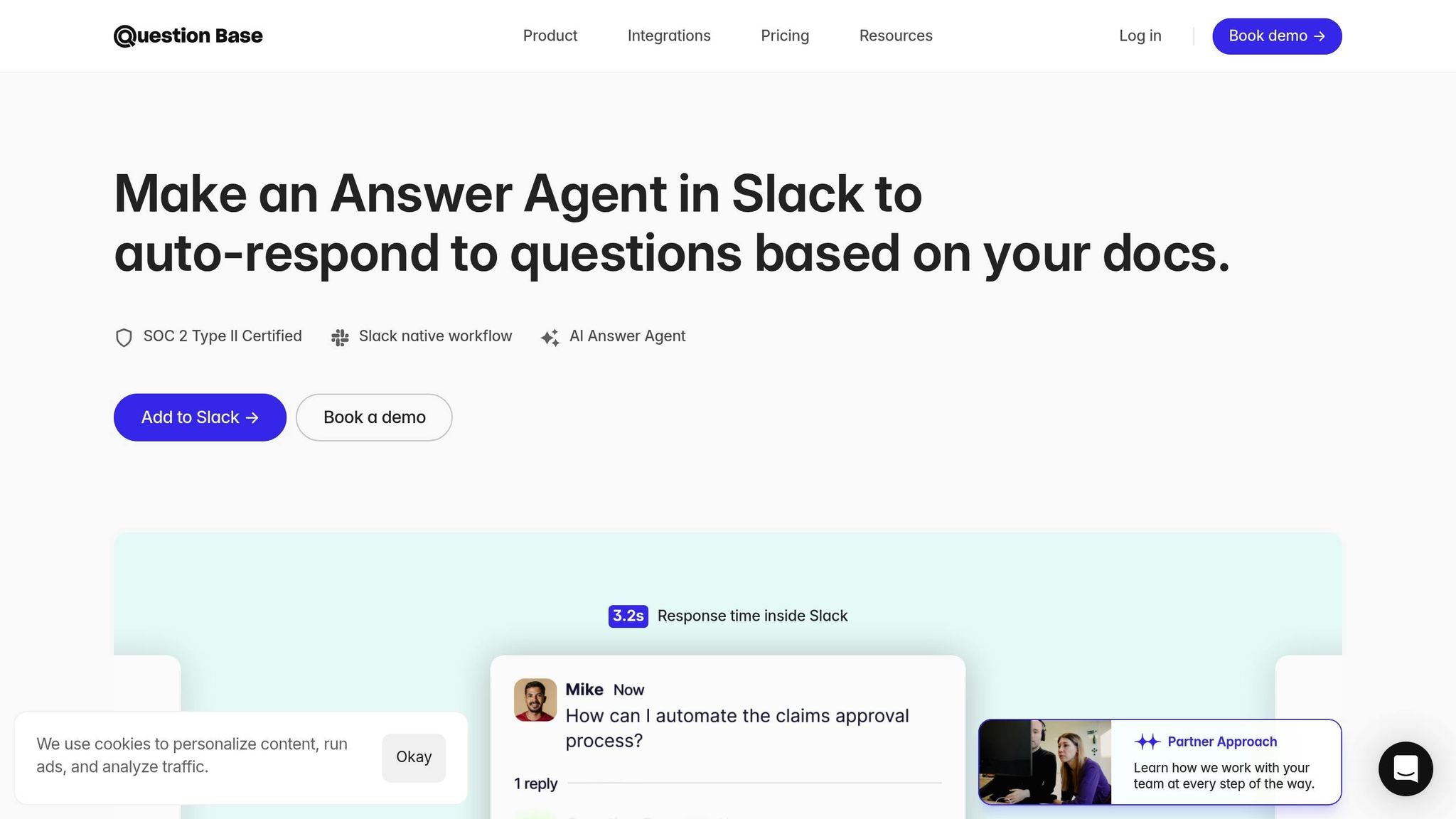
Slack AI is designed to enhance general productivity, offering tools like conversation summaries. However, it primarily relies on chat history rather than verified documentation. For teams that need reliable and up-to-date information, Question Base offers a distinct edge.
Unlike Slack AI, which generates responses based on previous chat messages that may be outdated or informal, Question Base connects directly to trusted documentation. This ensures consistent and accurate answers - an essential feature when precision matters. Slack AI’s reliance on chat history can lead to inconsistencies, while Question Base draws from verified sources like company wikis, knowledge bases, and other official documents.
Here’s a quick comparison of their core features:
Feature | Question Base | Slack AI |
|---|---|---|
Data Sources | Notion, Confluence, Salesforce, OneDrive, etc. | Primarily Slack chat history |
Answer Accuracy | Expert-verified answers from trusted sources | AI-generated based on Slack messages |
Knowledge Management | Case tracking, per-channel settings, duplicate detection | None |
Analytics | Resolution rate, unhelpful answers tracking, automation rate | Basic usage stats |
Enterprise Focus | Built for HR, IT, Ops - SOC2 compliant, customizable | General-purpose AI tool |
Question Base is the go-to solution for teams prioritizing accuracy, auditability, and knowledge ownership. While Slack AI is useful for summarizing conversations and speeding up individual workflows, Question Base ensures that entire teams stay aligned by delivering verified, consistent information.
Another area where Question Base stands out is its integration capabilities. Slack AI offers limited external documentation integration, only available on higher-tier plans like Business+ and Enterprise. Question Base, on the other hand, was specifically designed to bridge the gap between Slack questions and enterprise documentation systems, making it a better fit for dynamic FAQs and streamlining internal support.
Integration Options Across Tools
The ability to integrate seamlessly with other tools is a defining feature of enterprise-ready solutions. Question Base supports a wide range of platforms, including Google Drive (Docs, Sheets, Slides), Confluence (spaces, pages, databases), Zendesk (Help Center articles), Intercom (tickets, contacts), Notion (pages, databases), Salesforce (accounts, cases, opportunities), Dropbox, Freshdesk, HubSpot, OneDrive, Jira, and SharePoint.
Setting up integrations is straightforward and doesn’t require engineering support. Simply install the app from the Slack App Marketplace, invite the bot using /invite @questionbase, and connect your documentation tools. Custom integrations are also available, allowing organizations to tailor the tool to their unique workflows.
This plug-and-play approach is a sharp contrast to other solutions that often require complex technical setups. Beyond integration, Question Base also emphasizes security and customization, making it a robust choice for large-scale deployments.
Enterprise Security and Customization
For enterprises, security and customization are non-negotiable when it comes to managing knowledge effectively. Question Base is SOC 2 Type II Certified, meeting high security standards that many alternatives don’t match. The platform includes encryption at rest and in transit, with the option for on-premise deployment to meet strict data residency requirements. These features are especially important for handling sensitive information, whether it’s HR data, customer records, or proprietary business processes.
Customization is another area where Question Base shines. Organizations can adjust the AI’s tone and behavior, define escalation workflows, and tailor response styles for different Slack channels. For example, HR channels can have a more formal tone, while IT support channels might require a more technical approach. Features like case tracking, duplicate detection, and new knowledge capture ensure data quality is maintained over time.
In comparison, Slack AI’s customization options are limited. While it offers a "Channel Expert" AI agent on higher-tier plans, it lacks the granular control over tone, behavior, and source selection that Question Base provides.
Question Base also offers an expert escalation workflow, ensuring that unresolved queries are routed to the right subject matter experts. This not only maintains service quality but also captures new knowledge for future automation, making it a critical tool for enterprise support teams.
Measuring ROI: Metrics and Use Cases
Evaluating the return on investment (ROI) for tools like Question Base requires tracking specific metrics that highlight both financial savings and productivity improvements. The most effective approaches focus on measurable outcomes that clearly show how these tools benefit teams.
Key Metrics for ROI Evaluation
Resolution rate and automation rate are critical indicators of how well repetitive questions are being handled without human involvement. For instance, dynamic FAQs can auto-answer 35% of repetitive queries in just 3.2 seconds. In larger organizations, up to 40% of internal questions are repetitive [1]. With Question Base, resolution rates improve over time as the system learns and adapts to new queries.
Expert time savings offer a direct measure of cost reduction. Internal experts often spend around 6 hours weekly addressing repetitive questions [1]. By automating these tasks, organizations can calculate savings by multiplying the hours saved by the average hourly wage of their experts.
Knowledge gap identification allows teams to pinpoint areas where documentation is lacking. Question Base identifies and flags unhelpful responses, enabling teams to refine their knowledge base and address gaps before they lead to larger productivity losses.
Monitoring answer accuracy scores ensures that automation doesn’t compromise quality. Question Base users report an average accuracy score of 4.8 out of 5 [1], proving that automation can maintain high standards while reducing manual workloads.
These metrics are supported by real-world success stories from enterprises that have implemented dynamic FAQ solutions.
Enterprise Case Studies: Success Stories
A study by Forrester Consulting, commissioned by Slack, revealed that 94% of Slack customers reported positive ROI. Key improvements included a 33% reduction in time spent in meetings and an 82% boost in cross-functional collaboration [3].
Ticketbutler significantly enhanced its support efficiency with Question Base. Linn Stokke, Online Events & Marketing Specialist at Ticketbutler, highlighted the impact:
"Since we started using QB we haven't used our Google support docs. And if I go on vacation or sick leave, I feel comfortable that QB will just take over." [1]
Petsy also saw substantial benefits. Monica Limanto, CEO at Petsy, shared her experience:
"We implemented Question Base to eliminate repetitive questions and to collate answers and information in one place for a growing team. Question Base has exceeded our expectations - it's easy to use, intuitive and a massive time saver." [1]
For DoIT International, Question Base was like adding extra staff capacity. Willem Bens, Manager of Sales North EMEA, remarked:
"It's like having an extra person answering questions in Slack." [1]
Consider this: employees spend 20–30% of their week searching for answers in tools like Slack [1]. In a company with 1,000 employees, this lost time can cost over $2 million annually [1]. Dynamic FAQs tackle this issue by delivering instant, accurate responses.
Enhancv faced similar challenges with repetitive questions. Aleksandar Ginovski, Head of Product, explained:
"Before Question Base, we've been seeing repetitive questions all around our Slack channels." [1]
These examples highlight measurable improvements, such as a 27% reduction in onboarding time for new hires [2], 23% faster resolution times [2], and a 15% increase in team satisfaction scores [2]. Additionally, Slack automation features save an average of 5.6 hours per employee per week [2]. Across large organizations, these time savings translate into significant cost reductions and productivity gains, making dynamic FAQ solutions a worthwhile investment.
Best Practices for Implementing Dynamic FAQs in Slack
Rolling out dynamic FAQs in Slack isn’t just about turning on a feature - it’s about thoughtful preparation and strategic execution. Enterprises that follow these best practices often see quicker adoption and better results from their investment.
Preparing for Deployment
Start with security compliance. Before introducing any AI-powered tool into Slack, ensure it meets your organization’s security standards. For example, Question Base is SOC 2 Type II compliant, offering encryption both at rest and in transit. It also supports optional on-premise deployment for businesses with strict data governance needs. This ensures your knowledge management system aligns with your company’s security policies from day one.
Integrate with your existing tools. A seamless knowledge ecosystem works best when your FAQ solution connects to platforms you already use, such as Notion, Confluence, Google Drive, Zendesk, Salesforce, Dropbox, or Jira. By leveraging your current content repositories, you avoid the time and cost of rebuilding a knowledge base from scratch.
Work within Slack-native workflows. Choose a solution that fits naturally into how your teams already communicate. Deploy the system in both public and private Slack channels where questions are frequently asked. For instance, at LPL Financial, this approach automated 40,000 monthly interactions, saving $15–$50 per interaction [4].
Customize AI behavior by channel. Tailor the agent’s tone, response style, and content sources to suit the needs of different teams. For example, HR channels might require formal responses about policies, while engineering channels benefit from more technical and detailed answers.
Set up clear escalation workflows. Not every question will have an immediate AI-driven answer. Ensure unanswered queries are routed to human experts, and integrate these workflows with existing support ticketing systems. This not only resolves issues faster but also helps improve your knowledge base over time.
These steps create a solid foundation for a successful deployment, setting the stage for long-term return on investment.
Maximizing ROI Through Customization and Training
Once your system is securely deployed and integrated, the focus shifts to fine-tuning and empowering your teams to use it effectively.
Match AI responses to your organizational voice. Generic answers can feel impersonal and reduce trust. Configure your FAQ system to reflect your company’s unique terminology, tone, and communication style. This ensures the AI feels like an extension of your team, not a disconnected tool.
Regularly audit and update content. As your use cases evolve, schedule quarterly reviews to identify outdated or missing information. Question Base provides reports on content gaps, helping teams address issues before they affect productivity.
Train your team for success. Host hands-on workshops to teach employees how to use the system effectively. Focus on how to ask precise questions, when to escalate issues, and how to contribute to the knowledge base. Companies that invest in training often see 23% faster resolution times and 15% higher team satisfaction scores [2].
Use Slack conversation history for a head start. Past Slack discussions are rich with institutional knowledge. Analyzing these conversations can help identify frequently asked questions and provide real-world context for answers, making your FAQ system more effective from the start.
Continuous Improvement and Knowledge Gap Analysis
The work doesn’t stop after deployment. Ongoing refinement is essential to keep your dynamic FAQ system effective and relevant.
Track unanswered questions. When the AI fails to resolve a query, flag it for review. This helps you identify and fill knowledge gaps before they hinder productivity.
Let analytics guide your strategy. Monitor which questions come up most often, which answers receive low ratings, and where employees struggle to find information. These insights can help prioritize content updates and allocate resources more effectively.
Turn Slack threads into permanent FAQs. Valuable insights often surface in Slack discussions. Capture expert responses from these conversations and transform them into searchable FAQ entries. This ensures that knowledge shared in the moment becomes a lasting resource.
Create feedback loops. Allow users to rate the quality of AI responses and suggest improvements. This ongoing feedback ensures the system evolves to meet your team’s needs.
Expand gradually. Start with common support questions, then branch out into onboarding materials, policy updates, and procedural guides. By scaling step-by-step, you can maintain system performance while addressing new use cases.
Conclusion: Dynamic FAQs as a Business Advantage for Enterprises
Dynamic FAQs within Slack are proving to be a game-changer for enterprise productivity, delivering a 94% positive ROI and reshaping how teams work [3].
By saving 5.6 hours per employee each week and cutting resolution times by 23%, these tools significantly enhance efficiency. For large organizations, these benefits translate into avoiding millions of dollars in lost productivity caused by employees hunting for information or experts repeatedly answering the same questions [2].
Question Base transforms Slack into a trusted knowledge hub, delivering verified answers in just 3.2 seconds with an impressive 4.8/5 accuracy rating. Unlike generic AI tools that rely on chat history, Question Base integrates directly with enterprise documentation platforms like Notion, Confluence, Salesforce, and Google Drive. This ensures that responses are always drawn from accurate, up-to-date sources.
Dynamic FAQs also improve onboarding and foster better collaboration. Enterprises report a 27% decrease in onboarding time for new hires, a 33% reduction in meeting durations, and an 82% improvement in cross-team collaboration [2] [3].
Security and compliance are top priorities. With SOC 2 Type II certification, encryption for data in transit and at rest, and optional on-premise deployment, Question Base meets stringent enterprise requirements while offering flexibility to align with corporate policies. These features, combined with seamless integrations and precise knowledge management, ensure that businesses can maintain governance standards while reaping measurable benefits.
Additionally, with 80% of employees preferring to ask questions in chat rather than navigating wikis [1], Slack-native knowledge solutions are not just a convenience - they’re a strategic shift. Dynamic FAQs in Slack empower organizations to boost efficiency, improve employee satisfaction, and adapt more nimbly to change, making them a vital tool in the broader journey of digital transformation.
FAQs
How can dynamic FAQs in Slack help streamline onboarding and boost employee satisfaction?
Dynamic FAQs within Slack, such as those offered by Question Base, deliver instant and precise responses by tapping into your company’s trusted documentation. This streamlines the process of finding answers, cutting down on repeated questions and saving time - especially during onboarding.
When internal knowledge is easier to access, new hires can adapt more quickly, while seasoned employees spend less time fielding routine inquiries. This streamlined approach not only accelerates onboarding but also boosts employee satisfaction by minimizing frustration and promoting a more productive work environment.
How does Question Base compare to Slack AI for handling repetitive questions and ensuring accurate answers?
Slack AI shines when it comes to general productivity tasks, like summarizing conversations. However, Question Base is specifically designed to tackle repetitive questions with pinpoint accuracy. By connecting directly to trusted documentation tools such as Notion, Confluence, and Salesforce, it ensures your team gets expert-verified answers that are both accurate and dependable.
While Slack AI primarily pulls insights from chat history, Question Base goes a step further by integrating with external knowledge sources and transforming them into a dynamic, ever-evolving FAQ. This approach eliminates the need to rely solely on past conversations, offering quick and precise responses. It’s a perfect solution for HR, IT, and operational support teams looking to streamline their workflows and reduce interruptions.
How can enterprises evaluate the ROI of using dynamic FAQs in Slack, and what key metrics should they track?
Enterprises can measure the ROI of dynamic FAQs in Slack by keeping an eye on key metrics that highlight both productivity gains and cost savings. Start with the resolution rate, which tracks how often employee questions are answered effectively, and the automation rate, which reveals the percentage of queries resolved without human involvement. Another critical metric is the volume of unhelpful answers, as it can pinpoint gaps in your knowledge base that need attention.
By diving into these metrics, companies can clearly see the time saved, the drop in support costs, and the boost in overall internal efficiency. This data ensures teams remain focused and free from unnecessary roadblocks.