∙
Cooper
∙
Reading time:
34 min

Dreamforce 2025 showcased how AI is transforming enterprise operations, emphasizing the rise of "agentic enterprises" where AI agents take on complex workflows, integrate seamlessly with data, and operate under strict governance. Key themes included AI-powered internal support, unified data platforms, and Slack-native automation. Companies shared success stories of faster support resolution, improved customer satisfaction, and reduced costs by adopting Salesforce's new tools like Agentforce 360 and Data 360.
Key Takeaways:
Agentforce 360: AI agents that manage end-to-end workflows, reducing resolution times and enhancing transparency.
Data 360: A unified platform for consistent, real-time data that powers AI decision-making.
Slack AI OS: Slack becomes a hub for AI-driven collaboration, integrating human teams, AI agents, and data.
No-Code AI Tools: Tools like Einstein Copilot Studio make it easier to create AI agents without programming.
Governance & Security: The Einstein Trust Layer ensures compliance and secure AI operations across platforms.
Cross-Platform Integrations: AI connects disparate systems, breaking down silos for streamlined workflows.
The event highlighted how enterprises can leverage these advancements to simplify support, improve efficiency, and build trust in AI-driven processes. Organizations adopting these strategies now position themselves for long-term success in an AI-powered future.
Building an Agentic Enterprise: The Dreamforce 2025 Keynote in Under 6 Minutes
1. Agentforce 360: AI-Driven Enterprise Operations
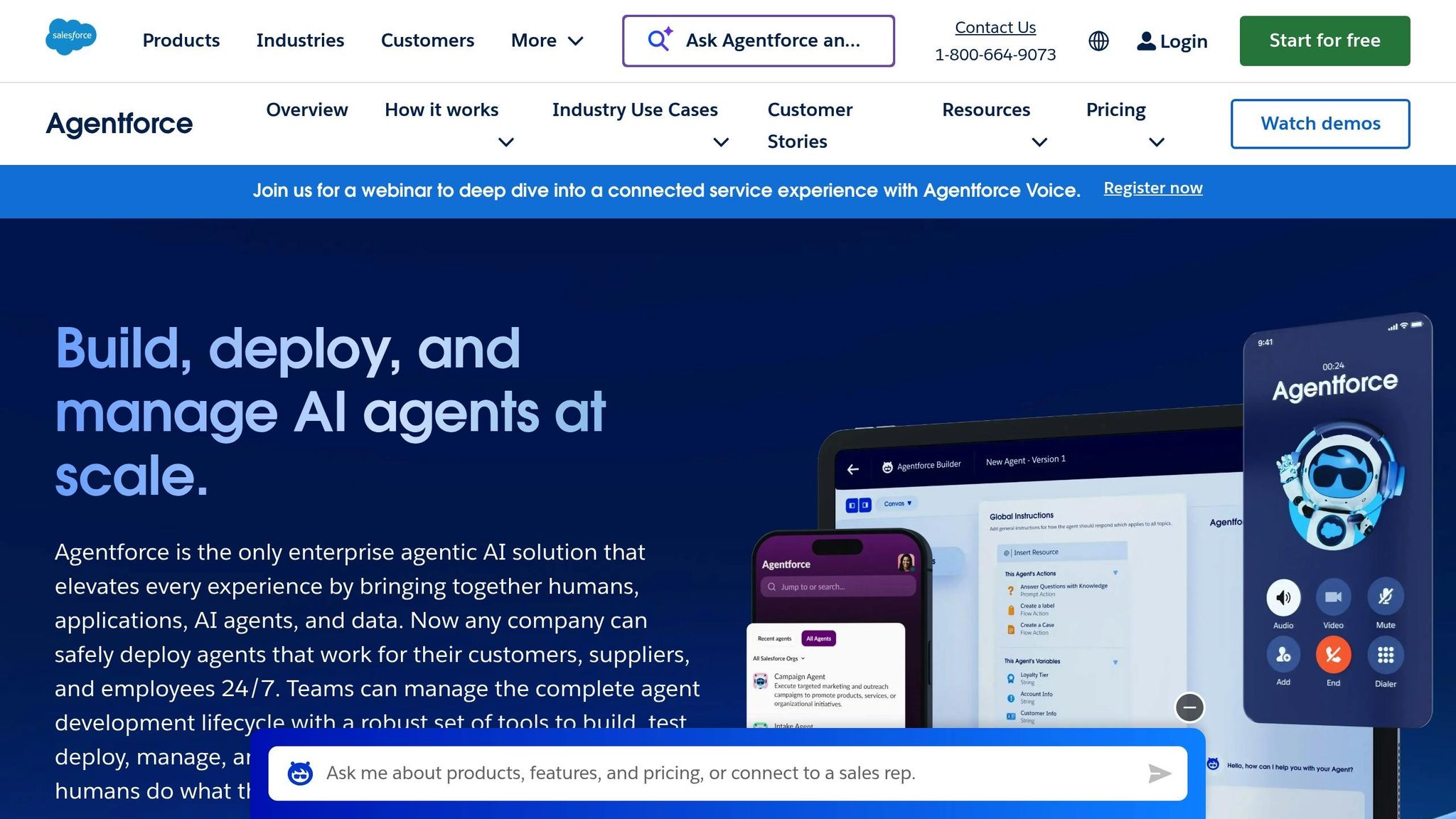
Agentforce 360 marks Salesforce's ambitious step into the realm of the "agentic enterprise", moving beyond simple automation to intelligent agents that can think, act, and work within complex business processes. Unlike basic chatbots or standard automation tools, this platform acts as a central hub, connecting AI agents with enterprise data and workflows across the entire Salesforce ecosystem. These agents don’t just answer questions - they take charge of entire processes, from updating case records to activating workflows that span multiple departments, all with full transparency.
The platform is built on an 11-layer architecture specifically designed to handle the demands of AI-driven operations. Key components include a Semantic Layer for unified data management, an AI/ML Layer for centralized intelligence, and an Orchestration Layer that coordinates workflows between agents, human teams, and existing systems. Together, these layers enable businesses to rethink their operational strategies from the ground up.
At Dreamforce 2025, Salesforce showcased the power of Agentforce 360 by partnering with a Fortune 500 financial institution. During the demonstration, an AI agent processed live data, applied complex business rules, and resolved customer support cases on its own. The result? Average resolution times dropped from 2.3 hours to just 18 minutes. All actions were fully auditable through the platform’s Command Center, which offers real-time monitoring and detailed decision tracking. This example highlights how AI can transform enterprise operations by delivering faster results without compromising oversight.
The Command Center is a standout feature, giving teams real-time visibility into agent activities. It allows knowledge managers and IT leaders to trace decision paths, fine-tune performance, and ensure that critical business processes are handled with precision. Every action taken by these AI agents is governed by Salesforce's Einstein Trust Layer, which enforces strict security and compliance protocols for data usage and access.
Agentforce 360 also includes no-code tools like Agentforce Builder and Einstein Copilot Studio, enabling both technical and non-technical users to create AI agents using simple natural language instructions. This approach makes AI development accessible to a broader range of teams, helping businesses quickly implement AI solutions that deliver measurable results.
One example from Dreamforce featured a retail company using Agentforce 360 to automate both order processing and customer support across multiple departments simultaneously. The platform’s ability to streamline operations in diverse industries underscores its potential to redefine enterprise workflows.
2. Data 360: Unified Data for Better AI Results
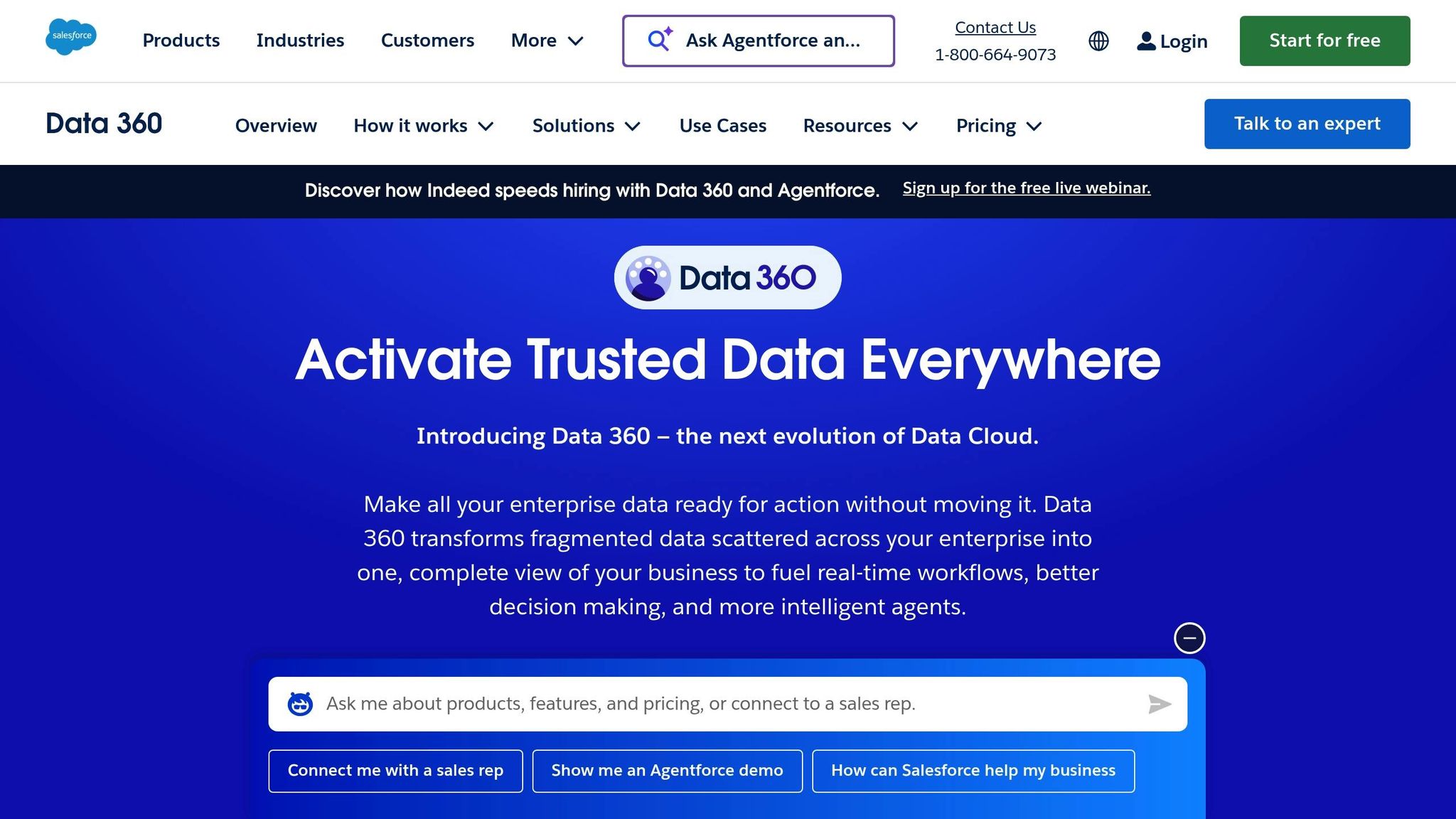
Building on the operational improvements introduced by Agentforce 360, Data 360 establishes a unified data foundation that redefines enterprise data management within the Salesforce ecosystem. It’s not just a data warehouse - it’s a comprehensive data fabric that pulls in information from a wide variety of sources, including traditional databases, PDFs, spreadsheets, images, and even IoT sensor data. This integration creates a single source of truth that directly fuels AI reasoning models, ensuring decisions are based on consistent, real-time data [2].
One of the standout features of Data 360 is its semantic data layer, designed to tackle a common challenge in enterprise AI: inconsistent definitions across departments. For example, when one team defines "revenue" differently than another, AI agents can end up delivering conflicting insights. The semantic layer ensures that all teams - and their AI agents - operate with the same business logic and definitions, eliminating these discrepancies [2].
Data 360 also introduces real-time data pipelines, replacing slow, traditional ETL processes. AI agents can now access harmonized, context-rich information instantly. Tools like Intelligent Context and Tableau Semantics further enhance the platform by transforming unstructured data into actionable insights [1]. For organizations with complex structures, Data 360 offers secure clean rooms that allow subsidiaries, partners, and business units to collaborate on data without compromising sensitive information. For instance, a multinational company can align sales, support, and marketing efforts across regions while maintaining strict data governance [2].
The platform extends Salesforce's Einstein Trust Layer, ensuring all data workflows are governed, auditable, and compliant with industry regulations. This is especially critical for industries like finance and healthcare, where data transparency and regulatory compliance are non-negotiable [2].
What sets Data 360 apart is its seamless integration across the entire Salesforce ecosystem and beyond. Unified data flows power intelligent automation across processes, ensuring that AI-driven actions are based on high-quality, verified information [2][3].
For knowledge managers and IT leaders, Data 360 ensures that AI operates on trusted, accurate data. Its 11-layer architecture guarantees that every AI-driven decision or recommendation is rooted in consistent, reliable information [2]. This robust data foundation enables enterprises to go beyond experimenting with AI and fully integrate intelligent automation into their operational strategies [2][3].
While Slack AI is great for summarizing conversations, Question Base takes things a step further by connecting directly to trusted knowledge sources like Notion, Confluence, and Salesforce. This ensures that AI-powered support delivers expert-verified answers rather than relying on interpretations of past conversations. For teams handling critical business processes where accuracy and auditability are essential, Question Base provides a reliable solution - one that enhances internal support and operational efficiency. We’ll dive deeper into this topic in the next section.
3. No-Code AI Agent Development: Building AI Without Programming
At Dreamforce 2025, Salesforce showcased a major leap in AI accessibility with tools designed to eliminate the need for advanced programming skills. With Agentforce Builder and Einstein Copilot Studio, enterprises can now streamline AI development, replacing months of coding with user-friendly, natural-language interfaces.
These platforms empower teams to create sophisticated AI agents using simple tools like drag-and-drop interfaces and natural language commands. These agents can incorporate business logic, interact with real-time data, and perform tasks such as updating customer cases or triggering workflows. The conversational builder allows users to define how an agent should behave just by describing their needs, while the platform handles the technical heavy lifting behind the scenes. This approach aligns perfectly with the hybrid reasoning capabilities found in next-generation AI tools.
One standout feature is the combination of AI-generated responses with predefined business rules and validation checks. This hybrid reasoning enables organizations to quickly prototype and deploy AI agents without needing extensive development resources.
Built-In Security and Governance
Salesforce places a strong emphasis on security and governance. Every no-code AI agent operates within Salesforce's "trust boundary", with the Einstein Trust Layer ensuring secure data handling, access controls, and prompt management. This setup guarantees that all agent actions are auditable and compliant with organizational policies. Additionally, unified policy engines make it easier for businesses to enforce governance across all AI workflows.
Integration Beyond Salesforce
These tools aren’t limited to the Salesforce ecosystem. They integrate with external models, pull data from various platforms, and function within unified data frameworks - all while maintaining strict governance standards. This flexibility allows companies to build new AI capabilities while leveraging their existing technology investments.
Early Success Stories
Early adopters are already seeing tangible benefits. Partners using Agentforce 360 have reported revenue increases of 5–10%, with the potential for even greater gains as adoption grows [4]. These results stem from faster response times, reduced manual workloads, and more consistent service delivery across teams.
For knowledge managers and IT leaders, no-code AI development offers a way to transform unstructured chat data into actionable insights. Teams can quickly iterate and customize agents to meet changing business needs, deploy solutions faster, and track performance through detailed analytics dashboards. This agile approach lays the groundwork for tools like Question Base, which take operational support to the next level.
How Question Base Fits In
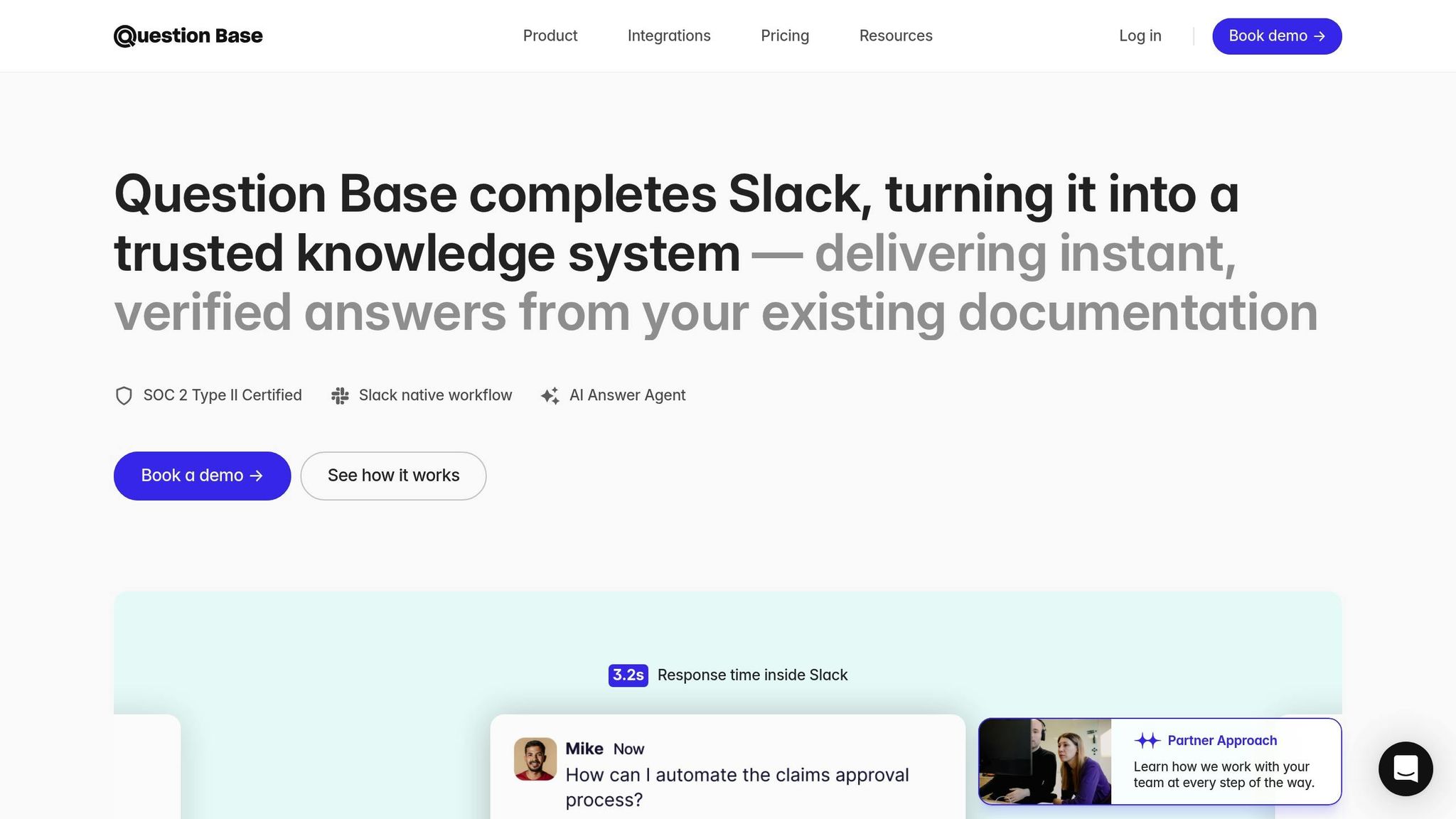
While Slack AI helps summarize past conversations, Question Base focuses on creating a future-ready knowledge framework. It connects directly to trusted sources like Notion, Confluence, and Salesforce, ensuring that teams receive verified answers. This targeted approach allows knowledge managers to deploy AI-powered support with the precision and accountability that enterprise operations require - all without needing programming expertise. These no-code advancements are driving a shift toward smarter, more operationalized knowledge management.
The "Agentic Enterprise" Era
The rise of no-code AI development signals a broader trend toward the "agentic enterprise", where autonomous agents manage core business processes from start to finish. By focusing on defining business outcomes instead of technical complexities, organizations can move faster from AI experimentation to full-scale operational transformation.
4. Slack AI OS and Slack-Native Automation
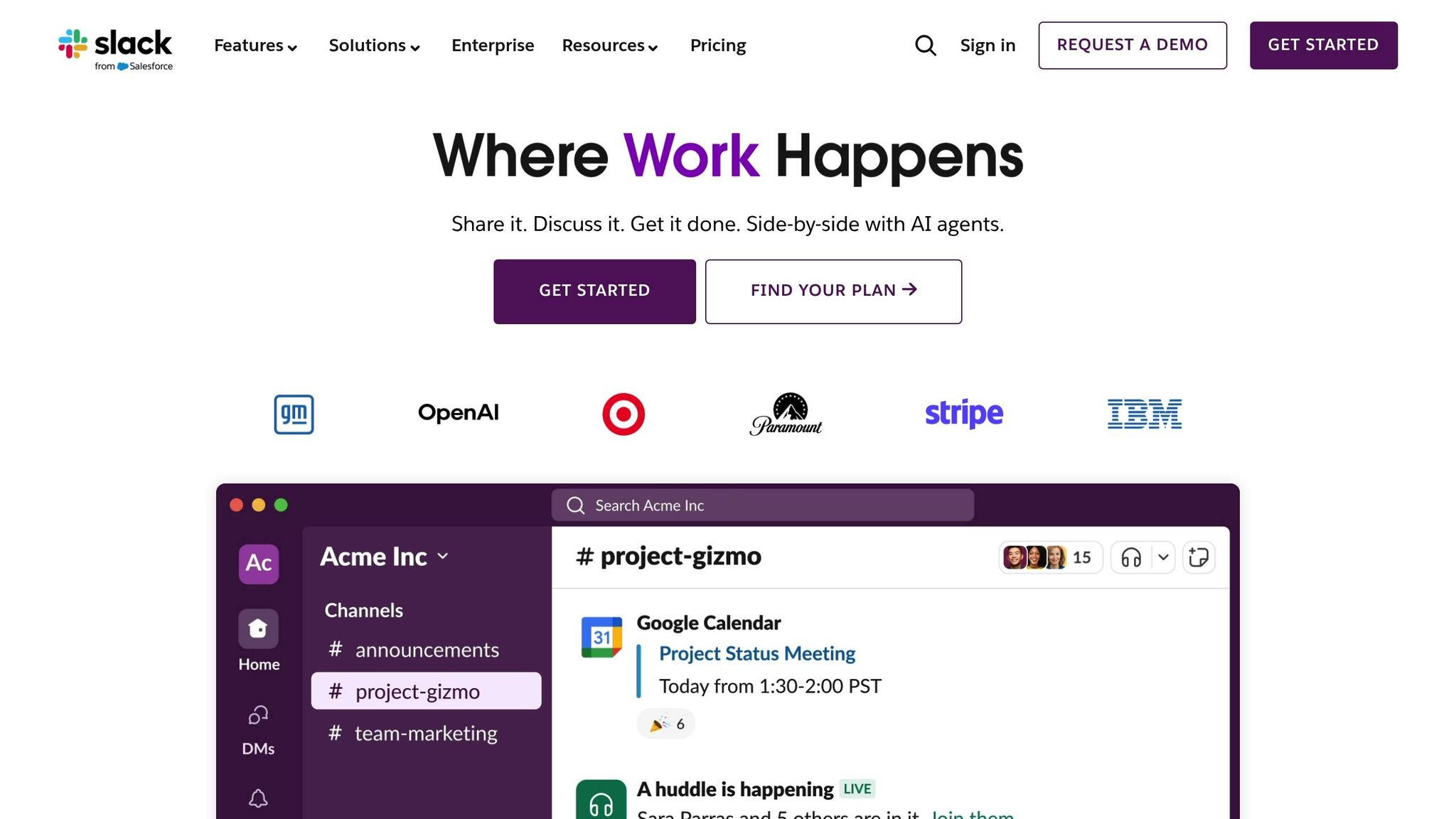
At Dreamforce 2025, Salesforce unveiled Slack AI OS, a bold step toward making Slack the central hub for enterprise AI operations. This vision positions Slack as the "Agentic OS", where human teams, AI agents, and enterprise data come together in a seamless ecosystem. The result? A smarter, more collaborative workspace powered by intelligent automation and real-time decision-making.
One of the standout features is the introduction of multi-agent collaboration within Slack channels. Imagine marketing teams pulling live campaign data while finance updates budgets - all within the same workspace. This eliminates the need for constant tool-switching, streamlining workflows and enabling faster, smarter decisions.
Native AI Features
Slack has introduced several AI-powered tools designed to tackle common workplace challenges. These include:
Automatic thread summarization: Quickly condense lengthy conversations into key points.
Meeting note generation: Capture detailed notes without missing critical details.
Intelligent next-action proposals: Turn discussions into actionable insights.
These features aim to reduce the chaos of scattered information, missed follow-ups, and the manual effort required to organize discussions.
A highlight of these capabilities is the "Channel Expert", an AI agent powered by Agentforce and available on Business+ and Enterprise plans. This tool revolutionizes knowledge sharing by making institutional information easily accessible directly within Slack, eliminating the need to jump between apps.
Cross-Model Integration and Governance
Slack AI OS doesn’t stop at native features - it expands through integration and governance. A key development here is the Model Context Protocol (MCP), which allows Slack to integrate with external AI models like OpenAI's GPT, Google's Gemini, and Anthropic's Claude. This flexibility ensures organizations can choose the best AI model for specific tasks without being tied to a single provider.
On the governance side, Slack leverages Salesforce’s Einstein Trust Layer to manage data access and ensure compliance. This unified policy management system balances innovation with strict control, offering both security and adaptability.
Slack AI Strengths and Limitations
Slack AI excels at improving general productivity. By summarizing conversations and speeding up workflows, it helps users quickly act on chat history. However, its reliance on past messages can be a drawback for teams that need verified, large-scale knowledge.
For enterprises requiring more reliable, expert-verified information, tools like Question Base provide a stronger alternative. Unlike Slack AI, which primarily learns from chat history, Question Base connects to trusted sources like Notion, Confluence, and Salesforce. This ensures teams get accurate answers backed by trusted documents, making it ideal for critical business processes where precision and accountability are non-negotiable.
Implementation Strategy for Enterprise Success
To make the most of Slack AI OS, enterprises should first identify workflows where multi-agent collaboration can replace manual coordination. Cross-functional processes that rely on real-time data sharing and decision-making are strong candidates for early adoption.
Slack AI OS also plays a vital role in Salesforce's broader Agentic Enterprise strategy, where AI agents manage core business processes end-to-end. This positions Slack as the conversational interface that bridges human expertise with AI-driven automation, fostering deeper integration across Salesforce’s ecosystem.
For IT leaders and knowledge managers, the challenge lies in balancing Slack’s convenience with the need for scalable, auditable knowledge management. Ensuring enterprise-grade security and compliance remains a top priority as organizations embrace this new era of Slack-native automation.
5. AI-Powered Internal Support: Accurate Answers at Scale
At Dreamforce 2025, one of the standout themes wasn’t just about AI getting smarter - it was about AI becoming a dependable force for enterprise internal support. Companies are now shifting from experimental chatbots to deploying domain-specific agents capable of solving complex problems with near-human precision. By building on advancements in data unification and accessible AI tools, these technologies are transforming internal support systems, scaling human expertise like never before.
The Agentforce 360 platform has become a key player in this evolution, enabling organizations to create AI agents that go far beyond merely searching through old conversations. These agents combine conversational AI, real-time data integration, and advanced reasoning to deliver context-aware solutions at scale. This marks a significant departure from traditional support models reliant on human agents or static knowledge bases.
Real-World Impact: Tangible Results
Organizations adopting AI-powered support solutions are seeing dramatic improvements, including up to a 40% reduction in average ticket handling time and a 30% boost in first-contact resolution rates[2][3]. Such results are not just numbers - they represent a fundamental shift in how enterprises handle internal support.
In September 2025, a Fortune 100 financial services company implemented Salesforce Agentforce 360 to overhaul its internal IT support. By integrating domain-specific AI agents with Data 360 and Slack, the company slashed its average ticket resolution time from 2.5 hours to just 18 minutes within three months. Under the leadership of CIO Angela Martinez, the initiative also reduced escalations by 62% and increased employee satisfaction by 28%[2].
These achievements are made possible by unified data layers like Data 360, which harmonizes structured and unstructured data across the enterprise. Semantic layers ensure consistent definitions and context, while AI/ML layers focus on domain-specific reasoning and model training, creating a foundation for reliable and effective AI responses.
The Accuracy Challenge: Moving Beyond Chat Logs
While these results are impressive, they highlight the need for solutions that extend beyond analyzing chat history. Tools like Slack AI can summarize conversations, but they rely heavily on past messages. Enterprises with large-scale, verified knowledge requirements need something more robust.
That’s where purpose-built tools like Question Base come into play. Instead of relying solely on chat logs, Question Base connects directly to trusted enterprise sources like Notion, Confluence, and Salesforce. This ensures it provides verified, up-to-date answers. With built-in human verification, the system creates a feedback loop that enhances accuracy over time while adhering to enterprise-grade security and compliance standards.
Implementation Strategy: Laying the Right Foundation
Early use cases in areas like HR onboarding and IT troubleshooting have demonstrated the potential of AI agents to drastically cut response times while lightening the load on support teams. The first step for many organizations has been investing in unified data infrastructure, ensuring their AI agents have clean, consistent data to work with from the start.
In August 2025, a global retail chain used Einstein Copilot Studio to develop a suite of HR support agents. These agents autonomously handled 87% of routine HR inquiries, freeing up HR staff for more complex tasks. Response times dropped from one business day to under 10 minutes. Spearheaded by HR Director Michael Lee, the initiative also reduced HR-related helpdesk tickets by 41%[3].
The Einstein Trust Layer has been pivotal in these efforts, enabling enterprises to centrally manage data usage, access, and retention policies. This is particularly critical for industries with strict regulatory requirements.
Multi-Agent Collaboration: The Next Frontier
Another exciting development is the rise of multi-agent collaboration within platforms like Slack. Instead of relying on a single AI assistant, organizations are deploying multiple specialized agents that collaborate to address complex, cross-functional requests. For instance, an IT support agent might team up with security compliance and knowledge management agents to deliver comprehensive, well-rounded solutions.
For knowledge managers and IT leaders, the takeaway from Dreamforce 2025 is clear: AI-powered internal support isn’t about replacing human expertise. Instead, it’s about amplifying and scaling that expertise through intelligent automation that prioritizes accuracy, accountability, and trust.
6. Enterprise Knowledge Management: Converting Chat to Organized Knowledge
At Dreamforce 2025, one of the standout advancements was the transformation of chat platforms from simple communication tools into sophisticated knowledge management systems. By leveraging AI, enterprises are now able to capture, structure, and share insights from Slack conversations instantly. This shift connects the informal nature of daily chats with the structured, lasting knowledge that organizations rely on to operate effectively.
The challenge lies in dealing with unstructured data. While chat conversations hold immense value, extracting actionable insights from the thousands of messages exchanged daily across multiple channels requires advanced AI. These tools must understand context, categorize information accurately, and adhere to strict data privacy standards [2] [4].
Real-Time Knowledge Extraction in Action
Salesforce's Data 360 platform leads the charge by integrating both structured and unstructured data to create a unified context layer for agents and applications [2]. This semantic layer helps AI interpret the relationships and intent within conversations, making information retrieval faster and more effective [2]. It’s this unified approach that powers real-time insights and serves as the foundation for robust knowledge management.
Meanwhile, Slack's new AI features take things a step further by summarizing threads, generating meeting notes, and suggesting next actions. These tools transform fleeting conversations into organized, lasting knowledge [3]. For example, a financial services firm tested these features to great effect: internal support chats were automatically summarized and categorized by topic. Action items and frequently asked questions were extracted and added to a central knowledge base. This process reduced redundant questions by 30% and sped up onboarding for new hires, leading to measurable productivity improvements and higher employee satisfaction [3].
Beyond Slack AI: Tailored Knowledge Solutions
While Slack AI excels at streamlining conversations, enterprises often require more precise and reliable knowledge management tools. Question Base offers a specialized solution by connecting directly to trusted platforms like Notion, Confluence, and Salesforce. Unlike Slack AI, which generates responses based on historical conversations, Question Base focuses on AI-generated content that is verified by humans. This ensures higher accuracy and compliance with enterprise security standards - an essential feature for industries handling sensitive or regulated data.
Governance and Compliance at Scale
The Einstein Trust Layer within Data 360 ensures that all knowledge extraction adheres to strict governance policies. Features like access controls and data masking restrict visibility to authorized users only [2] [4]. Additionally, organizations can customize AI behavior and enforce per-channel settings to maintain compliance with departmental and regulatory requirements. All data processing takes place in secure, compliant environments, giving enterprises confidence in the integrity of their knowledge management systems.
Measuring Knowledge Management Success
Platforms like Data 360 and Slack AI OS now include dashboards that track the conversion of chat into knowledge, as well as metrics like access rates and reuse [4]. These tools allow organizations to measure key outcomes, such as reduced duplicate support tickets, faster information retrieval, higher employee adoption rates, and overall knowledge base usage. For knowledge managers and IT leaders, the key to success lies in piloting these tools in areas with the highest impact, such as HR onboarding or IT support. Early adopters stress the importance of preparing data, aligning teams, and establishing clear governance policies before scaling these solutions across the organization [4]. The ultimate goal isn’t to replace human expertise but to ensure that the valuable knowledge shared in everyday conversations becomes a lasting, searchable resource for the entire team.
7. Security, Compliance, and Customization in AI Knowledge Platforms
In today’s enterprise AI landscape, security and compliance are no longer optional - they’re essential. At Dreamforce 2025, industry leaders highlighted the shift from AI experimentation to full-scale deployment, emphasizing that platforms must meet strict regulatory standards while offering the flexibility to address unique business needs [3]. This growing focus on security underscores the importance of tailored solutions designed to meet diverse enterprise demands.
The Trust Boundary: Enterprise-Grade Security Architecture
Salesforce’s Einstein Trust Layer has set a new standard in AI governance. It features a unified policy engine that oversees data handling, access controls, and retention across all AI workflows [2]. Operating within what Salesforce calls a "trust boundary", this secure framework includes encryption, access management, and detailed audit trails, ensuring compliance at an enterprise level [3].
The platform’s 11-layer architecture - spanning semantic, AI/ML, agentic, and orchestration layers [1] - supports the secure deployment of AI agents. This multi-layered approach ensures sensitive enterprise data remains protected both at rest and in transit. Real-time monitoring and compliance checks are particularly vital for organizations operating in heavily regulated industries.
Regulatory Compliance: Built-In, Not Added Later
Agentforce 360 integrates compliance directly into its framework, offering features like automated audit logging, data residency controls, and pre-set policies [3]. Salesforce’s collaboration with Anthropic, announced at Dreamforce 2025, focuses on regulated industries, ensuring their solutions align with stringent standards like GDPR, HIPAA, and FINRA [3].
A financial services firm shared its success story at Dreamforce 2025, showcasing how it used Agentforce 360 to streamline client onboarding and portfolio management. The firm maintained full compliance with FINRA and GDPR by leveraging AI agents to handle sensitive client data. Automated compliance checks ensured only authorized access, while real-time alerts flagged potential policy breaches for immediate action [3].
Customization Without Sacrificing Compliance
Balancing the need for customization with strict compliance is a challenge many enterprises face. Tools like Einstein Copilot Studio address this by offering granular customization options tailored to highly regulated industries [3]. This includes defining user roles, setting permissions, integrating with identity providers via SSO, and configuring compliance rules for specific data types or business units.
In addition, Data 360’s secure clean rooms enable organizations to share insights and collaborate without exposing sensitive information. This ensures strict data boundaries are maintained while allowing enterprises to benefit from shared AI-driven insights [2].
Question Base: Designed for Compliance and Control
Specialized platforms are stepping up to meet the needs of enterprises handling sensitive or regulated data. While Slack AI is effective for general productivity, it often falls short for organizations requiring stricter controls. Question Base stands out by offering SOC 2 Type II compliance, encryption for data at rest and in transit, and optional on-premise deployment. Unlike Slack AI, which relies on chat history, Question Base draws from trusted sources like Notion, Confluence, and Salesforce to deliver verified answers.
The platform’s per-channel settings and customizable AI behavior give organizations precise control over accessible information in different contexts. Its case tracking and audit capabilities further support regulatory compliance. For enterprises needing verified, scalable answers, Question Base provides the governance and oversight that general-purpose AI tools often lack.
Future-Proofing Through Adaptive Compliance
At Dreamforce 2025, industry leaders emphasized that trust, transparency, and adaptability are critical for the future of AI knowledge platforms [1]. As AI gains more autonomy, maintaining innovation while aligning with evolving regulations will require ongoing investment in clarity, human-AI collaboration, and flexible compliance measures [1] [3]. Solutions like Agentforce 360 and Data 360 demonstrate how adaptive compliance frameworks can uphold operational integrity over time.
A phased approach is recommended: first, establish a solid, trustworthy data foundation. Then, introduce domain-specific AI agents incrementally, and finally, orchestrate cross-domain automation with continuous monitoring [1]. Regular security assessments, compliance training, and leveraging platform updates are key to staying ahead of emerging threats and regulatory changes [1] [3].
Salesforce executives summed up this shift, stating that customers demand "secure, trusted applications that solve real problems", rather than piecemeal, do-it-yourself AI solutions [3]. For industries such as finance and healthcare, this focus on built-in security and compliance is essential to adopting AI-driven enterprise models while maintaining the highest standards of data protection and regulatory adherence.
8. Cross-Platform Integrations: Connecting Knowledge Sources
For enterprise AI to thrive, it must tackle one of the biggest challenges: breaking down data silos and creating seamless access to organizational knowledge. At Dreamforce 2025, much of the conversation revolved around cross-platform integrations. These integrations enable AI agents to connect with, analyze, and act on information from various systems, turning disjointed data into streamlined workflows.
The Integration Imperative: From Fragmentation to Unity
Organizations depend on a variety of platforms - CRM tools, collaboration software, document repositories, and analytics dashboards. The introduction of Data 360 addresses the issue of fragmented data by unifying information across these sources. This solution ensures that definitions and metrics remain consistent across departments, reducing misunderstandings caused by differing interpretations of the same data.
With AI-ready pipelines, Data 360 feeds clean, structured data directly into reasoning models, speeding up decision-making while maintaining high standards for data quality and compliance [2]. For enterprises navigating complex data environments, this approach ensures accuracy and consistency, laying the groundwork for AI-driven processes to operate across multiple platforms.
Slack as the Command Hub: Multi-Agent Orchestration
Slack's expanding integration capabilities have shifted it from being just a messaging platform to a central operational hub. The introduction of the Model Context Protocol (MCP) allows Slack to integrate with external large language models like OpenAI's GPT, Google Gemini, and Anthropic Claude. This enables teams to collaborate with multiple AI agents in a single Slack channel [2][3].
For instance, imagine marketing and finance teams collaborating in Slack. Marketing agents can pull campaign performance data, while finance agents update budget figures in real time - all within the same channel. This eliminates the need for back-and-forth emails and speeds up decision-making [2]. Such integrations also enhance platforms like Question Base, ensuring that verified knowledge is accessible across systems.
OpenAI Partnership: Expanding Beyond Platform Limits
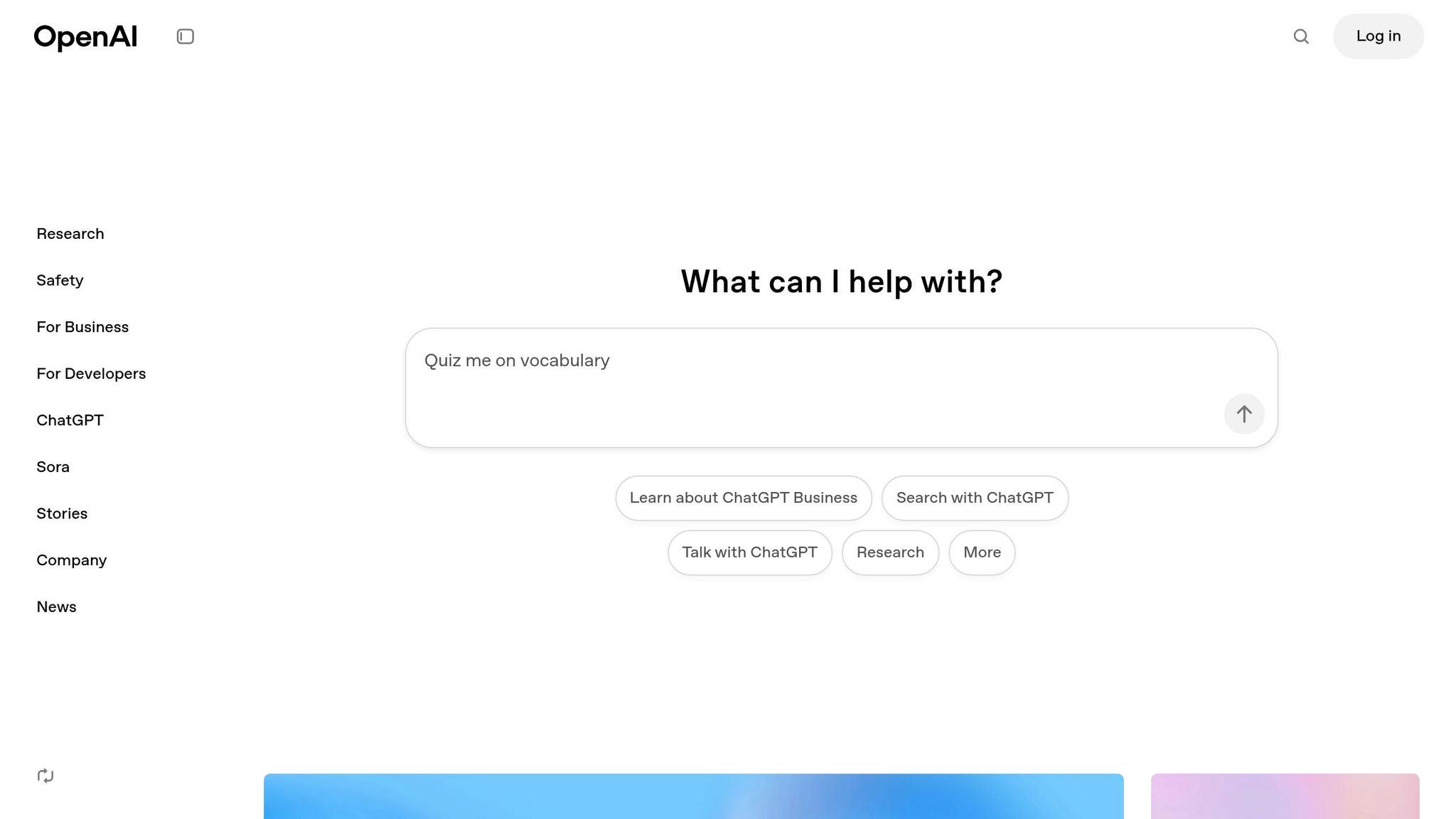
The partnership between Salesforce and OpenAI highlights how integrations can push enterprise capabilities further. Through this collaboration, users can query Salesforce data - like CRM and Tableau analytics - directly within ChatGPT. This makes it possible to gain real-time business insights and take action, even outside of the Salesforce platform [3]. Additionally, the Agentforce Commerce Protocol enables secure transactions and commerce features within ChatGPT, providing enterprises with full control and compliance [3].
Purpose-Built Integration Solutions
While unified data and AI-powered tools are transforming workflows, specialized integrations are key for ensuring that verified knowledge flows smoothly between platforms. Slack AI offers general productivity tools and basic integrations with external systems for its Business Plan and Enterprise users. However, platforms like Question Base go a step further by focusing specifically on enterprise knowledge management.
Question Base directly integrates with trusted sources such as Notion, Confluence, Salesforce, Google Drive, and Zendesk to deliver verified answers, bypassing the pitfalls of AI-generated interpretations based solely on chat history. By connecting to authoritative documentation, the platform ensures employees receive accurate and reliable information. Its per-channel customization feature allows teams to access knowledge tailored to their needs while maintaining strict security boundaries.
Integration Approach | Slack AI | Question Base |
|---|---|---|
Primary Data Sources | Slack chat history, limited external tools | Notion, Confluence, Salesforce, Google Drive, Zendesk |
Knowledge Verification | AI-generated from conversations | Expert-verified from trusted documents |
Enterprise Focus | General productivity | Internal support and knowledge management |
Customization | Basic channel settings | Per-channel knowledge sources and AI behavior |
Security and Governance Across Integrations
As data flows between platforms, security becomes a critical concern. The Einstein Trust Layer addresses these challenges by extending security and compliance controls across integrated workflows. It ensures that data access, retention, and usage are fully auditable and adhere to enterprise policies [2][3].
Secure clean rooms offer an additional layer of protection, enabling subsidiaries to collaborate without exposing sensitive data [2]. This feature is particularly valuable for companies that need to maintain strict data boundaries while still leveraging shared insights from AI systems.
Future-Proofing Through Open Architecture
The shift toward open, interoperable AI architectures is reshaping how enterprises approach technology. Instead of being locked into a single-vendor ecosystem, organizations can now connect internal and external data, models, and workflows using standardized protocols and APIs [2][3].
This flexibility accelerates innovation and reduces dependency on specific vendors, allowing enterprises to adapt to evolving business needs without overhauling existing systems. Features like multi-agent collaboration and cross-model compatibility are becoming standard, enabling organizations to choose the best tools for their unique requirements while maintaining centralized governance and security.
To succeed with cross-platform integration, organizations must start with a unified data strategy. By leveraging semantic layers for consistency and prioritizing security and compliance, enterprises can unlock the full potential of AI-driven automation and decision-making. This approach not only enhances efficiency but also sets the stage for cross-functional collaboration and operational transformation [1][2][3].
9. Analytics and Insights: Measuring Support and Knowledge Performance
In the world of enterprise AI support, advanced analytics have become the backbone of measuring success. They allow organizations to track resolution rates, assess the effectiveness of automation, and uncover knowledge gaps - all in real time. As companies move beyond experimenting with AI and embrace full-scale deployment, these metrics become essential for ensuring transparency and driving continuous improvement.
Real-Time Monitoring with Agentforce 360 Command Center
The Agentforce 360 Command Center offers a cutting-edge approach to performance tracking. By providing real-time visibility into agent metrics, it empowers support leaders to identify behavioral patterns and areas where training or knowledge resources may need adjustments. This level of insight fosters ongoing improvements and ensures that teams stay aligned with performance goals.
Data 360: A Unified Approach to Metrics
One of the biggest hurdles in enterprise analytics is maintaining consistency in how metrics are defined across different departments. Data 360 tackles this by introducing a semantic layer that standardizes metrics across teams, turning raw data into actionable insights. This alignment enables IT, HR, and customer support teams to make faster, more cohesive decisions, ensuring everyone is working from the same playbook.
Key Metrics for Evaluating AI Support
To gauge the success of AI-powered support systems, organizations must focus on a few critical metrics:
Resolution Rate: The percentage of queries resolved by AI agents.
Automation Rate: The proportion of inquiries managed without human involvement.
First-Contact Resolution: How effectively AI resolves issues without requiring follow-ups.
Unhelpful Responses: Identifying instances where the AI fails to provide useful answers, signaling areas for improvement.
These metrics not only measure operational efficiency but also highlight the quality of the knowledge base supporting the AI.
Advanced Analytics vs. Basic Usage Stats
There’s a clear difference between simple usage stats and the deeper insights provided by advanced analytics. For example, while Slack AI focuses on tracking general chat activity, specialized platforms like Question Base dive into more meaningful metrics. They analyze not just the frequency of questions or resolution rates but also pinpoint unhelpful responses that reveal knowledge gaps.
Analytics Capability | Slack AI | Question Base |
|---|---|---|
Primary Focus | Basic chat usage stats | Support-specific performance metrics |
Key Metrics | General usage statistics | Questions asked, resolution rate, automation rate |
Problem Identification | Limited insights | Identifies unhelpful answers |
Continuous Improvement | General productivity focus | Targets knowledge gaps for resolution |
Using Slack as an Analytics Hub
Slack is evolving into more than just a communication platform - it’s becoming an operational hub that combines collaboration with analytics. By integrating AI-driven insights directly into daily workflows, teams can tie support performance to broader business goals. This seamless integration allows organizations to monitor and improve support processes without disrupting their day-to-day operations.
Ensuring Security and Compliance in Analytics
Security and compliance remain critical in analytics. Tools like the Einstein Trust Layer and secure clean rooms ensure that data integrity is maintained while protecting sensitive information. These features allow organizations to share insights safely, with consistent access controls across all analytical processes.
Insights Fuel Continuous Improvement
Analytics are the key to creating a cycle of continuous improvement. For example, when certain queries repeatedly require human intervention or resolution rates decline, knowledge managers can step in to update documentation or retrain AI agents. AI itself can also contribute by analyzing interactions to uncover new insights, which can then enrich the knowledge base. By establishing core KPIs tied to business objectives and involving cross-functional teams in monitoring these metrics, organizations can move from reactive problem-solving to proactive, data-driven knowledge management.
10. Future-Proofing Organizations: Building Agility and Alignment
As we approach 2025, organizations face an enterprise landscape that demands adaptability, scalability, and resilience in the face of rapid technological evolution. Future-proofing isn’t about predicting the future - it’s about creating systems and cultures that can thrive no matter what changes come. This sets the stage for the strategic approaches outlined below.
The Agentic Enterprise Model
The Agentic Enterprise model brings together human expertise and autonomous AI agents capable of sensing, reasoning, and acting. Salesforce’s new 11-layer architecture is a prime example of this approach. By combining unified data, centralized AI/ML, and orchestration features, it provides a scalable framework for AI adoption while ensuring complete control and transparency[1]. This design allows organizations to embrace AI confidently, knowing they maintain oversight at every step.
Real-World Success in Financial Services
This model is already delivering tangible results. For instance, a Fortune 100 financial services firm implemented Agentforce 360 to streamline customer onboarding and compliance processes. Within just three months, onboarding times dropped by 47%, and compliance accuracy improved by 32% - a project spearheaded by their CIO, Angela Martinez. The firm also relied on the Agentforce Command Center for real-time monitoring of AI-driven decisions.
In another example, a global retail chain leveraged the Einstein Trust Layer in October 2025 to centralize AI governance across marketing and supply chain operations. According to their Chief Data Officer, Michael Lee, this initiative led to a 28% decrease in data privacy incidents and a 19% boost in campaign personalization effectiveness[3].
Building Knowledge Resilience with Specialized Platforms
While general productivity tools like Slack AI are helpful for summarization tasks, organizations aiming to future-proof their operations need platforms designed for specialized knowledge management. For instance, Question Base connects to trusted sources like Notion, Confluence, Salesforce, and OneDrive, delivering precise answers that strengthen long-term knowledge support.
Future-Proofing Capability | Slack AI | Question Base |
|---|---|---|
Knowledge Source | Primarily Slack chat history | Verified documents across enterprise platforms |
Governance Features | Basic usage controls | Case tracking, duplicate detection, knowledge gap analysis |
Enterprise Focus | General productivity enhancement | Tailored for HR, IT, and operational support |
Compliance | Standard Slack security | SOC 2 compliant with on-premise options |
The Three Pillars of AI Future-Proofing
Specialized solutions like these support broader strategies, which can be distilled into three key pillars. Marc Benioff has highlighted that successful AI integration relies on Integration, Orchestration, and Trust - the foundation for organizational agility[3].
Integration: AI agents must work across all business functions, not just isolated departments. The Einstein Trust Layer ensures centralized governance of data usage, access, and retention policies[2].
Orchestration: This involves coordinating multiple AI agents to operate seamlessly. Platforms like Agentforce 360 empower organizations to manage intelligent agents tailored to specific workflows, with real-time monitoring and performance adjustments[2][3].
Trust: Transparent and explainable AI decisions are essential. This includes robust governance frameworks, audit trails, and clear escalation paths for human oversight when necessary.
Practical Steps for Knowledge Managers and IT Leaders
To prepare for the future, knowledge managers and IT leaders should prioritize investments in unified data platforms (like Data 360), adopt agentic solutions (such as Agentforce 360), and implement responsible AI governance. Empowering users with low-code tools can also simplify deployment and enhance collaboration. Whether leveraging Slack’s native AI for general productivity or specialized tools like Question Base for knowledge management, the goal is to create workflows where humans and AI complement each other seamlessly.
Measuring Future-Readiness
Tracking metrics like time-to-implement, automation ratios, data consistency scores, compliance incidents, and AI adoption rates can provide valuable insights into how well an organization is adapting to AI-driven change[2][5]. These KPIs help measure progress toward building an agile, aligned organization that effectively integrates AI into its operations.
The move toward intelligent, agent-driven systems that span multiple departments is more than just a technological improvement - it’s a complete rethinking of how businesses stay competitive and responsive in an ever-changing environment. Organizations that embrace this shift now will set the standard for success in the years ahead.
Conclusion
Dreamforce 2025 delivered a resounding message: AI has moved from being experimental to becoming a core strategy for competitive businesses. The transition to the Agentic Enterprise model isn’t just about adopting shiny new tools - it’s about reimagining how businesses function when humans and AI agents work seamlessly together.
The results are already evident. Companies leveraging unified platforms like Agentforce 360 are seeing marked improvements in workflows. Its 11-layer architecture lays the groundwork for scalable AI integration, ensuring businesses can adapt and grow with these tools[1]. This momentum highlights the critical next steps in embedding AI into enterprise operations.
For IT leaders and knowledge managers, success lies in implementing integrated data and AI governance frameworks. These frameworks create a foundation for consistent performance across all business functions[2][3].
Tools that simplify deployment, such as Agentforce Builder, are empowering teams to create AI agents using natural language, speeding up the pace of innovation[2]. Meanwhile, Slack AI has proven effective at summarizing conversations, but Question Base takes it a step further. It’s designed specifically for enterprise knowledge management in support environments, pulling directly from trusted sources like Notion, Confluence, and Salesforce.
The importance of responsible AI can’t be overstated. Industry leaders, including Marc Benioff, have emphasized that governance, compliance, and explainability are non-negotiable. Salesforce’s Einstein Trust Layer is a prime example of how organizations can maintain security and regulatory compliance while scaling AI across their operations[2][3].
Looking ahead, businesses that prioritize unified data platforms, strong governance policies, and cross-platform integrations will maximize the value of their existing systems. These strategies not only refine operations but also strengthen the foundation of enterprise knowledge management.
The transformation is already underway. The challenge now is to act quickly and integrate these insights to build a truly agile and AI-driven enterprise.
FAQs
How is Agentforce 360 different from traditional automation tools for managing enterprise operations?
Unfortunately, I don’t have specific information about Agentforce 360 at this time. For accurate and detailed insights, it’s best to consult their official documentation or contact their support team directly.
How does Data 360 ensure reliable and consistent AI-driven decision-making across an organization?
Data 360 plays a key role in making AI-driven decisions dependable and consistent. By integrating information from trusted sources and using processes verified by experts, it ensures that AI recommendations are grounded in reliable data. It seamlessly connects to your organization’s knowledge hubs, such as Notion, Confluence, or Salesforce, guaranteeing that the insights provided are always accurate and up to date.
With a strong emphasis on data accuracy, traceability, and ownership, Data 360 empowers teams to make informed decisions with confidence. This minimizes the risk of mistakes caused by outdated or incomplete data. This is particularly important for enterprise teams in HR, IT, and operations, where precision and alignment are not just preferred - they’re essential.
How do no-code AI tools like Einstein Copilot Studio help non-technical users build AI solutions?
No-code AI platforms like Einstein Copilot Studio make it easier for non-technical users to create AI-driven solutions. These tools feature user-friendly interfaces - think drag-and-drop functionality or ready-made templates - that remove the need for advanced coding skills.
With Einstein Copilot Studio, users can craft workflows, automate repetitive tasks, and deploy tailored AI models to meet their unique requirements. By integrating with reliable data sources and offering flexible customization, these platforms empower professionals in fields like HR, IT, and operations to leverage AI without needing technical expertise. This approach is transforming how organizations work, enabling faster innovation and boosting team productivity.