∙
Cooper
∙
Reading time:
14 min

Repetitive questions waste time and money. For teams using Slack, this problem grows as channels expand and messages pile up. While Slack AI helps users search and summarize conversations, Question Base takes Slack moderation further by automating answers, managing escalation workflows, and integrating with trusted documentation tools.
Key Takeaways:
Slack AI: Best for quick summaries and searches within Slack. Lacks advanced moderation tools like verified answers or case tracking.
Question Base: Designed for structured support in Slack, offering verified answers, escalation workflows, and analytics. Integrates with tools like Confluence, Zendesk, and Google Drive.
Quick Comparison:
Feature | Question Base | Slack AI |
|---|---|---|
Data Sources | External docs (e.g., Notion, Zendesk) + Slack | Slack message history only |
Automated Answers | Yes, with verified responses | No |
Escalation Workflows | Customizable | Not available |
Analytics | Tracks resolution rates, content gaps | Basic usage stats |
Pricing | Starts at $8/user/month | $18/user/month |
For high-volume, compliance-heavy support channels, Question Base offers the structure and security Slack AI lacks. Together, they can complement each other - Slack AI for quick access to past conversations and Question Base for accurate, reliable support automation.
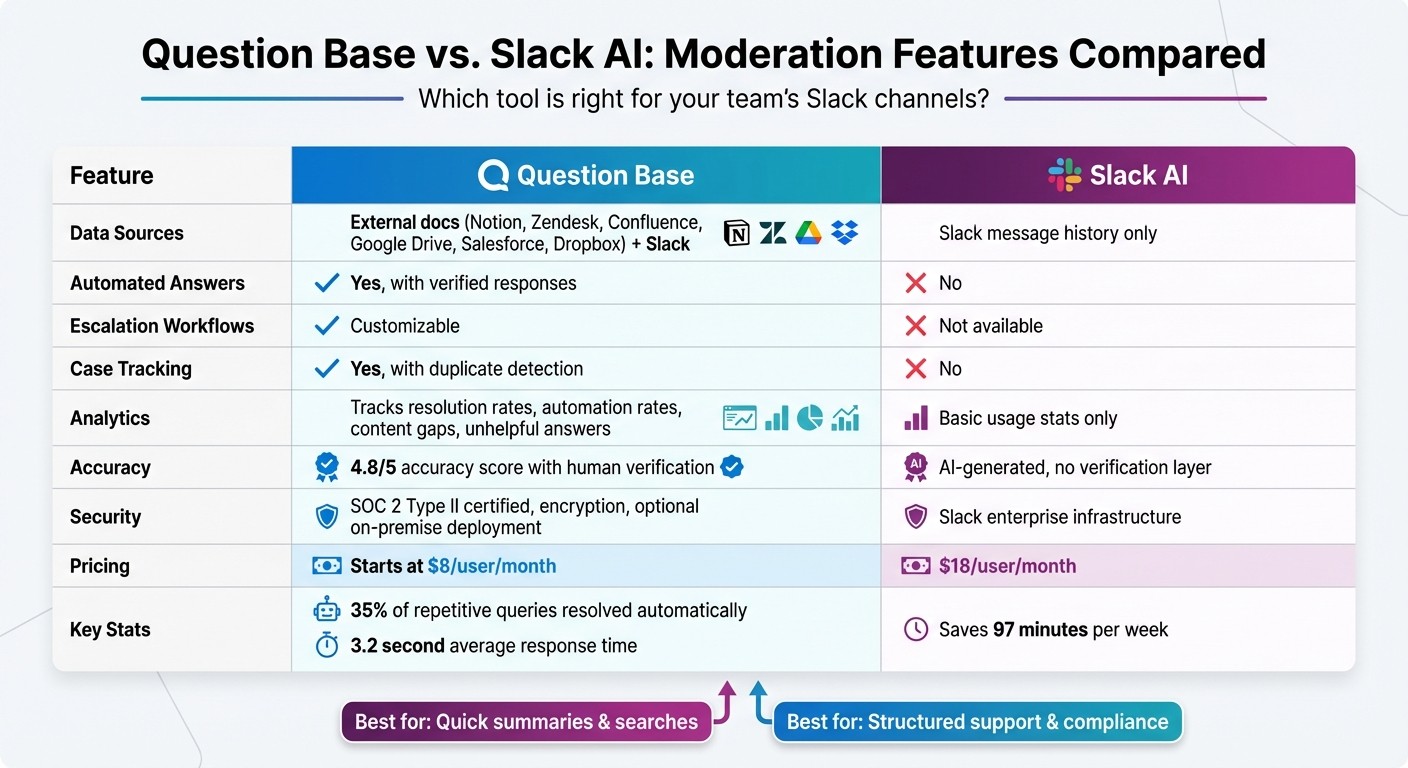
Question Base vs Slack AI Feature Comparison for Slack Moderation
Question Base for Slack Channel Moderation
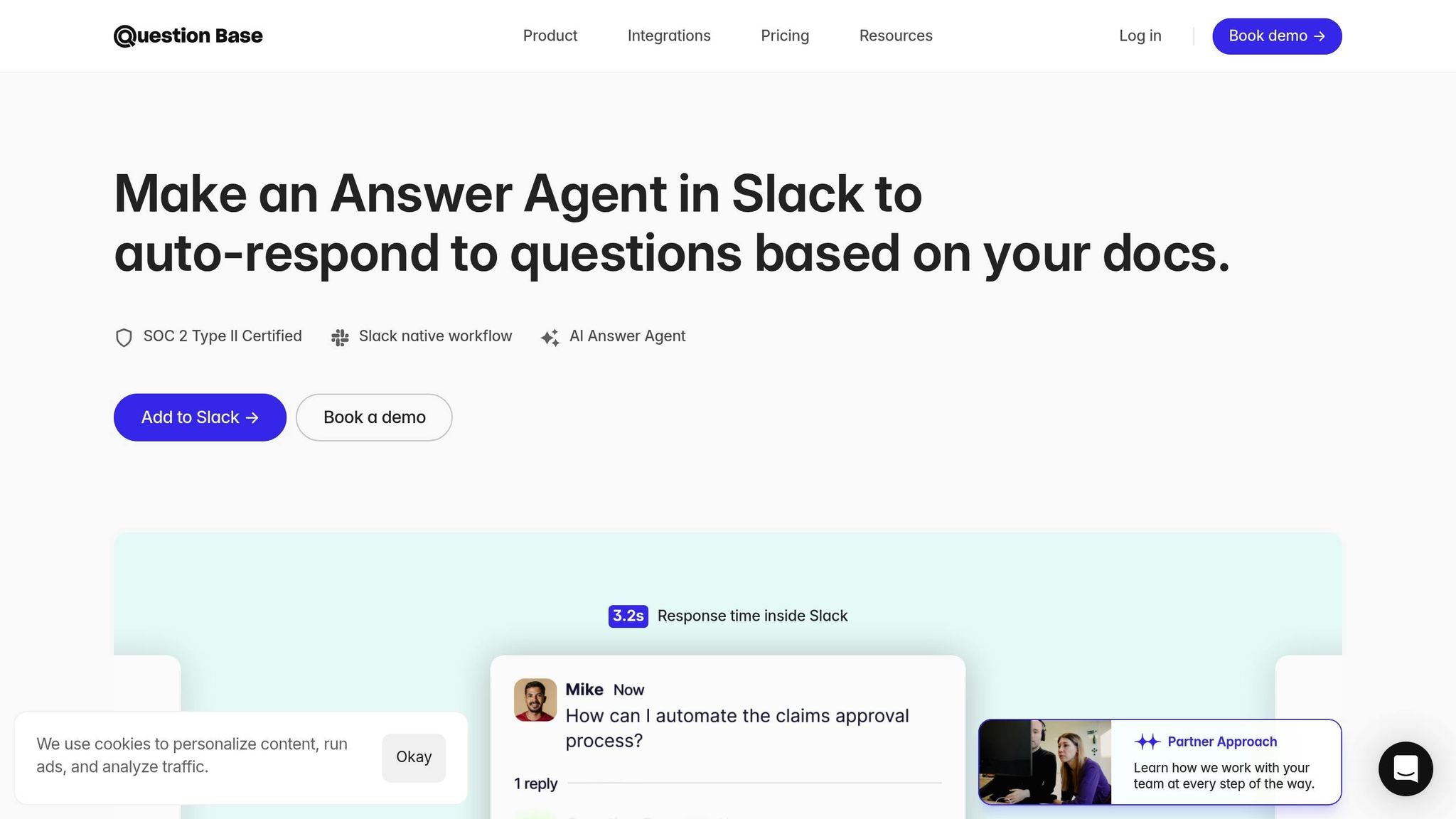
What is Question Base?
Question Base is a Slack-native AI agent designed to provide structured, verified support directly within Slack for enterprise teams. It integrates seamlessly with your existing documentation tools - Notion, Confluence, Google Drive, Zendesk, Intercom, Salesforce, Dropbox, and more - to deliver accurate answers right where your team communicates. There’s no need to migrate data; Question Base overlays your current resources to provide instant responses.
Getting started is straightforward: install the app, link your documentation tools, and invite the bot using /invite @questionbase. No technical expertise or engineering work is required. Once set up, the AI immediately begins answering questions by referencing your trusted sources, complete with clear source annotations. This makes it an ideal solution for moderating Slack channels in dynamic, fast-paced environments.
Moderation Features
Question Base is built with HR, IT, and internal support teams in mind, offering precise control over how questions are managed in busy Slack channels. By automatically identifying and answering repetitive questions, it transforms common queries into reusable FAQs that appear directly in the channel. This feature not only reduces noise but also frees up time for team experts to focus on more complex issues.
The platform allows per-channel customization, enabling teams to adjust the AI’s tone, behavior, and content sources to suit specific needs. For example, you can configure it to auto-answer routine questions in one channel while requiring manual escalation for sensitive topics in another. Its escalation workflows ensure that unresolved or complex issues are directed to the right individuals or systems, such as Zendesk, Intercom, or Jira. These workflows include clear guardrails, ensuring the AI operates within its boundaries.
"We implemented Question Base to eliminate repetitive questions and to collate answers and information in one place for a growing team. Question Base has exceeded our expectations - it's easy to use, intuitive and a massive time saver. We now have a reliable and useful knowledge base, making it easy to share knowledge across the team." - Monica Limanto, CEO, Petsy
Another standout feature is its ability to capture new knowledge from Slack conversations. When valuable information emerges in threads, the AI learns from it and integrates it into your company’s documentation, keeping your knowledge base fresh and aligned with your team’s evolving needs. This approach turns daily Q&A into a continuously improving resource, while also providing advanced analytics and governance tools.
Analytics and Governance
For enterprise teams, having insight into the effectiveness of their tools is crucial. Question Base provides analytics dashboards that highlight automation rates, resolution rates, top topics, and unanswered questions. These insights help leaders identify content gaps and fine-tune their documentation to better serve their teams.
The platform also tracks unhelpful responses, enabling teams to refine the AI’s answers for ongoing improvement. With access controls and content scoping, admins can decide which workspaces, channels, and document repositories the AI can access. This is particularly important for organizations in regulated industries or those handling sensitive employee data, where strict governance and policy enforcement are essential. These features ensure that sensitive internal knowledge remains secure while still being accessible to those who need it.
Enterprise Security and Compliance
Designed with large organizations in mind, Question Base meets stringent security standards. It is SOC 2 Type II certified and uses encryption for data both at rest and in transit, safeguarding internal knowledge and employee interactions. For companies with specific data residency or compliance needs, the platform offers optional on-premise deployment and private cloud hosting as part of its enterprise-tier solutions.
Question Base also supports multi-workspace environments and white-labeling, making it ideal for organizations using Slack Enterprise Grid. This flexibility allows different business units to maintain standardized support experiences while retaining localized control over configurations. With robust control over content access, AI behavior, and escalation processes, Question Base ensures compliance and security for even the most regulated industries.
Slack AI for Channel Moderation
Core Features of Slack AI
Slack AI simplifies channel moderation by providing tools like thread summaries, channel recaps, and enhanced search across message history. These capabilities are designed to keep teams informed without the need to scroll through endless messages manually.
According to Slack, these AI features can save users an average of 97 minutes per week[5]. For teams managing busy channels, this means quicker access to context and less time spent navigating lengthy discussions. Slack AI is available on Pro, Business+, and Enterprise+ plans, though advanced features like enterprise search are exclusive to higher-tier plans[3][4]. The service costs $18 per user per month[1][6] and integrates seamlessly within the Slack interface, requiring no additional setup. While these tools are helpful for basic moderation, their full potential lies in their ability to streamline workflows, as discussed below.
Moderation Use Cases
Slack AI offers several features that can assist with moderation tasks. For instance, it can summarize lengthy threads, allowing moderators to quickly grasp the context of ongoing discussions. Its search functionality enables moderators to comb through message history to locate relevant conversations, which can help in resolving disputes, identifying recurring concerns, or making informed decisions. Additionally, moderators can share AI-generated search results directly in channels or DMs with a single click, making it easier to surface key insights during active discussions[2].
While these tools enhance moderation workflows, they are not specifically designed for dedicated moderation management. Slack AI helps moderators save time by delivering quick summaries and search results, but it doesn’t replace the need for more advanced moderation systems or human oversight.
Limitations for Structured Moderation
Despite its usefulness, Slack AI has notable limitations when it comes to structured moderation. Its primary data source is Slack message history, meaning it doesn’t integrate with external enterprise systems like Salesforce, Confluence, Notion, or Zendesk. This restricts its ability to cross-reference answers with trusted documentation[1][6].
Additionally, Slack AI lacks critical features such as case tracking, duplicate detection, and escalation workflows. These are essential for managing high-volume support or moderation channels effectively[1][6]. Without these tools, there’s no way to track whether questions have been resolved, identify recurring issues, or route complex cases to the appropriate team members. Its analytics also focus on general usage metrics, rather than offering insights specific to moderation, such as resolution rates or patterns in unhelpful responses[1][6].
Another key limitation is that Slack AI generates answers based on past conversations rather than verified documentation. This absence of a human verification layer can be a significant drawback for teams operating in compliance-heavy or regulated industries, where accuracy and accountability are critical[1][6]. For organizations managing sensitive support functions, these gaps can create challenges in ensuring reliability and maintaining audit trails.
Feature Comparison: Question Base vs. Slack AI
Moderation Features Compared
When it comes to moderation features, Slack AI focuses on improving productivity through tools like conversation summaries and enhanced search capabilities. On the other hand, Question Base is designed to handle high-volume internal queries with precision, offering structured and verified support tailored for compliance-heavy environments.
Here’s a side-by-side breakdown of how these tools compare across key moderation features:
Feature | Question Base | Slack AI |
|---|---|---|
Data Sources | Integrates with Notion, Confluence, Google Drive, Zendesk, Intercom, Salesforce, Dropbox, and others, while also pulling information from Slack channels and FAQs. | Relies mainly on Slack message history, files, canvases, and clips. Enterprise search is included with Business+ and Enterprise plans. |
Accuracy & Verification | Provides AI-generated answers that are reviewed and verified by humans, achieving a 4.8 accuracy score[1]. | Uses AI to generate summaries and search results, but lacks a formal human verification process. |
Automated Question Handling | Automatically answers recurring questions by referencing documentation and verified responses, resolving 35% of repetitive queries with an average response time of 3.2 seconds[1]. | Focuses on natural-language search and thread summaries but does not automate Q&A systematically. |
Escalation Workflows | Features customizable escalation workflows to route questions to human experts, with options to adjust tone, behavior, and routing based on topic or channel. | Does not support built-in escalation rules or topic-specific routing for unanswered questions. |
Knowledge Management | Includes features like per-channel settings, case tracking, duplicate detection, and the ability to capture new knowledge directly from Slack threads. | Offers a pre-built AI agent (Channel Expert) on Business+ and Enterprise plans but lacks advanced tools like case tracking or duplicate management. |
Analytics | Tracks resolution rates, automation rates, unhelpful answers, and content gaps, enabling teams to refine their support processes. | Provides general usage stats but does not include detailed moderation metrics like resolution rates or recurring issue detection. |
Enterprise Controls | SOC 2 Type II certified, with encryption at rest and in transit. Supports optional on-premise deployment, white-labeling, and multi-workspace setups. | Built on Slack's enterprise-grade infrastructure, allowing admins to control feature access by role or group, though it lacks specific moderation controls. |
Pricing | Starter: $0/user/month; Pro: $8/user/month; Enterprise: custom pricing. | $18/user/month add-on available for Pro, Business+, and Enterprise+ plans. |
This comparison highlights how each tool addresses different needs. For teams managing internal support channels - such as IT help desks, HR inquiries, or operational Q&A - Question Base stands out by providing the structure, verification, and governance necessary for accurate and auditable knowledge management.
Maria Jensen, UX Lead & Scrum Master at Ticketbutler, shared her experience with Question Base:
"Before, we could easily spend 5–10 minutes searching in a very long document for the exact support case and procedure plus involving several colleagues in trying to find the correct answer. Now, QB finds the relevant answers in a few seconds." [1]
While Slack AI is an excellent tool for general productivity - helping teams stay organized and informed without wading through lengthy threads - Question Base is purpose-built for scenarios where accuracy, structured escalation, and auditability are critical. By addressing these gaps, Question Base provides a tailored solution for teams facing complex moderation challenges.
Which Tool is Right for Your Team?
When Slack AI Shines
Slack AI is a great fit for teams that need quick access to information without relying on formal support workflows. If your main objective is to help team members find answers faster and cut down on endless scrolling, Slack AI delivers with features like channel recaps, thread summaries, and an AI-powered search.
This tool is especially useful for teams that don’t run high-volume support channels - like #ask-IT or #ask-HR - that require strict processes for escalation, audit trails, or compliance. For departments focused on boosting general productivity, Slack AI’s seamless integration eliminates the need for lengthy procurement steps. Its straightforward admin controls make it easy to enable features for specific user groups or roles.
When Question Base is the Smarter Choice
For mid-sized and enterprise teams managing formal support, IT, HR, or operations channels, Question Base is the better tool for ensuring accuracy, accountability, and compliance. If your team deals with a high volume of repetitive questions, you need more than just a search tool - you need a system that delivers verified, policy-compliant answers sourced directly from trusted documentation.
Question Base is designed for environments where SOC 2 Type II certification, encryption, and optional on-premise deployment are crucial, especially in regulated industries or security-sensitive settings. Its advanced features, like per-channel settings, customizable escalation workflows, and detailed analytics (e.g., resolution rates, automation rates, and content gap tracking), provide support leaders with the control and insights needed to refine knowledge management continuously. For teams that require strict oversight and compliance, Question Base becomes the backbone of effective channel moderation.
Combining Slack AI and Question Base
Many organizations see the value in using both tools together to cover different needs. Slack AI serves as a personal productivity assistant, helping employees quickly summarize threads, search Slack history, and automate simple tasks. On the other hand, Question Base provides the structured support system needed for channels like #customer-support, #ask-IT, or #compliance, where verified answers, governance, and audit trails are essential.
This combined approach allows teams to leverage Slack AI for everyday information retrieval while relying on Question Base for high-stakes channels that demand structured workflows and compliance. Together, they create a balanced system that supports both quick, informal information access and rigorous, reliable support - enhancing how your organization manages Slack channels overall.
Work with AI and Agents in Slack to Transform Your Success | Innovations | Slack
Conclusion
Slack AI and Question Base each address different needs within team communication and support. Slack AI is designed to help users quickly catch up on conversations, summarize threads, and search through chat history. It’s a handy tool for teams that rely on informal workflows and need quick access to past discussions.
However, when it comes to structured support channels, Slack AI falls short. That’s where Question Base steps in. Built specifically for enterprise teams like HR, IT, and operations, Question Base goes beyond conversation summaries by delivering verified answers sourced directly from trusted documentation. It allows teams to maintain full control over AI behavior, tone, and escalation workflows - critical for ensuring accuracy and accountability in high-stakes environments.
Analytics is another area where Question Base sets itself apart. While Slack AI offers basic usage insights, Question Base provides detailed metrics, including resolution rates, automation performance, and content gaps. These insights empower knowledge managers to fine-tune their support systems. Features like case tracking, duplicate detection, and per-channel customization transform Slack into more than a chat platform - it becomes a structured, self-improving knowledge management system.
For U.S.-based enterprises managing sensitive data or operating in regulated industries, Question Base offers an added layer of security. With SOC 2 Type II certification, robust encryption, and optional on-premise deployment, it provides compliance and security features that go beyond what Slack AI offers. At $8 per user per month - compared to Slack AI’s $18 - Question Base delivers enterprise-level support capabilities at a more accessible price point, making it an excellent choice for teams that require rigorous workflows.
If your team relies on formal support channels where accuracy, governance, and auditability are essential, Question Base turns routine Q&A into a scalable, searchable knowledge base tailored to your needs.
FAQs
How does Question Base deliver more accurate answers compared to Slack AI?
Question Base delivers highly reliable answers by integrating directly with trusted documentation platforms like Notion, Confluence, Salesforce, and others. This ensures that responses are always grounded in verified, up-to-date sources rather than being limited to Slack chat history.
In contrast to Slack AI, which pulls answers from past conversations, Question Base empowers organizations to customize and review content for accuracy. This guarantees employees receive consistent, dependable information, making it a perfect solution for teams focused on precision and maintaining control over their knowledge base.
Why is Question Base ideal for compliance-focused organizations?
Question Base caters to organizations with stringent compliance requirements by providing SOC 2 Type II certification, encryption for data at rest and in transit, and the option for on-premise deployment. These measures ensure your data stays protected and meets rigorous regulatory standards.
The platform also offers extensive customization, enabling teams to manage content accessibility, tailor the AI's tone and behavior, and set up escalation paths to human support when needed. This adaptability allows organizations to uphold compliance while ensuring their internal knowledge management remains precise and secure.
Can Question Base and Slack AI work together to meet different team needs?
Yes, Question Base and Slack AI work hand-in-hand to address a variety of team challenges. While Slack AI specializes in summarizing conversations and streamlining communication, Question Base focuses on providing reliable, expert-approved answers by seamlessly integrating with trusted tools like Notion, Confluence, and Salesforce.
When used together, these tools create a powerful synergy: Slack AI delivers real-time insights from team chats, and Question Base ensures easy access to structured, verified knowledge. This combination is particularly beneficial for HR, IT, and operations teams that prioritize security, accuracy, and auditability, helping maintain productivity and consistency throughout the organization.