∙
Cooper
∙
Reading time:
14 min

Repetitive questions in Slack cost time and money. Employees spend up to 30% of their week searching for answers, while experts lose 6–8 hours weekly addressing the same queries. This inefficiency can cost companies with 1,000 employees over $2 million annually. The root problem? Information is scattered across tools like Confluence, Google Drive, and Salesforce, while Slack becomes a chaotic hub of buried threads and duplicate questions.
AI solves this by bridging Slack with trusted documentation systems, automating responses, and identifying knowledge gaps. Tools like Question Base integrate with platforms like Notion, Zendesk, and SharePoint to provide accurate, verified answers directly in Slack, reducing search time by up to 60%. Unlike Slack AI, which focuses on chat summaries, Question Base connects to external resources, tracks unanswered questions, and builds a self-improving knowledge base - all at a lower cost.
For enterprises managing HR, IT, and operations, AI-powered solutions like Question Base streamline workflows, cut costs, and ensure teams get the right answers faster.
Common Problems That Create Slack Knowledge Gaps
Information Buried in Threads and DMs
Slack conversations often hold critical insights, but these can easily get lost in the constant flow of messages. For instance, when a senior engineer resolves a production issue through a direct message or HR clarifies a policy in a lengthy thread, that information becomes inaccessible to the broader team. This lack of visibility can create hurdles for new hires during onboarding, delay incident responses as teams waste time rediscovering solutions, and hinder cross-department collaborations due to missing context.
"Answers get buried in threads. Critical knowledge gets buried in chat instead of being captured." [1]
With numerous channels spanning products, departments, and markets, Slack can feel like an endless stream of updates. This dynamic often results in valuable insights being buried, while the challenge of locating scattered documentation becomes even more pronounced.
Documentation Scattered Across Multiple Tools
Large organizations frequently rely on a wide array of tools to store their policies and workflows - often across 16 to 30+ systems. HR might use Google Drive for employee handbooks, IT teams may store runbooks in Confluence, sales teams depend on Salesforce, customer support teams use Zendesk, and engineering notes are tucked away in Notion. When employees have questions, they often turn to Slack because navigating through these fragmented platforms is cumbersome and time-consuming.
Without a unified search function that bridges these tools, the same questions are asked repeatedly. Employees can spend as much as 20–30% of their workweek hunting for information, and nearly 40% of internal questions end up being duplicates.
Conflicting and Unverified Answers
When there’s no system in place to verify information, conflicting answers can circulate, leading to confusion. Outdated policies or inconsistent guidelines can pose substantial risks, especially in compliance-heavy areas like HR, finance, IT, or security - where strict U.S. regulations leave little room for error. Without a way to highlight the most accurate and updated answers, this issue only grows as organizations scale.
Monica Limanto, CEO of Petsy, shared how implementing a verification system transformed their operations:
"We now have a reliable and useful knowledge base, making it easy to share knowledge across the team. We no longer have staff waiting on busy managers for an answer... plus it's easy to verify answers as new questions come along." [1]
No Visibility into Missing Content
Another pressing issue is the lack of tools to identify unanswered questions, recurring topics, or areas where employees struggle to find clarity. Without analytics to pinpoint these gaps, support teams can’t prioritize which articles need updating or creation, and leadership remains unaware of key knowledge challenges. This lack of visibility leads to repeated inefficiencies and wasted time.
"Before Question Base, we've been seeing repetitive questions all around our Slack channels." - Aleksandar Ginovski, Head of Product, Enhancv [1]
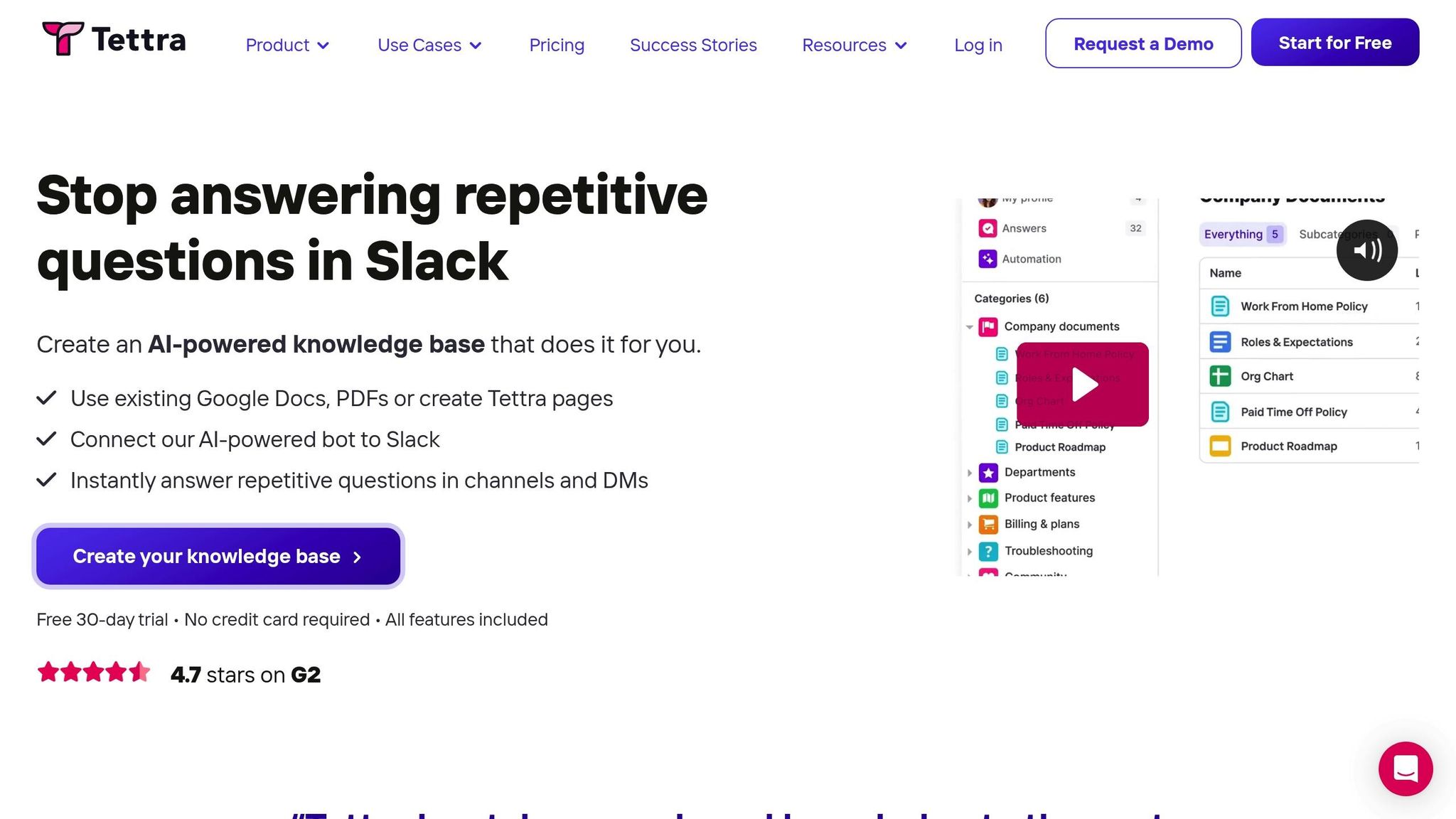
Tettra Slack Integration: AI Knowledge Base
How AI Identifies and Fills Slack Knowledge Gaps
AI doesn’t just respond to questions in Slack - it actively identifies patterns that highlight recurring issues, outdated information, or missing documentation. By analyzing repeated queries, unanswered threads, and areas where employees struggle to find clarity, AI tools pinpoint exactly where improvements are needed. According to research from Stanford University, generative AI can cut knowledge retrieval time by up to 60% [4]. This ability forms the foundation of advanced search and gap detection features.
AI-Powered Search and Gap Detection
Modern AI tools analyze Slack conversations to uncover knowledge gaps. They track resolution rates to see how often questions are answered, flag duplicate queries that indicate hard-to-find information, and identify threads where employees organically create new answers. For instance, when the same question pops up in multiple channels or employees repeatedly explain the same policy, AI marks these as high-priority areas for documentation updates.
Question Base goes a step further by monitoring metrics like automation rates and investigations into unhelpful answers. These insights reveal not only which questions are being asked but also where existing responses fail to resolve issues [1]. By tracking unanswered or unresolved questions, content teams gain a clear roadmap for updating and refining documentation.
Connecting Slack Questions to Trusted Sources
One of the biggest challenges in Slack-based workflows is scattered documentation. AI bridges this gap by connecting Slack to centralized, trusted sources of information, such as Notion, Confluence, Google Drive, Zendesk, Salesforce, and SharePoint. Instead of relying solely on chat history, AI agents search across these platforms to find verified answers and deliver them directly in Slack, complete with source annotations.
This integration ensures employees get accurate, official responses without leaving Slack. For example, when someone asks about a PTO policy or a technical guide, the AI pulls directly from the approved documentation. Question Base supports all major documentation tools, creating a seamless link between questions in Slack and the authoritative sources where answers reside [1].
"Since we started using QB we haven't used our Google support docs. And if I go on vacation or sick leave, I feel comfortable that QB will just take over." - Linn Stokke, Online Events & Marketing Specialist, Ticketbutler [1]
Tracking Answer Quality and Knowledge Coverage
Spotting gaps is only part of the solution - AI also tracks how effective its answers are. Enterprise-grade AI tools like Question Base monitor metrics such as answer accuracy, escalation rates (when human intervention is needed), and user feedback on responses. With an average answer accuracy score of 4.8, Question Base provides detailed analytics on questions asked, resolution rates, and automation success [1].
These insights empower knowledge managers to address recurring issues by updating documentation. Additionally, the system captures new knowledge from Slack conversations. For instance, when someone shares a helpful answer in a thread, the AI can suggest adding it to the official knowledge base.
"We now have a reliable and useful knowledge base, making it easy to share knowledge across the team... plus it's easy to verify answers as new questions come along." - Monica Limanto, CEO, Petsy [1]
How Question Base Closes Slack Knowledge Gaps
Question Base transforms Slack into a smarter, more efficient knowledge assistant by connecting questions to trusted documentation. Unlike tools that depend solely on chat history, Question Base pulls answers directly from your organization’s existing resources - like Notion, Confluence, Google Drive, Salesforce, Zendesk, Intercom, SharePoint, and more. Best of all, setup is quick and easy through Slack's Marketplace.
Connecting Slack to Your Documentation Tools
Once knowledge gaps are identified, Question Base integrates seamlessly with the tools your team already uses. It connects to over 12 major platforms, including Google Drive, Confluence, Salesforce, Notion, Zendesk, Intercom, and Dropbox. When someone asks a question in Slack, the AI searches these integrated sources to deliver precise answers, complete with source annotations and quotes that link back to the original document. This means employees no longer need to leave Slack, dig through various tools, or wait for colleagues to respond - they get the information they need right where they’re working.
Delivering Verified and Customizable Answers
Question Base ensures accuracy by blending AI-powered responses with human oversight. While the AI drafts answers based on your documentation, teams can review, edit, and refine them before wider distribution. This added layer of human verification ensures responses align with company policies, regulatory standards, and current workflows. Organizations also have full control over the AI’s tone, behavior, and escalation processes. This is especially important for teams in HR, IT, and operations, where precision and compliance are critical. The result? A system that delivers "AI generated → Human verified" answers, balancing speed with reliability.
Building a Living FAQ and Reducing Duplicate Questions
One of the biggest challenges in any organization is dealing with repetitive questions. Question Base tackles this by auto-answering 35% of recurring queries using its duplicate detection feature. When the same question pops up across different channels, the AI recognizes it and provides consistent, verified responses. It also captures new knowledge from Slack conversations. For example, a helpful explanation shared in a thread can be added to your official documentation with just one click. Over time, this creates a living FAQ that grows and evolves with your team’s needs, turning fleeting Slack chats into structured, searchable knowledge.
"We went from answering the same questions over and over, to setting it up once and it answers the same questions over and over for us :)" - Brandon Horvatic [1]
Analytics for Continuous Improvement
Question Base doesn’t just deliver answers - it helps you improve your knowledge base over time. Its analytics dashboards track key metrics like automation rates, resolution rates, and areas where answers fall short. These insights highlight what’s working, where human involvement is needed, and which topics require better coverage. The platform even tracks unanswered questions, giving knowledge managers a clear roadmap for updating and expanding documentation. This data-driven approach makes it easier to align content updates with sprint cycles or quarterly plans, keeping your knowledge base agile and effective.
Enterprise-Grade Security and Scalability
For organizations with strict security needs, Question Base is built to deliver peace of mind. It supports SOC 2 Type II compliance and uses encryption both at rest and in transit. Enterprise clients can also choose options like on-premise deployment, white-labeling, and multi-workspace support. The platform respects existing access controls, ensuring employees only see the information they’re authorized to view. Whether you’re managing a single Slack workspace or coordinating across multiple teams and locations, Question Base scales effortlessly to meet enterprise demands - without adding extra engineering work to your plate.
Question Base vs. Slack AI: A Fact-Based Comparison
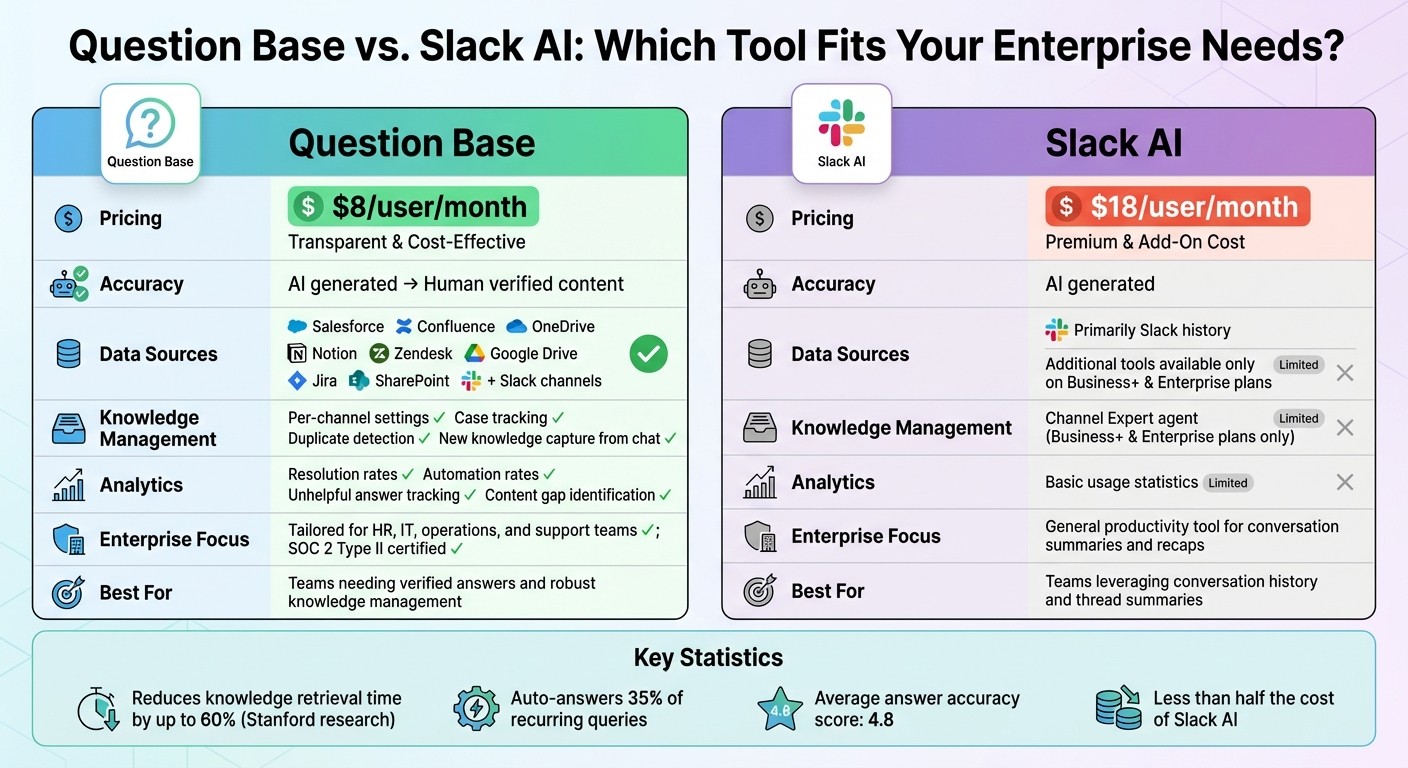
Question Base vs Slack AI Feature Comparison for Enterprise Teams
Bridging knowledge gaps in Slack requires the right tools for the job. Here's how Slack AI and Question Base stack up.
When to Use Slack AI
Slack AI thrives in leveraging conversation history. It can summarize lengthy threads, generate channel recaps, and quickly surface relevant information from past discussions. For instance, marketers using Slack AI reported saving 100 minutes per week and cutting onboarding time by half by utilizing these chat-focused features [3]. If your team's knowledge primarily lives within Slack, Slack AI provides quick and effective insights. This makes it a strong choice for small to mid-sized teams aiming to boost productivity without relying heavily on external documentation systems. However, for enterprises managing complex workflows, the story changes - enter Question Base.
Why Enterprises Choose Question Base
While Slack AI is great for speeding up individual workflows, Question Base is designed to keep entire teams aligned by pulling answers from verified sources. For HR, IT, operations, and support teams - where precision, compliance, and accountability are critical - Question Base integrates seamlessly with platforms like Confluence, Salesforce, Zendesk, Notion, and Google Drive. It delivers "AI generated → Human verified" answers, complete with source annotations that link directly to the original documents. This ensures responses are not just accurate but also compliant with company policies and regulatory standards.
"Since we started using Question Base, we don't spend any time looking up our procedures in a support manual. Now, QB finds the relevant answers in a few seconds." - Maria Jensen, UX Lead & Scrum Master, Ticketbutler [1].
Question Base also excels in knowledge management. It tracks duplicate questions, captures new insights from Slack conversations with a single click, and allows per-channel AI behavior customization. Its analytics dashboard provides actionable insights, such as resolution rates and automation performance, helping knowledge managers continuously refine processes. At $8 per user per month, Question Base is less than half the cost of Slack AI’s $18 per user per month. It also offers enterprise-grade features like SOC 2 Type II certification, on-premise deployment, and white-labeling options [1][2].
Feature Comparison Table
Here’s a side-by-side breakdown of the key differences:
Feature | Question Base | Slack AI |
|---|---|---|
Accuracy | AI generated → Human verified content | AI generated |
Data Sources | Salesforce, Confluence, OneDrive, Notion, Zendesk, Google Drive, Jira, SharePoint + Slack channels | Primarily Slack history; additional tools available only on Business+ & Enterprise plans |
Knowledge Management | Per-channel settings, case tracking, duplicate detection, new knowledge capture from chat | Channel Expert agent (Business+ & Enterprise plans only) |
Analytics | Resolution rates, automation rates, unhelpful answer tracking, content gap identification | Basic usage statistics |
Enterprise Focus | Tailored for HR, IT, operations, and support teams; SOC 2 Type II certified | General productivity tool for conversation summaries and recaps |
Pricing | $8/user/month | $18/user/month |
For teams that prioritize verified answers and robust knowledge management over simple AI-generated summaries, Question Base provides the structure, security, and tools enterprises need to thrive.
Conclusion
Slack doesn’t have to be just a chat tool - it can become the backbone of your team’s knowledge-sharing efforts. With AI, Slack evolves into a powerful knowledge hub, delivering the right answers exactly when and where your team needs them. According to Stanford research highlighted by Slack's Workforce Lab, generative AI can reduce the time spent on knowledge retrieval and workflow automation by up to 60% [4]. For enterprises juggling complex processes across HR, IT, operations, and support teams, Question Base offers the structure, security, and adaptability to scale seamlessly. At just $8 per user per month - less than half the price of Slack AI - Question Base integrates with trusted platforms like Salesforce, Confluence, Google Drive, and Notion to provide AI-generated, human-verified answers with full source annotations [1][2]. This blend of speed and accuracy helps organizations maintain operational efficiency without compromising on reliability.
Beyond immediate results, Question Base ensures your knowledge base keeps getting better. By refining verified answers through everyday Slack interactions, your team creates a self-improving system [1]. With SOC 2 Type II certification, options for on-premise deployment, and analytics that track resolution rates and identify content gaps, Question Base delivers the enterprise-grade capabilities needed to support long-term success [1][2].
FAQs
How does AI help teams address knowledge gaps in Slack?
AI closes knowledge gaps in Slack by directly integrating with trusted documentation platforms like Notion, Confluence, and Salesforce, instead of relying solely on chat history. Tools such as Question Base take it a step further by capturing and organizing insights shared in conversations, transforming them into structured, searchable knowledge. This approach not only identifies frequently asked questions but also pinpoints areas where information may be outdated or incomplete.
While Slack AI primarily focuses on summarizing chat history, Question Base goes beyond by actively managing knowledge repositories to provide accurate, expert-verified answers. By keeping information current and easy to access, it helps teams stay on the same page, avoid unnecessary delays, and cut down on repetitive questions.
What advantages does Question Base offer compared to Slack AI?
Question Base caters to enterprise teams such as HR, IT, and operations by delivering expert-verified answers sourced from reliable platforms like Confluence, Notion, and Salesforce. This approach ensures precise and traceable responses, setting it apart from Slack AI, which primarily focuses on summarizing chat history.
Equipped with features like automatic knowledge organization, SOC 2 compliance, and extensive customization options, Question Base transforms Slack into a well-structured, searchable knowledge center. By streamlining access to accurate and actionable information, it minimizes repetitive questions, saves valuable time, and keeps teams working in sync - all without leaving Slack.
How does Question Base provide accurate answers?
Question Base ensures accurate and reliable answers by directly pulling information from trusted documentation platforms such as Notion, Confluence, Salesforce, and other enterprise tools. Unlike systems that depend on chat history, it sources responses from verified content, keeping the information both current and dependable.
What's more, Knowledge Managers have the ability to tailor the system to their team’s specific needs. They can control what content is accessible, fine-tune the AI's behavior, and address any knowledge gaps as they emerge. This flexibility allows the platform to adapt over time while consistently delivering precise and trustworthy responses.