∙
Cooper
∙
Reading time:
17 min

Remote teams waste up to 30% of their workweek searching for scattered information, costing companies millions annually. Slack AI agents solve this by automating answers, centralizing knowledge, and keeping decisions visible. Here’s how they improve transparency:
Centralized Answers: AI agents pull verified information from trusted sources like Google Drive or Confluence directly into Slack.
Visible Decisions: Past discussions and decisions are retrieved instantly, eliminating endless scrolling.
Automated Support: Routine questions like “What’s the parental leave policy?” are answered in seconds, reducing repetitive tasks.
Spotting Gaps: AI tracks recurring unanswered questions, helping teams improve documentation.
Open Communication: By sharing answers in public channels, AI promotes collaboration and reduces silos.
Quick Comparison: Slack AI focuses on summarizing conversations, while tools like Question Base integrate directly with documentation systems, offering more accurate, source-linked answers for internal support.
Next Steps: Install Question Base to simplify workflows and ensure transparency across your team.
Your New Coworker? AI Agent in Slack Explained by the CMO
What Are Slack AI Agents And Why Transparency Matters
Slack AI agents are advanced tools integrated into Slack that go beyond basic commands to handle more complex tasks. Unlike traditional bots that respond to fixed commands like "/help" with pre-set scripts, these agents understand natural language, gather information from multiple systems, and perform multi-step workflows such as opening IT tickets or updating records. Slack refers to them as "intelligent agents" - technology designed to plan, decide, and act on behalf of users, not just provide answers[4]. This expanded functionality plays a key role in fostering transparency across teams.
These agents can quickly connect to trusted data sources and deliver accurate answers in seconds. They learn context, improve over time, and address detailed questions like "What’s our parental leave policy?" or "How do I submit an expense report?" - ensuring consistent responses every time.
This level of capability is especially important for maintaining transparency in remote work settings where centralized, accessible information is critical. According to Slack’s "Future of Work" study, 87% of employees want their companies to prioritize transparency[3]. By making knowledge searchable and available directly within Slack, AI agents ensure that information flows clearly and openly where work happens.
AI agents also enhance trust by disclosing data ownership, upholding strong security measures, and signaling when human intervention is necessary. This openness reassures teams by showing exactly what the AI can access and when it’s time to escalate an issue to a person.
In remote and asynchronous work environments, these agents provide consistent, immediate responses that keep everyone on the same page. Questions about policies, onboarding, or routine approvals no longer hinge on a single person’s availability - they’re addressed 24/7, giving every team member access to reliable information. These features underscore how AI agents are transforming how teams access and share knowledge effectively.
1. Connecting Teams to Trusted Knowledge Sources
Streamlining Knowledge Access and Accuracy
For remote teams, finding accurate information often feels like a scavenger hunt across platforms like Google Drive, Confluence, Salesforce, and Notion. Employees either interrupt colleagues for answers or waste time digging through multiple tools. This scattered approach slows everything down and breeds inefficiency.
Slack AI agents tackle this issue head-on by integrating directly with trusted documentation platforms and delivering answers right where questions arise - inside Slack channels. Question Base connects seamlessly with tools like Google Drive, Confluence, Salesforce, Notion, Zendesk, Jira, and SharePoint. It pulls verified answers from an established knowledge bank, complete with citations and source details[1]. Unlike systems that depend solely on chat history, this integration ensures teams get reliable, documented information. By centralizing access, teams can make decisions based on accurate, shared knowledge.
Enabling Transparent Decision-Making
When official knowledge sources are embedded in Slack, decision-making becomes more open and collaborative. Instead of relying on private DMs or scattered email threads, AI agents bring verified context from official documents into public Slack channels. For instance, if a product manager asks, "What’s our Q1 pricing strategy?", the agent retrieves the answer directly from the official strategy document, complete with a cited source. This ensures everyone on the team is working from the same trusted information.
This shift changes how distributed teams collaborate and share insights.
"We no longer have staff waiting on busy managers for an answer. Question Base is there in seconds, plus it's easy to verify answers as new questions come along"[1]
Monica Limanto, CEO of Petsy
By relying on documented facts instead of individual memory, teams can make decisions that are both informed and transparent.
Spotting and Filling Knowledge Gaps
Beyond providing immediate answers, a centralized system also shines a light on gaps in your documentation. If the same question keeps coming up without a clear answer, it’s a sign that something’s missing. Question Base tracks these unanswered or escalated questions, giving managers a clear view of where documentation needs improvement. This creates a feedback loop where everyday Q&A helps refine and expand the knowledge base. Over time, experts can continuously update and improve the information available within Slack[1].
2. Keeping Decisions And Context Visible In Channels
Support for Transparent Decision-Making
Remote teams often struggle to keep track of why certain decisions were made. Picture this: someone asks, "What did we decide about the new pricing model?" - and the answer is buried in a massive thread from weeks ago. AI agents simplify this by summarizing lengthy discussions and pulling up past decisions directly in the current Slack channel. Instead of endless scrolling or pestering colleagues, the agent locates the relevant conversation, links the original thread, and attaches any related documents. This ensures everyone has access to the same reliable information.
This level of visibility matters more than you might think. According to the Slack Future of Work study, 87% of workers want their companies to embrace greater transparency [3]. When decisions and their reasoning are accessible in shared channels, team members can align their efforts with the company’s goals. Transparency also pays off - companies that prioritize openness report 21% higher profit margins and 22% greater productivity compared to less transparent organizations [3].
Automation of Recurring Tasks
AI agents don’t just keep tabs on decisions - they also make repetitive tasks easier. For example, they can summarize progress on milestones, record approvals, and share ticket updates directly in Slack channels. By automating these routine updates, teams save time and ensure that the context behind decisions stays front and center, without requiring manual input.
Encouragement of Open Communication
In addition to supporting transparency and task automation, AI agents promote open communication. By taking over the routine sharing of information - like posting summaries, tracking decisions, and logging outcomes - they create a culture where transparency is standard. Instead of relying on a few team members to manually document and share updates, the agent acts like an extra team member, ensuring daily communication flows smoothly. This approach breaks down silos, keeps teams aligned, and supports the fast-paced, open workflows that remote teams need to thrive.
3. Automating Internal Support With Clear Answers
Centralizing Knowledge for Consistency
Remote teams often lose valuable time answering the same questions repeatedly. Research shows employees spend 20–30% of their workweek - up to 12 hours - searching for scattered information across Slack threads, wikis, and various documentation tools[1]. For a company with 1,000 employees, this inefficiency can cost over $2 million annually in lost productivity[1].
Slack AI agents streamline this process by pulling information from trusted, centralized sources. For example, if someone asks, "What's our parental leave policy?" in a public Slack channel, the agent instantly provides the official answer from your HR knowledge base, complete with a citation linking back to the original document. This ensures everyone receives consistent, accurate information, eliminating conflicting interpretations. By consolidating knowledge in this way, teams can lay the groundwork for automating repetitive support tasks.
Automating Repetitive Requests
AI agents can handle routine support requests from start to finish. For instance, when an employee types "How do I reset my VPN?" in the #it-help channel, the agent responds with clear, step-by-step instructions and a link to the relevant guide. If the issue remains unresolved, it can automatically create a ticket with all the necessary context[7]. HR teams also benefit when questions like "How do I update my tax withholding?" are answered instantly with policy-compliant responses, reducing the need for manual intervention[6].
Question Base simplifies this even further by addressing 35% of repetitive queries with an average response time of just 3.2 seconds. This saves internal experts more than six hours per week[1]. At $8 per user per month, it’s less than half the cost of Slack AI's $18 monthly fee and integrates directly with your existing documentation systems[1][2]. Unlike Slack AI, which primarily searches past chat history, Question Base pulls from verified knowledge sources, ensuring responses align with up-to-date policies rather than outdated conversations.
Promoting Open Communication
Beyond automating support, these AI agents create an environment that encourages open communication. By providing instant answers in shared channels, they make it easier for employees to ask questions without feeling like they’re interrupting colleagues. This approach resonates with the 80% of employees who prefer asking questions in chat rather than navigating a wiki[1]. By integrating seamlessly into Slack, AI agents transform it into a dynamic knowledge hub, keeping teams aligned and free from unnecessary roadblocks.
4. Identifying Knowledge Gaps and Misalignment
Spotting Knowledge Gaps
When documentation is scattered across platforms or buried in informal Slack chats, vital information often slips through the cracks. AI agents step in by tracking unanswered questions and analyzing recurring issues that automated systems can't resolve. This process pinpoints exactly where documentation is incomplete or outdated.
With Question Base, this task becomes even more streamlined. The platform logs unanswered questions and alerts the appropriate expert to address them. Its analytics dashboard highlights the topics that consistently cause confusion. By identifying recurring questions, teams can see where critical information is missing. These patterns transform vague suspicions about knowledge gaps into actionable data, enabling teams to make informed updates that improve clarity and efficiency.
Supporting Better Decision-Making
Analyzing knowledge gaps isn't just about fixing what's broken - it's a strategic tool for setting documentation priorities. Question Base generates content gap reports that can be aligned with sprints or quarterly planning, helping leaders allocate resources effectively [1]. This process promotes transparency in operations, ensuring everyone has access to accurate and updated information.
Transparency isn't just a buzzword - it delivers measurable results. Organizations with high transparency enjoy 21% higher profit margins and 22% greater productivity compared to those with low engagement [3]. By providing clear insights, Question Base ensures teams stay aligned, reducing departmental miscommunication and inefficiencies. Beyond decision-making, this approach fosters a culture that values clarity and collaboration.
Promoting Open Communication
AI agents don't just centralize information - they actively refine how teams communicate. Question Base takes this a step further by converting expert responses in Slack threads into structured, searchable documentation. What starts as a fleeting Slack message becomes part of a growing, organized knowledge base [1][2].
This approach ensures that the knowledge base evolves alongside the team's needs. It also reduces the frustration of repeated questions and encourages teams to share and document information more openly.
"Before Question Base, we've been seeing repetitive questions all around our Slack channels" [1]
Aleksandar Ginovski, Head of Product at Enhancv
5. Building Open-By-Default Communication Habits
Encouraging Open Communication
Open communication transforms how teams access and share knowledge, ensuring that accurate information is readily available to everyone. It's not just a policy; it's a practice embedded into the way teams operate. AI agents in Slack make this possible by surfacing information in public channels rather than letting it get lost in private messages or email threads. When employees can quickly find reliable answers without disrupting their colleagues, they’re more likely to ask questions openly, which benefits the entire team.
Question Base takes this a step further by capturing expert responses and turning them into a shared knowledge repository. This process shifts the way teams share insights, fostering a culture where documented and accessible information becomes the norm. Such openness paves the way for smoother automation and centralized knowledge-sharing.
Automating Repetitive Tasks
Automation is a key ally in maintaining open communication. Consider this: experts often spend around six hours each week answering repetitive questions [1]. That’s valuable time that could be redirected toward more strategic, impactful work. Question Base steps in to address this issue by handling up to 40% of recurring internal questions in large organizations [1]. This frees up experts to focus on complex discussions that require deeper insight and context.
When employees see that they can get fast, reliable answers from an automated system, trust in the process grows. This trust encourages team members to ask questions in open channels, knowing they’ll get accurate responses without overwhelming their colleagues. Leaders can further reinforce this culture by openly sharing challenges and using AI tools to distribute information transparently, signaling that openness is valued at every level [3].
Centralizing Knowledge for Accuracy
A centralized knowledge base builds confidence across teams. Question Base integrates seamlessly with trusted platforms like Notion, Confluence, Salesforce, and Google Drive, ensuring that answers are drawn from verified, up-to-date sources - not scattered chat histories. This guarantees that the information employees rely on is both accurate and current.
The impact of such transparency is hard to ignore. Organizations that prioritize openness report 21% higher profit margins and 22% greater productivity compared to those with less engaged teams [3]. By automatically delivering relevant insights and maintaining a clear view of company-wide context [8], AI tools like Question Base ensure that critical information reaches the right people at the right time. This makes transparency not just a guiding principle but a true competitive edge.
Comparison: Slack AI vs Question Base
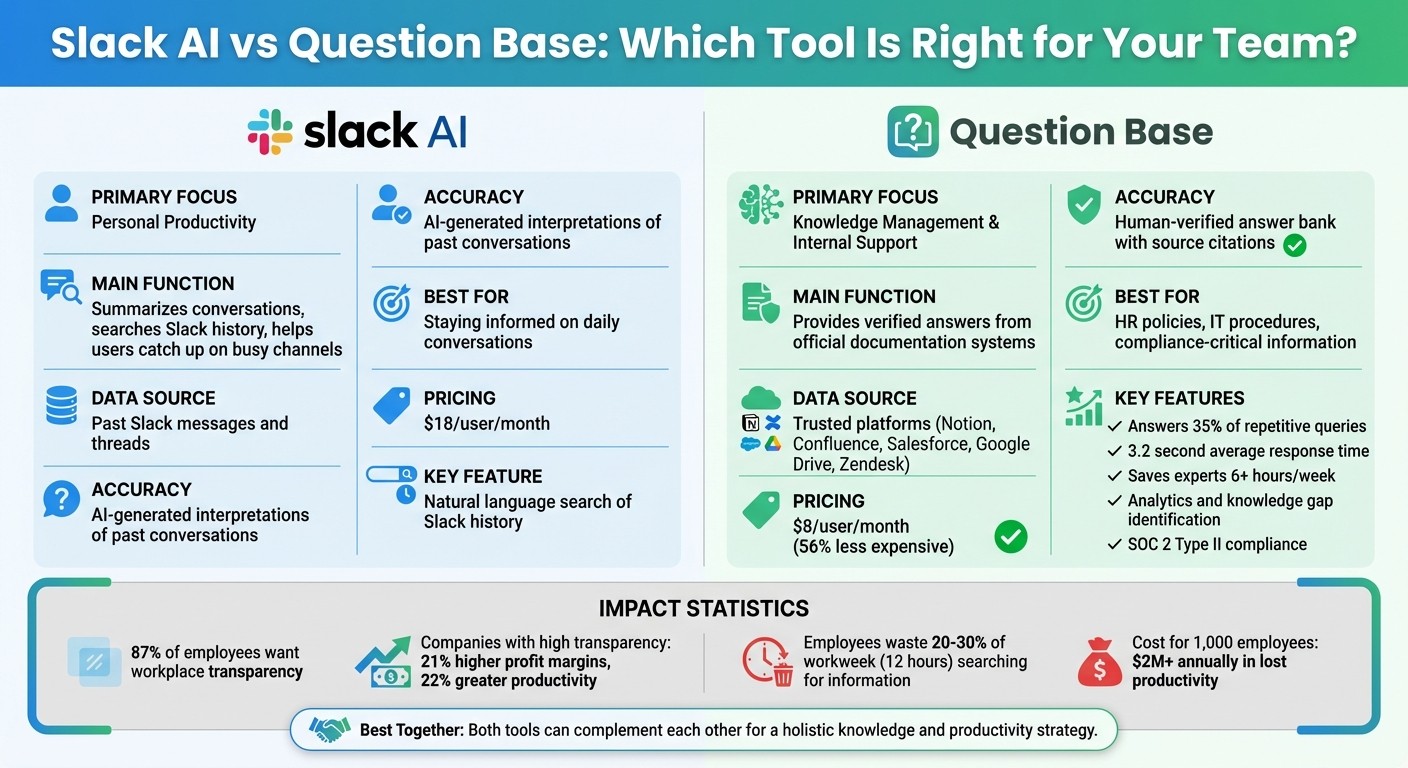
Slack AI vs Question Base: Feature and Pricing Comparison
While both Slack AI and Question Base operate within Slack, they are designed for distinct purposes. Slack AI focuses on personal productivity, helping users keep up with busy channels, summarize lengthy threads, and search Slack history using natural language.[5][9]
Question Base, however, is tailored for knowledge management and internal support. Instead of summarizing past conversations, it connects directly to trusted documentation platforms like Notion, Confluence, Salesforce, Google Drive, and Zendesk to provide verified, source-linked answers in real time. Essentially, Slack AI helps users locate what was said in Slack, while Question Base ensures employees receive precise answers from official company resources - not just AI-generated interpretations of past messages. This distinction is especially critical when accuracy and compliance are non-negotiable.
The difference in accuracy and accountability is a key factor. Slack AI generates responses based on Slack content, which can provide useful context but doesn’t guarantee precision or compliance. In contrast, Question Base relies on a human-verified answer bank, empowering knowledge experts to review, refine, and control the information shared by the AI.[1][2] This level of oversight is indispensable for areas like HR policies, IT procedures, and customer support workflows, particularly in regulated industries where incorrect information can lead to serious consequences.
When it comes to transparency, both tools play complementary roles. Slack AI helps surface decisions and updates buried in conversations, making it easier for teams to stay informed.[5][9] Question Base goes a step further by turning insights into lasting documentation, identifying gaps in knowledge, and offering analytics on resolution times and automation.[1][2] This creates a continuous improvement loop, where transparency isn’t just about visibility - it’s about building a reliable, evolving knowledge base that the entire team can depend on.
Cost and scalability also set these tools apart. Slack AI is priced at $18 per user per month as an add-on to existing Slack plans. Question Base, starting at $8 per user per month, offers robust integrations and enterprise-grade features like SOC 2 Type II compliance, on-premise deployment, and white-labeling.[1][2] For growing U.S. businesses, Question Base provides structured knowledge management at nearly half the cost, while Slack AI enhances daily productivity. Many teams find value in using both: Slack AI to stay on top of conversations and Question Base to ensure accurate, reliable answers reach the right people - every time.
Conclusion
Slack AI agents bring transparency to the forefront by seamlessly integrating verified sources, automating support, surfacing decisions, identifying knowledge gaps, and encouraging open communication. This isn’t just a nice-to-have; it’s a business advantage. Research highlights that 87% of employees value transparency in their workplace, and companies that embrace openness report profit margins 21% higher than the average. Transparency, therefore, is more than a workplace value - it’s a competitive edge.[3]
But the benefits don’t stop at productivity. Tools like Slack AI and Question Base elevate team workflows by simplifying complex processes. Slack AI ensures individuals stay informed, summarizing conversations and threads to save time. Meanwhile, Question Base integrates human-verified answers from trusted platforms and identifies knowledge gaps, making it a go-to solution for HR, IT, and operations teams managing intricate policies and procedures. For these teams, precision and accountability are non-negotiable.
To get started, focus on impactful use cases like automating HR FAQs or providing instant project updates. Be upfront about how the AI operates - what it can access, how it works, and when employees can escalate issues to human experts. This clarity fosters trust and ensures AI is seen as a helpful tool rather than a mysterious system.
Transparency isn’t just about sharing more - it’s about delivering accurate, actionable, and consistent information to everyone. Slack AI agents make this possible by transforming scattered knowledge into a dynamic, shared resource that grows with your team. Whether you’re scaling a startup or managing a large enterprise, Question Base ensures transparency without adding complexity, allowing teams to focus on what matters most.
Ready to make the leap? Install Question Base from the Slack App Marketplace, connect your documentation tools, and start answering questions instantly - no engineering required.
FAQs
How can Slack AI agents improve transparency within teams?
Slack AI agents bring clarity to team communication by automating responses to repetitive questions, breaking down knowledge silos, and organizing shared insights into structured, searchable formats. This ensures that vital information doesn’t get buried in endless chat threads and remains easily accessible to everyone.
What sets Question Base apart from general-purpose AI tools like Slack AI is its direct connection to trusted platforms such as Notion, Confluence, and Salesforce. While Slack AI focuses on summarizing conversations or pulling answers from chat history, Question Base delivers accurate, verified answers straight from reliable sources. By transforming fleeting conversations into a centralized, living knowledge base, these AI agents help teams stay aligned, informed, and ready to tackle challenges efficiently.
How is Question Base different from Slack AI?
Slack AI is excellent for pulling quick summaries and generating responses using chat history. But Question Base takes a more tailored approach for enterprise knowledge management. By connecting directly to trusted documentation platforms like Notion, Confluence, and Salesforce, it ensures teams get precise, expert-approved answers instead of relying on AI-generated guesses.
For departments like HR, IT, and support, Question Base shines with features such as knowledge organization, audit controls, and SOC 2 Type II compliance, offering a secure and scalable solution. While Slack AI is centered around boosting individual productivity, Question Base empowers entire teams by transforming company knowledge into a dynamic, searchable tool that keeps everyone on the same page.
How do AI agents help teams identify and address knowledge gaps?
AI agents are changing the way teams handle knowledge gaps by analyzing current documentation and team discussions to uncover missing, outdated, or ambiguous information. Question Base takes this a step further by integrating seamlessly with trusted platforms like Notion, Confluence, and Salesforce. It organizes your knowledge base while conducting smart audits and generating reports to pinpoint areas that need attention.
What sets Question Base apart from tools like Slack AI, which primarily summarize past conversations, is its proactive approach. It keeps tabs on unresolved questions, highlights duplicate inquiries, and keeps FAQs up to date as workflows shift. This ensures teams always have access to reliable, up-to-date answers, cutting down on repeated questions and improving overall productivity.