∙
Cooper
∙
Reading time:
15 min

Miscommunication in remote work wastes time and damages team dynamics. Without face-to-face interactions, emails and Slack messages often lose emotional context, leading to misunderstandings, missed signals, and unnecessary conflicts. Sentiment analysis offers a solution by using AI to interpret the emotional tone of messages, helping managers identify issues early and respond effectively. This is especially critical for cross-functional teams where communication silos often lead to friction.
Key takeaways:
55% of employees lose up to 2 hours daily due to poor communication.
Sentiment analysis tools in Slack track emotions like frustration or confusion, offering real-time insights.
AI identifies trends (e.g., rising negativity) and predicts challenges like burnout or disengagement.
Tools like Question Base ensure accurate answers in Slack, reducing frustration and improving morale.
Communication Problems in Remote Teams
Misread Tone Creates Conflict
When we communicate through text alone, we lose the emotional layers that make face-to-face conversations effective. Non-verbal cues, which account for up to 93% of communication impact [8], simply don't exist in Slack messages or emails.
Take a straightforward request like, "Can you send that report today?" Without a friendly tone or a reassuring smile, this can easily come across as impatient or demanding. Studies show that 79% of business leaders and 76% of knowledge workers find it far more challenging to interpret tone in written communication compared to verbal exchanges [6]. This gap in understanding often turns neutral statements into perceived criticisms, and constructive feedback can feel like personal attacks.
The fallout? Misinterpreted messages spark unnecessary conflict, eroding trust and collaboration. Unlike task-related disagreements that can fuel productive conversations, these tone-related misunderstandings create emotional rifts that are much harder to repair.
Missing Emotional Signals in Digital Messages
In remote settings, managers lose access to the subtle, in-person cues that reveal how team members are really doing. The furrowed brow signaling confusion during a meeting or the slumped shoulders of someone feeling overwhelmed at their desk - these signals vanish in text-based interactions.
For instance, loneliness is a major challenge for 20% of remote workers [8], but managers often miss the signs until team morale has already taken a hit. A simple "Sounds good" in response to a new task might mask feelings of stress or burnout, leaving leaders unaware of the need for support or adjustments.
This lack of visibility makes it harder to step in before small issues snowball into major problems. Without the informal check-ins that naturally happen in an office - like hallway chats or quick coffee breaks - emotional struggles often go unnoticed. Over time, this disconnect doesn't just affect individual well-being; it also undermines team cohesion and overall productivity.
How Communication Failures Reduce Productivity
These communication gaps don't just strain relationships - they also waste time and drag down efficiency. Misunderstandings force teams to over-explain, delay important conversations, or revisit decisions, creating bottlenecks in workflows.
This lack of clarity has a ripple effect. Projects stall as teams wait for clarification, and misalignment grows. Often, this happens because critical information is buried in chat history rather than being captured as verified, searchable answers. Alarmingly, only 14% of employees feel fully aligned with their company's goals [3], and poor communication is a big reason why.
The impact is undeniable: 86% of employees and executives point to ineffective communication or collaboration as the leading cause of workplace failures [7]. What might start as a misinterpreted Slack message can escalate into missed deadlines, duplicated efforts, and disengaged team members who feel unsupported or misunderstood. The cost of these breakdowns is far more than just hurt feelings - it's a tangible hit to the organization's performance.
Remote Workspace Sessions | Sentiment Analysis
How Sentiment Analysis Addresses These Problems
Sentiment analysis turns vague digital interactions into clear, actionable insights, bridging critical gaps in remote communication.
This technology goes far beyond simply labeling messages as positive or negative. Today’s advanced tools leverage Natural Language Processing (NLP) and Large Language Models to uncover the emotional nuances hidden within Slack conversations, emails, and support tickets. These systems can detect specific emotions like frustration, confusion, or gratitude within individual sentences, offering a more detailed understanding of team dynamics [5].
The sophistication of sentiment analysis has grown significantly. For instance, aspect-based analysis dissects complex messages into distinct components. Take this example: "I love the new dashboard, but the reporting feature is driving me crazy." Rather than scoring the message as a whole, the AI evaluates each part separately [5]. Additionally, semantic search and vector embeddings allow the system to recognize that phrases like "team burnout" and "employee exhaustion" point to the same underlying concern [9]. This level of detail empowers managers to act before small issues escalate.
For remote teams, this capability is particularly transformative. It shifts management strategies from reactive to proactive. Traditional employee surveys, often conducted quarterly, provide only a limited snapshot of morale and frequently miss emerging problems. In contrast, AI-driven sentiment analysis continuously monitors communication in real-time, eliminating the need for repetitive surveys while offering instant insight into team sentiment [10][11]. With modern platforms achieving accuracy rates as high as 85% to 95%, these tools are reliable enough to support critical management decisions [10].
Spotting Negative Trends Before They Escalate
The true strength of sentiment analysis lies in its ability to detect issues early. By monitoring Slack channels and other communication platforms, AI can identify patterns - such as a rise in frustrated language around a specific project or decreased participation from usually active team members. These systems don’t just evaluate individual messages; they also track trends over time, flagging significant shifts in sentiment. Urgent or highly negative messages can be escalated automatically, ensuring managers intervene before problems spiral out of control [5].
A real-world example of this technology in action comes from Webelight Solutions. In July 2025, the company launched a 24/7 Intelligent AI Mental Health Chatbot that used real-time emotion detection for personalized wellness check-ins. Supporting over 5,000 active users, the project resulted in a 30% increase in user retention and a 90% reduction in support wait times [13].
Sentiment analysis also predicts future challenges. By identifying patterns like a rise in negative language or declining engagement, AI can forecast risks such as employee turnover or project failure weeks before they become apparent [10][12]. Given that nearly 50% of project failures stem from poor communication and misaligned expectations, this predictive capability is a game-changer. It ensures potential issues are addressed before they derail progress [12].
Better Feedback and Team Morale
Beyond spotting problems, sentiment analysis helps managers respond more effectively. By understanding the emotional context behind team communications, managers can offer feedback that is both empathetic and constructive.
Modern AI tools excel at granular emotion detection, identifying specific emotions like disappointment, confusion, or appreciation tied to particular topics - whether it’s a new company policy or a software update [5]. This level of detail allows managers to pinpoint not just that someone is frustrated, but also the root cause of their frustration.
Feedback can even be automated. For example, messages with "delighted" sentiment could trigger public recognition, while those with "disappointed" sentiment might prompt a private check-in [5]. Companies that have incorporated sentiment analysis into their engagement strategies have seen turnover rates drop by 21% to 51% [14]. Considering that managers account for 70% of the variance in team engagement, these insights are invaluable [14].
Using Data to Improve Collaboration
The value of sentiment analysis extends beyond individual interactions, offering a broader view of team collaboration. It highlights patterns that reveal when communication is effective and when it’s falling short, providing actionable data to refine processes.
AI can identify the best times for engagement and condense lengthy Slack threads into key takeaways to streamline collaboration [1][2]. This is often achieved through AI query understanding that provides instant answers within team workflows. It also sheds light on areas where communication workflows need improvement, such as channels overwhelmed by messages or cross-functional teams struggling to stay aligned on shifting priorities. These insights help teams work smarter, not harder, ensuring better collaboration across the board.
Sentiment Analysis Tools for Slack
Slack AI vs Question Base Feature Comparison for Remote Teams
Remote teams thrive when they have tools that not only capture emotional undertones but also turn them into actionable insights. As Slack has become the go-to communication hub for remote work, AI-powered sentiment analysis tools are reshaping how teams engage and collaborate on the platform.
Slack AI Sentiment Capabilities
Slack's built-in AI tools aim to streamline productivity by managing the constant stream of workplace conversations. These features allow users to summarize lengthy threads, document meeting notes, and search messages and files efficiently - helping team members quickly get up to speed on ongoing projects [2][3]. Additionally, Slack AI can detect recurring questions and identify sentiment trends within channels [3].
This functionality addresses a major pain point, as nearly half (47%) of knowledge workers struggle to locate the information they need [1]. By highlighting key themes and sentiment patterns, Slack AI empowers leaders to assess whether their messages are resonating or if certain topics are creating friction. Christina Janzer, Slack’s Senior Vice President of Research and Analytics, underscores this challenge:
"If the average desk worker is spending two full days each week on this 'work of work,' that's a problem - and an opportunity" [4].
However, while Slack AI effectively summarizes past conversations, it doesn’t connect directly to an organization’s verified knowledge base. Its sentiment analysis relies heavily on chat history, which is useful for spotting general trends but doesn’t guarantee responses that are accurate or grounded in trusted documentation.
How Question Base Enhances Sentiment Analysis
Question Base steps in to fill this gap by focusing on delivering precise, up-to-date answers sourced from your organization’s trusted knowledge repositories. While Slack AI is great for summarizing previous discussions, Question Base ensures that employees receive reliable, expert-verified responses right within Slack. This distinction is crucial because the value of sentiment analysis hinges on the quality of information circulating in your channels.
The platform integrates seamlessly with widely used documentation tools like Notion, Confluence, Google Drive, Zendesk, and Salesforce. When employees ask questions in Slack, they receive accurate answers directly from these verified sources, reducing frustration - a common driver of negative sentiment.
Question Base also identifies knowledge gaps by tracking unanswered questions and flagging recurring problem areas. This proactive approach allows managers to address communication breakdowns before they escalate into larger morale issues. Additionally, a one-click capture feature transforms Slack threads into searchable resources, ensuring that important knowledge isn’t lost in endless chat history.
For enterprise teams managing HR, IT, and operations support, these capabilities are game-changing. By reducing the time employees spend searching for answers - knowledge workers lose about a month each year to inefficient searches [9] - the overall sentiment across the organization improves significantly.
Question Base vs. Slack AI: Feature Comparison
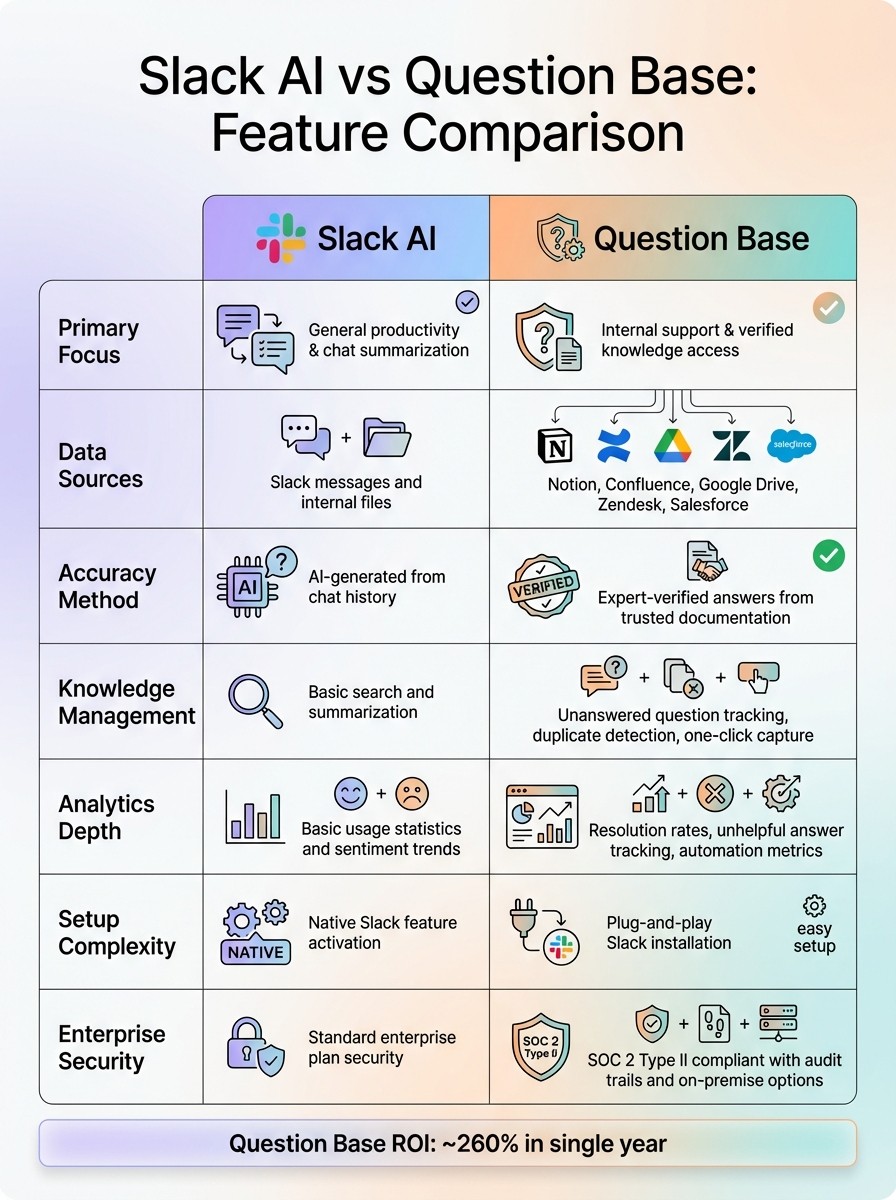
Here’s a breakdown of how Slack AI and Question Base stack up against each other:
Feature | Slack AI | Question Base |
|---|---|---|
Primary Focus | General productivity & chat summarization | Internal support & verified knowledge access |
Data Sources | Slack messages and internal files | Notion, Confluence, Google Drive, Zendesk, Salesforce |
Accuracy Method | AI-generated from chat history | Expert-verified answers from trusted documentation |
Knowledge Management | Basic search and summarization | Unanswered question tracking, duplicate detection, one-click capture |
Analytics Depth | Basic usage statistics and sentiment trends | Resolution rates, unhelpful answer tracking, automation metrics |
Setup Complexity | Native Slack feature activation | Plug-and-play Slack installation |
Enterprise Security | Standard enterprise plan security | SOC 2 Type II compliant with audit trails and on-premise options |
Slack AI’s ability to detect sentiment trends from past conversations makes it a valuable tool for understanding team dynamics. However, Question Base takes a more proactive approach by ensuring employees receive timely, accurate answers, which helps prevent negative sentiment from arising in the first place. Organizations using Question Base report an impressive single-year ROI of roughly 260% [9] by eliminating repetitive, low-value tasks. These features not only improve team morale but also provide critical support for HR, IT, and operations teams.
Enterprise Benefits of Sentiment Analysis
Expanding on earlier discussions about how sentiment analysis strengthens team dynamics, its advantages for enterprises can significantly boost overall performance.
Managing Morale Before Issues Escalate
Sentiment analysis helps leaders identify signs of frustration, confusion, or disappointment early, allowing them to address potential problems before they lead to disengagement [5]. Misalignment among employees is a pressing challenge - nearly half of those who feel disconnected from their work plan to leave within two years [3].
For instance, in 2024, Salesforce introduced its Agentforce AI agents internally to support its global workforce, including a Sales Agent that assists over 25,000 sellers. Remarkably, 86% of employees now rely on this tool, collectively saving hundreds of thousands of hours each year [1]. By catching and resolving issues early, these tools foster more effective and focused team communication.
Streamlining Communication and Collaboration
High-traffic Slack channels can often overwhelm teams with excessive chatter. Sentiment analysis helps cut through the noise by flagging messages that require immediate attention and identifying topics that may be creating tension or confusion.
Take Plative, a global technology consulting firm, as an example. By deploying three custom AI agents in Slack for their sales team, they achieved a 50% reduction in sales call preparation time and a 50% increase in upsell bookings. Additionally, this efficiency allowed the company to avoid hiring one full-time employee for every five consultants added [1]. These improvements not only enhanced team productivity but also optimized resource allocation.
Enhanced Support for HR, IT, and Operations Teams
HR, IT, and operations departments often grapple with repetitive inquiries that sap both time and energy. Research shows that desk workers spend a staggering 41% of their time on repetitive tasks [4]. Tools like Question Base, which incorporate sentiment detection, automate responses to common questions and monitor unresolved queries. This approach helps identify gaps in documentation or training materials, ensuring teams can address recurring issues effectively [3]. By reducing these time-consuming tasks, these tools free up teams to focus on more strategic work.
Conclusion
Remote teams often face challenges like misinterpreted tone, overlooked cues, and scattered information, all of which can hinder effective collaboration.
Interestingly, 80% of desk workers using AI report increased productivity [4], and one SaaS company managed to reduce engineering attrition by 22% in just two quarters using sentiment analysis within Slack [15].
These examples highlight the importance of combining dependable data with verified knowledge. While Slack AI excels at summarizing conversations, enterprises seeking accurate, trusted answers turn to Question Base. By integrating directly with platforms like Notion, Confluence, and Google Drive, Question Base provides expert-verified responses that teams can rely on.
For organizations with large workforces, AI communication analysis goes beyond gauging emotions - it’s about ensuring alignment, cutting down on repetitive tasks, and enabling teams to focus on impactful work. With nearly half of knowledge workers (47%) struggling to locate the information they need [1], tools that merge sentiment insights with instant, precise answers are crucial for maintaining productivity and cohesion.
Question Base transforms Slack into a powerful internal knowledge assistant, offering enterprise-grade security and seamless integrations to keep teams connected and efficient.
FAQs
How can sentiment analysis improve communication in remote teams?
Sentiment analysis examines the tone of Slack messages to determine if they convey positive, neutral, or negative emotions. This tool allows teams to catch potential misunderstandings or negative feelings early, enabling them to address concerns quickly and keep communication clear and effective - especially in remote work settings.
With real-time insights into team sentiment, this approach helps ensure conversations stay on track and collaborative, minimizing the chances of miscommunication and supporting a more productive and harmonious remote work environment.
How does Question Base compare to Slack AI for sentiment analysis?
Slack AI leverages natural language processing (NLP) to evaluate text from Slack channels and direct messages, assigning a sentiment score that ranges from -1 to +1. While this can provide a quick pulse on conversations, it relies entirely on chat history without cross-referencing trusted company documents for validation. Its analytics are fairly straightforward, offering sentiment scores and visualizations, positioning the tool as a general productivity enhancer.
In contrast, Question Base takes sentiment analysis to the next level by integrating insights with verified data from sources like Notion, Confluence, and Salesforce. This approach not only boosts accuracy but also ensures insights are traceable and reliable. Beyond sentiment analysis, Question Base delivers advanced operational analytics, including metrics like resolution rates and trend tracking, making it an excellent choice for HR, IT, and Ops teams. Built with enterprise-grade security and extensive customization options, it’s designed to meet the complex demands of large organizations.
How does sentiment analysis help identify and resolve remote team challenges?
Sentiment analysis examines Slack messages to determine whether their tone is positive, neutral, or negative. By spotting trends in sentiment - such as a shift toward frustration or negativity - it can flag potential issues like declining morale or growing dissatisfaction. This early detection allows leaders to step in with support or communication before small concerns turn into bigger problems.
Taking action based on these insights helps maintain a stronger, more cohesive team environment, ensuring challenges are addressed promptly and productivity remains on track.