∙
Cooper
∙
Reading time:
9 min

Repetitive questions and lost information in Slack threads slow teams down. 47% of digital workers struggle to find the information they need, leading to wasted time and frustration. Two AI tools aim to fix this: Slack AI and Question Base.
Slack AI: Summarizes threads and recaps channels to help users catch up quickly. It integrates with tools like Google Drive and Salesforce, saving time but lacks customization and detailed analytics.
Question Base: Delivers verified answers from trusted sources like Notion and Confluence. It tracks resolution rates, identifies knowledge gaps, and offers enterprise-level security and customization.
Key takeaway: Slack AI is great for quick conversation summaries, while Question Base excels at providing accurate, scalable knowledge management.
Quick Comparison:
Category | Slack AI | Question Base |
|---|---|---|
Main Function | Thread summaries, channel recaps | Expert-approved answers from docs |
Integrations | Limited external sources | Extensive (Notion, Confluence, etc.) |
Analytics | Basic usage stats | Tracks resolution rates, gaps |
Customization | Limited | High (content, tone, workflows) |
Security | Standard Slack compliance | SOC 2 Type II, encryption, on-premise |
If your team needs quick Slack summaries, choose Slack AI. For accurate information directly from trusted sources, Question Base is the better option.
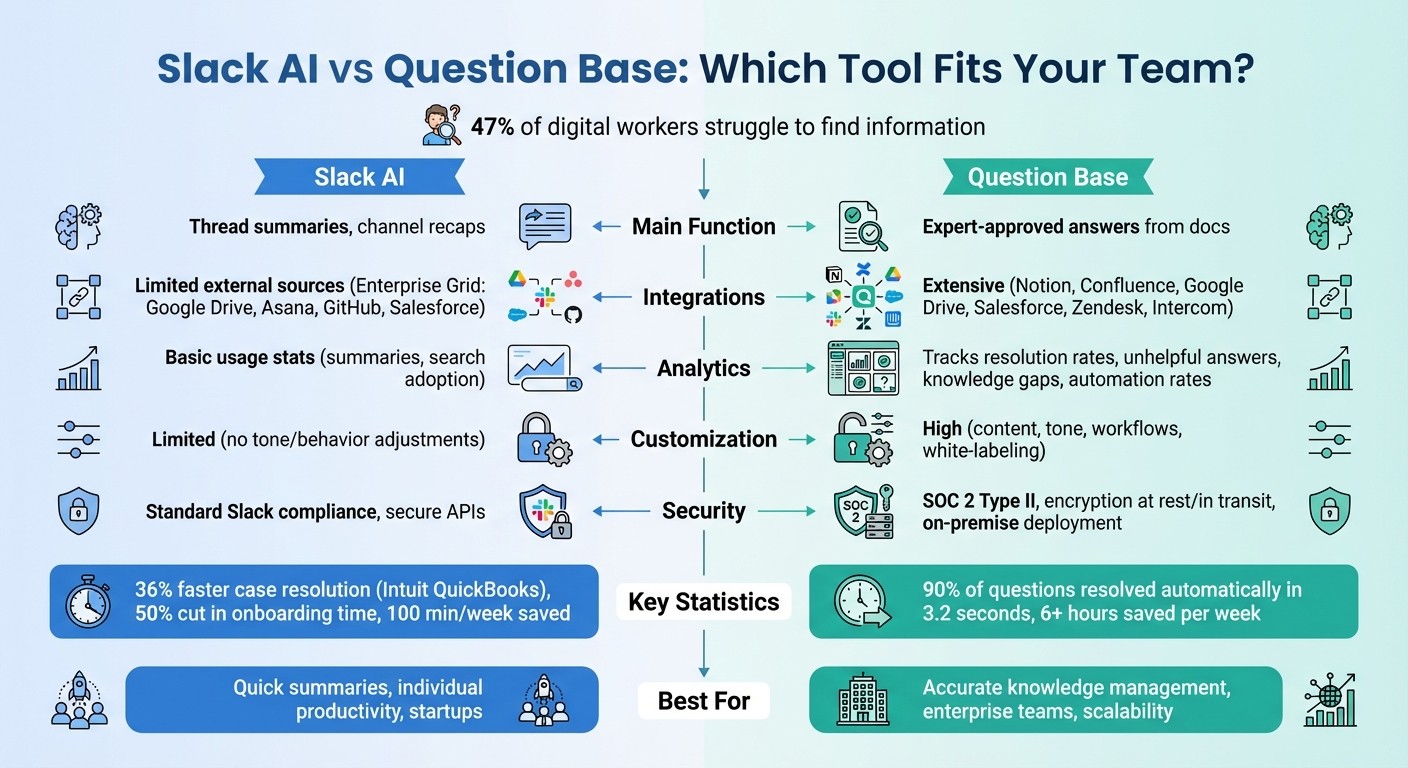
Slack AI vs Question Base: Feature Comparison for Team Communication
1. Slack AI
Slack AI serves as a productivity booster, helping users stay on top of conversations and navigate their workspace with ease. It shines when it comes to summarizing threads, creating channel recaps, and keeping everyone in the loop - without the need to sift through every message. It’s a natural extension of Slack’s core features, designed to make collaboration smoother.
Knowledge Source Integration
Enterprise Grid customers can take Slack AI to the next level by connecting it with tools like Google Drive, Asana, GitHub, and Salesforce. By leveraging natural language processing (NLP) and machine learning, Slack AI quickly understands user intent and pulls relevant data on demand. For instance, Intuit QuickBooks saw impressive results after integrating Slack’s AI-powered knowledge base: a 36% faster resolution of support cases, improved Net Promoter Scores (NPS), and a 50% cut in onboarding time. On top of that, marketers saved an average of 100 minutes per week [3]. These integrations streamline workflows and improve how teams communicate and measure their progress.
Scalability for Enterprises
Slack AI isn’t just about integrations - it’s built to scale with enterprise needs. It operates seamlessly across Enterprise Grid and multi-workspace setups, all while maintaining enterprise-grade security and permissions. During searches, customer data stays securely within Slack’s environment. However, there are some limitations. Slack AI offers little room for customization, meaning teams can’t adjust the AI’s tone, behavior, or create structured audit trails to track its activity.
Analytics & Metrics
While Slack AI delivers on functionality and scalability, measuring its impact is another story. It provides basic usage stats but falls short when it comes to deeper insights. Metrics like resolution rates, the accuracy of responses, or the effectiveness of automation aren’t available. These are crucial for understanding whether teams are finding the right information or just retrieving chat history without actionable outcomes.
2. Question Base
Question Base stands apart from Slack AI by offering verified answers directly from trusted sources, rather than summarizing chat threads. Instead of pulling information from Slack's message history, it connects to your organization’s established knowledge repositories like Notion, Confluence, Google Drive, Salesforce, Zendesk, and Intercom. This ensures employees receive accurate, expert-approved answers straight from your official documentation, creating a more dependable and actionable resource.
Knowledge Source Integration
Question Base operates as a straightforward AI agent. You can install it via the Slack App Marketplace, invite it with /invite @questionbase, and link it to your documentation platforms to start retrieving precise answers instantly. As Willem Bens, Manager of Sales North EMEA at DoIT International, explains:
"It's like having an extra person answering questions in Slack." [1]
This integration transforms how teams access information. Instead of telling employees, "Check Notion for that", Question Base fetches the details and delivers them directly within Slack conversations, saving time and effort.
Analytics & Metrics
Beyond basic usage stats, Question Base offers detailed insights into its performance. It tracks resolution rates, flags unhelpful responses, and identifies unanswered queries. These metrics provide team leaders with actionable data to spot knowledge gaps and fine-tune content. This approach ensures organizations can measure not only how often the AI is used but also how effectively it resolves issues.
Customization & Security
Designed for enterprise needs, Question Base includes SOC 2 Type II compliance, encryption both at rest and in transit, and optional on-premise deployment. It allows full customization over content, tone, and escalation workflows. For organizations on the Enterprise tier - starting at $20,000 annually - additional features include white-labeling, multi-workspace support, and tailored enhancements to meet specific needs.
Strengths and Weaknesses
Slack AI and Question Base tackle communication challenges from very different angles. While Slack AI focuses on summarizing conversations to help users quickly catch up, Question Base zeroes in on providing accurate, verified answers from trusted documentation. This distinction reflects how each tool defines and enhances communication efficiency.
Slack AI shines when it comes to navigating high-volume conversations. Its intelligent search and prioritization features are designed for general productivity, making it easy for teams to review and manage discussions. Additionally, Slack's paid Analytics Dashboard offers an AI tab that tracks adoption metrics, such as how often users rely on summaries versus other features like Canvas [5].
On the other hand, Question Base is built to deliver precise answers. It automatically resolves 90% of repetitive questions in just 3.2 seconds, saving internal experts over six hours per week [1]. As Brandon Horvatic explains:
"Question Base is incredible! We went from answering the same questions over and over, to setting it up once and it answers the same questions over and over for us." [1]
This divergence in functionality sets the stage for a deeper comparison of how each tool performs in real-world scenarios. While Slack AI provides basic usage statistics, Question Base goes further by tracking critical metrics like resolution rates, identifying unhelpful responses, and flagging knowledge gaps. These insights are essential for teams aiming to measure and improve communication effectiveness. The table below highlights the key differences:
Category | Slack AI | Question Base |
|---|---|---|
Data Sources | Primarily Slack chat history; limited external integrations on lower tiers | Integrates with Notion, Confluence, Google Drive, Salesforce, Zendesk, Intercom, and more |
Analytics | Basic usage stats (summaries, search adoption, Canvas clicks) | Tracks resolution rates, unhelpful answers, automation rates, and knowledge gaps |
Security & Compliance | Secure APIs, standard Slack compliance | SOC 2 Type II, encryption at rest and in transit, optional on-premise deployment |
Enterprise Features | General-purpose AI tool, device access without VPN [4] | White-labeling, multi-workspace support, per-channel settings, case tracking, duplicate detection |
Primary Use Case | Summarizing past conversations, intelligent search | Delivering expert-verified answers from trusted documentation |
Slack AI is ideal for boosting individual productivity, offering tools to streamline workflows and provide quick conversational context. In contrast, Question Base is designed for team-wide knowledge management, excelling in environments where accuracy, accountability, and knowledge ownership are priorities. For HR, IT, and operations teams, Question Base brings powerful analytics and integrations that Slack AI lacks.
Ultimately, the decision comes down to what your team values most: streamlined conversation summaries for day-to-day productivity or a robust system for managing and distributing verified knowledge to enhance communication across the organization.
Conclusion
Deciding between Slack AI and Question Base comes down to your team's specific goals for communication and knowledge management. Slack AI focuses on enhancing individual productivity with built-in features like meeting summaries and quick note-taking, all without requiring additional setup. This simplicity makes it a great option for teams seeking immediate, personal efficiency.
On the other hand, Question Base is tailored for enterprises needing accurate and scalable knowledge-sharing solutions. By integrating seamlessly with tools like Notion, Confluence, Salesforce, and Zendesk, it delivers expert-approved answers in an impressive average of 3.2 seconds[1]. As Monica Limanto, CEO of Petsy, puts it:
"We implemented Question Base to eliminate repetitive questions and to collate answers and information in one place... it's easy to use, intuitive and a massive time saver."[1]
For startups, Slack AI's effortless conversation summaries might be the perfect fit. Meanwhile, larger organizations stand to benefit from Question Base's enterprise-level security, multi-workspace capabilities, and in-depth analytics.
The right choice hinges on your team's priorities. If quick summaries and personal productivity are your focus, Slack AI delivers. But for enterprises prioritizing verified, scalable knowledge management, Question Base is the clear winner. With AI adoption projected to grow from 55% in 2023 to 78% in 2024[2], the demand for tools that not only streamline communication but also organize and operationalize knowledge is only increasing. This comparison further highlights how each platform reshapes internal workflows to meet evolving team needs.
FAQs
How does Question Base improve knowledge management compared to Slack AI?
Question Base transforms how teams manage knowledge in Slack by seamlessly integrating with trusted documentation platforms like Notion, Confluence, Salesforce, and Zendesk. This integration enables it to deliver expert-verified answers directly within Slack, guaranteeing both accuracy and dependability. In comparison, Slack AI primarily focuses on summarizing conversations and deriving insights from chat history.
What sets Question Base apart is its ability to build a structured, searchable knowledge base. It does this by automatically capturing key information, creating FAQs, and identifying gaps in knowledge. This approach turns short-lived Slack discussions into a lasting, evolving resource tailored to your organization's needs. By reducing repetitive questions and improving workflow efficiency, it becomes an essential tool for teams. It also offers customization options and enterprise-grade security, making it particularly beneficial for HR, IT, and operations teams that handle intricate and ever-changing knowledge bases.
While Slack AI enhances individual productivity, Question Base is designed to keep entire teams aligned by delivering quick, precise answers and organizing internal knowledge in a way that supports long-term collaboration.
What security features does Question Base offer for enterprises?
Question Base prioritizes enterprise-grade security, offering robust measures to protect sensitive data. Its key features include SOC 2 Type II compliance, encryption both at rest and in transit, and an optional on-premise deployment for organizations seeking greater control over their data. These safeguards make it a reliable choice for enterprises with a strong focus on data protection.
Can Slack AI and Question Base work together effectively?
Yes, Slack AI and Question Base work well together, offering a dynamic duo for enterprises aiming to boost productivity and streamline knowledge management. Slack AI shines when it comes to summarizing conversations and enhancing search capabilities within chat history, allowing users to quickly locate relevant information. Meanwhile, Question Base integrates seamlessly with trusted external documentation platforms like Notion, Confluence, and Salesforce, providing precise, expert-verified answers at scale.
When paired, these tools create a balanced solution: Slack AI delivers conversational insights, while Question Base adds a structured, reliable knowledge layer. Together, they minimize repetitive questions, improve response accuracy, and help ensure compliance - especially valuable for teams handling large volumes of documentation or working within regulated environments.