∙
Cooper
∙
Reading time:
10 min

AI agents like Slackbot claim to save teams up to a full workday each week by automating repetitive tasks and simplifying workflows. While Slack AI is effective for summarizing conversations and automating responses based on chat history, its limitations become evident in enterprise environments where precise, verified answers from external platforms like Notion or Confluence are essential.
Key insights:
Slackbot’s strength lies in personal productivity, helping users with tasks like meeting prep and summarization.
Limitations: It relies on Slack’s internal ecosystem, making it less effective for enterprises needing accurate answers from trusted, external knowledge bases.
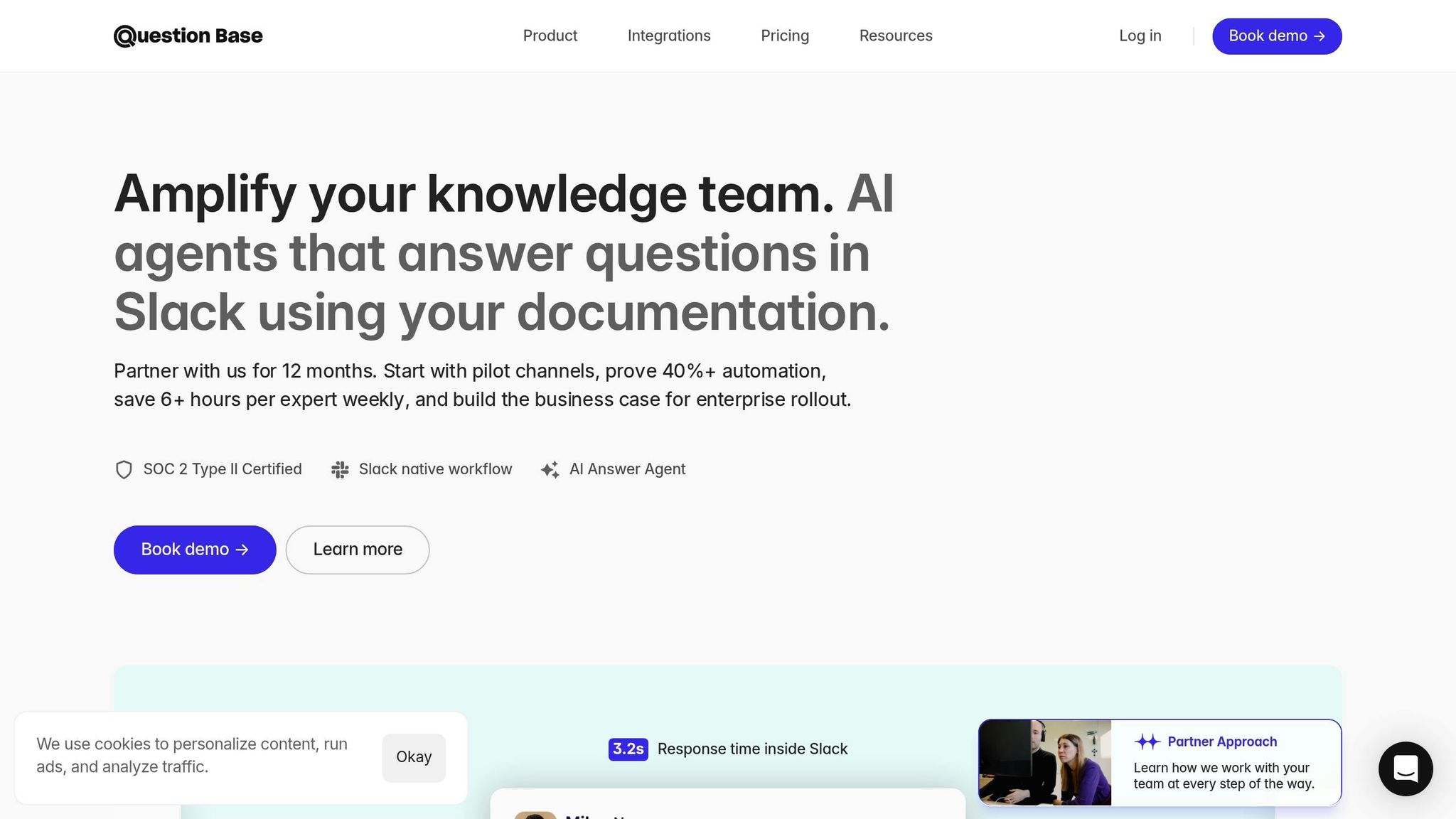
Question Base offers a solution by integrating with platforms like Salesforce and Google Drive, providing verified, up-to-date answers directly in Slack.
For enterprises, tools like Question Base can save up to 6 hours per week by automating 90% of repetitive questions, ensuring accuracy and reducing interruptions. Slackbot is great for individual workflows, but Question Base is better suited for managing large-scale internal support needs.
Supercharge Your Workflows With Slack AI
The Productivity Problem in Enterprise Slack
Slack has changed the way teams communicate, making collaboration faster and more dynamic. However, the same features that make Slack so effective also create challenges. Key information often gets buried in crowded channels, direct messages, and even emoji-laden replies. This clutter highlights the hidden costs of workplace interruptions and repetitive questions.
Repetitive Questions and Their Cost
Teams in HR, IT, and operations are no strangers to routine queries like "Where can I find the PTO policy?", "How do I reset my password?", or "What's the onboarding checklist?" These repeated questions pull experts away from their primary responsibilities, turning them into unofficial FAQ hubs. For a company with 1,000 employees, the time lost to these interruptions can add up to over $2 million annually in lost productivity[1]. Without Slack automation for high-volume teams to manage and reuse answers, experts are left juggling endless direct messages and mentions, often repeating themselves without a way to track or prioritize responses.
Knowledge Scattered Across Slack Conversations
Slack’s focus on real-time conversations over structured organization means that critical updates often vanish in the flow of discussions, casual chats, and side threads. When someone later searches for a policy or procedure, they’re more likely to stumble upon outdated or incomplete answers rather than the latest, accurate information. This inefficiency eats into productive time and, in industries like healthcare or finance, can even lead to compliance risks or costly mistakes.
Interruptions and Context Switching
Interruptions hit workers every 3 minutes on average[3], and recovering focus after each one takes an extra 23 minutes[3]. Even a brief disruption - just 2.8 seconds - can double error rates on complex tasks[4]. On top of that, employees switch between apps and websites nearly 1,200 times daily, consuming roughly 9% of their annual work hours[4]. This constant context switching not only slows productivity but also drains mental energy, leading to a 9% increase in exhaustion. It’s no wonder that 73.2% of workers report feeling overwhelmed[4]. Altogether, U.S. businesses lose between $588 billion and $650 billion each year due to these distractions[4].
Examining Slackbot's Productivity Claims
What Slackbot Claims to Deliver
Slack AI, alongside Slackbot, aims to streamline repetitive tasks by leveraging Slack message history to automate responses. Looking ahead, Slack plans to transform Slackbot into a "personalized AI companion" by early 2026. This revamped version promises to pull context from messages, files, and even calendars to assist with drafting content and summarizing meetings[2].
Reported Productivity Gains
Slack suggests its tools can save users up to a full day of work each week. While specific case studies or detailed data backing this claim haven't been shared, related statistics offer some context. Workers reportedly lose around 100 minutes daily simply by switching between apps more than 10 times[5]. Tools that reduce this kind of friction could indeed boost productivity. However, rethinking internal support in Slack is necessary because these improvements don't address the broader challenge of accessing and integrating information from multiple, trusted sources outside Slack.
Limitations of Slackbot's Approach
One critical limitation lies in Slack AI's reliance on Slack's internal ecosystem. Its functionality is largely confined to Slack's chat history, which means it cannot automatically access enterprise knowledge stored in external platforms like Notion, Confluence, or SharePoint. For example, if your PTO policy resides in Notion or compliance guidelines are saved in SharePoint, Slack AI won't surface this information unless someone explicitly shares it within Slack. This dependency can lead to inefficiencies and inaccuracies, especially when teams need precise, verified answers.
For teams in HR, IT, and operations - where compliance-sensitive questions are common - this approach falls short. These teams require information that is directly linked to reliable, up-to-date sources, not just interpretations derived from past conversations.
A Purpose-Built Alternative: Question Base in Slack
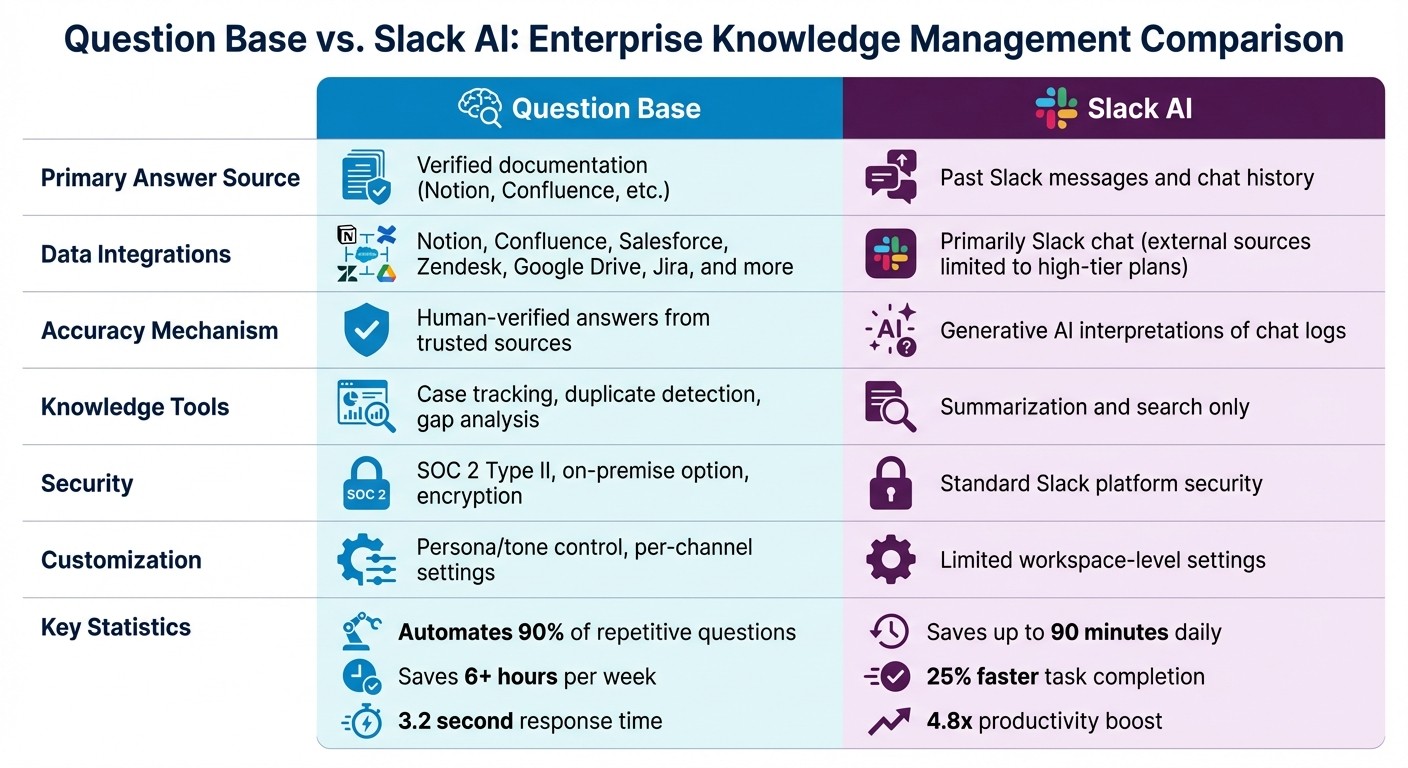
Question Base vs Slack AI Feature Comparison for Enterprise Teams
How Question Base Solves Enterprise Challenges
While Slack AI is great for overall productivity, Question Base stands out by delivering verified answers specifically tailored for internal support teams - HR, IT, and operations. These teams don’t need AI guesses based on past chats; they need accurate responses pulled directly from trusted sources.
Question Base integrates seamlessly with enterprise tools like Notion, Confluence, Salesforce, Google Drive, Zendesk, and Jira. This integration ensures answers come directly from up-to-date documentation, saving teams from wasting an average of 12 hours per week searching through disconnected systems [1]. For example, when someone asks about PTO policies, compliance guidelines, or technical steps, the response is pulled straight from your official documentation - not pieced together from Slack’s history.
Brandon Horvatic sums up the impact:
"We went from answering repetitive questions in Slack, to setting it up once and it answers the same questions over and over for us."
Question Base automates up to 90% of repetitive questions in just 3.2 seconds [1], while still allowing human oversight through answer verification and case tracking. Internal experts report saving more than 6 hours per week by automating their most common inquiries [1]. Next, let’s dive into how Question Base compares directly with Slack AI.
Question Base vs. Slackbot: Feature Comparison
The table below highlights the key differences between Question Base and Slack AI. While Slack AI focuses on general productivity, Question Base is purpose-built for managing enterprise knowledge effectively:
Feature | Question Base | Slack AI / Slackbot |
|---|---|---|
Primary Answer Source | Verified documentation (Notion, Confluence, etc.) | Past Slack messages and chat history |
Data Integrations | Notion, Confluence, Salesforce, Zendesk, Google Drive, Jira, and more | Primarily Slack chat (external sources limited to high-tier plans) |
Accuracy Mechanism | Human-verified answers from trusted sources | Generative AI interpretations of chat logs |
Knowledge Tools | Case tracking, duplicate detection, gap analysis | Summarization and search only |
Security | SOC 2 Type II, on-premise option, encryption | Standard Slack platform security |
Customization | Persona/tone control, per-channel settings | Limited workspace-level settings |
In addition to these features, Question Base offers analytics tailored for support leaders, such as resolution rates, automation percentages, and knowledge gap tracking. These insights help teams measure ROI and continuously refine their knowledge systems.
Real-World Use Cases for Question Base
Enterprise teams turn to Question Base when accuracy, accountability, and knowledge ownership are critical. Monica Limanto, CEO of Petsy, highlights its impact:
"Question Base has exceeded our expectations - it's easy to use, intuitive and a massive time saver."
A standout feature is thread capture, which simplifies scaling for growing organizations. Juraj Pal, one of the early adopters, calls it a "game-changer" for teams overwhelmed by repetitive questions. Instead of responding to the same query repeatedly, experts validate a single answer that Question Base delivers automatically to future askers.
The setup process is refreshingly simple - no engineering required. Teams can install the app directly from Slack’s marketplace, connect their documentation tools, and invite the bot into relevant channels. From there, Question Base starts answering questions immediately, with enterprise-grade security (SOC 2 Type II compliance, encryption at rest and in transit) built in from the start. For organizations needing extra control, on-premise deployment and white-labeling options are also available.
These practical benefits make Question Base a strategic investment for enterprise teams. Pricing starts at $6,000 per year, which includes hands-on setup and performance analytics - an intentional choice for teams focusing on efficient internal support [1].
Conclusion: Do AI Agents Save Time?
AI agents can save time - when they align with your enterprise's specific needs. Since its January 13, 2026 rollout, Slackbot has proven effective for personal productivity, helping users save up to 90 minutes daily by simplifying meeting prep and canvas creation. Organizations have reported 25% faster task completion and a 4.8x boost in productivity as a result [6].
However, these benefits primarily address individual workflows rather than the demands of enterprise-scale support. Slackbot excels at summarization and meeting preparation but struggles to meet the precise needs of teams managing large volumes of internal queries across HR, IT, and operations. Relying on AI that interprets past Slack messages alone can create accuracy gaps - especially in areas where compliance, accountability, and verified knowledge are non-negotiable.
This is where Question Base steps in to bridge the gap. By integrating directly with trusted documentation platforms like Notion, Confluence, and Salesforce, it ensures verified answers and provides actionable analytics, as highlighted earlier [1].
The promise of reclaiming a full day of work per week is achievable - but only with the right tool for the job. Slackbot is a great fit for individual task acceleration, while Question Base is designed to keep teams aligned by operationalizing knowledge at scale. For organizations prioritizing accuracy and reliability, the choice is clear.
FAQs
How does Question Base boost productivity compared to Slackbot?
Question Base enhances team productivity by delivering expert-verified answers sourced directly from trusted platforms like Notion, Confluence, and Salesforce. Unlike AI-generated replies that rely solely on Slack messages, this approach ensures teams receive accurate and dependable information quickly - a critical advantage for HR, IT, and operations teams that depend on precision.
The platform also offers robust features such as case tracking, duplicate detection, and analytics. These tools not only help measure resolution rates but also uncover knowledge gaps, streamline workflows, and cut down on repetitive inquiries. While tools like Slackbot and Slack AI are great for tasks like summarizing conversations, Question Base is specifically designed to deliver trustworthy answers and produce measurable improvements for enterprise support teams.
What challenges does Slackbot face in supporting enterprise teams?
Slackbot can be a handy tool for boosting productivity in general, but it often falls short when it comes to supporting enterprise teams effectively. Its responses are built on Slack message data, which limits both the depth and accuracy of the information it provides. This makes it unreliable for managing complex or critical tasks, especially in support workflows where precision is non-negotiable. Slackbot’s reliance on chat history can also lead to inconsistent or incomplete answers, further complicating operations.
Another key drawback is its lack of advanced knowledge management features. For example, Slackbot doesn’t offer case tracking, duplicate question detection, or seamless connections with external tools like Notion or Confluence. These are essential for scaling support in larger organizations. Without them, teams often deal with repeated questions, slower workflows, and rising operational costs. For environments that demand reliable, consistent, and scalable solutions, Slackbot may not be the best fit.
How does Question Base provide accurate and reliable answers?
Question Base prioritizes accuracy and reliability by sourcing answers directly from trusted, expert-approved systems like Notion, Confluence, Salesforce, and other enterprise content platforms. Unlike Slack AI, which primarily pulls from chat history to generate responses, Question Base taps into authoritative documentation, guaranteeing answers that are precise and easy to verify.
This method reduces the chance of misinformation, aligns with enterprise compliance standards, and ensures teams have access to reliable, up-to-date knowledge that fits seamlessly into their workflows.