∙
Cooper
∙
Reading time:
9 min

Slackbot’s new AI features are designed to boost individual productivity, while Question Base delivers precise, organization-wide knowledge management.
On January 13, 2026, Slack launched an upgraded Slackbot for Business+ and Enterprise+ users, introducing advanced AI capabilities like conversational search, file analysis, and content drafting. It simplifies daily tasks by summarizing meetings, analyzing documents, and drafting emails - saving employees time.
However, Slackbot focuses on personal workflows and relies on Slack chat history, which can lack accuracy for enterprise needs. This is where Question Base excels. It connects directly to verified documentation platforms like Notion, Salesforce, and Confluence, ensuring employees receive reliable answers with source attribution. It also automates repetitive inquiries, saving internal experts over 6 hours weekly while improving team efficiency.
For enterprises, Slackbot supports personal productivity, while Question Base ensures dependable, scalable knowledge management. A hybrid approach often works best, combining Slackbot’s AI for individual tasks with Question Base for handling verified organizational knowledge.
Here’s a quick comparison:
Feature | Slackbot | Question Base |
|---|---|---|
Core Focus | Personal productivity | |
Data Sources | Slack chats, internal tools | Trusted platforms (Notion, Salesforce) |
Accuracy | Relies on Slack history | Verified, expert-approved responses |
Security | Slack AI Guardrails | SOC 2 Type II, encryption, on-premise |
Best Use Case | Summarizing, drafting, quick tasks | Answering HR, IT, and policy questions |
Slackbot is ready-to-use and ideal for quick tasks, while Question Base transforms Slack into a trusted knowledge hub for enterprise teams. Choose based on whether you need personal efficiency, reliable knowledge, or both.
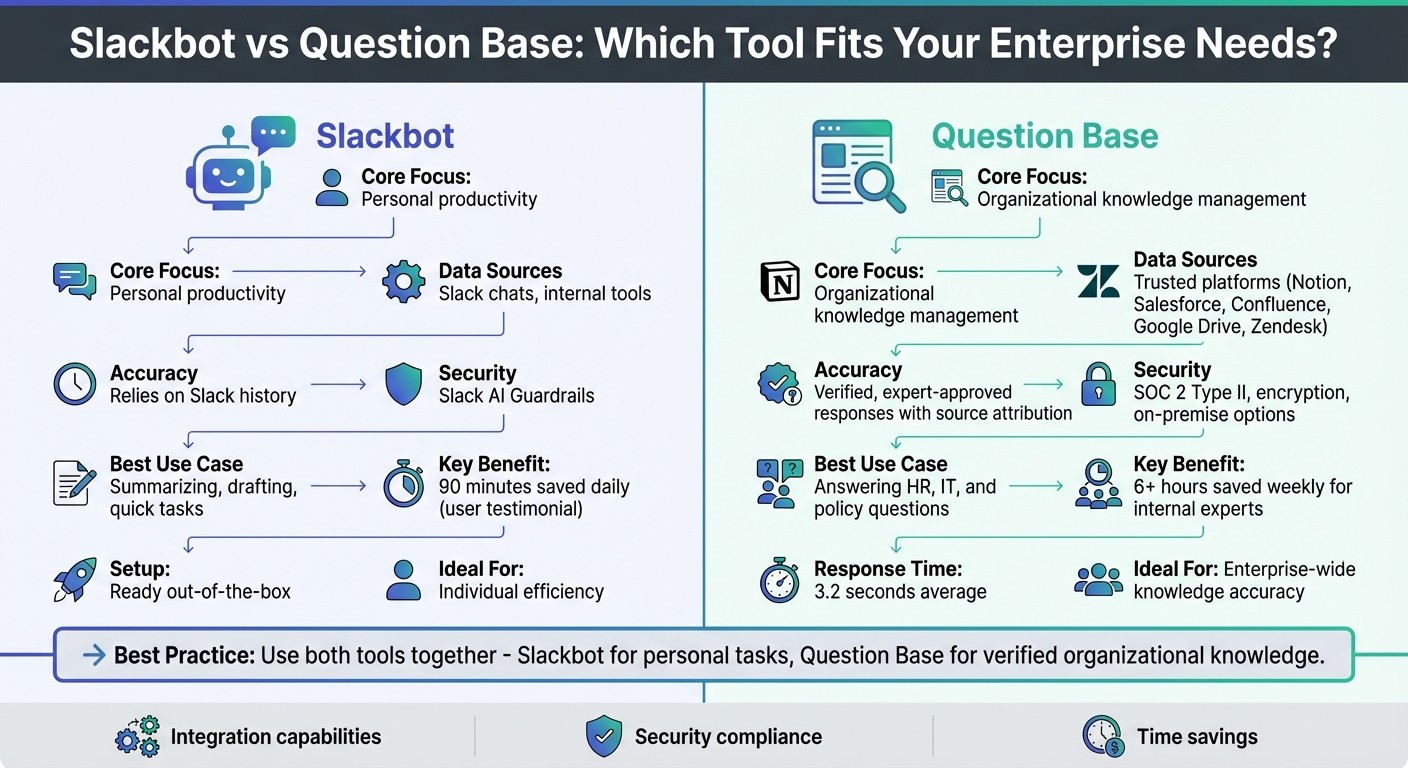
Slackbot vs Question Base: Feature Comparison for Enterprise Teams
1. Slackbot
Core Features
Slackbot's latest iteration represents a full transformation, evolving from a simple notification tool into what Slack refers to as a "personal, context-aware AI agent." The best part? It’s ready to go out of the box - Business+ and Enterprise+ users can activate it instantly via the Slackbot icon, with no training required.
This upgraded Slackbot tackles three primary tasks: conversational search, file analysis, and content drafting. Unlike traditional keyword-based tools, Slackbot engages in reasoning and adapts to the user’s communication style. It can sift through complex documents like PDFs, spreadsheets, transcripts, and slide decks to pull out key data points or identify trends. When it comes to drafting, it creates initial versions of customer emails, meeting outlines, and project briefs - saving significant time.
One Salesforce user shared their experience:
Slackbot saves me 90 minutes daily. I asked it to create a canvas for a meeting, and in 17 seconds it delivered a superior draft [1].
These enhancements position Slackbot as a powerful tool for enterprise-level productivity.
Enterprise Security and Compliance
Slackbot doesn’t just focus on functionality - it’s built with enterprise security as a top priority. Operated under Slack AI Guardrails, it ensures that data remains secure and protected. It respects existing enterprise roles and permissions, only providing access to information the user is authorized to view. Additionally, real-time protections are in place to guard against threats like phishing and prompt injection attacks.
Integration Flexibility
Slackbot also shines in its ability to integrate seamlessly with third-party agents, such as Agentforce, without compromising security or permissions. While its primary role is to synthesize information from Slack channels, huddles, canvases, and connected tools, this integration capability enables it to manage tasks across multiple systems, delivering tailored insights for each user’s unique context.
2. Question Base
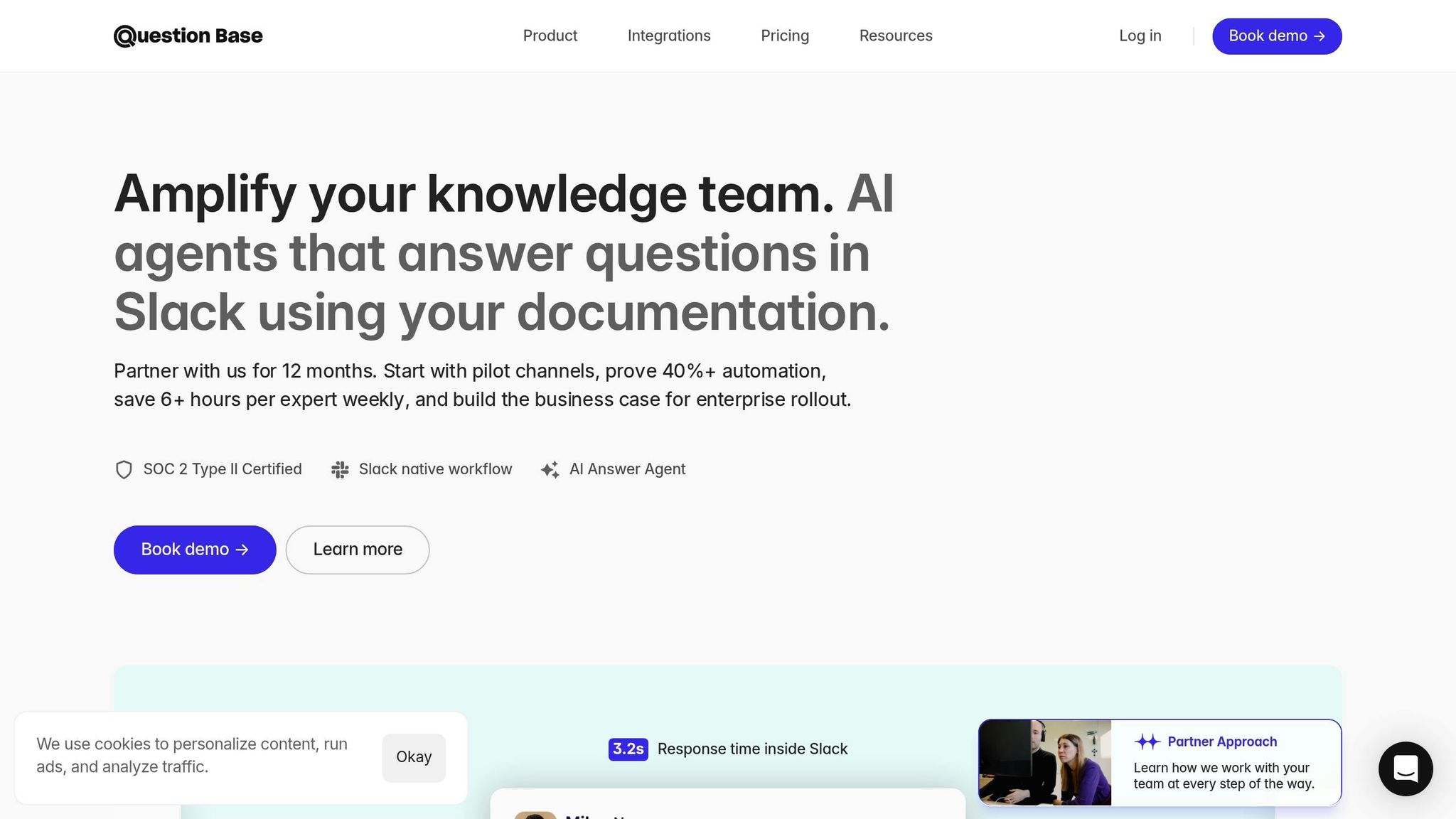
Core Features
Question Base stands apart from Slack AI by focusing on delivering verified answers. While Slack AI shines at summarizing past conversations or drafting content, Question Base connects directly to your organization's trusted documentation sources - platforms like Notion, Confluence, Salesforce, Google Drive, and Zendesk. Instead of relying on prior chats, it ensures employees receive answers drawn from expert-approved materials.
Team members can ask questions naturally within Slack, and Question Base responds instantly, complete with source attribution for transparency. If it can’t find an answer, it flags the gap and escalates the query to the appropriate experts, continually improving the knowledge base over time.
"It's like having an extra person answering questions in Slack" [2].
This direct access to verified information sets a strong foundation for effective knowledge management.
Knowledge Management Capabilities
Question Base goes beyond just answering questions - it transforms how knowledge flows through an organization. Unlike Slack AI, which centers on individual productivity, Question Base is tailored for enterprise-wide knowledge management. It identifies unanswered questions, flags duplicate queries, and delivers analytics on resolution rates and automation performance. By automating repetitive inquiries, internal experts reclaim an average of 6+ hours per week [2], allowing them to focus on complex challenges that require their expertise.
Additionally, the platform turns one-off Slack conversations into permanent, searchable documentation. This shift transforms Slack from a fleeting communication tool into a dynamic knowledge repository that grows alongside your organization.
Enterprise Security and Compliance
For organizations where precision, accountability, and data governance matter, Question Base is built to meet the highest standards. It is SOC 2 Type II certified, encrypts data both at rest and in transit, and offers role-based access with detailed audit logs. For teams with strict data residency requirements, it even provides an on-premise deployment option, making it ideal for HR, IT, and operations teams managing sensitive information.
Organizations maintain complete control over what content the AI accesses, how it responds, and when it should escalate to human support. This flexibility ensures that Question Base aligns seamlessly with your security protocols and compliance needs, adapting to your organization rather than the other way around.
Slack School | Meet Slackbot, your AI Agent for Work
Strengths and Weaknesses
Looking beyond the feature comparisons, let’s dive into the specific strengths and weaknesses of Slack AI and Question Base in enterprise settings.
Slack AI and Question Base each bring unique benefits to the table, tailored to distinct needs - individual productivity versus enterprise knowledge management. Slack AI shines in boosting individual productivity, offering tools like conversation summaries, message drafting, and information retrieval from past chats. However, its reliance on unverified Slack chat history can lead to accuracy gaps, especially for teams that require precise, up-to-date information. For instance, when HR needs to distribute official policies or IT must share exact security protocols, informal Slack chats may not provide the most reliable or current answers. On the other hand, Question Base connects directly to expert-verified sources - such as Notion, Confluence, and Salesforce - ensuring that responses are always rooted in official, approved documentation.
Integration capabilities further distinguish the two tools. Slack AI primarily focuses on internal Slack data and Salesforce, while Question Base offers native integrations with a wider range of platforms, including Google Drive, Zendesk, Intercom, and Dropbox. This broader connectivity is especially valuable for organizations managing knowledge across multiple platforms, not just Slack. These integration differences clearly define the distinct roles of each tool within an enterprise.
Security and customization are additional areas where Question Base stands out. With SOC 2 Type II certification, enterprise-grade encryption, and on-premise deployment options, it’s designed to meet the needs of regulated industries handling sensitive data. Moreover, organizations have granular control over AI behavior, content access, and escalation workflows - making it a robust choice for enterprise knowledge management, as opposed to Slack AI’s focus on individual efficiency.
Conclusion
Deciding between Slack AI and Question Base hinges on your organization’s priorities: enhancing individual productivity or streamlining enterprise-level knowledge management. Slack AI excels at summarizing conversations, drafting messages, and helping employees stay updated on meetings - all seamlessly integrated into your existing Slack setup. For teams focused on personal efficiency and general productivity, it’s a straightforward, no-setup option.
But if your organization frequently faces repetitive questions from HR, IT, or Operations teams, Question Base is designed to tackle that specific problem. It connects directly to trusted documentation platforms like Notion, Confluence, and Salesforce, ensuring responses come from verified sources rather than informal chat threads. UX Lead Maria Jensen from Ticketbutler highlights its impact, noting that Question Base reduces search times from 5–10 minutes to just seconds [2]. With an average response time of 3.2 seconds and the ability to save internal experts over six hours weekly, it transforms how support teams operate [2].
For organizations with strict compliance requirements, the differences become even more pronounced. Question Base offers SOC 2 Type II certification, enterprise-grade encryption, and on-premise deployment options - key features for environments needing secure audit trails and verified information.
Many large enterprises find that they don’t need to choose between the two tools. A hybrid approach often works best: Slack AI for everyday productivity and meeting recaps, and Question Base for policy-driven support channels where accuracy and documentation are critical. Starting at $500/month with a year-long pilot, Question Base also provides dedicated implementation support to help you build a reliable knowledge management system from day one [2].
Ultimately, the decision depends on whether you’re optimizing for individual efficiency, organizational knowledge accuracy, or both. Each tool plays a distinct role in addressing these needs.
FAQs
How does Slackbot help improve personal productivity?
Slackbot enhances personal productivity by offering support that aligns with each user's role and responsibilities. It keeps individuals organized and on track by providing actionable insights and automating workflows tailored to their specific tasks.
By handling repetitive chores and sending timely reminders, Slackbot frees up employees to concentrate on more critical work. This reduces the time wasted searching for information or dealing with manual processes, allowing teams to work more efficiently.
What are the key advantages of using Question Base for managing enterprise knowledge?
Question Base delivers reliable, verified answers by tapping into trusted sources such as Notion, Confluence, Salesforce, and Google Drive. Unlike Slack AI, which focuses on extracting information from chat history, Question Base ensures responses are grounded in authoritative documentation, offering accuracy and compliance you can count on.
Tailored for enterprise teams in HR, IT, and operations, it comes packed with features like case tracking, duplicate detection, analytics, and SOC 2 compliance. These tools help organizations streamline support workflows, pinpoint knowledge gaps, and safeguard data. By consolidating knowledge and cutting down on repetitive questions, Question Base boosts efficiency and keeps teams aligned and productive.
How can using both Slackbot and Question Base benefit enterprises?
Using Slackbot and Question Base together offers enterprises a well-rounded solution to meet diverse needs. Slackbot shines in summarizing conversations and providing quick, context-aware help based on Slack’s internal data. This makes it great for boosting individual productivity and addressing immediate, informal questions. Meanwhile, Question Base connects to trusted sources like Notion, Confluence, and Salesforce, delivering precise, expert-verified answers at scale. It’s particularly suited for managing complex or high-volume queries where accuracy and compliance are non-negotiable.
By integrating these tools, enterprises can simplify workflows - leveraging Slackbot for instant, on-the-spot support and Question Base for structured, dependable knowledge management. This combination reduces repetitive inquiries, enhances efficiency, and ensures teams can access both quick insights and reliable information exactly when they need it.