∙
Cooper
∙
Reading time:
12 min

Repetitive questions waste time. Teams using Slack face a common problem: finding accurate, up-to-date answers quickly. While generative AI can produce text, it often lacks the context needed for enterprise workflows. The solution? Context-aware AI - technology that delivers precise answers by connecting directly to verified company data.
Key takeaways:
97 minutes saved per week: Context-aware AI reduces time spent searching for information.
37% faster decisions and 36% quicker customer responses: AI bridges Slack discussions with trusted data sources like Notion and Salesforce.
90% of repetitive questions automated: Context-aware AI ensures responses are accurate and grounded in real-time data.
Unlike generative AI, which risks inaccuracies, context-aware tools prioritize reliability. Slack’s Real-Time Search API and Model Context Protocol enable this by securely accessing and integrating team data. Tools like Question Base go further, connecting Slack to official documentation for expert-reviewed, traceable answers at scale.
If your Slack team struggles with scattered knowledge and repetitive queries, context-aware AI could transform how you work.
Why Context Matters in Enterprise AI Workflows
What Context-Aware AI Means
Context-aware AI tailors its responses by considering the asker's role and the specific business situation. Unlike generative AI - which is skilled at producing polished text - context-aware AI focuses on delivering accurate answers rooted in verified business logic and real organizational data.
Take this example: the question "How did sales perform last quarter?" could mean vastly different things to a CFO compared to a regional sales manager. The CFO might want a high-level overview of company-wide revenue, while the sales manager could be looking for regional performance metrics. Context-aware AI handles these nuances by leveraging situational awareness, adapting in real time, and mapping relationships within the organization.
As employees refine their questions, correct AI responses, and adjust searches, context-aware AI builds an institutional memory. Over time, it evolves from being just another tool to becoming an integral part of understanding and addressing your organization's specific needs.
Where Generative AI Falls Short Without Context
Generative AI often delivers answers with confidence - even when those answers are wrong. Without a firm grasp of how an organization defines its metrics or why certain data points are relevant, it risks producing misleading or inaccurate results. On the other hand, context-aware AI prioritizes accuracy alongside clarity, ensuring its responses are both trustworthy and actionable.
Another challenge with generative AI and traditional business intelligence tools is their reliance on outdated or static data. When real-time changes occur - like sudden demand spikes, supplier delays, or customer cancellations - decisions based on stale data can lead to costly mistakes. This gap highlights the importance of Slack's advancements in supporting context-aware AI, which is designed to stay aligned with dynamic, real-time enterprise workflows. This requires organizations to architect for continuous AI innovation to maintain accuracy as data evolves.
Panel 3: From Recall to Context Aware Reasoning | Future of Data and AI | Agentic AI Conference
How Slack Supports Context-Aware AI
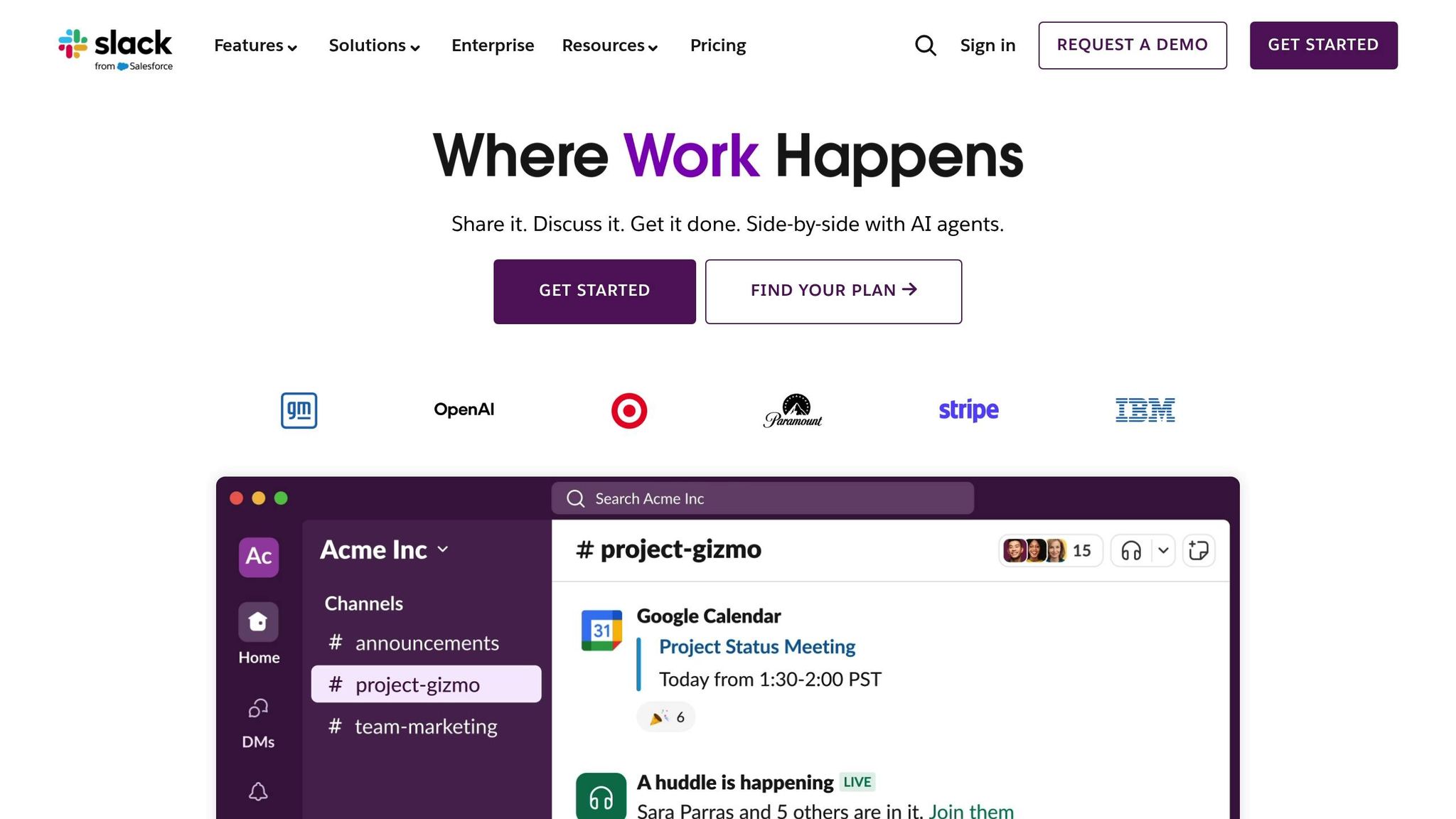
Slack has laid the groundwork for AI agents to deliver responses tailored to real organizational contexts through two essential features: the Real-Time Search API and the Model Context Protocol. These innovations ensure AI tools are integrated seamlessly into Slack, leveraging up-to-date team data to provide relevant and accurate responses.
Real-Time Search API: Tapping Into Team Data
The Real-Time Search (RTS) API allows AI agents to access Slack messages, threads, and files in real time while adhering to enterprise security permissions [7][8]. Unlike traditional systems that might require exporting entire conversation histories to external databases, this API lets AI tools query specific information as needed, without compromising security.
"The RTS API is designed with enterprise security at its core, enabling tools to interact with customers' conversational data without needing to bulk download it or store it elsewhere." - Salesforce [7]
AI agents utilize the search:read.public scope to access data from public channels where the user is a member, ensuring that information retrieval aligns with Slack's permission settings [6][9]. This direct, real-time access is a key component in enabling AI tools to deliver relevant insights while maintaining data integrity.
Model Context Protocol: Bridging AI and Slack
Building on the real-time data capabilities of the RTS API, the Model Context Protocol (MCP) standardizes how AI agents interact with Slack data. MCP ensures that large language models only retrieve the specific information necessary to answer a query, minimizing irrelevant data and improving response accuracy [7][8].
"By connecting to Slack through the MCP server, we can now ground queries in the context of team conversations - helping users surface answers that are not only accurate but directly relevant to their work." - Frank te Pas, Head of Enterprise Product, Perplexity [7]
With over 1.7 million apps actively used on Slack each week [7], MCP provides the framework needed for AI tools to operate effectively across various workflows, ensuring they remain context-aware and efficient at scale.
Question Base vs. Slack AI: A Comparison
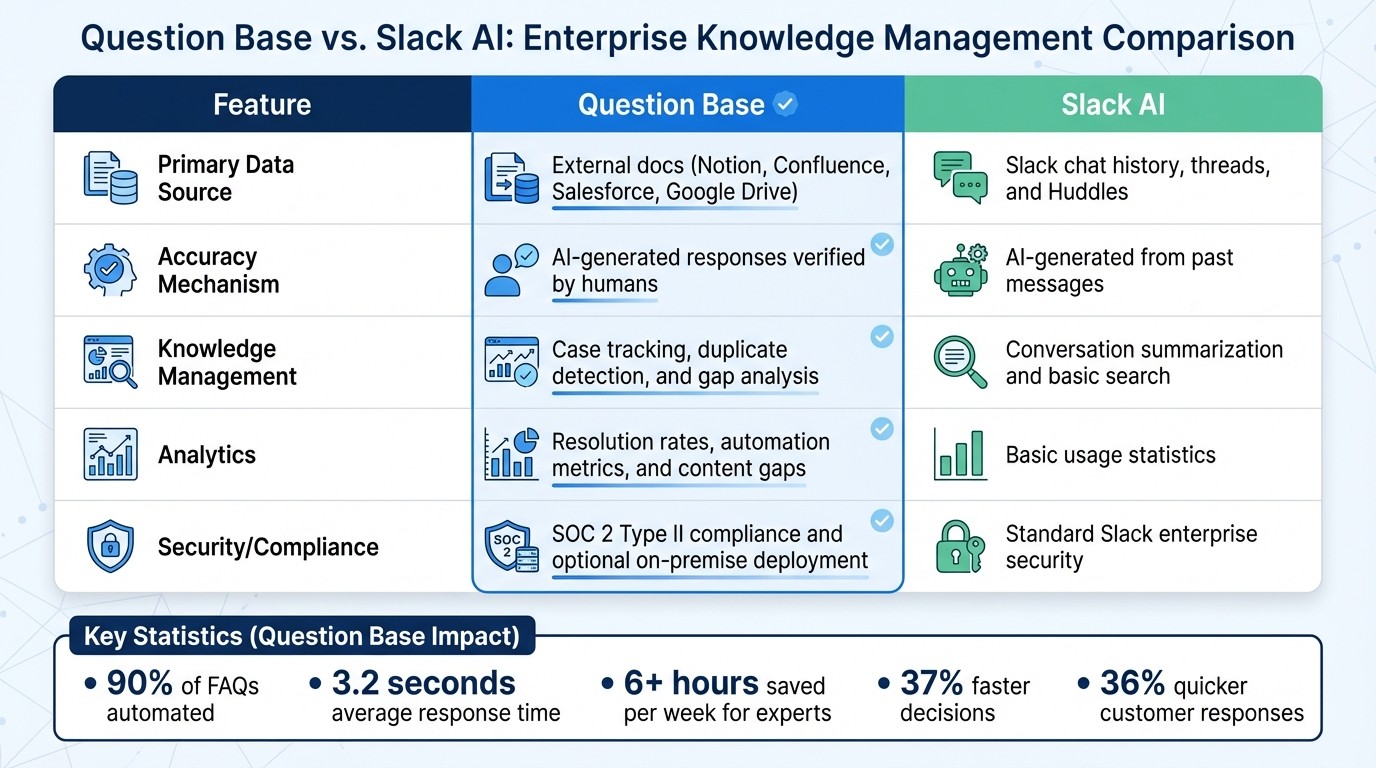
Question Base vs Slack AI: Enterprise Knowledge Management Features Comparison
When it comes to enterprise AI, context is everything. Let’s break down how Slack AI and Question Base approach this challenge. Slack AI focuses on summarizing conversations and pulling information from chat history, while Question Base is designed specifically for enterprise knowledge management. It connects directly to trusted sources like Notion, Confluence, Salesforce, and Google Drive to deliver verified, expert-reviewed answers at scale.
Verified Knowledge vs. Generated Responses
Slack AI relies on chat history, threads, and Huddles to generate responses [4]. This method is effective for recapping meetings or retrieving past decisions but can be limited by the informal, incomplete, or outdated nature of conversational data.
On the other hand, Question Base pulls answers from official documentation and verifies them through expert review. This ensures responses are accurate, up-to-date, and traceable to your organization’s trusted sources. Monica Limanto, CEO of Petsy, highlights the benefits:
"We implemented Question Base to eliminate repetitive questions... It's easy to verify answers as new questions come along" [3].
This approach guarantees that every response aligns with your company’s approved knowledge base.
Enterprise Features Compared
While both tools prioritize enterprise data security, their functionalities cater to different needs. Slack AI uses permissions-based access to conversational data and integrates with the Slack Marketplace for scalability [4]. Question Base, however, offers additional enterprise-grade features like SOC 2 Type II compliance, on-premise deployment options, and advanced analytics to track resolution rates, automation performance, and knowledge gaps across HR, IT, and operations.
Feature | Question Base | Slack AI |
|---|---|---|
Primary Data Source | External docs (Notion, Confluence, Salesforce, etc.) | Slack chat history, threads, and Huddles |
Accuracy Mechanism | AI-generated responses verified by humans | AI-generated from past messages |
Knowledge Management | Case tracking, duplicate detection, and gap analysis | Conversation summarization and basic search |
Analytics | Resolution rates, automation metrics, and content gaps | Basic usage statistics |
Security/Compliance | SOC 2 Type II compliance and optional on-premise deployment | Standard Slack enterprise security |
A standout feature of Question Base is its ability to identify knowledge gaps - unanswered questions the AI encounters - and flag them for expert review. This creates a continuous improvement cycle for the knowledge base. Slack AI, by contrast, does not offer the same level of governance or lifecycle management for content.
When to Use Each Tool
Slack AI shines when you need to summarize threads or quickly extract conversational context to speed up decisions. It’s particularly effective for individual productivity, with studies showing it can accelerate decision-making by 37% through real-time integration with chat history [4].
For teams requiring verified and auditable answers at scale, Question Base is the better fit. It's ideal for HR onboarding, IT troubleshooting, and compliance-related inquiries where accuracy and traceability are critical. Linn Stokke, Online Events & Marketing Specialist at Ticketbutler, shares her experience:
"Since we started using QB we haven't used our Google support docs. And if I go on vacation or sick leave, I feel comfortable that QB will just take over" [3].
Slack AI is a powerful tool for personal efficiency, while Question Base is tailored for authoritative, organization-wide knowledge management. With a 90% automation rate on FAQs and an average response time of 3.2 seconds, Question Base saves internal experts over 6 hours per week [3][2].
How to Build a Context-Driven Knowledge Strategy in Slack
To create a context-aware AI strategy in Slack, focus on connecting reliable documentation, automating repetitive questions, and using real-world data to refine performance.
Connecting Your Knowledge Sources
Start by integrating your documentation tools into Slack using the RTS API and MCP. These technologies enable AI agents to pull live data from platforms like Notion, Confluence, Salesforce, and Google Drive, all while adhering to user permissions [4][5].
Teams that use the RTS API have seen decisions made 37% faster and response times improve by 36% [4]. With Question Base, you can connect these trusted platforms to deliver verified answers in seconds [3].
To set this up, install the necessary apps, grant access to your documentation, and configure settings for each Slack channel to control how the AI delivers answers. This creates a centralized system where employees can ask questions in Slack and receive responses sourced from your organization’s most reliable data - not just from chat history.
After integration, striking the right balance between automation and human review becomes essential to maintain quality and accuracy.
Combining AI Automation with Human Review
AI works best when it handles routine questions on its own while escalating more complex or sensitive inquiries to human experts. Question Base achieves this through expert verification workflows: the AI drafts responses based on connected documentation, but team members review and approve these answers before they’re added to the permanent knowledge base [1][2].
Set up clear escalation processes to ensure the AI routes complex queries to the right experts. For example, HR-related questions can go to People Ops, while IT issues can be directed to the tech team. This avoids bottlenecks and ensures responses are accurate. With Question Base, expert-approved answers are stored and reused, cutting down on repetitive questions [3].
Keep an eye on analytics to identify unhelpful AI responses. This helps pinpoint areas where expert input is needed. Organizations using this method report automating 90% of FAQs, saving experts over 6 hours per week [3][2].
Once automation and human input are aligned, tracking performance becomes the next step to fine-tune the system and address any gaps.
Tracking Performance and Making Improvements
Analytics are key to measuring success. Monitor resolution rates, response times, and gaps in your knowledge base. Pay attention to how often the AI resolves questions on the first attempt, which queries remain unanswered, and where employees are spending the most time searching for information.
Question Base offers detailed dashboards that highlight automation rates, resolution times, and content gaps - unanswered questions that reveal missing documentation. This creates a feedback loop: when the AI flags a gap, experts can update or create the relevant content, allowing the knowledge base to grow automatically.
Regularly audit your content to address flagged gaps and refresh high-demand topics. This data-driven approach ensures your AI strategy stays aligned with your organization’s evolving needs, keeping responses accurate and relevant over time.
Conclusion
The future of AI in Slack hinges on context, not just its ability to generate content. While Slack AI is great for summarizing conversations and helping individuals catch up on discussions, enterprise teams require accurate answers sourced from trusted documentation.
This is where context-aware tools like Question Base step in. By integrating directly with platforms like Notion, Confluence, and Salesforce, Question Base delivers expert-verified responses in an average of just 3.2 seconds [3]. Companies adopting this approach have managed to automate 90% of repetitive questions [3], save internal experts over 6 hours per week [2], and cut down manual workloads by 35% in the first month alone [1].
Slack AI enhances personal productivity, whereas Question Base ensures team alignment by providing a dependable knowledge base - without disrupting existing workflows. Considering that 80% of employees prefer asking questions in chat over searching a wiki [3], seamless integration with current practices is crucial.
A strategy built around context bridges the gap between trusted documentation and automation, balances machine efficiency with human oversight, and tracks performance to address knowledge gaps. For enterprises prioritizing precision, accountability, and scalable support, context isn’t just helpful - it’s essential.
FAQs
How does context-aware AI make Slack more effective for decision-making?
Context-aware AI enhances decision-making in Slack by tapping into trusted platforms like Notion, Confluence, and Salesforce to deliver accurate, verified answers tailored to your company’s specific needs. Unlike generic AI systems that primarily depend on Slack chat history, this technology integrates with your unique workflows, policies, and institutional knowledge, ensuring responses align with your internal standards.
By understanding the context of each query - whether it’s about ongoing projects or departmental protocols - it minimizes repetitive questions, accelerates workflows, and empowers teams to make quicker, better-informed decisions. This transforms Slack into a powerful knowledge hub, driving productivity and maintaining compliance in environments where precision is critical.
Why is context important for generative AI in enterprise settings?
Generative AI often struggles in enterprise settings where accuracy, trust, and relevance are non-negotiable. Without access to trusted company knowledge bases like Notion, Confluence, or Salesforce, these models rely on patterns from large datasets or chat history alone. The result? Answers that can be outdated, incomplete, or outright incorrect - especially in critical areas like HR, IT, or compliance, where precision is everything.
Solutions like Question Base overcome these pitfalls by connecting directly to verified company sources. This ensures responses are not only accurate but also aligned with organizational policies and ready for audits. By tapping into institutional knowledge, tools like these deliver reliable support, boosting productivity and enabling smarter decision-making across teams.
How does Question Base deliver more accurate answers than Slack AI?
Question Base ensures precise and dependable answers by tapping directly into trusted enterprise knowledge hubs like Notion, Confluence, Salesforce, and others. Unlike systems that rely on Slack chat history, it draws from verified documentation, guaranteeing responses that align with your organization's official guidelines and data.
This method minimizes the chances of misinformation, making Question Base a game-changer for HR, IT, and operations teams, where accuracy and adherence to policies are non-negotiable. With its focus on expert-approved content, it empowers teams to remain efficient and confidently aligned with organizational standards.