∙
Cooper
∙
Reading time:
18 min

Slackbot is no longer just a notification tool - it’s now a powerful AI assistant designed to streamline work inside Slack. Salesforce’s latest update transforms Slackbot into a context-aware AI hub that connects tools like Salesforce CRM, Google Drive, and OneDrive, enabling employees to work faster and smarter without switching apps.
Key Highlights:
Time Savings: Internal trials showed Slackbot saving employees 2 to 20 hours per week by automating repetitive tasks like summarizing conversations, preparing meeting briefs, and updating CRM records.
Contextual AI: Slackbot pulls live data from connected tools, prioritizing relevant information based on user activity and conversations.
Workflow Automation: Features include summarizing and verifying lengthy threads, automating IT support, and preparing meeting materials in seconds.
Cross-Platform Integration: Slackbot integrates with enterprise tools, reducing the need for app switching and centralizing workflows in Slack.
While Slackbot excels at improving productivity, its reliance on chat history may limit accuracy for tasks requiring verified answers. For teams managing sensitive or compliance-heavy knowledge, specialized tools like Question Base offer better accuracy by pulling from trusted documentation platforms like Notion and Confluence.
Quick Overview:
Who benefits? Sales, marketing, IT, and operations teams looking to reduce repetitive tasks and improve collaboration.
What’s the trade-off? Slackbot is fast but may lack the precision needed for verified knowledge. Tools like Question Base fill this gap.
ROI Impact: Companies like Salesforce saved 16,800 hours annually by automating IT workflows with Slackbot.
Slackbot is a step forward for conversational AI in enterprise workflows, but pairing it with tools like Question Base ensures both speed and accuracy for critical tasks.
Core Features of AI-Powered Slackbot
The updated Slackbot is more than just a messaging assistant - it's a context-aware tool designed to pull together data from conversations, files, and enterprise systems. Instead of merely finding documents like traditional search tools, it processes and synthesizes information in real time, delivering tailored insights directly within your workflow.
Contextual Intelligence and Real-Time Responses
What sets Slackbot apart is its ability to understand who you are, what you're working on, and what you need at that moment. By analyzing signals like active channels, collaborators, and scheduled events, it prioritizes the most relevant data. When you ask a question, Slackbot doesn’t just search Slack; it pulls live data from connected tools such as Salesforce CRM, Google Drive, and OneDrive via a live data API.
For instance, Salesforce users can query account details, check deal statuses, or even update CRM records using natural language - all without leaving Slack. Importantly, the AI respects enterprise security protocols, only accessing data you’re authorized to view and providing clear citations for every response.
"Because so much of our work happens in Slack, Slackbot already understands our world. I don't have to write a long brief to get it up to speed... it just gets the context from day one." - Megan Harrigan, Director of Global CX Projects & Readiness, Xero [2]
In late 2024, Salesforce introduced its Techforce Agent to support 28,000 employees, handling over 64,000 IT conversations. Led by Neil Cummins, Director of Techforce Support, the agent resolved 35% of IT issues instantly, saving the company 16,800 hours annually [4].
This level of contextual understanding is what powers Slackbot’s ability to automate tasks effectively.
Automation and Workflow Optimization
Slackbot goes beyond answering questions - it can analyze and summarize Slack conversations, turning hours of discussion into concise decisions and actionable items. It also drafts emails, briefs, and updates in your style, speeding up communication and eliminating the frustration of starting from scratch.
One standout feature is meeting preparation. Before a meeting, Slackbot gathers relevant files, recent discussions, and key priorities, ensuring everyone shows up informed and ready. Mollie Bodensteiner, SVP of Operations at Engine, shares how Slackbot has transformed her day: "I ask it to create a canvas for a meeting tomorrow, and in 17 seconds it's better than I could ever do" [1]. This feature alone saves her at least 90 minutes daily.
Additionally, Slackbot can analyze complex documents like transcripts, spreadsheets, and PDFs, extracting key data and summaries to save employees from combing through lengthy files. For teams juggling large amounts of information, this capability can save 15 to 20 minutes per use [2].
By automating these routine tasks, Slackbot doesn’t just save time - it enhances productivity across the board.
Cross-Platform Integrations
Slackbot acts as a central hub, seamlessly connecting enterprise tools into one interface. With integrations across platforms like Google Drive, OneDrive, Notion, and Salesforce, it eliminates the need for constant "app hopping." Employees can search these platforms directly from Slack’s search bar, pulling data from Gmail, Outlook, or even on-premise software without breaking their workflow.
But Slackbot doesn’t stop at search. It routes complex tasks to specialized agents - like Agentforce for sales or IT support agents - through natural conversation. This orchestration ensures that requests are automatically sent to the right system, whether it’s updating a CRM record, resetting a password, or analyzing customer data.
Take Salesforce’s BaseCamp Agent, for example. Deployed for over 17,000 employees, it consolidated support content from seven departments - including HR and Legal - into Slack. The result? A 96%+ self-service rate and a 5% year-over-year reduction in manual support cases [6]. By centralizing knowledge and automating routine tasks, Slackbot transforms Slack from a communication tool into a command center for enterprise operations.
How Slackbot AI Changes Enterprise Workflows
Slackbot has evolved far beyond its roots as a simple notification tool. It now functions as a context-aware AI agent, transforming how teams across sales, marketing, IT, and operations work. By reducing app switching and endless thread scanning, Slackbot is streamlining workflows and boosting efficiency.
Enhancing Collaboration in Marketing and Sales
Slackbot is making a noticeable impact on sales and marketing teams by cutting down on manual tasks like preparing for customer meetings and tracking deal progress. For instance, Accenture's Salesforce Business Group adopted Agentforce within Slack in early 2026. Under the leadership of Stephanie Sadowski, this tool now automates the creation of contacts and close plans. Sales reps can access insights instantly, significantly reducing the time needed to get up to speed [7].
With its integration into Salesforce CRM, Slackbot allows teams to pull account data, analyze discovery calls, and generate executive summaries - all without leaving Slack. For example, when a sales rep needs details about a customer’s budget signals or pain points from a recent call, Slackbot analyzes the call transcript and extracts actionable insights on the spot, saving hours of reviewing recordings.
Marketing teams also benefit from Slackbot’s ability to synthesize discussions from various Slack channels like #sales-strategy and #finance. This feature provides a unified view of project statuses and pricing decisions, ensuring alignment on campaign goals and timelines while reducing the risk of miscommunication.
Streamlining IT and Operations
IT and operations teams are often bogged down by repetitive tasks such as password resets, access requests, and policy-related questions. Slackbot tackles these routine support tasks through automation, freeing up teams to focus on more strategic work. For example, Salesforce's Techforce Agent now resolves 35% of IT issues instantly, illustrating how automation lightens the workload [4].
"The real power of the agent is that it gives people the exact piece of information they need without the back-and-forth." - Neil Cummins, Director of Techforce Support, Salesforce [4]
Engineering teams, too, are leveraging Slackbot to summarize technical discussions, such as those about API latency or deployment blockers from previous sprints. In the event of a complex incident, Slackbot can automatically create incident channels, bring in the necessary stakeholders, and summarize related technical discussions. What once required 30 minutes of manual coordination is now reduced to a 30-second automated process.
Addressing Broader Organizational Challenges
Slackbot isn’t just improving departmental workflows - it’s tackling larger organizational issues like information silos, fragmented knowledge, and inefficiencies that slow everyone down.
At Engine, a travel-management company, Mollie Bodensteiner, SVP of Operations, describes Slackbot as a "chaos tamer." By consolidating cross-channel discussions and identifying project blockers, Slackbot saves her about 30 minutes each day [5].
"Slackbot has been an absolute chaos tamer for our team. It's not just for simple tasks; it's like having a virtual assistant, with far more context based on our business than any external tool." - Mollie Bodensteiner, SVP of Operations, Engine [5]
This move toward conversational interfaces aligns with Salesforce’s vision of an "agentic operating system." Slack becomes the central hub where specialized agents for IT, HR, sales, and other functions work together seamlessly. Employees no longer need to learn multiple systems; instead, they interact with enterprise tools through natural conversations in Slack.
New hires and cross-functional teams benefit greatly from this setup. Slackbot helps them quickly understand company policies, locate internal experts, and get up to speed without overwhelming colleagues with repetitive questions. The "Channel Expert" feature further streamlines this process by providing instant answers to FAQs based on historical Slack data, allowing human experts to focus on more complex issues.
Slackbot AI vs. Purpose-Built Tools like Question Base
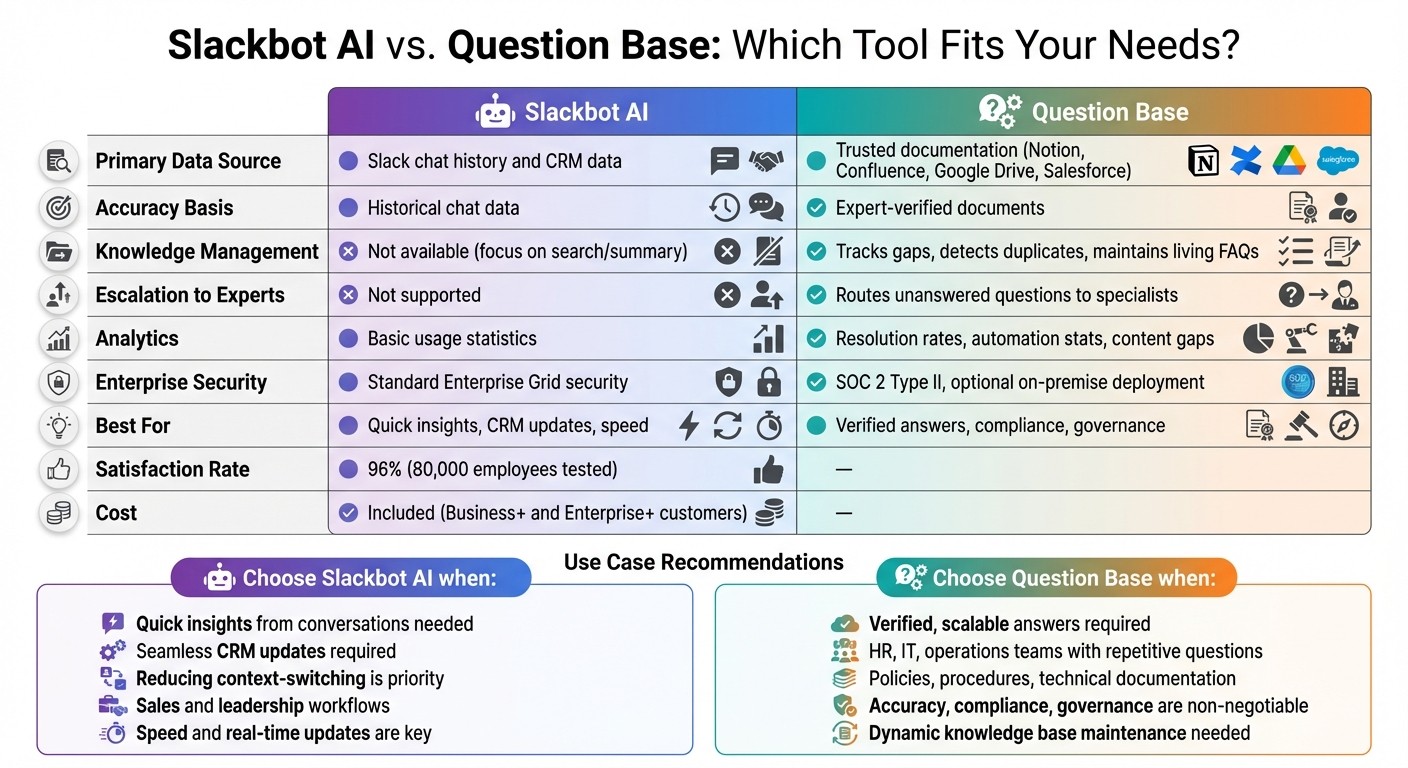
Slackbot AI vs Question Base: Feature Comparison for Enterprise Knowledge Management
Slackbot AI is a handy tool for improving individual productivity, offering features like conversation summaries and CRM updates. But when it comes to enterprise-level knowledge management, a specialized solution like Question Base is better equipped to handle the job.
Feature Comparison
The revamped Slackbot AI, launched by Salesforce in January 2026, achieved an impressive 96% satisfaction rate among 80,000 employees during internal testing [5]. It functions as a "super agent", designed to help individuals work more efficiently. However, its strengths lie in analyzing past Slack conversations and integrating with CRM workflows - not in managing structured, verified knowledge across an organization.
Question Base, on the other hand, takes a completely different approach. Instead of relying on chat history, it connects directly to trusted documentation platforms like Notion, Confluence, Google Drive, and Salesforce. This ensures that the answers it provides are based on expert-verified content, not AI interpretations of old Slack threads.
Feature | Slackbot AI | Question Base |
|---|---|---|
Primary Data Source | Slack chat history and CRM data | Trusted documentation (Notion, Confluence, etc.) |
Accuracy Basis | Based on historical chat data | Verified, trusted documents |
Knowledge Management | Not available (focus on search/summary) | Tracks gaps, detects duplicates, and maintains living FAQs |
Escalation to Experts | Not supported | Routes unanswered questions to specialists |
Analytics | Basic usage statistics | Tracks resolution rates, automation stats, and content gaps |
Enterprise Security | Standard Enterprise Grid security | SOC 2 Type II, with optional on-premise deployment |
This side-by-side comparison highlights how each tool serves different needs - especially for teams that require accurate, compliant knowledge.
Strengths and Limitations
Slackbot AI shines in scenarios like helping sales teams monitor deal progress or enabling leadership to quickly catch up on cross-functional conversations. It’s built for speed, delivering real-time insights that enhance CRM workflows and streamline conversational productivity.
However, Slackbot AI’s heavy reliance on chat history limits its accuracy and auditability. Unlike Question Base, it doesn’t verify answers against official documentation or track knowledge gaps. It also lacks the ability to escalate unanswered questions to subject matter experts.
Question Base bridges these gaps by emphasizing knowledge ownership and accountability. For example, HR teams can use it to answer policy-related questions with responses directly pulled from employee handbooks. IT teams benefit by accessing troubleshooting guides stored in Confluence, without wasting time digging through outdated Slack threads. When the AI doesn’t have an answer, it automatically escalates the query to the right expert and flags the gap for future content updates. This makes it especially valuable for teams where accuracy, compliance, and governance are non-negotiable.
Use Cases: When to Choose Each Tool
In practice, the choice between Slackbot AI and Question Base depends on your team’s specific needs.
Use Slackbot AI if your team needs quick insights from conversations, seamless CRM updates, or tools to reduce context-switching between Slack and Salesforce. Since it’s included at no extra cost for Business+ and Enterprise+ customers [5], it’s a natural fit for sales and leadership workflows where speed and real-time updates are key.
Use Question Base when your organization requires verified, scalable answers - especially for HR, IT, and operations teams that deal with repetitive questions about policies, procedures, or technical documentation. If you’ve ever told someone, “It’s in Notion - go find it,” Question Base can automate that process. It’s designed for teams that need to maintain a dynamic knowledge base, track performance, and continuously improve internal support.
Business Impact and ROI for Enterprises
Slackbot AI has evolved from a simple notification tool into a context-aware assistant, delivering measurable productivity improvements. This section explores how enterprises can assess returns on investment (ROI) while weighing the trade-offs between speed and trust in knowledge accuracy - an important factor when deciding between general-purpose and specialized AI solutions.
Balancing Speed and Knowledge Accuracy
Internal trials reveal that Slackbot AI can save teams anywhere from 2 to 20 hours per week [5]. For example, Beast Industries generates meeting canvases in just 17 seconds, and Engine’s operations team saves up to 20 minutes per summary task, cutting down daily context-switching time by about 30 minutes [1][5].
However, speed often comes with compromises. Slackbot AI primarily relies on chat history and CRM data rather than verified documentation, which can pose risks for teams handling sensitive areas like HR policies or IT troubleshooting. In such cases, accuracy, compliance, and auditability are non-negotiable. A study by Boston Consulting Group (BCG) found that a 30% improvement in employee productivity can lead to 50% higher top-line revenue [3], but only if it doesn’t come at the expense of work quality or result in costly errors caused by misinformation.
Specialized tools like Question Base tackle this issue by anchoring answers in verified content from trusted platforms like Notion, Confluence, and Google Drive. When accuracy is crucial, the ROI conversation shifts from focusing solely on speed to considering the potential costs of misinformation - where incorrect policies or outdated procedures can outweigh the time saved by faster responses. This creates a nuanced balance between speed and accuracy, laying the groundwork for a deeper ROI analysis.
Measuring ROI in Conversational Interfaces
The value of conversational AI goes beyond simple time savings, with ROI metrics offering a clearer picture of its overall impact. To illustrate, Salesforce’s internal IT team, led by Neil Cummins, Director of Techforce Support, implemented an AI agent in January 2026 that now handles over 25,000 monthly requests. By streamlining their knowledge base from 2,000 to 600 AI-optimized articles, they achieved a 35% instant resolution rate and saved 16,800 hours annually for their 28,000 employees [4]. Similarly, Salesforce’s HR-focused BaseCamp Agent reduced manual Employee Success case volumes by 5% year-over-year, contributing to a self-service rate exceeding 96% across support areas [6].
"The real power of the agent is that it gives people the exact piece of information they need without the back-and-forth."
– Neil Cummins, Director of Techforce Support, Salesforce [4]
Metrics such as resolution rates, time saved, and reduced case volumes serve as concrete indicators of ROI. For enterprises deciding between Slackbot AI and specialized tools, identifying the right metrics is critical. For IT and HR teams, automation rates and hours saved are key measures of success. In scenarios where knowledge accuracy and compliance are paramount, tracking escalation rates, answer reliability, and adherence to governance standards becomes essential. Tools like Question Base, with built-in analytics, simplify the process of measuring ROI in knowledge-intensive operations.
Future Outlook for Slackbot and Conversational AI
Salesforce envisions Slackbot AI as more than just a productivity tool. Parker Harris, Co-Founder and CTO of Salesforce, summed it up:
"The old Slackbot was, you know, a little tricycle, and the new Slackbot is like, you know, a Porsche" [5]
This underscores Salesforce’s ambition to make Slackbot the primary gateway for enterprise AI. Currently powered by Anthropic’s Claude model, Slackbot AI is set to integrate Google Gemini by late 2026 [5].
The larger trend suggests that conversational AI is on track to become the standard interface for enterprise workflows. Success in this space will depend not just on having AI capabilities but on how seamlessly those tools integrate into existing processes, maintain accuracy, and scale across departments. While Slackbot AI - available at no additional cost for Business+ and Enterprise+ customers [5] - is a strong option for general productivity, enterprises may need specialized tools to manage high-stakes, knowledge-driven tasks.
For teams overseeing internal support, a hybrid strategy - using Slackbot AI for broad efficiency gains and purpose-built tools like Question Base for verified and compliant knowledge - can strike the right balance between speed and accuracy. This approach ensures measurable business value while safeguarding the integrity of enterprise knowledge.
Conclusion
Salesforce has reimagined Slackbot, turning it from a basic notification tool into a powerful AI-driven conversational interface that redefines how enterprises work. By tying its AI capabilities directly to real conversations, files, and decisions, Salesforce is betting on a future where work happens in chat rather than across scattered apps. As Parker Harris aptly stated, "Slackbot isn't just another copilot or AI assistant. It's the front door to the agentic enterprise, powered by Salesforce" [5].
"Slackbot isn't just another copilot or AI assistant. It's the front door to the agentic enterprise, powered by Salesforce" [5]
The results of Salesforce's internal testing highlight impressive efficiency gains. The Techforce Agent resolved 35% of IT issues instantly, saving a staggering 16,800 hours annually [4]. This demonstrates how conversational AI can speed up access to knowledge and streamline workflows. With Slackbot offered at no additional cost for Business+ and Enterprise+ customers [5], it’s easier than ever for organizations to explore its potential.
However, speed alone isn’t the full story. For teams managing sensitive tasks like HR policies, compliance-heavy IT processes, or customer-facing support, accuracy and accountability are just as important as quick responses. While Slackbot shines at summarizing conversations and pulling insights from chat history, specialized tools like Question Base ensure that answers are backed by verified documentation from platforms like Notion and Confluence. This reduces risks in situations where speed might otherwise compromise precision.
The solution lies in striking a balance. Use Slackbot to drive productivity across general workflows, and rely on purpose-built tools like Question Base for scenarios where accuracy, compliance, and expert validation are critical. This hybrid strategy allows enterprises to reap the efficiency benefits of conversational AI without sacrificing the reliability of their knowledge.
As conversational interfaces become the go-to method for interacting with enterprise systems, the key to success will be balancing innovation with precision. Solutions like Question Base exemplify how organizations can achieve this equilibrium, ensuring both efficiency and trust.
FAQs
How does Slackbot's AI make workflows more efficient?
Slackbot's AI enhances workflow efficiency by delivering instant, context-aware support right inside Slack. It allows employees to quickly locate answers, handle repetitive tasks, and access essential knowledge - all without stepping away from their workspace. This means less time spent hunting for information and managing routine tasks, freeing up more time for meaningful work.
What sets Slackbot apart from generic AI tools is its ability to tap into the specific messages, files, and tools already within your Slack environment. It provides customized insights and automates workflows tailored to teams such as HR, IT, sales, and operations. By simplifying internal processes, Slackbot keeps teams focused on their most important priorities.
What challenges does Slackbot face in managing verified knowledge effectively?
Slackbot excels at summarizing conversations and delivering quick responses, but it falls short when it comes to handling verified knowledge. Its AI relies heavily on Slack messages as its primary source, which can lead to gaps in accuracy and depth - especially for tasks that demand trusted, expert-reviewed information from platforms like Notion, Confluence, or Salesforce.
Beyond that, Slackbot lacks essential features such as case tracking, duplicate detection, and governance controls. These tools are critical for ensuring consistent, reliable knowledge management at scale. While Slackbot is a strong tool for boosting general productivity, its chat-centric design isn’t tailored for the structured processes and precision required in enterprise-level knowledge management.
How does Slackbot compare to tools like Question Base for managing enterprise knowledge?
Slackbot is a handy tool for boosting productivity and assisting with quick exchanges in Slack. It’s particularly good at summarizing conversations and providing instant replies based on Slack messages and channel history. However, when it comes to enterprise-level knowledge management, it can sometimes fall short in delivering the precision and depth required.
Question Base takes things further by focusing specifically on the needs of support teams, HR, IT, and operations. It integrates seamlessly with trusted platforms like Notion, Confluence, and Salesforce to provide expert-verified answers. Its advanced features - such as case tracking, duplicate detection, and analytics - help ensure that knowledge remains accurate, scalable, and consistent across all teams. For organizations that value precision, auditability, and control over their knowledge, Question Base offers a tailored solution.