∙
Cooper
∙
Reading time:
17 min

Slack can be a double-edged sword for large teams. While it connects people, it often buries critical information under endless messages, wasting time and causing frustration.
Here’s the reality:
Employees spend 20–30% of their week searching for information in Slack.
Experts lose 6–8 hours weekly answering repetitive questions.
Up to 40% of internal queries are duplicates, costing companies millions annually.
The solution? AI-driven tools like Question Base. These tools transform Slack into a knowledge hub by analyzing communication patterns, answering repetitive questions instantly, and organizing valuable insights. Question Base connects to trusted platforms like Notion and Zendesk, delivering verified responses in 3.2 seconds, saving experts 6+ hours per week, and improving team workflows.
The Problem: Too Much Communication, Too Little Clarity
Slack workspaces, meant to streamline collaboration, can often feel like a maze of scattered updates and endless notifications. As channels multiply across teams, products, and departments, critical information gets buried, leaving employees struggling to stay aligned. Let’s break down how this overload of communication hampers team productivity.
Knowledge Gets Lost in Threads and Channels
In fast-paced Slack environments, essential updates and decisions often vanish into the ether of threads, channels, and private chats. A solution shared in one channel might never reach others who could benefit from it. Key updates can quickly be buried under a flood of new messages, making it nearly impossible to retrieve them later.
"Slack is where documentation goes to die, brought up once in passing, and never to be found again." - Brigitte Lyons[1]
The problem grows worse with private conversations, which account for over 60% of Slack messages[2]. These silos block cross-team visibility and prevent shared learning. Teams often end up duplicating work, unaware that solutions already exist elsewhere in the workspace. While Slack’s native analytics provide basic insights - like who’s active and where discussions are happening - they don’t address the larger issue: knowledge accessibility[5][6]. The fleeting nature of chat means that even valuable context from today can become irretrievable tomorrow, forcing employees to waste hours searching for information they know is out there.
Answering the Same Questions Over and Over
Subject matter experts face a constant barrage of repetitive questions. Without a system to capture and surface past answers, they’re stuck in a loop, answering the same inquiries week after week. Ethan Laub, Principal Product Manager at OfficeRnD, highlights the frustration:
"There's documentation, but people keep asking in chat." - Ethan Laub, Principal Product Manager, OfficeRnD[1]
The root of this issue lies in behavior: 80% of employees prefer asking questions in chat rather than searching a wiki[1]. This creates a cycle where every question is treated as a one-off, rather than an opportunity to build a reusable knowledge base.
How Communication Bottlenecks Slow Teams Down
When communication breaks down, it doesn’t just frustrate employees - it slows everything. Teams lose time to duplicated work, delayed responses, and poor coordination, with the effects rippling across departments.
Customer support teams feel this pain acutely. Without proper organization and analytics, support leaders lack visibility into key metrics like response times, ticket volumes, and customer satisfaction scores[3]. Without tracking conversation volumes, it’s nearly impossible to identify peak demand periods or allocate resources effectively[3].
Metrics like response times can reveal when teams are overloaded or when ownership of tasks is unclear[2]. Additionally, analyzing message patterns can show whether communication is balanced or dominated by a few voices. The structure of Slack channels also plays a role - too few channels result in overcrowding and confusion, while too many fragment teams and make it hard to know where to post updates[7]. Both extremes disrupt coordination.
This lack of structure also affects support teams’ ability to capture and organize valuable insights. Frequently asked questions and customer feedback often go undocumented, leaving teams to research and answer the same questions repeatedly. Tickets can slip through the cracks as duplicated efforts emerge. These inefficiencies not only limit internal knowledge sharing but also make life harder for support teams.
To address these challenges, organizations need to track metrics like response times, message patterns, channel usage, private conversation ratios, and even late-night activity - which can signal burnout[2][7][4]. These insights highlight the urgent need for smarter tools that don’t just streamline communication but also provide actionable insights to improve workflows.
The Solution: AI and Predictive Analytics for Better Communication
Managing the chaos of scattered knowledge and repetitive questions requires more than just basic chat analytics. High-performing teams need tools that go deeper. Predictive analytics and AI-powered platforms can transform Slack from a simple messaging tool into a treasure trove of actionable insights.
How Predictive Analytics Enhances Team Communication
Predictive analytics works by analyzing patterns in team communication - things like response times, message volumes, and engagement levels. It highlights areas where questions linger unanswered, which often signals team overload or unclear task ownership. For example, if 60% or more of conversations happen in private messages, opportunities for cross-functional learning decrease. Similarly, a spike in late-night activity could indicate poor work-life balance, while one person dominating conversations might point to bottlenecks in collaboration[2].
These tools also help track trends over time, whether daily or monthly, and identify peak support demand[3]. By treating Slack as a continuous record of team interactions, predictive analytics uncovers what’s working and where communication workflows need improvement[2].
Metrics like response times show how quickly questions are answered, while message contribution patterns reveal whether discussions are balanced or dominated by a few voices[2]. Engagement data measures how actively team members participate in channels and react to posts[7]. For instance, one company boosted thread usage from just 10% to 45% of message volume within a month by leveraging targeted recommendations[4]. These insights give leaders the tools they need to address friction points and foster smoother collaboration.
While predictive analytics identifies gaps, AI solutions like Question Base step in to fill them with fast, verified answers.
AI Tools That Provide Verified Answers
Purpose-built tools like Question Base tackle the root causes of inefficiency in team communication. Employees often spend 20–30% of their workweek hunting for information, and up to 40% of internal questions are repetitive[1].
Question Base connects directly to trusted sources like Notion, Confluence, Salesforce, OneDrive, and Zendesk, delivering human-verified answers in just 3.2 seconds[1]. During a typical 30-day pilot, this AI tool auto-answered 35% of repetitive questions[1]. Unlike generic AI tools, Question Base achieves a 4.8 answer score accuracy by pulling information from verified documentation instead of relying solely on past chat history[1]. Teams can customize how answers are presented and which sources are used for specific Slack channels, ensuring responses are both relevant and precise[1][8]. If the AI encounters a question it can’t confidently answer, it escalates the issue to human experts through an organized workflow, ensuring no query goes unresolved[1].
By combining predictive analytics with AI capabilities, Question Base not only delivers instant answers but also improves over time. It identifies recurring topics in Slack threads and integrates those into company documentation, turning fleeting conversations into a structured, searchable knowledge base.
But the benefits don’t stop there. Continuous performance tracking ensures communication keeps getting better.
Metrics That Drive Long-Term Communication Improvements
Key metrics like automation rates and resolution rates measure how effectively questions are answered. Answer score accuracy and reviews of unhelpful responses are equally important for maintaining trust and quality. Monitoring unanswered questions can also reveal gaps in the knowledge base that need attention[1][8].
Question Base provides detailed dashboards that go beyond simple usage stats. These dashboards display metrics such as the number of questions asked, resolution and automation rates, and investigations into less helpful responses. This level of insight helps leaders make informed decisions about improving documentation, fine-tuning AI behavior, and allocating expert resources more effectively[8]. For customer support teams, tracking conversation volumes, customer satisfaction (CSAT) scores, escalation rates, and ticket volumes paints a full picture of how well communication is functioning. These insights help pinpoint potential bottlenecks before they snowball into bigger issues[3].
Slack AI vs. Purpose-Built Knowledge Tools

Slack has become the go-to communication platform for countless teams, and its built-in AI features bring real benefits to everyday workflows. However, when it comes to managing enterprise knowledge on a larger scale, there’s a clear difference between general AI tools and those specifically designed for delivering reliable, accurate information.
What Slack AI Does Well
Slack AI shines when it comes to summarizing conversations in channels and huddles, leveraging your existing chat history to provide quick insights. Its analytics offer a snapshot of communication trends, such as message volumes and engagement levels, which can be particularly helpful for teams looking to improve collaboration.
For example, Slack’s built-in analytics can reveal patterns like which channels are most active or how many messages are sent privately versus publicly. One company used this data to discover that 75% of their messages were being exchanged in private channels or direct messages. By adopting a “public-by-default” communication strategy, they saw a 40% increase in public channel activity, which greatly improved transparency and onboarding efforts[6].
That said, Slack AI’s capabilities remain confined to what’s happening within Slack itself. It doesn’t integrate with external knowledge repositories like Confluence, Notion, or Zendesk. For teams whose critical knowledge lives outside of Slack threads, this limitation can leave a lot to be desired.
What Question Base Brings to the Table
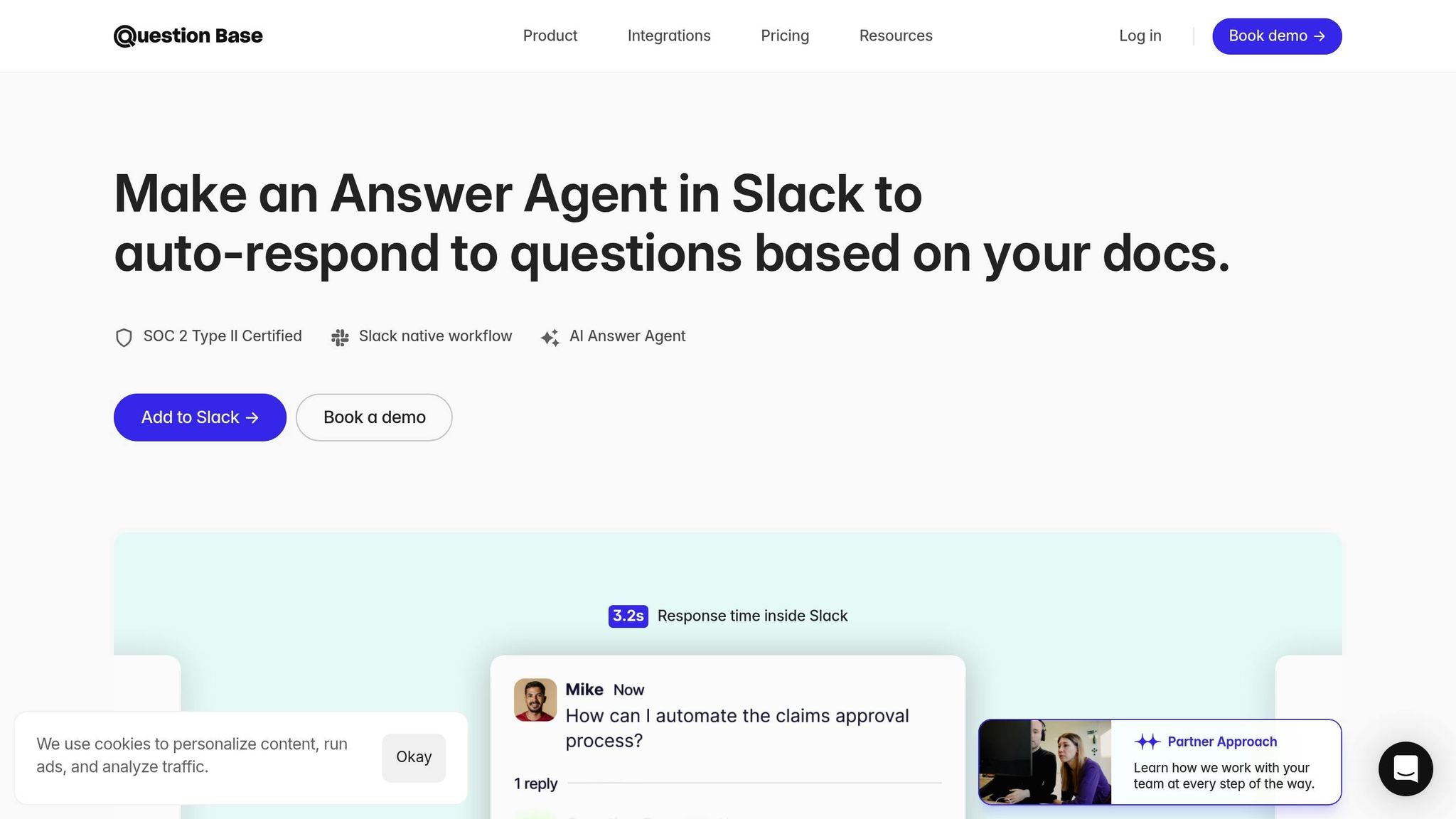
Question Base takes things a step further by connecting directly to trusted documentation platforms - like Notion, Confluence, Google Drive, Zendesk, and more. This allows it to deliver AI-generated answers that are not only accurate but also come with clear source citations and an escalation process for unresolved queries. In doing so, Question Base turns fleeting Slack conversations into actionable, long-lasting knowledge.
Every response includes a source citation, ensuring transparency and traceability. If the AI encounters a question it can’t confidently answer, it escalates the query to human experts via a structured workflow, guaranteeing that no question is overlooked.
For enterprise users, Question Base offers robust security features, including SOC 2 Type II compliance, encryption both at rest and in transit, and optional on-premise deployment. Teams have full control over what the AI can access, how it responds, and how escalations are handled. The Enterprise plan even includes white-labeling, multi-workspace support, and tailored options that go beyond Slack AI’s capabilities.
Beyond answering questions, Question Base actively organizes and improves your knowledge base over time. It identifies frequently asked questions in Slack and integrates those answers into your documentation, creating a structured, searchable repository. The platform also provides detailed analytics, such as content gap reports and insights into unhelpful answers, helping teams refine their knowledge management strategies. Whether it’s aligning with sprint cycles or quarterly planning, Question Base supports high-volume teams with the insights they need to stay agile.
Installing Question Base is straightforward. Simply add it through the Slack App Marketplace, invite the bot to relevant channels using /invite @questionbase, and connect your documentation tools - no coding required.
Feature Comparison Table
Here’s a side-by-side look at how Question Base stacks up against Slack AI:
Feature | Question Base | Slack AI |
|---|---|---|
Accuracy | AI-generated answers with verified sources | AI-generated answers |
Data Sources | Notion, Confluence, Salesforce, Google Drive, Zendesk, Intercom, and more | Primarily Slack chat history; external tools available only on Business+ and Enterprise plans |
Knowledge Management | Advanced features like per-channel settings, duplicate detection, and content audits | Limited to predefined AI agents on higher-tier plans |
Analytics | Tracks questions asked, resolution rates, automation rates, and content gaps | Basic stats like message volume, active users, and reactions |
Enterprise Security | SOC 2 Type II certified, encryption at rest and in transit, on-premise options | Standard Slack security infrastructure |
Verification & Trust | Source citations and expert escalation workflow | No explicit source annotation or escalation |
Pricing | $8 per user per month | $18 per user per month |
This comparison highlights why specialized tools like Question Base are essential for enterprise teams that rely on verified, scalable knowledge solutions.
The decision between Slack AI and Question Base ultimately depends on your team’s needs. If your knowledge primarily exists within Slack and you only require basic summarization, Slack AI can be a good fit. But for teams that rely on external documentation, need verified answers at scale, or prioritize security and customization, Question Base offers capabilities that go far beyond what Slack AI can provide.
How to Set Up Question Base for Large Teams
Setting up Question Base is designed to be quick and straightforward, giving HR leaders, IT managers, and operations teams the ability to implement it without needing engineering resources. The process is secure and efficient, ensuring teams can get started without delay.
Installation and Tool Connections
To get started, install Question Base directly from the Slack App Marketplace. There's no need for API keys or custom development. Once added, invite the bot to your active Slack channels using /invite @questionbase. Within minutes, the AI agent is ready to assist your team by answering questions.
For seamless knowledge access, connect Question Base to your existing documentation platforms, such as Notion, Google Drive, Confluence, Zendesk, Intercom, Salesforce, or Dropbox. This integration allows your team to continue using their preferred tools while gaining the advantage of AI-powered search. If your documentation is spread across multiple platforms - like product specs in Confluence, HR policies in Google Drive, and support articles in Zendesk - Question Base can search all of them simultaneously, delivering relevant answers in seconds.
For teams with specialized systems or internal tools, custom integrations are available with the Enterprise tier, ensuring that even proprietary platforms can be included in your knowledge network.
Once the installation is complete, the next step is to fine-tune the AI's behavior to suit your team’s specific needs.
Configuring AI Behavior and Access Controls
After installation, you can customize the AI’s tone, response style, and access permissions using a simple admin dashboard. For example, a financial services company might prefer formal and concise responses, while a creative agency may opt for a more conversational tone.
Access controls allow you to define which documentation sources, channels, or content categories the AI can use when answering questions. Sensitive materials, such as confidential HR documents, financial data, or unreleased product plans, can be excluded from the AI’s search capabilities. Role-based permissions ensure that employees only access information relevant to their position. For instance, HR documents might be restricted to HR team members, while technical specs are accessible only to engineering staff.
You can also configure per-channel settings to tailor the AI’s behavior to specific teams. For example, a customer support channel might rely on help center articles and troubleshooting guides, while an engineering channel could prioritize technical documentation and API specs.
For questions the AI cannot confidently answer, Question Base includes configurable escalation flows. These flows allow you to route unresolved queries to the right human expert based on criteria like topic category, complexity, or confidence level. For instance, technical questions could be directed to engineering, while HR-related queries escalate to the HR department. This hybrid model ensures employees always receive accurate and timely information.
Once the AI’s behavior is configured, you can secure your setup with advanced enterprise-grade protections.
Enterprise Security and Compliance Features
For organizations with strict security needs, Question Base offers robust protections and compliance capabilities. The platform is SOC 2 Type II certified, meaning its security controls have been rigorously audited and consistently maintained over time. This certification is especially critical for regulated industries like healthcare, finance, and legal services.
Data security is a priority, with encryption at rest and in transit ensuring sensitive information remains protected whether stored or transmitted. These encryption standards meet industry best practices and are regularly updated to address emerging threats.
For organizations with stringent data residency or regulatory requirements, Question Base provides on-premise deployment as part of the Enterprise tier. This option allows the entire system to run within your organization’s infrastructure, keeping all data under your control and out of external cloud environments. On-premise deployment also includes additional features like white-labeling, multi-workspace support, and tailored configurations.
Large enterprises with multiple teams or regions can benefit from multi-workspace support, which enables separate instances for different departments, locations, or use cases. For example, a global company might deploy distinct Question Base instances for North America, Europe, and Asia-Pacific, each connected to region-specific documentation and compliance settings. You can also separate external customer support from internal employee support, ensuring each use case is optimized. With white-labeling, you can customize each workspace to reflect your organization’s branding, creating a seamless and integrated experience.
Organizations opting for on-premise deployment receive dedicated support for installation, configuration, and ongoing maintenance. This ensures smooth operation within your infrastructure and seamless integration with existing security systems, authentication protocols, or compliance frameworks.
With SOC 2 Type II certification, advanced encryption, and flexible deployment options, Question Base provides the security and compliance needed for even the most cautious organizations. Whether managing sensitive data, adhering to strict regulations, or maintaining high internal security standards, the platform offers the confidence to deploy AI tools without compromising on safety.
Conclusion
For high-volume teams, the constant barrage of messages often leads to a frustrating paradox: more communication results in less clarity. This overload doesn’t just cause confusion - it drains productivity, costing companies millions annually.
AI tools are stepping in to tackle this challenge head-on. Question Base transforms Slack from a simple chat tool into a reliable knowledge hub. By capturing and organizing information into a searchable system, it ensures employees get verified answers in just 3.2 seconds. These answers come straight from trusted documentation, cutting out the need to pause work, dig through multiple platforms, or wait for a colleague’s reply.
The results speak for themselves. Pilot programs have shown measurable time savings and improved efficiency. These immediate benefits also set the stage for long-term adaptability. With analytics dashboards, leadership gains insights from past interactions - pinpointing areas where documentation needs improvement or where additional training might help.
Security is a top priority, too. With enterprise-grade compliance, Question Base addresses the needs of regulated industries while maintaining the speed and ease users expect from modern AI tools.
FAQs
How does Question Base work with tools like Notion and Zendesk to streamline team communication?
Question Base connects effortlessly with tools like Notion, Zendesk, Confluence, and others, drawing reliable information straight from your existing documentation. This means your team can access precise, real-time answers directly within Slack, eliminating the need to sift through multiple platforms.
By linking to your knowledge repositories, Question Base helps your team save time and focus on what matters most. It also ensures that your internal knowledge remains easy to access and stays current as your processes and workflows grow and change.
How does Question Base differ from Slack AI in knowledge management and accuracy?
Slack AI is a solid tool for summarizing chats and boosting overall efficiency. But Question Base takes things a step further by focusing on delivering expert-approved answers directly from trusted platforms like Notion, Confluence, and Salesforce, instead of leaning heavily on Slack's chat history.
Beyond that, Question Base offers advanced tools like case tracking, per-channel configurations, and duplicate detection. These features ensure your knowledge stays accurate, organized, and scalable - something Slack AI doesn’t provide.
How do predictive analytics and AI tools like Question Base help streamline workflows and reduce repetitive questions in busy teams?
Predictive analytics and AI-driven solutions, such as Question Base, are transforming how teams manage their workflows. By cutting down on repetitive questions and delivering fast, reliable answers, Question Base streamlines operations. It integrates directly into Slack and connects with trusted knowledge sources like Notion, Confluence, and Salesforce, ensuring employees get expert-approved responses in just seconds. This eliminates the hassle of digging through multiple platforms or repeatedly asking the same questions.
What sets Question Base apart from general-purpose tools like Slack AI is its focus on enterprise needs. While Slack AI relies on chat history, Question Base is designed to prioritize accuracy and maintain control over knowledge. By automating up to 35% of repetitive queries and effectively organizing internal information, it empowers teams to stay aligned, save valuable time, and focus on more impactful work.