∙
Cooper
∙
Reading time:
14 min

Miscommunication slows teams down. In large enterprises, especially in regulated industries like healthcare and finance, poor collaboration leads to delays, duplicated work, and missed goals. Studies show 86% of workplace failures result from ineffective communication, and well-aligned teams are 20% more likely to succeed.
AI tools are changing how teams collaborate by automating answers to repetitive questions, centralizing knowledge, and bridging communication gaps across departments. For example, platforms like Question Base integrate with Slack and trusted documentation systems like Notion and Salesforce, ensuring employees get accurate, instant answers without switching tools.
Key Benefits of AI for Team Alignment:
Faster decisions: Reduce meeting times by 25% and improve project visibility by 75%.
Increased productivity: Automate 40% of repetitive queries, saving hours weekly.
Eliminate silos: Share verified knowledge across departments in seconds.
By connecting AI tools to trusted sources and embedding them into Slack workflows, enterprises can save time, reduce errors, and improve collaboration. Tools like Question Base ensure employees always have access to the right information, driving better outcomes across teams.
AI for team collaboration: drive greater impact on innovation and productivity
Improving Knowledge Sharing with AI
Traditional methods of sharing knowledge often hit roadblocks because they depend on manual searches and juggling multiple systems. AI-powered tools are changing this by making information instantly accessible and lightening the load on support teams. This shift allows organizations to streamline responses and integrate knowledge directly into workflows.
Automating Answers to Common Questions
AI can transform how teams align by automating answers to routine questions. In large organizations, repetitive inquiries make up nearly 40% of internal queries [5], and employees often spend 20–30% of their time hunting for information [5]. That’s equivalent to losing an entire workday every week - time that could be reclaimed with proper automation.
AI tools like Question Base tackle this issue by embedding themselves into platforms like Slack and connecting with trusted sources such as Notion, Confluence, and Salesforce. When employees ask questions in Slack, the AI delivers instant, contextually accurate answers based on verified data from these systems. This spares HR, IT, and operations teams from repeatedly addressing common questions about policies, procedures, or product details.
The benefits for support teams are immense. Instead of being bogged down by repetitive queries, they can focus on solving complex problems and driving strategic initiatives. AI collaboration tools can accelerate decision-making by 80% and increase productivity by up to 35% [1]. This allows support staff to dedicate their efforts to tasks that require human expertise.
What sets Question Base apart is its ability to evolve. The platform creates a dynamic FAQ that adapts as new questions arise and workflows change, turning everyday conversations into structured, reusable knowledge for current and future team members.
Accuracy is key to making automated responses effective. By connecting AI tools to verified knowledge bases rather than relying solely on chat history, organizations maintain control over the content, tone, and escalation processes. This ensures automated answers meet the same high standards as manual responses while significantly cutting response times.
Removing Communication Barriers Between Departments
AI doesn’t just handle repetitive questions - it also breaks down communication walls between departments. Traditional silos can make it difficult for teams to share knowledge effectively. For example, sales teams might struggle to access updated product documentation from engineering, or HR policies might be locked away in systems that operations teams can’t easily navigate. AI-powered knowledge tools address these issues by centralizing information and making it accessible across the organization.
The primary benefit is creating a single, unified source of truth that employees can access within their preferred communication tools. AI answer agents deliver this knowledge directly into existing workflows, cutting cross-departmental handoff times by 63% [1].
Question Base exemplifies this approach by integrating with multiple documentation and support systems simultaneously. Whether a marketing team member needs details about customer support procedures or an engineering team wants insights into sales processes, everyone receives consistent, accurate information - all within Slack.
This approach reduces reliance on individual gatekeepers and distributes responsibility for knowledge sharing. AI tools ensure that information is readily available to anyone who needs it, regardless of their department or role.
Additionally, AI tools improve over time by analyzing usage patterns and gathering feedback. They can highlight content gaps, helping organizations address these during planning cycles. For global teams working across time zones, AI-powered knowledge sharing is especially valuable. Employees can access information instantly without waiting for colleagues in other regions, and real-time translation features help global teams align 40% faster [1].
Connecting AI with Trusted Documentation Sources
For AI-driven knowledge management to truly deliver, it must rely on verified documentation sources. Enterprise-grade solutions go beyond casual chat history or informal conversations, connecting directly to expert-approved resources. This emphasis on trusted data naturally leads us to explore how modern AI tools integrate seamlessly with these reliable sources.
Tying AI to trusted documentation is a natural progression after automating routine answers. It strengthens team alignment, creating a more cohesive workflow. Organizations that prioritize verified sources experience measurable gains in efficiency, as centralizing resources helps cross-functional teams save time and avoid costly misinterpretations.
Linking to Verified Knowledge Sources
Today’s AI agents are designed to integrate with a variety of documentation platforms, bringing all your organizational knowledge under one roof. For instance, Question Base connects effortlessly with platforms like Notion, Confluence, Google Drive, Zendesk, Intercom, Salesforce, and Dropbox - all without requiring complex engineering setups.
As previously discussed, the setup process is simple through the Slack App Marketplace. Once configured, the AI pulls answers directly from your verified knowledge sources, ensuring responses are accurate and consistent, rather than relying on potentially unreliable chat history.
Imagine this: A product manager asks about the latest feature rollout process. Instead of sifting through Slack threads, the AI retrieves the answer from the most up-to-date Confluence page or Notion document. Sales teams can instantly access the latest technical specs from engineering, and HR policies become readily available to operations - all within Slack’s familiar interface.
The platform doesn’t just provide answers - it transforms temporary Slack messages into a searchable, lasting knowledge base. Insights shared in chats are captured and integrated into the system, evolving into a dynamic FAQ that grows alongside your team’s needs and workflows.
With built-in analytics, organizations can identify content gaps and conduct thorough audits aligned with their planning cycles. This means you can track unanswered questions and proactively address missing documentation before they disrupt productivity.
Enterprise-grade security features like SOC 2 Type II compliance, encryption, and optional on-premise deployment ensure your data remains safe. Full customization options allow you to control what content is accessible, adjust the AI’s tone, and set up escalation workflows tailored to your needs.
Question Base vs Slack AI for Knowledge Management
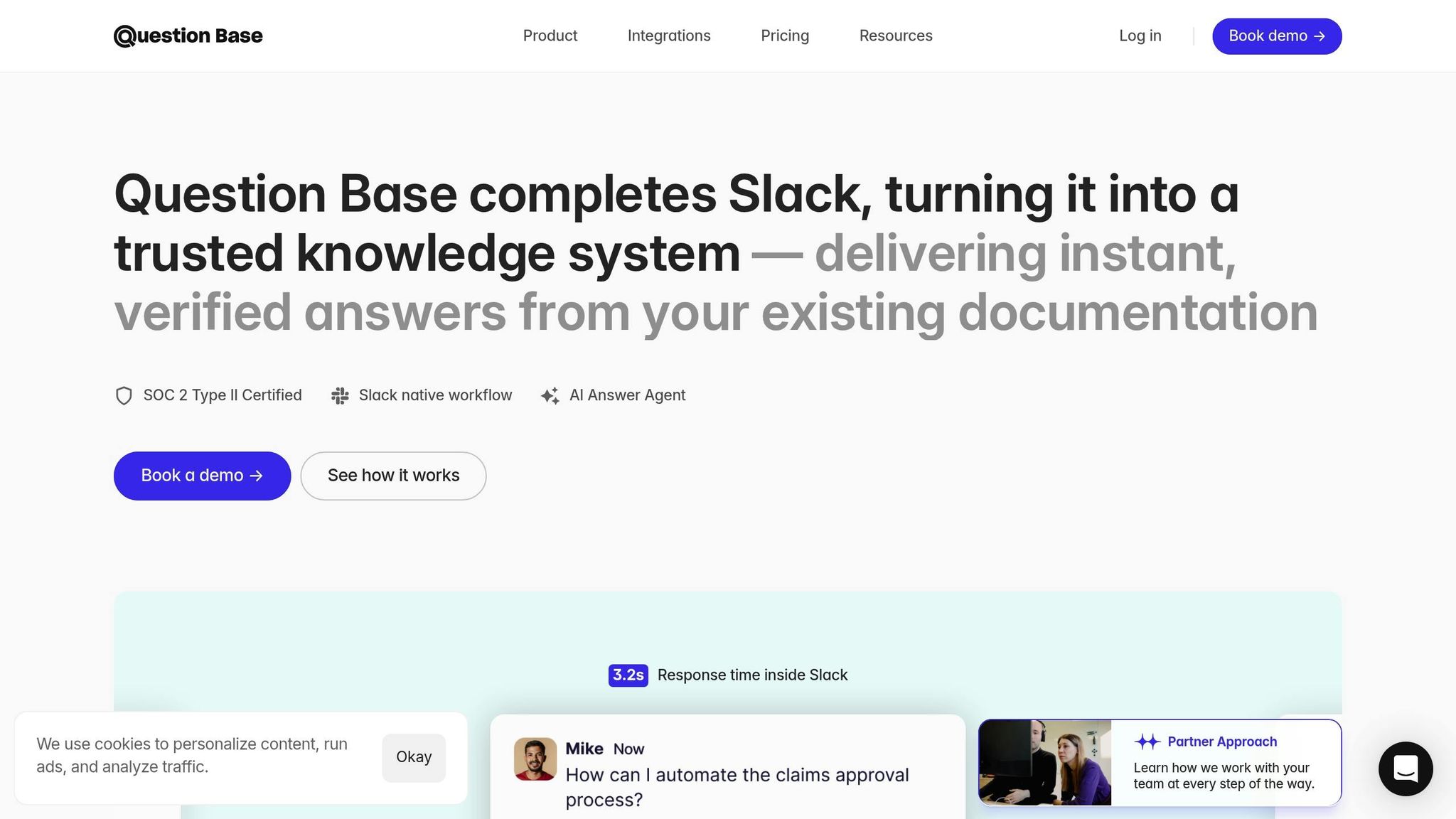
Now that we’ve established the value of integration, let’s compare how Question Base stands apart from general-purpose tools like Slack AI. While Slack AI is great for general productivity, organizations that need precise knowledge management will benefit from a more specialized solution.
Feature | Question Base | Slack AI |
|---|---|---|
Data Sources | Integrates with Notion, Confluence, Salesforce, Zendesk, Google Drive, Dropbox, Intercom | Relies mainly on Slack chat with limited external integrations on enterprise plans |
Accuracy | Provides answers verified by experts from trusted sources | Generates responses based on Slack chat history |
Knowledge Management | Includes case tracking, per-channel settings, duplicate detection, and AI learning from gaps | Lacks dedicated knowledge management features |
Analytics | Tracks resolution rates, unhelpful answers, and automation effectiveness | Offers basic usage statistics |
Enterprise Focus | Built for HR, IT, and Operations with SOC 2 compliance and full customization | General-purpose AI with broader but less specialized functionality |
The key difference lies in their purpose. Slack AI summarizes past conversations, while Question Base operationalizes your knowledge for future use. For teams that value verified answers over AI interpretations of chat history, integrating with trusted documentation becomes a must.
Unlike Slack AI, which primarily learns from chat threads, Question Base connects directly to your organization’s authoritative documents. So, when someone asks about company policies, technical specs, or procedural details, they receive information that’s been reviewed and approved by subject matter experts.
For enterprise teams where accuracy, accountability, and control over knowledge are non-negotiable, Question Base is the clear choice. It ensures that teams across departments can access reliable information instantly, fostering the kind of collaboration and alignment that drives meaningful results.
Best Practices for Setting Up AI-Powered Knowledge Tools
Integrating AI-powered knowledge tools into your existing workflows can dramatically improve efficiency. Some organizations have reduced query resolution times from 48 hours to less than 2 hours in just the first month.
The secret to success lies in making these tools a natural part of your team's daily routines, rather than introducing entirely new processes. When implemented thoughtfully, AI knowledge agents evolve from basic answer providers into systems that actively enhance how knowledge is shared across your organization.
How to Deploy an AI Answer Agent
To make the most of AI answer agents like Question Base, follow these steps for a smooth deployment:
Install directly from the Slack App Marketplace. Start by adding Question Base through Slack's marketplace. Once installed, invite the bot to relevant channels using /invite @questionbase. This native integration ensures the tool feels like an organic part of your communication flow, rather than an external add-on.
Connect your key documentation sources. The true value of an AI knowledge tool comes from its ability to pull information from your most trusted repositories. Question Base integrates seamlessly with platforms such as Notion, Confluence, Google Drive, Zendesk, Intercom, Salesforce, and Dropbox. Begin with your primary documentation hub (e.g., Confluence or Notion), then add your support ticket system (e.g., Zendesk), and finally include project-specific resources like Salesforce or Google Drive. This step-by-step approach ensures thorough coverage without overwhelming your system.
Tailor the AI’s behavior and secure your data. With Question Base, you can adjust how the AI interacts in different channels. For instance, you might opt for a professional tone in executive discussions and a more casual style for engineering teams. Security is a priority, with SOC 2 Type II compliance, encryption, and optional on-premise deployment. You can also set user permissions, define escalation protocols for unresolved queries, and create audit trails to meet compliance needs. This flexibility ensures your AI tool is both effective and trustworthy.
Keeping Your Knowledge Base Current and Effective
Once deployed, maintaining and improving your AI-powered system is essential to sustain its value. Regular updates and audits can lead to a 40% increase in employee satisfaction with internal support, while neglecting these steps often results in declining accuracy and adoption.
Capture new knowledge continuously. Empower your team to refine answers directly within Slack. This feature turns everyday Q&A into an evolving knowledge base. Insights from team discussions can be added to the system with a single click, ensuring valuable information doesn’t get lost in chat history. The AI also learns from conversations, identifying common responses and suggesting updates to documentation, so your knowledge base grows in step with your team’s expertise.
Track and address unanswered questions. Use analytics to identify gaps in your documentation. Question Base provides data on unresolved queries, helping you pinpoint areas that require immediate attention or expert input. By addressing these gaps, you ensure your knowledge base remains a reliable resource.
Schedule regular audits. Align content reviews with business planning cycles, such as quarterly updates or sprint retrospectives. Question Base offers tools to identify outdated information and prioritize updates. During these reviews, ensure all connected documentation is up-to-date, remove obsolete content, and incorporate any new processes or policies. This proactive approach keeps your system relevant and useful.
Monitor performance and gather feedback. Keep an eye on metrics like resolution rates, automation success, and user satisfaction. Question Base provides detailed analytics, including response times and accuracy ratings. Teams often find that AI tools handle 35% of repetitive questions within the first 30 days, freeing up time for more complex tasks.
Maintain human oversight. While AI excels at managing routine queries, human experts should review complex answers. Question Base makes this easy with a verification workflow that allows subject matter experts to approve AI-generated content before it’s added to the knowledge base. Experts can update answers directly in Slack, ensuring accuracy without disrupting their core responsibilities.
Conclusion: How AI Drives Team Alignment at Scale
Shifting from disjointed communication to smooth cross-functional alignment is reshaping how enterprises operate. Companies that adopt AI-driven knowledge management are experiencing measurable gains, directly boosting their efficiency and competitive edge.
Miscommunication and information gaps are notorious for causing costly project failures[2][4]. On the flip side, businesses that excel in cross-functional collaboration consistently surpass their goals and report higher employee satisfaction rates[3].
AI tools like Question Base tackle these challenges head-on by creating a unified, instantly accessible knowledge hub. Instead of waiting hours - or even days - for answers, employees can access verified responses in seconds, all within Slack. This immediacy changes the game for teamwork, eliminating the delays that often bog down cross-departmental projects.
Enterprises are seeing tangible results: fewer manual tasks, better project visibility, and quicker decision-making[1]. These aren’t minor tweaks; they represent a fundamental shift in how work gets done. For instance, when Klaxoon incorporated AI-powered collaboration features, they slashed cross-departmental handoff times by 60% and cut miscommunication errors by 40%[1].
Efficiency is only part of the picture - security is just as critical. Question Base ensures enterprise-grade security with features like SOC 2 Type II compliance, encryption at rest and in transit, and optional on-premise deployment. Organizations can confidently share knowledge while maintaining strict access controls, customizing AI behavior, and creating audit trails to safeguard sensitive information.
This approach also highlights the importance of balancing AI with human expertise. The 70/30 rule - where AI manages 70% of routine queries while human experts handle the more complex, strategic decisions - has proven effective. This blend of AI’s speed and human judgment has led to a 28% increase in team satisfaction[1].
As AI-driven knowledge management continues to evolve, it empowers organizations to stay agile in fast-changing markets. By ensuring that teams operate with the most up-to-date information and adapt to shifting workflows, businesses can align hundreds - or even thousands - of employees. Those who embrace this shift now will be better positioned to work smarter, make faster decisions, and remain competitive in dynamic environments.
FAQs
How does Question Base ensure accurate answers for cross-functional teams?
Question Base stands out by sourcing information directly from reliable platforms such as Notion, Confluence, Salesforce, and others. Instead of depending solely on chat history, it integrates with your verified documentation, delivering answers grounded in your organization’s established knowledge base.
This method reduces inaccuracies and ensures that teams in HR, IT, and operations have access to uniform, expert-reviewed information, helping them stay coordinated and efficient.
What makes Question Base a better choice than general-purpose AI tools like Slack AI for managing internal knowledge?
Question Base is designed specifically for teams that rely on precise, expert-approved answers sourced from trusted platforms like Notion, Confluence, or Salesforce. Unlike Slack AI, which primarily pulls from Slack chat history, Question Base integrates directly with your documentation tools to deliver reliable and up-to-date information.
The platform also includes advanced knowledge management tools, such as case tracking, per-channel configurations, and duplicate detection. These features help streamline workflows and maintain better organization, making it an excellent choice for HR, IT, and operations teams that prioritize accuracy, flexibility, and enterprise-level security.
How can enterprises use AI tools like Question Base to streamline workflows and align cross-functional teams?
Enterprises can bring their teams closer together by weaving AI tools like Question Base into their daily workflows. By linking Question Base with platforms such as Notion, Confluence, or Salesforce, teams gain quick access to accurate answers right within Slack. This reduces the back-and-forth of repetitive questions and frees up time for more important tasks.
What’s more, Question Base turns Slack discussions into searchable, well-organized documentation, making sure valuable insights and knowledge are preserved and easy to retrieve. As processes shift and grow, Question Base keeps pace by spotting content gaps and updating its knowledge base, ensuring teams remain connected and productive.