∙
Cooper
∙
Reading time:
15 min

Repetitive questions and scattered knowledge slow remote teams down. AI Slack bots solve these problems by delivering instant answers, consolidating information, and reducing delays caused by time zones. Teams spend less time searching for information and more time on meaningful work.
Key Takeaways:
Save Time: AI bots handle repetitive questions, cutting response times and freeing up experts for complex tasks.
24/7 Availability: Bots provide answers anytime, eliminating delays across time zones.
Unified Knowledge: Bots integrate with tools like Notion, Confluence, and Google Drive, making information easy to find.
Improved Productivity: Teams using bots report a 70% productivity boost and up to 80% less time spent on repetitive tasks.
Structured Knowledge: Bots turn Slack conversations into a searchable, evolving knowledge base.
AI bots like Question Base go beyond Slack’s built-in tools by connecting to trusted documentation, ensuring accurate responses, and identifying knowledge gaps for continuous improvement. For large or distributed teams, these bots transform Slack into a powerful knowledge assistant.
Build a Slack AI Agent That Answers Questions (Step-by-Step Tutorial)
Main Benefits of AI Slack Bots for Remote Teams
AI-powered Slack bots are changing the game for remote teams by simplifying how they access and share knowledge. When used effectively, these bots can boost productivity, speed up response times, and improve how teams retain and manage information. Let’s explore three key areas where these bots make a noticeable impact.
Reducing Repeated Questions
Remote teams often deal with the same questions over and over - things like resetting passwords, understanding PTO policies, navigating expense procedures, or onboarding processes. Answering these repetitive queries disrupts workflows and drains productivity.
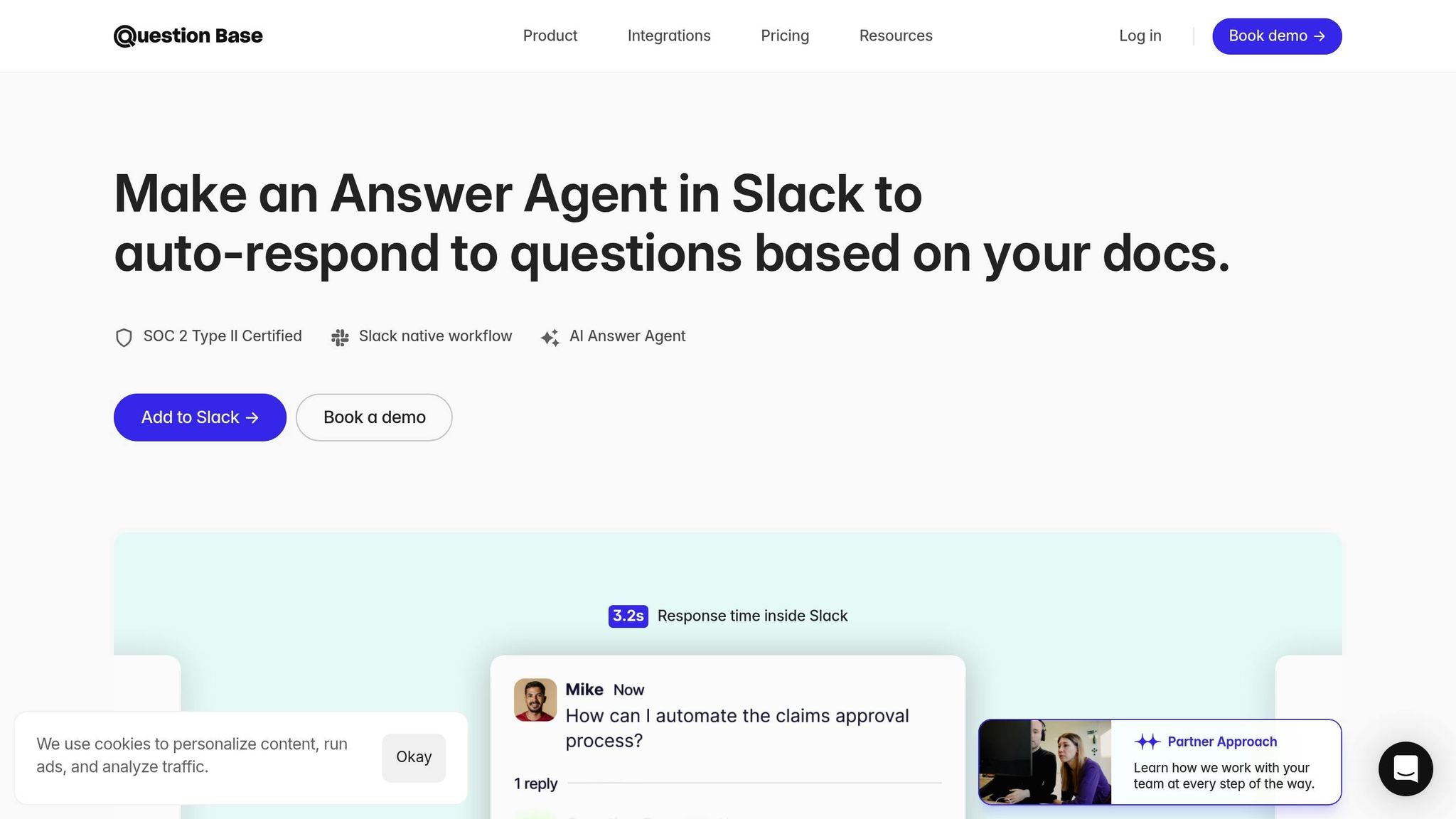
AI Slack bots step in to break this cycle by handling routine questions automatically. For instance, Question Base delivers instant answers with an average response time of just 3.2 seconds[1]. This allows internal experts to focus on more strategic work instead of repeatedly addressing the same issues.
"Now, QB finds the relevant answers in a few seconds, and if not, we can easily add a new answer that will be used the next time."
Maria Jensen, UX Lead & Scrum Master, Ticketbutler[1]
The results speak for themselves: teams using AI-driven platforms have reported a 70% boost in productivity and up to an 80% reduction in time spent on repetitive tasks[2]. These instant responses keep workflows on track by minimizing delays and reducing the mental strain of constant context switching.
Speeding Up Responses Across Time Zones
For distributed teams, time zone differences often lead to frustrating delays. A developer in San Francisco might need input from a colleague in London, only to realize it’s outside working hours. These gaps can slow projects down significantly.
AI Slack bots eliminate this barrier by working around the clock. Whether it’s 9 AM or 3 AM, team members can get the information they need without waiting. On average, this 24/7 availability can save teams up to 2 hours per day[2]. For more complex issues, the bots can escalate queries to the right experts, ensuring even non-automated tasks are resolved efficiently.
"Question Base is there in seconds, plus it's easy to verify answers as new questions come along."
Additional benefits include a 25% reduction in time spent on manual tasks and a 30% improvement in collaboration effectiveness[2], making these bots indispensable for globally distributed teams.
Making Slack Conversations Searchable
While Slack excels at real-time communication, it’s easy for important information to get lost in the flood of messages. Finding critical details later often means sifting through endless threads or asking the same questions again.
AI Slack bots solve this problem by capturing and organizing knowledge from conversations as it happens. With just one click, helpful answers can be added to a centralized, evolving FAQ. This ensures that essential information is always easy to find.
Studies show that 80% of employees prefer asking questions in chat rather than searching a traditional wiki. Yet, many spend 20–30% of their week looking for information in Slack[1]. By indexing conversations and integrating with tools like Google Drive, Confluence, Salesforce, Notion, Zendesk, and Jira, Question Base simplifies knowledge retrieval and reduces the time wasted on searching.
On top of that, features like continuous learning and built-in analytics - tracking automation rates, resolution times, and knowledge gaps - help teams keep their internal support systems up-to-date and running smoothly.
Question Base vs. Slack AI: What's Different
Slack AI has gained popularity as a productivity tool for remote teams, known for summarizing conversations, generating smart replies, and automating workflows within Slack. While these features are valuable, it’s important to recognize how specialized platforms like Question Base differ, especially when it comes to managing enterprise knowledge on a larger scale.
Designed Specifically for Enterprise Knowledge Management
Slack AI focuses on general productivity tasks - like summarizing threads, transcribing meetings, and helping users navigate past conversations. Question Base, however, is tailored for enterprise knowledge management. Its core strength lies in delivering verified answers from trusted documentation sources, rather than interpreting Slack message history.
This distinction is particularly important in industries where accuracy and compliance are non-negotiable. For example, in regulated sectors or when handling sensitive data, relying on casual Slack messages for answers can lead to errors. Question Base ensures responses are grounded in your organization’s official knowledge base, complete with precise quotes and source annotations for every answer.
The platform also offers an impressive average answer accuracy score of 4.8, thanks to its "human-in-the-loop" system. This allows teams to review and refine answers, ensuring that the knowledge base improves continuously. Unlike Slack AI, which learns passively from chat history, Question Base actively evolves with expert oversight.
Feature Comparison
To better understand how these tools differ, let’s break down their features side by side:
Feature | Question Base | Slack AI |
|---|---|---|
Accuracy | Human-verified answers from trusted documentation sources | AI-generated content based primarily on Slack message history |
Data Sources | Connects to Notion, Confluence, Google Drive, Zendesk, Intercom, Salesforce, Dropbox, and more | Relies on Slack conversations; other tools only available at higher-tier plans |
Knowledge Management | Includes per-channel settings, case tracking, duplicate detection, AI learning from gaps, and new knowledge capture | Limited to improving conversation productivity |
Analytics | Provides metrics like resolution rates, automation rates, unhelpful answer tracking, and content gap reports | Offers basic usage statistics |
Customization | Full control over AI tone, behavior, accessible content, and escalation workflows | Limited to Slack’s built-in workflow features |
Security & Compliance | SOC 2 Type II certified, encryption at rest/in transit, optional on-premise deployment | Standard Slack security measures |
Pricing | $8 per user per month | $18 per user per month |
Best For | Enterprise knowledge retrieval, reducing repeated questions, and scaling employee support | Conversation summarization, meeting notes, and general productivity automation |
One standout area is analytics. Question Base provides in-depth reporting on frequently asked questions, documentation gaps, and unhelpful answers. These insights allow teams to audit and improve their knowledge base systematically, aligning with sprint cycles or quarterly goals. In contrast, Slack AI offers only basic productivity metrics, limiting its ability to drive long-term improvements.
When Question Base Outshines Slack AI
For organizations that prioritize reliable, enterprise-grade knowledge management, Question Base proves to be a better fit in several scenarios - especially for large-scale operations or regulated industries.
High-volume support teams thrive with Question Base’s specialized features. The platform creates a dynamic, evolving FAQ system by capturing new answers from Slack threads and integrating them into the knowledge base. While Slack AI can help users find past conversations, it doesn’t transform those interactions into structured, reusable knowledge.
Regulated industries like healthcare or finance require strict control over information accuracy and compliance. Question Base’s SOC 2 Type II certification and optional on-premise deployment make it an ideal choice for organizations needing robust audit trails and precise control over accessible documents.
Granular customization is another area where Question Base excels. Teams can configure the platform to meet specific needs, with options like white-labeling, multi-workspace support, and per-channel settings. Slack AI, on the other hand, offers limited customization and lacks this level of control over knowledge sources.
Teams focused on knowledge evolution will find Question Base transformative. Beyond answering questions, it identifies gaps in the knowledge base, tracks unresolved queries, and provides actionable insights to fill those gaps. This turns everyday Q&A into a self-improving system, ensuring that the knowledge base stays relevant and comprehensive.
Installing Question Base is simple: download it from the Slack App Marketplace, invite the bot (/invite @questionbase), connect your documents, and start receiving answers. For remote teams, its escalation workflows ensure that complex questions are routed to the right experts, complete with full context. Whether the query involves HR, engineering, or customer support, nothing gets overlooked.
While both tools have their strengths, their use cases differ. Slack AI is great for speeding up individual tasks, but Question Base transforms Slack into a powerful internal knowledge assistant, helping entire teams stay aligned and productive.
How to Deploy AI Slack Bots Effectively
Rolling out an AI Slack bot isn't just about turning it on and letting it run. To truly maximize its potential for improving response times and boosting productivity, you need a thoughtful approach that includes seamless integration, tailored adjustments, and consistent monitoring. Here’s how to ensure your AI Slack bot delivers lasting results.
Connecting to Your Knowledge Systems
The effectiveness of an AI Slack bot begins with its connection to your organization’s existing knowledge sources. Start by identifying where your team’s most-used information resides. This could be internal wikis, help docs, CRM tools, or shared drives like Notion, Confluence, Google Drive, Salesforce, Zendesk, Intercom, or Dropbox.
Modern AI bots are designed to integrate quickly - no coding required. Once connected, they can retrieve information instantly, keeping employees within Slack instead of toggling between tools.
When deciding which knowledge systems to prioritize, focus on where questions arise most often. For example, if HR handles a high volume of policy-related queries, linking the employee handbook in Google Drive should be an initial step. Similarly, if customer support frequently searches Zendesk for answers, that integration should take precedence. The goal is to ensure the bot pulls accurate, up-to-date information from trusted sources, avoiding reliance on casual Slack messages that may be outdated.
For businesses with unique needs, choose a bot that supports custom integrations. This allows even proprietary or less common platforms to contribute to the bot’s knowledge base, creating a more comprehensive and reliable system.
Adjusting AI Responses and Escalation Rules
Once the bot is connected to your knowledge systems, fine-tune its responses to align with your team’s preferences. Adjust the tone to match your company’s communication style - whether that’s formal for industries like finance or healthcare, or more laid-back for creative teams. This ensures the bot feels like an extension of your team rather than an impersonal tool.
It’s also crucial to define escalation rules for handling complex or sensitive inquiries. For example, you could set triggers based on complexity, confidence levels, or specific keywords. Questions about compensation, disciplinary issues, or security concerns might automatically route to HR, IT, or engineering, complete with the necessary context.
Customizing responses for specific Slack channels adds another level of precision. Different teams or projects may require tailored answers, ensuring the bot meets the unique needs of every group.
Escalation features are especially beneficial for remote teams spread across time zones. When the bot encounters a question outside its expertise, it can immediately hand off the issue to the right person, ensuring timely resolutions for complex problems while handling routine tasks efficiently.
Tracking and Improving Bot Performance
To keep your AI Slack bot running at its best, monitor key performance metrics regularly. Track how often the bot resolves questions without escalation, how quickly it responds, and what percentage of inquiries it handles compared to human agents. Research shows that AI bots can answer 44% of queries and reduce response times by 73%[3]. Use these benchmarks to gauge your bot’s effectiveness and identify areas for improvement.
Pay close attention to unanswered questions or frequent escalations, as these highlight gaps in your knowledge base or areas where the bot needs additional training. Set up routine reporting - aligned with sprint cycles or quarterly planning - to refine your bot’s capabilities and adjust its behavior based on real-world usage.
Analyze which topics the bot handles effectively and which require human intervention. If certain queries lead to repeated follow-ups or escalations, it may signal a need for clearer documentation or further bot training. For example, teams leveraging AI-powered workflows have seen a 25% reduction in time spent on manual tasks[2].
Create a feedback loop by capturing insights from Slack conversations. When employees share helpful answers, convert these into structured documentation that updates the bot’s knowledge base. This self-improving cycle strengthens your organization’s resources over time. Additionally, tracking duplicate questions can reveal opportunities to consolidate information and improve accessibility.
For remote teams, monitor adoption across time zones and departments. If certain groups aren’t using the bot effectively, consider whether they need additional training, updated escalation rules, or better-connected knowledge sources. The aim is to provide a seamless support experience - whether employees interact with the bot or a human agent - anytime, anywhere.
Finally, perform regular content audits to keep your bot relevant as your organization evolves. Review and update your knowledge base quarterly to reflect changes in processes, products, or policies. Use analytics to pinpoint which resources are most accessed and which are overlooked, ensuring your maintenance efforts have the greatest impact on productivity. By staying proactive, you’ll ensure your AI Slack bot remains a valuable asset for your team.
Conclusion
Remote teams often waste countless hours hunting for answers, waiting on colleagues in different time zones, or responding to the same questions over and over. AI Slack bots tackle these challenges head-on by delivering instant, accurate responses around the clock. For organizations dealing with extensive knowledge bases, this shift is more than convenient - it’s a game changer.
Research shows that AI-powered platforms can boost productivity by 70% and cut time spent on repetitive tasks by up to 80%. In a 1,000-person company, inefficiencies like these can cost over $2 million annually[1][2]. Repeated internal queries drain time and resources, but AI Slack bots help reclaim that lost productivity. By automating routine responses, they allow subject matter experts to focus on more impactful work instead of repeatedly addressing the same policies or procedures.
What makes tools like Question Base stand out is their emphasis on enterprise-grade knowledge management. While Slack AI is great for summarizing conversations and enhancing general productivity, Question Base goes further by connecting directly to verified sources such as Notion, Confluence, Google Drive, Salesforce, and Zendesk. This ensures employees always receive accurate, reliable answers. Features like case tracking, duplicate detection, and content gap reporting transform Slack into a dynamic knowledge hub that evolves alongside your organization, driving measurable efficiency gains.
For remote teams spread across multiple time zones, this capability is invaluable. Instead of waiting hours - or even days - for responses from colleagues in other regions, employees get answers instantly. With an average response time of just 3.2 seconds and the ability to auto-answer 35% of repetitive questions, Question Base saves experts over six hours each week. Additionally, its SOC 2 Type II compliance and optional on-premise deployment provide the security and control enterprises need to scale with confidence.
The adoption of AI Slack bots fundamentally reshapes how remote teams operate. By reducing costs and empowering employees with fast, reliable information, these tools make teams more agile and informed. Unlike general-purpose solutions, Question Base is purpose-built for managing enterprise knowledge at scale, making it an essential choice for organizations looking to optimize their operations.
FAQs
How do AI Slack bots like Question Base improve productivity for remote teams compared to Slack AI?
AI Slack bots like Question Base enhance productivity for remote teams by delivering precise, expert-backed answers straight from trusted platforms like Notion, Confluence, and Salesforce. While Slack AI relies heavily on chat history, Question Base takes it further by connecting directly to your organization’s documentation tools, ensuring the information is always reliable and current.
This integration keeps teams on the same page, cuts down on repetitive inquiries, and makes essential knowledge readily available. Built with enterprise demands in mind, it emphasizes precision, traceability, and control, offering HR, IT, and operations teams the tools they need to stay efficient and focused.
What security features make Question Base ideal for industries with strict compliance requirements?
Question Base is built to deliver enterprise-level security, tailored for industries that operate under strict regulations. It adheres to SOC 2 Type II standards, safeguarding your data with encryption both at rest and during transit. For companies requiring even tighter control, it provides an optional on-premise deployment option, allowing complete oversight of your data infrastructure.
How can remote teams use AI Slack bots to streamline knowledge sharing and boost productivity?
Remote teams can make the most of AI Slack bots by linking them with their current knowledge platforms. Take Question Base, for instance - it works effortlessly with tools like Notion, Confluence, and Salesforce to provide precise, expert-approved answers right inside Slack.
This setup minimizes repeated questions, ensures faster access to critical information, and allows teams to concentrate on more impactful tasks. By transforming fragmented documentation into a unified, searchable hub, AI Slack bots like Question Base help distributed teams boost both productivity and collaboration.