∙
Cooper
∙
Reading time:
12 min

Repetitive questions and scattered knowledge drain productivity. If your team struggles with finding answers or automating workflows, two solutions stand out: Custom Slack agents like Question Base and Agentforce, Salesforce’s AI platform.
Custom Slack agents specialize in answering repetitive questions by pulling verified, up-to-date information from tools like Notion, Confluence, and Google Drive. They reduce time wasted on searching and ensure accuracy with built-in human verification.
Agentforce, on the other hand, focuses on automating workflows within Salesforce. It handles tasks like case creation, CRM updates, and approval routing directly in Slack, making it ideal for Salesforce-heavy organizations.
Key differences:
Custom Slack agents prioritize knowledge management and verified answers.
Agentforce excels at workflow automation using Salesforce data.
Your choice depends on whether your team needs reliable answers or automated processes. Below, we break down the features, pricing, and use cases to help you decide.
AWS re:Invent 2024 - Building AI agents in Slack using AWS services (AIM258)
Custom Slack Agents for Knowledge Management
Custom Slack agents, such as Question Base, are tailored specifically for internal support teams grappling with repetitive inquiries. Unlike generic AI tools that merely summarize past conversations, these agents tap directly into your verified documentation sources - pulling accurate information from platforms like Notion, Confluence, Google Drive, Salesforce, and more. In larger organizations, these repetitive questions can drain experts of 6–8 hours every week, which adds up to over $2 million annually in lost productivity for a company with 1,000 employees [1].
Direct Access to Verified Knowledge
The key to these agents’ precision lies in their direct connection to trusted documentation. The difference is all about where the answers originate. While Slack AI relies on chat history - which might include outdated or informal exchanges - custom agents pull information from human-reviewed, up-to-date documentation. For instance, Question Base provides verified answers in just 3.2 seconds, complete with embedded source citations [1]. This method avoids AI hallucinations and ensures accuracy on critical topics like payroll policies or security protocols. Additionally, teams can use a one-click capture feature to turn expert responses in Slack into permanent FAQ entries, ensuring valuable institutional knowledge isn’t lost in endless Slack threads.
"Since we started using QB we haven't used our Google support docs. And if I go on vacation or sick leave, I feel comfortable that QB will just take over."
Linn Stokke, Online Events & Marketing Specialist, Ticketbutler [1]
Customization and Security Controls
Beyond accuracy, these agents offer extensive customization and strong security features. Enterprise teams often require granular control over how the AI operates. Custom Slack agents allow for per-channel configurations, enabling distinct knowledge bases and response styles for different channels, such as #hr or #it-support [1][2]. Administrators can set up escalation workflows that require expert approval before answers go live and adjust the agent’s tone to align with company communication standards. Question Base also supports SOC 2 Type II compliance, along with encryption for data at rest and in transit. For organizations with strict data residency needs, on-premise deployment is available. Additionally, white-labeling options let companies brand the agent as their own internal assistant. These features not only ensure data security but also make it easy to adapt the agent to team-specific needs.
Setup and Performance Tracking
Getting started is simple: install the app from the Slack marketplace, connect your documentation tools, and invite the bot into active channels. Once up and running, analytics dashboards provide insights into resolution rates, automation performance, and knowledge gaps. These insights help managers identify outdated or missing documentation. During a standard 30-day pilot, these agents can resolve up to 35% of repetitive questions automatically [1], allowing subject matter experts to focus on more complex, high-value tasks.
"It's like having an extra person answering questions in Slack."
Willem Bens, Manager of Sales North EMEA, DoIT International[1]
Agentforce for Workflow Automation
Agentforce acts as "digital labor", streamlining enterprise-wide automation within the Salesforce ecosystem. It takes on tasks like creating service cases, routing approvals, and managing follow-up actions - all without manual intervention. Built specifically for organizations using Salesforce CRM, Service Cloud, Tableau, and MuleSoft, Agentforce is a tool designed to simplify complex processes. Below, we’ll explore how it automates workflows, its pricing structure, and its practical applications.
Enterprise Automation Across Salesforce Tools
At the heart of Agentforce is the Atlas Reasoning Engine, which powers its ability to handle queries, pull CRM data, and execute multi-step processes. For example, it can autonomously follow up on sales leads or even schedule patient appointments through healthcare portals. For teams using Salesforce channels in Slack (available with Business+ and Enterprise plans), Agentforce can directly update CRM records from Slack conversations. This includes tasks like changing opportunity stages or closing support tickets, minimizing the need to switch between platforms.
Agentforce’s integration capabilities extend beyond Salesforce. It works seamlessly with third-party tools like Workday, Asana, Box, and Adobe Express, making it an excellent choice for organizations that require cross-platform coordination within a Salesforce-focused environment.
Pricing Model and Platform Dependencies
Agentforce operates on a $2.00 per conversation pricing model and is deeply tied to Salesforce infrastructure. To function effectively, it requires access to Salesforce CRM, Service Cloud, and Data Cloud. For companies not already using Salesforce, this can add significant setup costs and complexity. Additionally, the platform relies on high-quality data - duplicate or incomplete CRM records can impact its performance. To maintain and optimize its functionality, Salesforce suggests appointing an "AI Agent Manager" to oversee and refine agent instructions, which adds an extra layer of operational responsibility.
These dependencies make Agentforce highly effective for Salesforce-heavy organizations but may pose challenges for companies with less mature Salesforce setups or inconsistent data practices.
Scale and Application Examples
Agentforce shines in automating intricate, cross-system workflows. For instance, a sales development representative (SDR) agent can handle inbound leads by pulling CRM data, drafting personalized emails, and logging interactions - all without human input. In IT and HR scenarios, it can manage employee requests, assign tasks based on workload, and trigger approval workflows using Salesforce Flow or Apex.
While custom Slack agents focus on pulling answers from verified sources, Agentforce primarily uses CRM data and Slack history to provide context. This distinction is crucial when deciding between tools: whether your team struggles more with fragmented knowledge or with time-consuming manual workflows will guide your choice.
Feature Comparison: Custom Slack Agents vs Agentforce
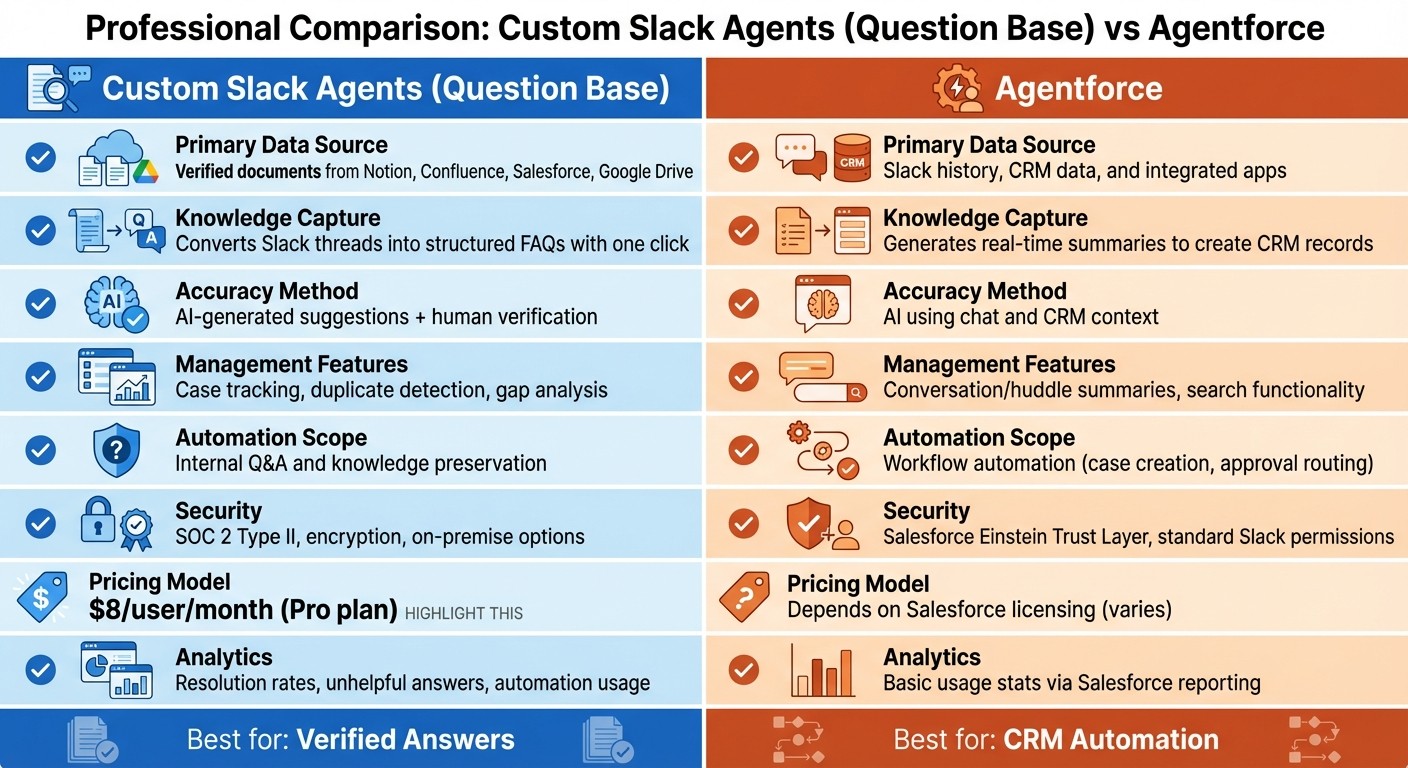
Custom Slack Agents vs Agentforce: Feature Comparison Chart
Side-by-Side Feature Breakdown
To build on the earlier discussion of their strengths, here’s a clear comparison between Custom Slack agents, like Question Base, and Agentforce. Each serves a distinct purpose: Question Base focuses on capturing verified knowledge from trusted sources, while Agentforce is designed for automating workflows by leveraging Slack history and CRM data.
The table below outlines how these solutions perform across key areas:
Feature | Custom Slack Agents (Question Base) | Agentforce |
|---|---|---|
Primary Data Source | Verified documents from platforms like Notion, Confluence, Salesforce, and Google Drive | Slack history, CRM data, and integrated apps |
Knowledge Capture | Converts Slack threads into structured FAQs with a single click | Generates real-time summaries to create CRM records |
Accuracy Method | Combines AI-generated suggestions with human verification | Relies on AI, using chat and CRM context for accuracy |
Management Features | Includes case tracking, duplicate detection, and gap analysis | Offers conversation and huddle summaries, along with search functionality |
Automation Scope | Focused on internal Q&A and preserving team knowledge | Automates workflows such as case creation and approval routing |
Security | SOC 2 Type II compliance, encryption, and on-premise options | Uses Salesforce Einstein Trust Layer and standard Slack permissions |
Pricing Model | $8/user/month for the Pro plan | Pricing depends on Salesforce licensing (varies by plan) |
Analytics | Tracks resolution rates, unhelpful answers, and automation usage | Provides basic usage stats through Salesforce reporting |
This breakdown highlights the unique roles of each tool. As James Lancaster, VP of Product for AI at Slack, explains: "Our vision here is that agents help people work faster and more efficiently... all within the context and knowledge of the conversation that's already happening in Slack" [3].
For trusted, verified answers, Question Base is the better option. If your team needs Salesforce-driven workflow automation, Agentforce is the way to go. Up next, we’ll explore scenarios where each solution shines.
Choosing the Right Solution for Your Team
Both solutions bring their own strengths to the table. Custom Slack agents like Question Base focus on delivering verified answers from your existing documentation, while Agentforce emphasizes CRM-driven automation, enabling tasks like case creation, approval routing, and record updates directly from Slack conversations.
Your choice should hinge on whether your team needs reliable answers or robust workflow automation. Research shows that knowledge workers spend between 20% and 30% of their time searching for information, and AI-powered tools can handle up to 35% of repetitive internal queries [2]. Below, we break down scenarios where each solution shines.
When Custom Slack Agents Are the Better Fit
If your primary challenge is scattered knowledge and repetitive questions, a custom Slack agent could be the answer. For example, if your HR team is constantly asked about benefits or your IT department regularly handles password resets, a tool like Question Base can provide instant, verified responses from trusted sources.
Question Base works best for organizations that:
Integrate multiple documentation platforms like Notion, Confluence, Google Drive, and Zendesk into a single, searchable layer.
Require SOC 2 Type II compliance and enterprise-level security, including on-premise deployment options.
Value human-in-the-loop verification to ensure responses are accurate and auditable.
Manage high-volume internal support across departments like HR, IT, and operations.
Want to track unanswered questions systematically and identify knowledge gaps.
At $8 per user per month for the Pro plan, Question Base is designed for quick deployment - often taking less than an hour without any engineering effort. Simply install the app, connect your documentation tools, and it starts answering questions immediately. It also captures key Slack threads and converts them into structured FAQs with a single click, ensuring important knowledge doesn’t get lost in chat history.
When Agentforce Is the Better Fit
If your organization is deeply tied to the Salesforce ecosystem and needs AI to take action rather than just provide information, Agentforce is a better choice. It’s ideal for teams looking to streamline workflows and manage CRM operations directly within Slack.
Agentforce is best suited for organizations that:
Use Salesforce CRM as their primary system of record.
Need AI agents to perform tasks like creating cases, updating records, and routing workflows - not just answering questions.
Want real-time summaries of customer histories and CRM data delivered in Slack.
Require seamless integration between Slack and Salesforce Data Cloud for unified customer insights.
Have the technical resources to configure and maintain Salesforce-dependent workflows.
Agentforce pricing depends on Salesforce licensing, and the setup process involves configuration within the Salesforce environment. While it’s not a simple plug-and-play option, for teams already embedded in Salesforce, it transforms Slack into a powerful hub for CRM management.
Conclusion
Custom Slack agents like Question Base and Agentforce address different needs, making the choice dependent on the specific challenges your team faces. Question Base focuses on enterprise knowledge management, offering verified, expert-approved answers by tapping into your existing resources like Notion, Confluence, Google Drive, and Zendesk. At $8 per user per month, it’s an effective solution for HR, IT, and operations teams looking to cut down on repetitive questions.
On the other hand, Agentforce specializes in Salesforce-based workflow automation. It handles tasks like creating cases, updating CRM records, and triggering complex, multi-step processes. For example, between March and September 2024, Salesforce’s internal "Engineering Agent" managed 18,000 support interactions for 3,500 users. This saved 30 hours per channel every month and is expected to contribute $20M in annual savings [4].
FAQs
What are the key benefits of using a custom Slack agent built with Question Base compared to Agentforce?
A custom Slack agent built with Question Base provides enterprises with a smarter approach to delivering accurate, source-backed answers while offering advanced tools for managing knowledge. Unlike solutions that primarily depend on Slack chat history, Question Base integrates directly with trusted repositories like Notion, Confluence, Salesforce, and OneDrive. This ensures that responses are verified by experts and grounded in reliable sources. Additional features like case tracking, duplicate detection, per-channel customization, and analytics further help teams enhance support quality and maintain precision.
In contrast, Agentforce functions more as a basic FAQ bot, pulling information from Slack conversations with limited integration options. While it’s easy to set up, it doesn’t offer the document-level connectivity, enterprise-grade controls, or governance capabilities that Question Base brings to the table. For HR, IT, and operations teams requiring dependable, scalable support with built-in auditability, Question Base stands out as the superior solution.
Can Agentforce connect with tools outside of Salesforce?
Agentforce isn't limited to Salesforce - it connects with a range of tools to meet enterprise demands. Designed with a Slack-first approach, it leverages pre-built connectors like MuleSoft to tap into APIs from platforms such as Notion, Confluence, OneDrive, and other third-party services. This setup enables agents to fetch verified information and take actions directly within Slack, streamlining workflows.
According to Salesforce, solutions powered by Agentforce can draw knowledge from trusted sources like Notion, Confluence, and Salesforce itself. This ensures smooth access to non-Salesforce repositories, making support more accurate and efficient.
What security features do custom Slack agents provide for enterprises?
Custom Slack agents take full advantage of Slack’s enterprise-grade security framework. These include encryption at rest and in transit, Enterprise Key Management for controlling encryption keys, and robust identity and access controls such as SAML-based SSO, SCIM provisioning, role-based permissions, and multi-factor authentication (MFA). To further ensure data protection, Slack employs its Model Context Protocol, which isolates AI agents and restricts their access to only the data they are explicitly authorized to use. For added transparency, audit logs and SIEM integration provide detailed visibility into agent activities.
Beyond Slack’s platform safeguards, Question Base adds an extra layer of protection tailored to support-specific needs. With SOC 2 compliance, expert-verified answers, and strict control over knowledge sources like Notion, Confluence, and Salesforce, it ensures both security and precision. Features such as case tracking, duplicate question detection, and granular per-channel settings help maintain accuracy while limiting the agent’s scope to pre-approved areas. This combination offers enterprises the auditability and control needed to manage their workflows with confidence.