∙
Cooper
∙
Reading time:
11 min

Slack AI and Question Base are two tools designed to improve productivity in Slack by addressing repetitive questions and managing internal knowledge efficiently. Here’s a quick breakdown:
Slack AI: Focuses on summarizing conversations, recaps, and searching Slack's history. Costs $18 per user/month as an add-on to existing Slack plans.
Question Base: Connects Slack to knowledge hubs like Notion or Google Drive, offering AI-verified answers. Costs $8 per user/month ($5 with annual billing).
Key differences:
Slack AI: Built-in Slack tool, relies on chat history, higher cost.
Question Base: Pulls from verified docs, lower cost, tailored for internal support teams.
Quick Comparison:
Feature | Question Base | Slack AI |
|---|---|---|
Base Price | $8/user/month (Pro Plan) | $18/user/month |
Primary Data | Verified docs (Notion, etc.) | Slack chat history |
Accuracy | AI + Human Verification | AI-Generated Only |
Customization | High (white-label, settings) | Low |
Enterprise | SOC 2, on-prem options | Standard Slack Security |
For teams handling repetitive questions, Question Base offers a cost-effective and precise solution. If your team is already deep in Slack workflows, Slack AI might fit better for general productivity.
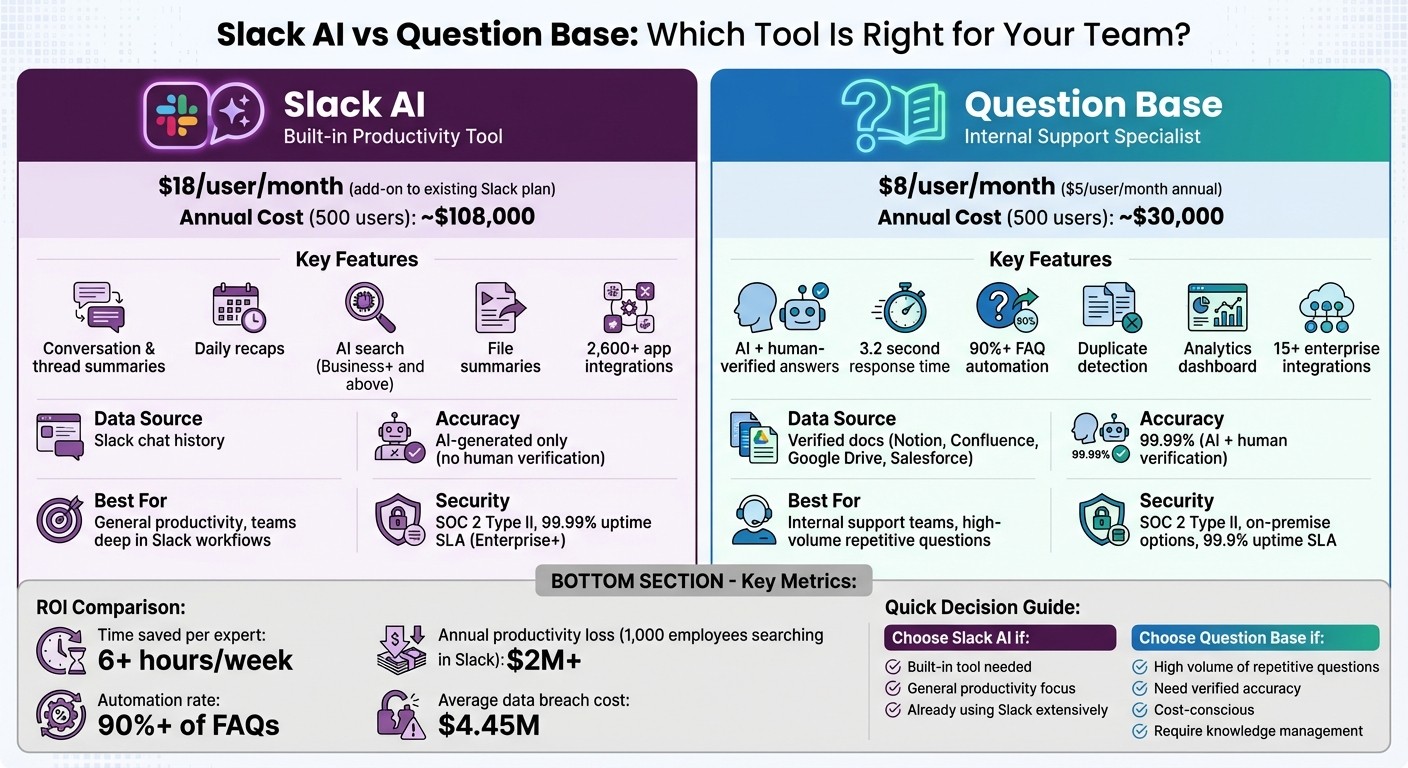
Slack AI vs Question Base: Pricing and Features Comparison
1. Slack AI

Pricing Structure
Slack AI is available as a paid add-on, priced at $18 per user, per month, which is added to your existing Slack plan. For instance, combining this with a Business+ plan brings the total to around $33 per user, per month. Slack only charges for active members, offering prorated credits for inactive users. For a team of 500, the AI add-on alone would amount to approximately $9,000 per month, or about $108,000 annually. These costs reflect the tiered access to features outlined below.
Features and Integrations
The AI capabilities you can access depend on your Slack plan. Teams on the Pro plan can use conversation and thread summaries, while Business+ and higher tiers unlock additional tools like AI search, recaps, file summaries, workflow generation, and for Enterprise+ users, Enterprise Search that integrates with platforms such as Google Drive and GitHub.
Slack emphasizes that customer data is kept private and is not used to train large language models (LLMs) [3].
Additionally, Slack AI connects with over 2,600 app integrations through its Slack App Directory, including popular tools like Salesforce and Google Drive. Business+ and Enterprise+ plans also feature Channel Expert, a pre-built AI agent powered by Agentforce [1].
Scalability and ROI
Slack AI is designed to handle the demands of large teams, using summarization tools to streamline workflows. Features like daily recaps and channel summaries make it easier to catch up on unread messages, while automated responses handle over 90% of FAQs, saving experts over 6 hours per week [1].
The platform’s value lies in its ability to boost productivity and reduce risks. Faster access to information enhances efficiency, while enterprise-grade security features help mitigate costly risks. With the average global cost of a data breach at $4.45 million [4], tools like HIPAA compliance, data loss prevention (DLP), and audit logs can provide substantial cost savings. For a 1,000-person team, the AI add-on would add around $216,000 annually.
Enterprise Readiness
Slack AI prioritizes security and compliance, offering encryption for data at rest and in transit. Enterprise+ plans include advanced features like SAML-based single sign-on (SSO), SCIM user management, and HIPAA compliance options [3]. Business+ and Enterprise+ tiers also benefit from a 99.99% uptime SLA, data residency choices, and Enterprise Mobility Management (EMM), making it particularly well-suited for industries with strict regulatory requirements.
2. Question Base
Pricing Structure
Question Base stands out with its flexible pricing, tailored to match your team's actual usage rather than locking you into a fixed per-user add-on like Slack AI. The Starter plan is free, giving small teams access to one integration and up to 10 pages of documentation - perfect for testing the platform without any upfront commitment. For those needing more, the Pro plan costs $8 per user, per month, or about $5 per user monthly when billed annually. This plan includes premium support through Slack Connect and integrates seamlessly with tools like Google Drive, Notion, Confluence, and Salesforce. Each user can connect up to 200 pages of documentation, with each page accommodating approximately 3,000 characters.
For teams looking to evaluate the platform’s ROI, a $1,000 two-month pilot includes success mapping, a knowledge audit, and performance tracking. To put this into perspective, a 500-person team using the Pro plan would spend around $30,000 annually (at $5 per user per month), a fraction of the $108,000 cost for Slack AI's add-on. For larger organizations, Enterprise pricing is custom-tailored and offers benefits like on-premise deployment, white-labeling, multi-workspace support, and a 99.9% uptime SLA. This pricing approach ensures a cost-effective solution packed with advanced features and integrations.
Features and Integrations
Designed specifically for internal support teams dealing with repetitive questions, Question Base integrates with over 15 enterprise tools, including Salesforce, Confluence, Notion, Jira, Google Drive, Zendesk, and Intercom. This allows it to pull answers directly from trusted documentation rather than relying on chat history. To ensure accuracy, the platform employs a human-verified model that reviews AI-generated answers before they’re added to the system, maintaining a high standard of accountability.
Answers are delivered in just 3.2 seconds, instantly converted into structured FAQs for future use. Managers gain valuable insights through analytics dashboards, which track automation rates, resolution times, and unanswered questions, helping to pinpoint knowledge gaps and prioritize updates. During a typical 30-day pilot, teams often see 35% of repetitive questions resolved automatically.
Scalability and ROI
Question Base is designed to scale with the volume of questions, not the size of your team, making it a cost-effective solution for growing organizations. For instance, in a company with 1,000 employees, the productivity loss from searching for information in Slack can exceed $2 million annually. By automating over 90% of FAQs, Question Base helps organizations recover these costs quickly, especially in departments like HR, IT, and operations where repetitive queries are most common. Subject matter experts save an average of 6+ hours per week, freeing up valuable time for more strategic work.
"Since we started using Question Base, we don't spend any time looking up our procedures in a support manual... QB finds the relevant answers in a few seconds."
Maria Jensen, Ticketbutler
For example, if 100 employees save 2 hours per week, and their time is valued at $50 per hour, the annual productivity gains could reach $520,000 - a return that far outweighs the cost of the Pro plan. Unlike Slack AI’s per-user pricing, Question Base rewards teams that centralize knowledge and reduce redundant queries, making it an ideal solution for high-volume support environments.
Enterprise Readiness
Question Base is built with enterprise-level requirements in mind. It is SOC 2 Type II compliant, offering features like Slack SSO and role-based access controls to ensure secure and efficient operations. Enterprise plans also include encryption for data at rest and in transit, as well as granular per-channel AI behavior settings - critical for organizations managing multiple products or departments. For industries with strict regulations, on-premise deployment options are available, and white-labeling allows companies to brand the agent as their own internal tool. Its cloud-native architecture is optimized for teams with 1,000+ employees, and multi-workspace support ensures seamless functionality for organizations using Slack Enterprise Grid.
Pros and Cons
Let’s break down the trade-offs between Slack AI and Question Base, building on the earlier pricing and feature comparisons.
Both platforms bring distinct advantages to enterprise teams, but their purposes and capabilities differ. Slack AI shines as a built-in productivity tool, offering features like conversation summaries and daily recaps without requiring any additional setup. However, it relies heavily on Slack’s chat history, which may include outdated or unverified information. Slack AI also lacks a formal human-verification process, which can raise concerns about accuracy. Additionally, its premium pricing - stacked on top of Slack’s base subscription fees - can escalate quickly.
Question Base, by contrast, is specifically designed for internal support teams handling repetitive inquiries. It sources answers from expert-verified documentation in platforms like Notion, Confluence, and Salesforce, ensuring a 99.99% accuracy rate for responses. Its standout features include unanswered question tracking, duplicate detection, and a learning loop that turns Slack discussions into structured FAQs. At $8/user/month for the Pro plan, Question Base is notably more affordable, though it requires third-party installation and its free tier is limited to 20 documentation pages.
For teams managing high volumes of support requests, Question Base offers a stronger return on investment. In one pilot, experts saved over six hours per week while automating 90% of FAQs - unlocking significant productivity gains for large organizations. Consider this: for a 1,000-person company, the cost of lost productivity from searching for information in Slack can exceed $2 million annually. Question Base helps reclaim much of that lost value.
Here’s a side-by-side comparison of the two platforms:
Feature | Question Base | Slack AI |
|---|---|---|
Base Price | $8/user/month | $18/user/month |
Pricing Transparency | High (clear Pro, Pilot, and Enterprise tiers) | Moderate (add-on cost depends on base plan) |
Primary Data Source | Verified docs (Notion, Confluence, etc.) | Slack chat history |
Accuracy Mechanism | AI-generated → Human-verified | AI-generated only |
Knowledge Management | Case tracking, gap analysis, FAQ capture | Conversation summaries |
Enterprise Readiness | SOC 2 Type II, on-prem option, 99.9% SLA | SOC 2 Type II, native Slack security |
Scalability | Built for 1,000+ employee teams | Built for all Slack scales |
Customization | High (white-labeling, custom tone, per-channel settings) | Low (standard Slack AI settings) |
Conclusion
Slack AI and Question Base cater to different enterprise needs, making it essential to choose the tool that aligns with your goals.
Slack AI shines in boosting general productivity. It simplifies tasks like summarizing lengthy threads, recapping Huddles, and helping team members stay on top of ongoing conversations. If your organization’s knowledge primarily resides within Slack’s chat history and you’re looking for lightweight support for day-to-day communication, Slack AI is a helpful addition.
Question Base, however, is specifically designed for internal support teams managing a high volume of repetitive queries. By integrating directly with trusted documentation platforms like Notion, Confluence, and Salesforce, it ensures that responses are both accurate and easy to trace. This focus on verified answers supports faster response times and scalable efficiency.
With an impressive 90%+ FAQ automation rate and an average response time of just 3.2 seconds [2][1], Question Base doesn’t just deliver accuracy - it also drives cost savings. At $8 per user per month compared to Slack AI’s $18 add-on, the financial benefits are clear. For a 1,000-person company, where employees spend 12 hours weekly searching for information - leading to an annual productivity loss of $2 million - these distinctions matter [2].
FAQs
How do Slack AI and Question Base differ in terms of data sources and accuracy?
Slack AI relies heavily on your Slack chat history to generate responses, with limited integration options for external documents - and those are only accessible on higher-tier plans. Its answers are crafted from past messages, but they lack formal verification, which can leave room for inaccuracies.
On the other hand, Question Base integrates seamlessly with a variety of trusted enterprise tools, including Notion, Confluence, Salesforce, Google Drive, and OneDrive. The platform delivers expert-verified answers, ensuring responses are accurate, traceable, and pulled directly from reliable sources. This makes Question Base an ideal solution for teams that prioritize dependable, well-documented knowledge over quick, chat-based replies.
How does the pricing for Slack AI compare to Question Base for large teams?
For larger teams, Slack AI’s answering bot add-on starts at $25 per user per month. In comparison, Question Base offers a more budget-friendly option, starting at just $8 per user per month, with an additional 37% discount available for annual billing. Question Base also stands out by providing a free tier for smaller teams and a $1,000 two-month pilot for short-term trials, catering to a variety of team sizes and budgets.
Beyond the pricing advantage, Question Base includes robust features such as integrations with trusted platforms like Notion, Confluence, and Salesforce. It also offers premium support and enterprise-friendly options, including on-premise deployment and white-labeling. In contrast, Slack AI primarily focuses on chat-based data and offers fewer customization options.
For enterprises managing hundreds or even thousands of users, Question Base delivers greater cost efficiency and flexibility, making it an ideal solution for large-scale deployments.
How does Question Base compare to Slack AI in terms of scalability and enterprise readiness?
Question Base is specifically designed to meet the demands of large enterprises, offering features tailored for scale and complexity. These include multi-workspace support, on-premise deployment, and white-labeling, ensuring smooth integration across organizations with thousands of users. Built for enterprise scalability, it also meets SOC 2 Type II compliance standards, providing strong security and auditability - an essential factor for teams in regulated industries. On top of that, its advanced analytics tools, like resolution rate tracking and identifying unhelpful answers, empower teams to fine-tune their knowledge base performance.
On the other hand, Slack AI focuses on improving general productivity by using AI to summarize conversations and generate answers based on Slack chat history. While it’s helpful for streamlining individual workflows, it doesn’t offer enterprise-focused capabilities such as on-premise deployment, multi-workspace management, or compliance certifications. For teams requiring secure, scalable, and verified knowledge management solutions, Question Base stands out as the more robust choice.