∙
Cooper
∙
Reading time:
14 min

Repetitive questions waste time. Companies lose millions annually as employees search for information buried in Slack threads or forgotten files. AI-powered knowledge tools like Slack AI and Question Base are changing this by turning Slack into a smarter, faster hub for finding answers.
Slack AI focuses on summarizing conversations and pulling insights from chats and integrations like Google Drive or Salesforce. It’s ideal for catching up on missed updates or retrieving key points from Slack threads.
Question Base goes further for enterprise needs, creating a verified, searchable knowledge base. It automates 90% of repetitive questions, saving experts over six hours weekly while maintaining accuracy through expert-reviewed answers.
Both tools aim to simplify workflows, reduce time spent searching, and improve team efficiency. Whether you need quick Slack summaries or a robust enterprise knowledge system, these solutions help teams work smarter without leaving Slack.
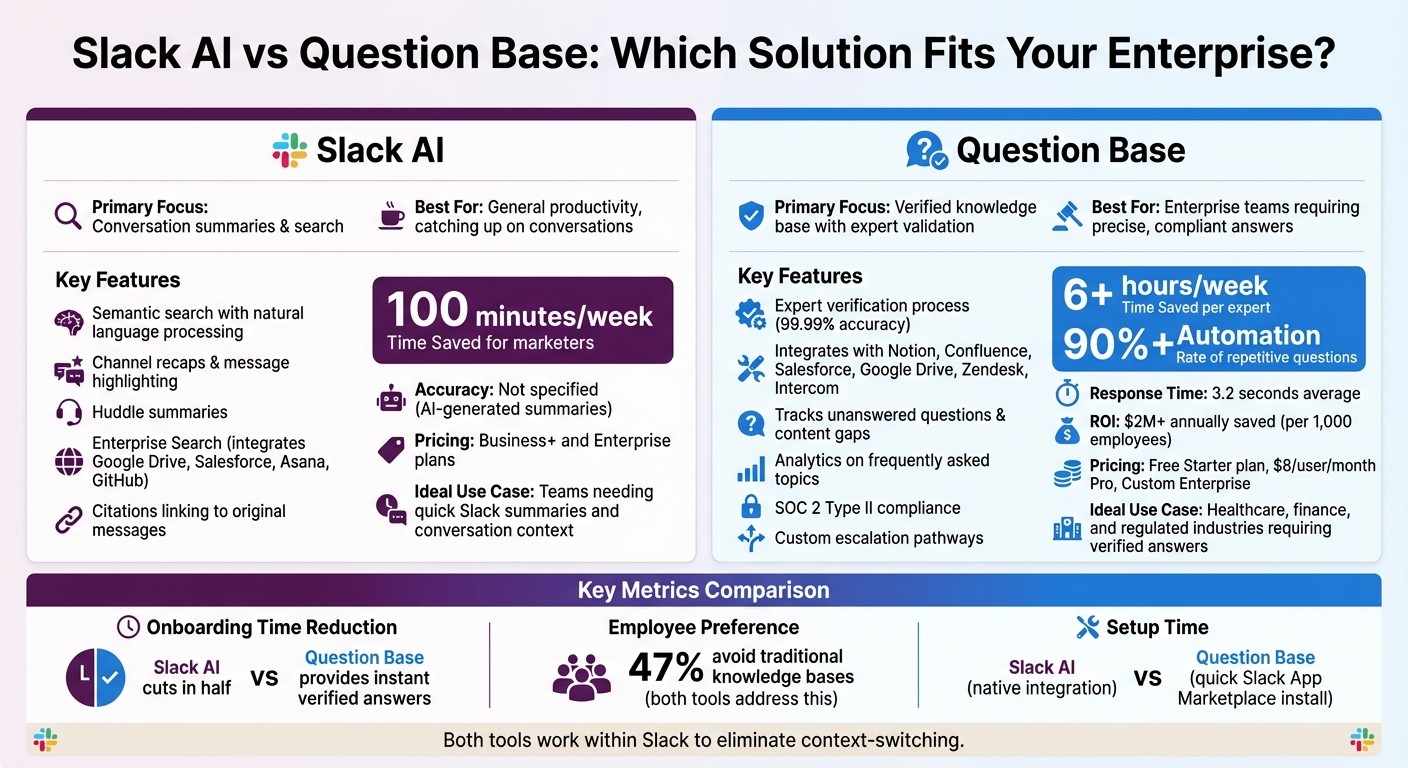
Slack AI vs Question Base: Feature Comparison for Enterprise Knowledge Management
Tettra Slack Integration: AI Knowledge Base
Slack AI: Features and What It Does Well
Previously, we touched on how AI is reshaping knowledge management in Slack. Now, let’s dive into the specific features of Slack AI and how it boosts productivity. One standout capability is its ability to streamline workflows through in-platform search and summarization. Powered by semantic search, Slack AI uses natural language processing to understand your intent rather than relying on exact keyword matches. For example, instead of searching for a specific phrase, you can ask, “How do I translate content?” and receive results tailored to your question’s meaning and context [7].
Slack AI also shines when it comes to conversation summaries. It creates concise overviews of key decisions and action points from channels, direct messages, and long threads. Features like channel recaps deliver personalized daily summaries, highlighting the most relevant updates for each user. Additionally, message highlighting surfaces important updates in busy channels, while huddle summaries capture essential takeaways from live audio and video calls. These tools simplify post-meeting follow-ups and ensure critical information doesn’t get lost in the shuffle [2].
What Slack AI Can Do
Slack AI ensures every answer is tied to its source, with citations linking back to original messages and files for easy verification. For users on Business+ and Enterprise plans, Slack AI goes even further with Enterprise Search, which integrates data from third-party apps like Google Drive, Salesforce, Asana, and GitHub [7][2]. This creates a unified search experience across platforms, making it easier to find what you need without jumping between tools.
The productivity gains are clear. Marketers, for instance, save up to 100 minutes each week, while onboarding times are significantly reduced - cut in half, to be precise [7]. These improvements tackle a major challenge: nearly half of employees (47%) avoid traditional knowledge bases because they’re often disorganized and require constant context-switching [7].
Where Slack AI Excels for Productivity
Slack AI is particularly effective at speeding up everyday tasks. It helps users catch up on missed conversations, provides quick summaries, and retrieves key information from past messages. For new hires, tools like channel recaps and thread summaries offer instant context on ongoing projects and past decisions, eliminating the need to sift through months of message history [7].
This tool is ideal for teams that already rely heavily on Slack for their daily workflows. By keeping everything within Slack’s interface, Slack AI reduces the friction of searching across multiple platforms, making it easier to navigate the constant flow of information. It’s designed to simplify how teams manage and access the wealth of knowledge that moves through their Slack workspace every day.
Question Base: Built for Enterprise Knowledge Management
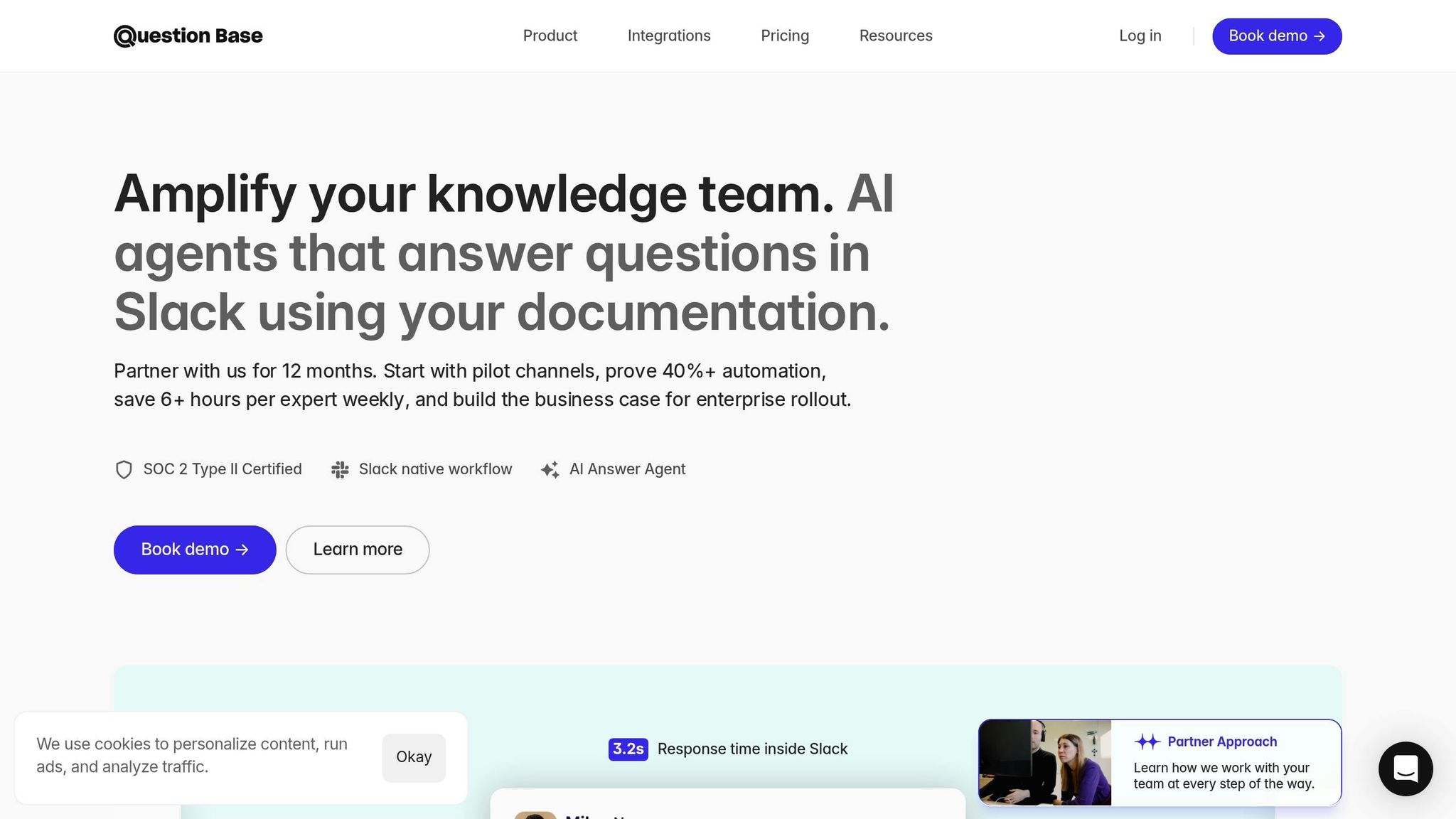
Slack AI is undeniably useful for general productivity tasks like summarizing conversations, but enterprise teams often require something more tailored to their needs. When it comes to delivering verified and accurate support, Question Base stands out by integrating directly with trusted documentation sources. Unlike chat-based systems that rely on AI-generated responses alone, Question Base pulls information from platforms like Notion, Confluence, Salesforce, Google Drive, Zendesk, and Intercom. This direct connection to reliable sources forms the backbone of its specialized approach, paving the way for deeper integrations explained below.
What Makes Question Base Different
At the heart of Question Base is its expert verification process. Human experts validate AI-generated answers before they are added to the permanent Answer Bank. This ensures an impressive 99.99% accuracy rate for verified answers, which is particularly critical for industries like healthcare and finance where compliance and precision are non-negotiable.
Maria Jensen, UX Lead at Ticketbutler, shared her experience: "Since we started using Question Base, we don't spend any time looking up our procedures in a support manual. Before, we could easily spend 5-10 minutes searching... Now, QB finds the relevant answers in a few seconds."
Beyond its accuracy, Question Base brings knowledge management tools that go beyond what Slack AI offers. The platform tracks unanswered questions to highlight content gaps, flags duplicate queries, and provides analytics on frequently asked topics. These insights help teams refine their documentation over time. Most organizations report automating over 90% of repetitive questions and saving their internal experts more than six hours per week. By reducing repetitive inquiries, Question Base not only improves productivity but also drives the advanced security and integration features discussed next.
Security and Customization for Enterprises
Accuracy is just one piece of the puzzle. Question Base is designed to meet enterprise-level demands for security and customization. The platform includes enterprise-grade security measures such as SOC 2 Type II compliance, encryption both at rest and in transit, and optional on-premise deployment for organizations with strict data residency requirements.
Administrators have granular control over how the platform operates. They can manage access to trusted sources, customize the AI’s tone and behavior, and set escalation pathways to human experts for sensitive topics. This ensures that employees only see the information they are authorized to access, maintaining security while improving accessibility.
Quick Setup and Integration
Getting started with Question Base is straightforward. The platform integrates easily through Slack's App Marketplace. Simply install the app, connect your documentation tools, and invite the bot using /invite @questionbase. Continuous data synchronization ensures that the AI always references the most up-to-date documentation.
For teams exploring the platform, the Starter plan is free and includes one integration with up to 10 pages of documentation. The Pro plan costs $8 per user per month and unlocks premium support along with multiple integrations covering up to 200 pages per seat. For larger organizations, Enterprise plans offer advanced options like white-labeling, multi-workspace support, and custom development tailored to unique needs.
Benefits and Real-World Use Cases
AI-powered knowledge search is transforming enterprise operations, delivering results that are both measurable and impactful. For example, organizations using Question Base often automate over 90% of repetitive questions, slashing average response times to just 3.2 seconds - down from the 5–10 minutes previously spent manually digging through documentation. This shift frees up internal experts, saving them more than 6 hours per week. To put it in perspective, companies with 1,000 employees can lose over $2 million annually in productivity due to the hidden cost of repetitive questions [4]. These results highlight how instant AI-driven answers are reshaping workflows across industries.
How Instant Answers Improve Productivity
Replacing manual searches with AI-driven solutions dramatically changes how teams work. Maria Jensen, UX Lead at Ticketbutler, shared that tasks that used to take 5–10 minutes now finish in a matter of seconds. Similarly, Monica Limanto, CEO of Petsy, introduced Question Base in August 2025 to handle a surge of repetitive questions, allowing her team to access verified answers instantly without relying on busy managers. Willem Bens, Manager of Sales North EMEA at DoIT International, summed it up perfectly:
"It's like having an extra person answering questions in Slack."
These efficiency gains don’t just save time - they allow departments to tailor AI knowledge search to address their specific challenges.
How Different Departments Use AI Knowledge Search
Different teams leverage AI-powered search in unique ways to streamline their operations:
HR Teams: Automate responses to benefits inquiries, policy clarifications, and onboarding processes. For example, when employees ask about refund policies or eligibility, the system provides consistent, pre-approved answers, reducing compliance risks.
IT Departments: Deliver instant technical support and troubleshooting guidance, significantly cutting down ticket volumes and improving response times.
Operations Teams: Simplify process documentation and workflow handovers, which is especially helpful for remote teams working across time zones.
Additionally, Question Base tracks frequently asked questions, helping knowledge managers spot gaps in documentation and proactively update content.
Applications by Industry
Industries with strict compliance demands stand to gain the most from AI-powered knowledge tools.
Healthcare: Medical staff can instantly access accurate protocols and compliance information, including escalation procedures for emergencies.
Financial Services: Firms rely on expert-verified answers for regulatory compliance, claims processing, and policy details - critical when precision directly impacts legal and financial outcomes.
Education: Institutions distribute internal knowledge consistently across large teams, ensuring clarity and reducing redundancy.
A notable example comes from Roger, where Cathrine Andersen adopted Question Base during a post-acquisition scaling phase in 2025. The tool shielded product managers and senior team members from being overwhelmed by questions from new hires. She described it as:
"a game-changer"
for managing growth during that crucial period.
Organizations typically see a 35% drop in manual workload within the first month of implementation. On average, employees save 1.4 hours per week across the board. As Question Base continues to learn from unanswered queries, its knowledge base evolves, adapting to the changing needs of teams and delivering even greater efficiency over time.
Measuring Results and What's Next
How to Track Success
To gauge the impact of AI-powered knowledge search, focus on key metrics that highlight operational improvements. Automation rates, for example, measure the percentage of repetitive questions resolved without human input. With Question Base, over 90% of such inquiries are handled automatically[1]. Another important metric is resolution efficiency, which tracks how quickly teams access verified answers. Enterprises using AI-driven search tools report average response times as fast as 3.2 seconds[9].
Reducing the workload for internal experts is another critical indicator. By automating routine questions, subject matter experts can reclaim more than 6 hours each week[1][9], allowing them to focus on higher-value tasks. Question Base also offers analytics dashboards that provide real-time insights into resolution rates, automation levels, and unanswered queries. These dashboards help identify gaps in documentation, enabling teams to proactively update and refine content.
While Slack AI provides basic stats on search queries and outputs[5][8], Question Base takes it further with enterprise-focused metrics. Teams can monitor duplicate questions, assess answer accuracy (which can reach up to 99.99% for verified responses[3]), and gain actionable insights for continuous improvement. Slack’s Enterprise+ plan also includes analytics that track queries across messages, files, and integrated tools like Google Drive[5][8]. Together, these features make Question Base a standout solution for enterprise knowledge management, offering data-driven insights that support ongoing optimization.
The Future of AI Knowledge Management
As AI knowledge management evolves, the focus will expand to deeper integration of internal and external data sources. By 2026, many enterprises are predicted to adopt systems that combine Slack-native data with tools like Notion, Confluence, Google Drive, and Salesforce. These solutions will use advanced technologies - such as semantic search, vector embeddings, and knowledge graphs - to deliver context-aware answers[6][7]. Instead of relying solely on past conversations, these systems will draw from verified, trusted resources across the organization.
Generative AI agents are already capable of synthesizing information, offering actionable insights, and suggesting content across platforms[6][7]. Imagine preparing for a quarterly review: a hybrid AI system could automatically compile data from analytics dashboards, recent Slack discussions, and project documents. Knowledge graphs further enhance this process by mapping relationships between people, projects, and files, while machine learning algorithms personalize results based on user behavior, reducing search times[6].
This next phase of AI knowledge management emphasizes a hybrid approach - combining real-time Slack data with reliable external documentation. This ensures both speed and precision, which is especially important in industries with strict compliance and audit requirements[1][3]. As these systems advance, they’ll automatically flag outdated content, identify missing documentation, and adapt to team needs without manual intervention. This transformation positions Slack not just as a messaging tool but as a dynamic hub for enterprise-grade knowledge management.
Conclusion: AI-Powered Knowledge Search for Enterprise Teams
AI-powered knowledge search has become a game-changer for enterprises, breaking down silos and driving productivity. Slack AI stands out with its ability to understand context and deliver quick summaries from messages, channels, and even integrated tools like Google Drive[5][10]. It’s designed to help users find the right information in seconds, all without leaving Slack - streamlining workflows and saving time.
For teams that require precise, verified answers on a larger scale, Question Base takes this a step further. It pulls from trusted documentation sources like Notion, Confluence, Salesforce, and Google Drive, ensuring expert-reviewed AI-generated responses with an impressive 99.99% accuracy rate[1][3]. This level of precision is especially crucial in regulated industries such as healthcare and finance, where compliance and transparency are non-negotiable.
"Question Base has become our single source of truth. The expert verification process gives us confidence that every answer meets our compliance standards." – Enterprise Product Manager[1]
The results speak for themselves. Enterprises using Question Base report saving over six hours per week per expert, achieving more than 90% automation on repetitive questions, and reducing average response times to just 3.2 seconds[1][9]. For a company with 1,000 employees, this translates into reclaiming over $2 million annually in productivity by cutting down time spent searching for information[4]. These improvements redefine how organizations access and share institutional knowledge.
Looking ahead, the future of AI knowledge management lies in hybrid systems that combine real-time Slack data with verified external documentation[6][7]. Whether you’re comparing Question Base vs. Slack AI for productivity or enterprise-grade solutions, integrating Slack-native AI tools ensures that conversations buried in threads become actionable insights. This evolution not only keeps teams aligned and efficient but also reinforces Slack’s position as a central hub for both day-to-day tasks and robust knowledge management.
FAQs
How does Slack AI help improve team productivity?
Slack AI enhances team productivity by streamlining how information is accessed and shared. It can summarize conversations, pinpoint key messages, and pull relevant context directly from Slack. This helps users save time and cut down on repetitive questions, making it a handy tool for quick insights and chat-based searches.
However, for teams that need trusted, precise answers from reliable sources like Notion, Confluence, or Salesforce, Question Base offers a more tailored solution. Built with HR, IT, and operational teams in mind, it connects seamlessly to enterprise knowledge repositories, ensuring answers are not only fast but also accurate. On top of that, Question Base provides powerful tools like analytics, knowledge gap identification, and expert-verified responses - perfect for organizations that value both precision and scalability.
Why is Question Base ideal for enterprise organizations?
Question Base is tailored to meet the demands of enterprise organizations, delivering expert-verified answers to guarantee accuracy, compliance, and reliability - critical for industries with strict regulations. Unlike generic AI tools, it integrates effortlessly with platforms like Notion, Confluence, Salesforce, and OneDrive, creating a centralized, searchable knowledge hub right within Slack.
Built with HR, IT, and operational teams in mind, Question Base includes features such as case tracking, duplicate detection, and AI-driven learning to address knowledge gaps, all designed to streamline workflows and boost productivity. With enterprise-grade security and scalability, it’s a dependable solution for organizations with thousands of employees, ensuring knowledge is managed with precision and adherence to governance requirements.
How does Question Base compare to Slack AI when it comes to integrating with external data sources?
Question Base and Slack AI take distinct paths when it comes to integrating data. Question Base establishes direct connections with trusted platforms like Notion, Confluence, Salesforce, and OneDrive. This ensures that the answers it provides are not only accurate but also verified and pulled from the most current documentation. For teams managing information across multiple systems, this approach guarantees reliable and traceable knowledge.
On the other hand, Slack AI leans heavily on Slack chat history, with limited integration capabilities for external tools depending on the plan. While this setup can be useful for retrieving quick context within Slack itself, it often lacks the depth and precision required for enterprise-level knowledge management. For organizations that depend on verified answers and smooth integration with external knowledge sources, Question Base delivers a more scalable and dependable solution.