∙
Cooper
∙
Reading time:
15 min

Repetitive questions waste time and slow teams down. If you’re using Slack, you’ve likely noticed how basic tools like Slackbot can handle small tasks but fall short for complex needs. That’s where AI Answer Agents come in - they connect to trusted platforms like Notion or Salesforce to deliver accurate, verified answers quickly.
Key Differences:
Slackbots: Great for simple, rule-based tasks (e.g., reminders, workflows) but rely on Slack history and lack advanced knowledge management or accuracy.
AI Answer Agents: Pull verified answers from external platforms, automate up to 90% of repetitive questions, and provide advanced analytics to improve team efficiency.
Quick Overview:
Slackbots are ideal for small, repetitive tasks.
AI Answer Agents handle complex, knowledge-heavy questions with precision and scale.
For teams with high question volumes or compliance needs, AI Answer Agents are the smarter choice.
What Is a Slackbot?
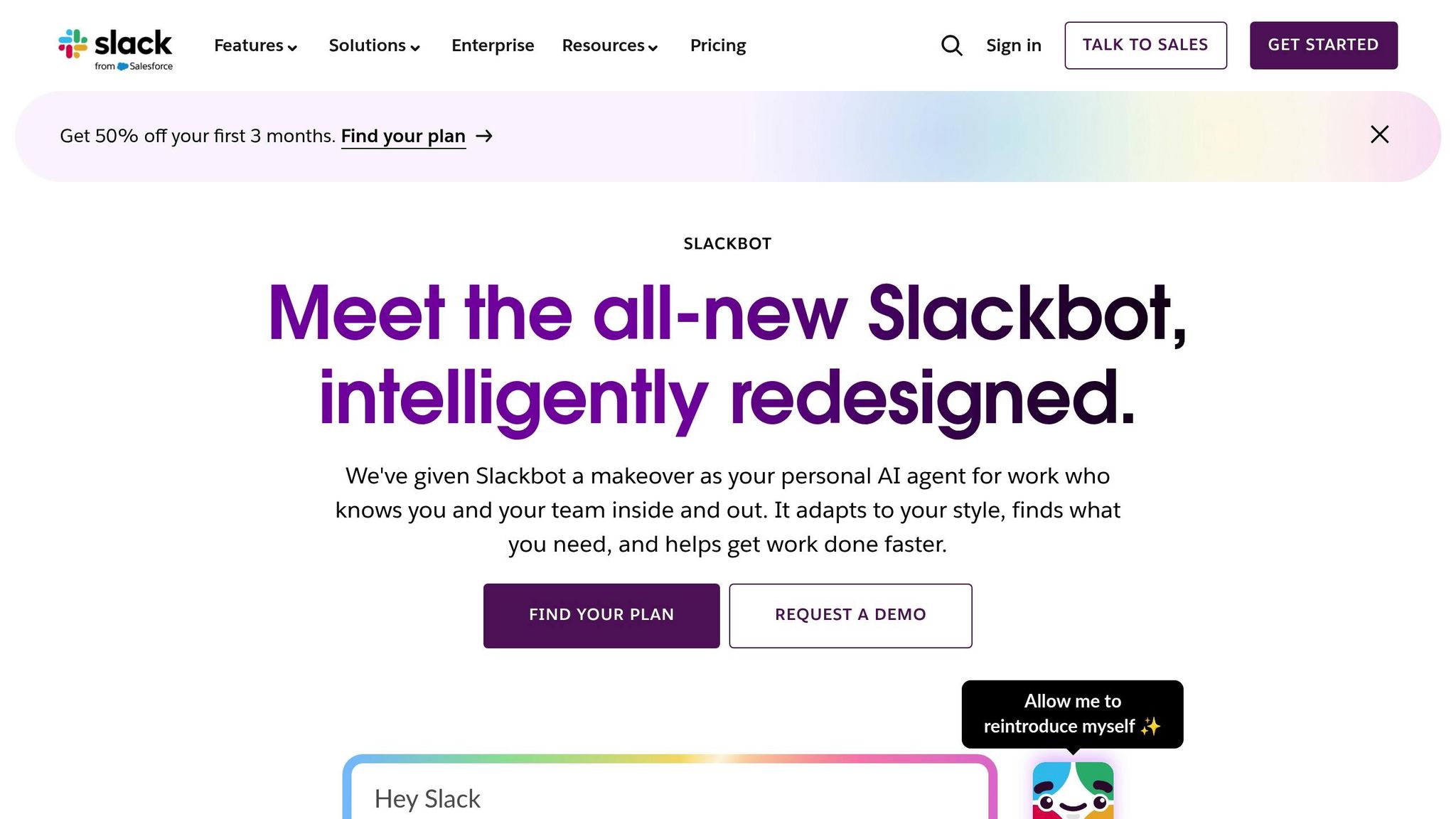
A Slackbot is Slack's built-in automation tool designed to handle simple, rule-based tasks. Picture it as a virtual assistant that responds to specific commands, sends scheduled alerts, and manages basic workflows - without the need for advanced AI capabilities.
Slackbots function using keyword triggers and slash commands. For instance, typing "wifi password" or entering /help prompts the bot to deliver a preconfigured response. This straightforward setup makes Slackbots practical for many routine tasks, though their functionality remains somewhat limited.
What Slackbots Can Do
Slackbots shine when it comes to handling predictable, repetitive tasks. They can send automated welcome messages to new channel members, such as "Welcome to #sales! Here's our onboarding guide." They’re also handy for setting up reminders, like daily stand-up prompts, or integrating with tools like Google Calendar to keep teams informed about upcoming events.
In addition to these basics, Slackbots can kick off workflows and provide helpful context. For example, they can summarize lengthy conversations or flag recurring topics in a channel. Recent updates have expanded their capabilities, allowing them to execute multi-step processes like creating new channels or populating task lists.
Where Slackbots Fall Short
Despite their usefulness, Slackbots come with clear limitations. Since they rely on predefined rules and specific keywords, they often struggle with varied phrasing, uncommon scenarios, or complex questions that don’t align with their programming.
One of the biggest challenges is their reliance on unstructured chat history rather than verified sources like Confluence, Notion, or Salesforce. This can lead to outdated or incomplete responses because they pull from informal conversations rather than authoritative data. Without proper lifecycle management, version control, or human oversight, Slackbots can fall behind as your organization evolves, potentially compromising accuracy and compliance.
Another drawback is the lack of in-depth analytics. While basic usage stats are available, Slackbots don’t offer insights into key metrics like resolution rates, content gaps, or areas where teams might need better knowledge resources. For growing organizations, this lack of visibility can hinder efforts to scale effectively.
What Is an AI Answer Agent?
An AI Answer Agent connects directly to trusted knowledge sources like Notion, Confluence, Salesforce, and Google Drive, delivering verified, context-aware answers in Slack. Unlike Slackbots, which rely on keyword triggers and chat history, these agents search across all connected systems to retrieve key data and provide accurate answers in seconds. With an average response time of just 3.2 seconds[1], employees can get the help they need without waiting on colleagues or sifting through multiple tools.
What makes AI Answer Agents stand out is their ability to adapt and improve over time. Teams can refine answers, capture insights from Slack conversations with a single click, and track unanswered questions to identify knowledge gaps. This creates a dynamic system that evolves alongside the organization, offering more than just quick responses - it’s a tool that grows smarter as it’s used.
What AI Answer Agents Can Do
AI Answer Agents streamline repetitive tasks and centralize scattered knowledge. By integrating with platforms like Notion, Confluence, and Salesforce, they bring essential information directly into Slack.
The automation capabilities are impressive. Within the first month, organizations often automate up to 35% of repetitive manual workloads[2], and this can climb to 90% over time for recurring questions[1]. With about 40% of all internal enterprise questions being repeats[1], these agents save teams from answering the same queries over and over.
But they don’t stop at answering questions. AI Answer Agents also offer advanced analytics, turning everyday interactions into actionable insights. They provide visibility into resolution rates, automation performance, and content gaps, helping teams identify areas where their knowledge base needs improvement. Additionally, teams can customize the tone of responses, manage access to sensitive content, and escalate complex issues - all while maintaining consistent, approved messaging. As Monica Limanto, CEO of Petsy, put it:
"We no longer have staff waiting on busy managers for an answer, Question Base is there in seconds, plus it's easy to verify answers as new questions come along."[1]
These features are reshaping how enterprises manage and scale their internal knowledge, making AI Answer Agents an essential tool for modern organizations.
Why Enterprises Use AI Answer Agents
For large organizations, accuracy, compliance, and scalability are critical - and that’s where AI Answer Agents excel. HR, IT, and operations teams benefit from reduced workloads, as these agents take over repetitive questions that would otherwise consume over six hours of experts’ time each week[1]. Instead of waiting on busy colleagues or managers who are out of office, employees can access immediate, auditable answers. Linn Stokke, Online Events & Marketing Specialist at Ticketbutler, shared:
"Since we started using QB we haven't used our Google support docs. And if I go on vacation or sick leave, I feel comfortable that QB will just take over."[1]
Enterprises also trust AI Answer Agents for their SOC 2 Type II compliance, end-to-end encryption, and flexible deployment options. These features ensure that sensitive information stays secure and accessible only to the right people, making them a reliable choice for organizations that prioritize data protection and efficiency.
Slackbots vs. AI Answer Agents: How They Compare
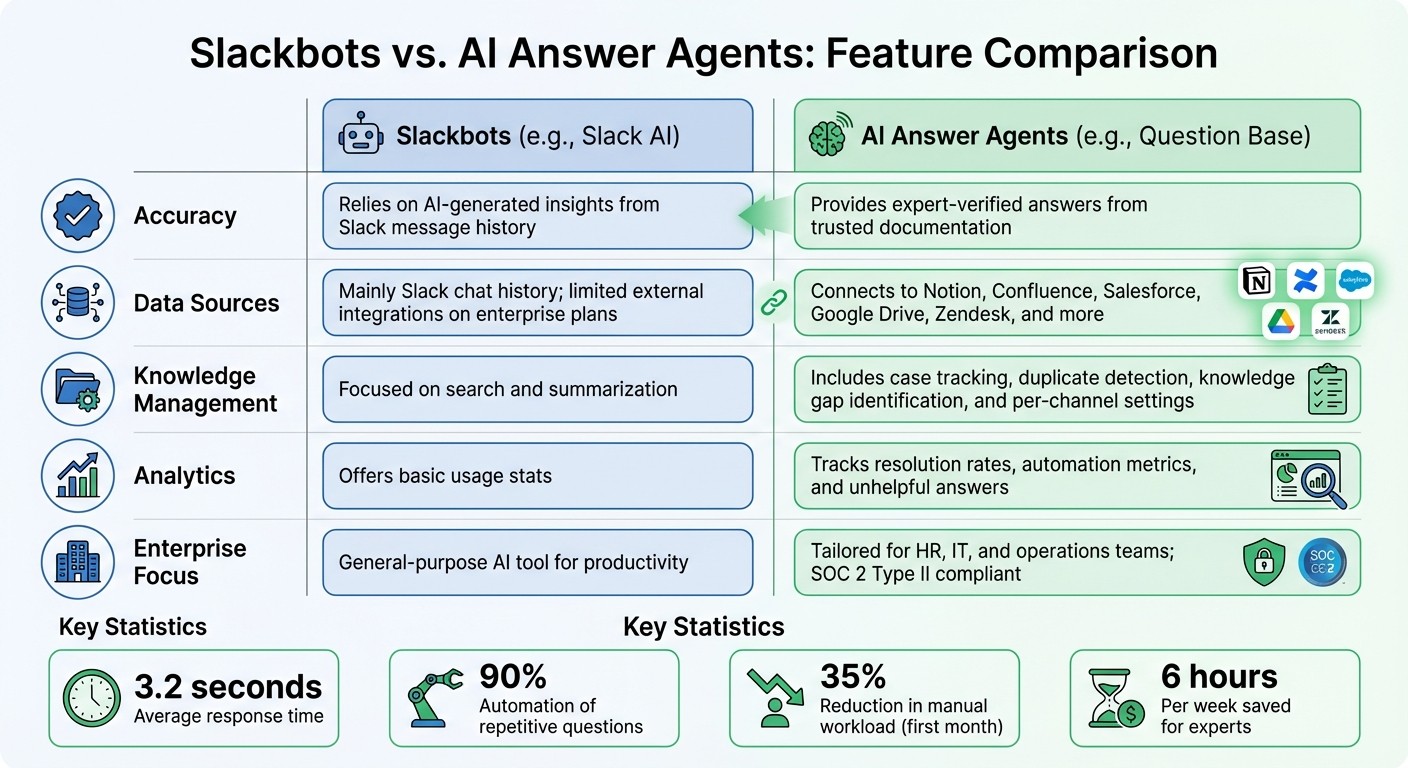
Slackbots vs AI Answer Agents Feature Comparison
Side-by-Side Feature Comparison
To better understand the distinction between Slackbots and AI Answer Agents, let’s break down their features and capabilities. While Slackbots like Slack AI are great for speeding up individual workflows by summarizing past conversations, AI Answer Agents such as Question Base are designed to deliver precise, trustworthy answers at scale - perfect for teams managing complex knowledge needs.
Feature | Slackbots (e.g., Slack AI) | AI Answer Agents (e.g., Question Base) |
|---|---|---|
Accuracy | Relies on AI-generated insights from Slack message history | Provides expert-verified answers from trusted documentation |
Data Sources | Mainly Slack chat history; limited external integrations on enterprise plans | Connects to Notion, Confluence, Salesforce, Google Drive, Zendesk, and more |
Knowledge Management | Focused on search and summarization | Includes case tracking, duplicate detection, knowledge gap identification, and per-channel settings |
Analytics | Offers basic usage stats | Tracks resolution rates, automation metrics, and unhelpful answers |
Enterprise Focus | General-purpose AI tool for productivity | Tailored for HR, IT, and operations teams; SOC 2 Type II compliant |
Slack AI shines when it comes to retrieving conversation history or summarizing Slack threads quickly. On the other hand, Question Base ensures answers come directly from your official documentation, verified by experts, making it a reliable choice for teams that need accuracy and accountability.
What These Differences Mean for Your Team
The differences outlined above are more than just technical - they directly impact how your team operates. For organizations in regulated industries like healthcare or finance, the ability to trace answers back to verified sources is essential. Slack AI’s reliance on informal chat history can lead to outdated or inaccurate responses, while Question Base ensures every answer is tied to official, expert-reviewed documentation. This level of traceability simplifies compliance and audit processes.
AI Answer Agents also bring advanced knowledge management to the table. Unlike Slack AI, which helps retrieve past discussions, Question Base goes further by identifying unanswered questions, spotting duplicate inquiries, and tracking resolution rates. This transforms everyday interactions into actionable insights, enabling teams to refine processes and build structured knowledge over time. For teams inundated with repetitive questions, these tools turn Slack into a hub of efficiency.
As Willem Bens, Manager of Sales North EMEA at DoIT International, explains:
"It's like having an extra person answering questions in Slack."[1]
When your team’s needs go beyond simple recall and require verified answers, advanced analytics, and tailored customization, AI Answer Agents like Question Base offer a more effective solution.
When to Use Slackbots vs. AI Answer Agents
When Slackbots Are Enough
Slackbots are ideal for handling straightforward, rule-based tasks that don’t call for advanced knowledge management or external data connections. For example, if your team needs to schedule meetings through Google Calendar, run quick polls for decisions, or answer simple FAQs like “What’s our holiday policy?”, a standard Slackbot can get the job done. Sales teams often rely on Slackbots for tasks like managing calendars or generating client meeting briefs from workspace data. This eliminates the need to switch between apps, saving each user roughly 30 minutes a day[3].
These tools shine in predictable, repetitive workflows. Tasks like setting reminders, updating canvases with conversation notes, or finding available meeting times are well within a Slackbot’s capabilities. They work by leveraging information already stored in Slack or through basic integrations. However, when tasks demand real-time, verified data from multiple sources or involve more intricate requirements, that’s where an AI Answer Agent steps in.
When You Need an AI Answer Agent
Slackbots have their limits, and that’s where AI Answer Agents like Question Base take over. These tools are invaluable for managing high-volume support channels or addressing complex, knowledge-heavy questions. For instance, if employees frequently ask about updated processes or specific policies stored across platforms like Notion, Confluence, Salesforce, or Google Drive, a Slackbot alone won’t cut it. AI Answer Agents connect directly to these trusted sources, delivering precise, expert-approved answers in seconds - far surpassing the capabilities of a Slackbot that relies solely on chat history.
Teams with specialized internal knowledge requirements benefit the most from this approach. When accuracy, compliance, and auditability are critical - especially for HR, IT, and operations teams handling sensitive or regulated information - AI Answer Agents offer the dependability that basic Slackbots lack.
The decision boils down to the complexity and volume of your team’s workload. If repetitive searches or duplicate questions are draining productivity, or if managers are stuck answering the same queries over and over, an AI Answer Agent can automate up to 90% of those recurring inquiries. Even better, it does so with an average response time of just 3.2 seconds[1]. For high-stakes tasks, where precision and speed are essential, basic Slackbots simply don’t measure up.
How to Choose the Right Tool for Your Team
What to Consider Before Deciding
Before diving in, take a close look at the complexity of your support needs. If your team frequently handles questions that require pulling data from multiple platforms - like Notion, Confluence, Salesforce, or Google Drive - a simple Slackbot vs. AI agent comparison shows why rule-based tools won’t cut it. In contrast, AI Answer Agents integrate directly with these tools, providing accurate, verified answers instead of relying on past chat history.
Compliance and security should also be top of mind. Teams in industries like healthcare, finance, or education often operate under strict regulations, where accuracy isn’t optional. For example, financial teams need SOC 2 Type II certification and must reference Standard Operating Procedures (SOPs) during audits[2]. Similarly, healthcare organizations rely on uninterrupted access to protocols and escalation procedures to meet their operational demands[2].
Another key factor is the volume of repetitive questions your team deals with daily. High query volumes are a strong indicator that automation could significantly reduce the workload on your experts. Research shows that 80% of employees prefer asking questions in chat rather than navigating a company wiki[1]. By automating up to 90% of repetitive questions, AI Answer Agents can free up an average of 6 hours per week for your team’s experts[1].
These considerations help pinpoint when an AI Answer Agent moves from being a helpful tool to an absolute necessity.
When AI Answer Agents Are the Better Choice
For organizations grappling with compliance challenges and heavy question traffic, AI Answer Agents often prove to be the smarter solution. Large enterprises in regulated industries typically need more advanced capabilities than what Slackbots can provide. Take education institutions, for instance - they require scalable, consistent knowledge-sharing across departments and faculty[2]. In environments where accuracy, auditability, and traceable answers are non-negotiable, AI Answer Agents become indispensable.
Implementation costs will depend on the specific needs of your deployment. For enterprise-level solutions, pricing is customized to ensure the investment aligns with the value delivered. Many companies experience tangible results quickly - such as a 35% reduction in manual workload within the first month of implementation[2]. Monica Limanto, CEO of Petsy, shared her experience:
"We implemented Question Base to eliminate repetitive questions and to collate answers and information in one place for a growing team. Question Base has exceeded our expectations - it's easy to use, intuitive and a massive time saver"[1].
For teams where knowledge management is critical and mistakes carry serious consequences, the decision often shifts from being about cost to being about operational necessity.
Conclusion
Slackbots are designed for straightforward tasks - sending reminders, triggering notifications, or handling basic requests. They excel at automation but fall short when it comes to addressing more complex needs, like retrieving verified information from platforms such as Notion, Confluence, or Salesforce.
On the other hand, AI Answer Agents, like Question Base, are purpose-built for managing enterprise knowledge. They connect directly to trusted documentation sources, delivering accurate answers in approximately 3.2 seconds and handling up to 90% of repetitive queries automatically[1]. For industries where precision, compliance, and scalability are non-negotiable - such as healthcare, finance, and education - this capability becomes essential.
The choice between these tools depends on your team’s specific needs. Teams dealing with high support volumes in regulated environments often find that investing in an AI Answer Agent delivers measurable efficiency improvements[1][2].
As Willem Bens, Manager of Sales North EMEA at DoIT International, aptly described:
"It's like having an extra person answering questions in Slack."[1]
For enterprises looking to go beyond basic automation, AI Answer Agents redefine how teams access and share verified knowledge within Slack.
FAQs
What makes AI Answer Agents better than Slackbots for enterprise support?
AI Answer Agents bring a level of sophistication that far surpasses the capabilities of traditional Slackbots. While Slackbots are useful for straightforward tasks - like setting reminders or handling basic queries - AI Answer Agents are crafted to meet the demands of complex, enterprise-level operations. These agents integrate directly with trusted platforms such as Notion, Confluence, and Salesforce, delivering precise, verified responses instead of relying solely on past chat history.
Beyond answering questions, AI Answer Agents streamline repetitive workflows, speed up response times, and provide insights through metrics like resolution rates and knowledge gaps. Designed specifically for teams in HR, IT, and operations, these tools offer flexibility, compliance, and scalability - features that standard Slackbots simply can’t provide. For organizations aiming to enhance accuracy and efficiency on a large scale, AI Answer Agents are the clear solution.
How do AI Answer Agents deliver accurate and compliant responses?
AI Answer Agents prioritize accuracy and compliance by directly integrating with trusted data sources such as Notion, Confluence, and Salesforce. Unlike tools that depend on chat history, these agents draw from verified systems, ensuring responses remain consistent, dependable, and free from typical AI mistakes like generating inaccurate or fabricated information.
For compliance, enterprise-grade solutions like Question Base offer features like data freshness tracking, expert-reviewed answers, and strict alignment with company policies. These capabilities simplify audits and help meet regulatory standards, providing teams with confidence in the reliability and integrity of the information they rely on.
When should a team switch from Slackbots to AI Answer Agents?
Teams should think about transitioning to AI Answer Agents when their requirements surpass what basic automation and simple response tools can handle. While tools like Slackbots and Slack AI are excellent for improving general productivity and summarizing conversations, AI Answer Agents such as Question Base are specifically designed to deliver precise, expert-reviewed answers and tackle complex, enterprise-level support needs.
For teams that depend on trusted platforms like Notion, Confluence, or Salesforce for their knowledge base - and need advanced features like case tracking, duplicate detection, in-depth analytics, or tailored automation workflows - moving to an AI Answer Agent is a practical step forward. This is particularly relevant for HR, IT, and operations teams that require compliance-ready solutions (e.g., SOC2 certification) and scalable tools to handle internal support demands effectively.
In essence, when your team’s priorities evolve from retrieving basic information to managing detailed knowledge systems with enterprise-level precision, AI Answer Agents like Question Base offer the advanced capabilities and dependability to meet these needs.