∙
Cooper
∙
Reading time:
29 min

AI pilots often fail because they don’t fit into existing workflows. Despite promising technologies, 95% of generative AI projects fall short due to outdated systems, siloed data, and resistance from employees. But when workflows align with AI tools, businesses see major improvements, like faster IT resolutions and better supply chain management.
Here’s what’s holding enterprises back - and how to fix it:
Legacy systems: Old tech lacks modern APIs, making data access and integration costly.
Fragmented data: Scattered, inconsistent records stall AI performance.
Scaling issues: Only 11% of companies fully implement AI workflows beyond pilots.
Employee resistance: Concerns about job security and tool complexity slow adoption.
Security risks: 62% of teams cite data protection as a top challenge.
Solutions include modular integrations, real-time data syncs, phased rollouts, and user-friendly AI tools like Question Base. By embedding AI directly into platforms like Slack, enterprises can simplify workflows, reduce resistance, and ensure secure, scalable adoption.
Key takeaway: Success comes from aligning AI with your existing processes - not forcing disruptive changes. Start small, modernize incrementally, and focus on tools that fit your team’s day-to-day work.
Challenge 1: Integrating AI with Legacy Systems
Why Legacy Systems Block AI Adoption
Many enterprises still rely on infrastructure built long before the rise of autonomous AI tools. The main issue isn’t just outdated technology - it’s that these systems were never built to communicate with AI effectively.
A major obstacle is the lack of modern APIs, which are essential for AI tools to access data, execute tasks, or update records across systems[3]. For example, enterprise resource planning (ERP) systems often operate in silos, making it nearly impossible for AI workflows to gather the information they need without costly custom development.
Beyond APIs, outdated hardware and slower processing capabilities further limit these systems. They struggle to handle the large datasets and continuous workflows that AI tools demand[2]. Adding to the complexity, data is frequently fragmented. Different departments rely on separate systems with incompatible formats and siloed databases[2]. This lack of standardization means that even basic information, like customer identifiers, may not align across systems, rendering AI-driven tasks like personalized recommendations or automated support unworkable.
The scale of the problem is striking: 86% of enterprises report needing tech upgrades, and 42% require access to eight or more data sources to make AI operational[7]. This isn’t just a small technical hiccup - it’s a widespread challenge that hinders AI adoption on a larger scale.
The complexity deepens when comparing traditional AI tools with modern agentic AI workflows. Traditional AI systems typically process data in batches or interact with specific systems on a set schedule. In contrast, agentic AI workflows need to operate seamlessly across multiple systems, making real-time decisions without human input[3]. Without modern APIs, these workflows face significant friction, as they can’t reliably access or update data across various platforms.
This explains why only 11% of enterprises have fully implemented AI agent workflows, despite growing interest and numerous pilot projects[3]. While organizations see the potential, their outdated infrastructure holds them back.
Solutions: API-Based and Modular Integration Methods
Replacing legacy systems entirely is often too costly and disruptive. Instead, companies should focus on strategic modernization to integrate AI without overhauling their entire infrastructure.
API-based integration is a practical first step. By creating modern interfaces on top of legacy systems, businesses can build a "translation layer" that allows AI tools to interact with older infrastructure[2][5]. For example, an API gateway can act as a bridge, enabling core systems to connect with advanced AI workflows.
Another effective approach is using modular AI platforms that are designed to work with existing systems[5]. These platforms adapt to current infrastructure, whether through modern REST APIs, older SOAP protocols, or direct database connections. They manage the complexity of translating between different formats, making integration smoother.
To address data fragmentation, organizations can adopt data lake architectures. These consolidate information from multiple legacy systems into a unified repository[2]. Instead of forcing AI workflows to navigate incompatible systems, a central data layer standardizes formats, fills in missing metadata, and ensures consistent access. For instance, a retail company might pull data from legacy point-of-sale systems, e-commerce platforms, and CRM tools into a single data lake, creating a unified source of truth for AI models.
Containerization and microservices provide another route for modernization. These techniques wrap legacy applications in updated interfaces, allowing AI systems to interact with them as if they were modern APIs. This way, the core legacy system remains operational while AI tools can communicate with it seamlessly.
When implementing these solutions, a phased approach is critical. Start with small pilot projects in non-critical areas to demonstrate value and build expertise[5]. For example, a healthcare provider might begin by automating appointment scheduling - a process with high volume but low risk. Success here, measured by metrics like reduced no-shows, can pave the way for expanding AI workflows to more complex tasks. This gradual rollout minimizes risk and builds organizational confidence.
During the transition, human oversight should remain a key component. AI can suggest actions or flag issues, but humans should retain control until the integration matures[10]. This reduces the pressure on legacy systems while ensuring reliability.
Before diving into integration projects, conduct a thorough readiness assessment. Take inventory of all legacy systems, documenting their technical specs, data formats, and API capabilities[2]. Identify low-risk systems for pilot projects and prioritize areas where AI automation would have the most impact. This careful planning helps avoid costly mistakes and ensures resources are allocated effectively.
If internal expertise is limited, external partnerships can accelerate progress. Systems integrators with experience in legacy modernization can provide valuable insights and help navigate common challenges[2].
The bottom line is this: legacy systems don’t have to be a roadblock for AI adoption. With solutions like API gateways, data lakes, modular platforms, and phased implementation, businesses can connect AI workflows to existing infrastructure without the expense and disruption of a full system replacement. These strategies enable organizations to modernize incrementally while unlocking the benefits of AI across their operations.
Challenge 2: Fragmented Data and Disconnected Systems
How Data Silos Impact AI Performance
Fragmented data creates a fundamental problem for AI systems, depriving them of the broad context they need to make decisions effectively. Unlike traditional software, which can operate within a single department using localized data, AI thrives on unified, interconnected information spanning the entire organization [2][3]. When departments like sales and customer service store customer data in different formats, AI agents tasked with automating workflows struggle to connect the dots. This lack of alignment disrupts decision-making and diminishes the efficiency of AI-driven processes [2].
Siloed data directly hampers AI performance. Without access to a complete and cohesive dataset, AI models produce unreliable outputs, leading to delays and failed projects [4]. The problem is compounded by missing metadata and outdated records, which prevent AI from understanding the relationships between data points [3]. For example, mismatched product identifiers across systems can cause AI to mismanage inventory, creating unnecessary inefficiencies.
The scale of this issue is striking. Only 24% of enterprises consider themselves data-driven, and a mere 2% prioritize investments in data literacy [2]. This lack of data maturity significantly contributes to the high failure rate of AI pilot projects.
Incomplete or inconsistent data also forces AI systems to expend resources on translation and validation rather than automation. This not only slows down processing but limits the number of workflows that can be fully automated. In many cases, enterprises must rely on manual oversight or preprocessing to make up for poor data quality, undermining the promise of AI efficiency [3].
The numbers speak to the depth of the problem: 95% of enterprise AI pilots fail, with fragmented data and poor integration being major culprits [6]. Organizations often invest in advanced AI models only to discover that their outdated records and disconnected systems prevent those models from delivering accurate results [3].
Solutions: Unified Data Systems and AI-Powered Standardization
Tackling data fragmentation doesn’t mean overhauling every system or forcing departments onto a single platform. Instead, organizations can adopt strategic consolidation methods that unify data while preserving existing workflows. The key lies in combining real-time synchronization with AI-powered standardization to address these challenges.
Real-time data synchronization is critical for AI success. Autonomous decision-making relies on timely and accurate information [3]. Without it, AI agents may act on outdated or partial data, leading to poor decisions and missed opportunities. For instance, an AI system managing supply chain logistics can’t reroute inventory effectively if it’s working with yesterday’s stock levels from disparate systems [9]. Implementing synchronization ensures that AI always operates with the most current data, whether it comes from legacy systems or newer platforms [3].
Hybrid AI workflow automation provides a practical approach for organizations dealing with fragmented systems. This method combines structured data from business process management (BPM) tools with AI’s ability to process unstructured inputs like emails and documents [4]. AI can clean and organize data automatically, while BPM enforces consistency, creating real-time data feeds that enhance decision-making [4]. By using modular, API-based integration methods, enterprises can connect their disparate systems through middleware and orchestration platforms. Tools like GraphQL APIs and pre-built connectors simplify data exchanges between systems, turning complex networks into streamlined workflows [3][4].
AI-powered data standardization automates the process of cleaning, organizing, and unifying data across fragmented systems [4]. Hybrid AI platforms can identify inconsistencies in data formats, apply standardization rules, and consolidate information from multiple sources into a single structure. This process eliminates the need for periodic manual reconciliation by continuously standardizing new data as it enters the system. The result is improved data quality that enhances AI performance [4].
As AI systems scale, robust data governance frameworks become indispensable. Effective governance begins with clear data ownership, assigning specific teams responsibility for maintaining data quality in their domains [2]. Organizations should also implement standardized data schemas and formats across departments, with AI systems enforcing these rules automatically [4]. Tracking data lineage - understanding where data originates, how it’s transformed, and where it’s used - helps teams quickly identify and resolve inconsistencies. Regular data audits tied to sprint cycles or quarterly planning can further address content gaps and evolving needs [3][4]. Governance frameworks should also define transparent data flows, access rights, and escalation procedures for quality issues, ensuring continuous improvement [3].
Measuring the success of data consolidation is equally important. Enterprises should monitor AI model accuracy across different data sources to understand the impact of unified versus fragmented data [3]. Tracking the percentage of AI decisions that require human intervention can reveal underlying data quality problems [3]. Additionally, measuring data processing times, latency, and the cost of manual reconciliation before and after consolidation provides concrete evidence of progress [4]. Increased employee confidence in AI outputs and higher adoption rates further highlight the benefits of improved data quality [5].
To avoid common pitfalls, organizations should adopt a phased approach. Start with smaller workflows to demonstrate success before scaling enterprise-wide. During the transition, incorporate human oversight to catch errors stemming from data quality issues [10]. Establishing cross-departmental data governance committees can also help break down silos and standardize practices [2]. By addressing fragmentation, enterprises not only improve AI accuracy but also enable seamless workflow integration, a critical factor for successful AI deployment.
The #1 PROBLEM with AI & Automation for Businesses (And How to Fix It)
Challenge 3: Expanding AI Beyond Initial Tests
Moving from small-scale AI trials to full-scale implementation across an enterprise is no small feat. Despite the growing number of pilot projects, only 11% of enterprises have fully implemented AI agent workflows [3]. This gap between successful pilots and widespread adoption has become so prominent that it’s now referred to as the "GenAI Divide" [6].
This divide is more than just a buzzword. MIT research shows that 95% of generative AI pilots fail to scale [6]. The issue isn’t with the AI models themselves but lies in what experts call the "learning gap" - the disconnect between tools, workflows, and organizational readiness [6]. While tools like ChatGPT are flexible enough for individual use, they often fall short in enterprise settings because they don’t adapt to specific workflows [6].
The challenge becomes even more pressing when you consider the ambitions of many organizations. Two-thirds of enterprises plan to have AI agents driving over 25% of their core processes by 2025, but many are not equipped with the necessary infrastructure to meet these goals [7]. This highlights the urgent need to address the barriers preventing AI from scaling effectively.
Common Obstacles to Scaling AI
AI pilot projects often thrive because they’re limited in scope - focused on a single department with dedicated resources and simplified data requirements. However, scaling AI across an entire organization introduces a host of technical and operational hurdles that pilots don’t encounter [2].
Maintaining AI performance across diverse workflows is a major challenge. A model that functions well in one department may falter when applied to different processes, data formats, or workflows. Without careful coordination, AI systems can quickly lose their effectiveness as they scale [2].
Infrastructure and resource limitations also create significant roadblocks. Many enterprises struggle with outdated cloud architectures, legacy APIs, and a shortage of skilled professionals. These gaps make it difficult to support the performance and reliability required for large-scale AI deployment, limiting the return on investment [3].
On top of these technical issues, organizational misalignment poses its own set of challenges. Siloed teams, inconsistent data standards, and a lack of clear governance make it nearly impossible to implement AI solutions seamlessly across departments [2]. When different teams operate independently, coordinating AI initiatives becomes a logistical nightmare.
Adding to this complexity is the way many organizations approach integration. Instead of adopting unified solutions, 41% of enterprises use hybrid build-and-buy strategies, 28% rely on single-purpose SaaS agents, and 24% opt for custom development [7]. This patchwork approach often mirrors the early days of cloud adoption, leading to technical debt and operational inefficiencies [7].
Solutions: Phased Rollout and Modular Deployment
To navigate these challenges, enterprises need a deliberate, phased approach rather than rushing into organization-wide deployment after a successful pilot. Phased rollouts allow for systematic progress, reducing risks and building momentum [2][3].
Start small with targeted workflows to demonstrate immediate value and identify potential issues early on [5]. By focusing on one area at a time, organizations can refine their processes, gain stakeholder confidence, and establish measurable goals for each phase. This gradual approach also helps manage resource constraints more effectively [5].
Adopt modular, API-ready platforms to simplify integration and deployment [5]. These platforms can layer onto existing systems, adding new capabilities without disrupting established workflows. Unlike custom-built solutions, modular platforms require less engineering effort and reduce the risk of introducing errors [5].
Before scaling AI broadly, enterprises should prioritize modernizing their infrastructure. This includes upgrading cloud systems to handle continuous, resource-intensive workflows and investing in tools that ensure reliable performance [3]. Middleware and orchestration platforms can help connect AI initiatives to business processes, but careful planning is needed to avoid creating new technical debt [3].
Establishing clear governance frameworks is critical for maintaining consistency across departments. This involves defining ownership of AI responsibilities, standardizing processes, and creating transparent guidelines for decision-making [2]. Cross-functional teams and shared success metrics can help ensure that AI initiatives remain aligned and coordinated [2].
Human-in-the-loop workflows offer an additional layer of quality control during scaling [10]. Instead of jumping straight to full automation, organizations can implement oversight mechanisms to catch errors and validate decisions. This balanced approach allows for faster deployment while managing potential risks [10].
Tracking progress is essential for identifying bottlenecks and justifying continued investment. Organizations should establish clear metrics to measure success, such as model performance across departments, adoption rates, time-to-value for new deployments, and return on investment compared to pilot results [2]. Monitoring data quality, integration rates, and the frequency of human intervention can provide early warnings of potential issues [3].
Finally, addressing the skills gap is crucial. Enterprises can invest in internal training programs, attract top talent with competitive offers, and collaborate with external partners to fill expertise gaps [10].
Scaling AI isn’t just about technology - it’s about transforming the way organizations operate. By combining phased rollouts, modular platforms, strong governance, and a focus on risk management, enterprises can close the gap between pilot success and full-scale deployment, laying the groundwork for AI to thrive beyond initial tests.
Challenge 4: Employee Pushback and Low Adoption Rates
Beyond the technical hurdles of integrating AI, organizations often face a more human challenge: employee pushback. Even the most advanced AI systems can fall short if employees are hesitant or unwilling to use them. Concerns about job security, disruptions to workflows, and doubts about whether AI will genuinely make work easier are common reasons employees resist these tools. Without their buy-in, even well-designed AI initiatives can lead to longer implementation timelines, higher costs, and underutilized systems, preventing companies from fully capitalizing on their investment.
Why Employees Resist AI Tools
Employee resistance to AI is not without reason. Many workers worry about job displacement, with 31% citing concerns about being replaced by automation [8]. Others question whether AI will actually simplify their day-to-day tasks [2]. When organizations fail to explain how AI reduces workloads or improves processes, these tools can appear as just another layer of complexity. This perception worsens when automation is framed as a "replacement" rather than a "relief" [8].
Trust in AI also diminishes when systems operate like black boxes, offering little transparency about how decisions are made. Additionally, gaps between technical and non-technical teams can create misalignment, further stalling adoption [2].
The broader lack of organizational readiness compounds the issue. Only 24% of enterprises consider themselves data-driven, and a mere 2% prioritize investments in data literacy [2]. Without a solid grasp of what AI can and cannot do, employees are less likely to embrace these tools confidently.
When adoption slows, underutilized AI systems send a clear message to leadership: the initiative lacks support across the organization. This can create a vicious cycle, making it harder to secure the resources needed to expand projects beyond their initial stages. Breaking this cycle requires clear communication and robust training programs.
Solutions: User-Friendly AI and Proper Training
To address employee resistance, organizations must treat AI adoption as a cultural shift, not just a technical upgrade. Start by reframing the narrative around AI: emphasize how these tools can complement human skills by taking over repetitive tasks, freeing employees to focus on work that demands creativity and judgment [8]. Share specific examples of how AI can reduce workloads and improve work-life balance to reshape perceptions.
Open and transparent communication is key. Explain how roles might evolve and outline clear career paths that AI adoption can create. For instance, new roles like AI trainers, workflow designers, and knowledge managers can emerge, offering opportunities for growth and advancement [2]. Involving employees early in the decision-making and implementation process fosters a sense of ownership and reduces the feeling that these changes are being imposed from the top down [2].
Designing AI tools with the user in mind also makes a big difference. Integrating AI into familiar platforms like Slack helps minimize the learning curve [8]. For example, AI-powered Slack agents that provide instant answers within chat channels allow employees to access support without leaving their usual workflows. Similarly, modular AI platforms that layer onto existing systems are often more effective than disruptive, all-encompassing replacements [5].
Training is another critical component. Start with foundational AI literacy to help employees understand what AI can and cannot do [2]. Offer role-specific training tailored to how different teams will use the tools, and encourage peer mentorship to build confidence [5]. Provide ongoing support through resources like video tutorials, detailed documentation, and dedicated help channels to ensure learning continues beyond initial sessions.
Adopting a human-in-the-loop approach can also ease the transition. When AI tools act as decision-support systems - offering recommendations that employees can review and approve - trust builds over time, and staff maintain control over important outcomes.
Finally, tracking adoption is essential. Use multi-dimensional metrics to measure not just usage rates but also engagement levels and the complexity of tasks being handled [5]. Regular surveys, time-to-proficiency analyses, and feedback loops can pinpoint areas for improvement. Sharing early wins and success stories can further encourage adoption and shift organizational attitudes toward AI integration.
Challenge 5: Security Risks and Compliance Requirements
When enterprises integrate AI into their operations, security and compliance concerns often become the biggest obstacles. AI systems frequently need access to sensitive information across various platforms, making them more vulnerable to data breaches, unauthorized access, and compliance violations. These risks are a major reason why many AI projects fail to move beyond the initial stages.
Main Security and Compliance Concerns
Security remains a dominant issue in discussions about AI adoption. A striking 62% of practitioners cite security as their top concern during AI development and deployment. Meanwhile, 53% of enterprise leaders rank it as one of their biggest challenges [7]. This disparity highlights a potential blind spot, where frontline teams may see risks that executives have yet to fully grasp.
The challenge goes beyond just safeguarding data. AI systems often rely on multiple data sources to function effectively. In fact, 42% of enterprises report needing access to eight or more data sources to deploy AI agents [7]. Each additional connection point creates more opportunities for unauthorized access or data leaks. For instance, when AI workflows pull data from systems like customer relationship management platforms, internal documentation, financial records, and employee databases, maintaining consistent security across all these areas becomes increasingly difficult.
Data governance is another pressing issue. Nearly half (49%) of practitioners and 40% of enterprise leaders identify it as a top priority [7]. Without clear governance frameworks, organizations face problems like siloed data, missing metadata, and outdated information. These issues not only weaken security but also reduce AI reliability, as the systems can struggle to differentiate between current and outdated data or determine who has the right to access specific information.
Legacy systems further complicate matters, often requiring additional security measures. The lack of transparency in AI decision-making introduces yet another layer of risk. When AI systems produce outcomes without clear explanations, it becomes harder for organizations to ensure accountability. This is especially concerning in highly regulated industries, where companies must prove that automated decisions comply with anti-discrimination and privacy laws.
The gap in infrastructure is also significant. Over 86% of enterprises report needing upgrades to their existing technology to securely deploy AI agents [7]. Patchwork solutions that worked for earlier technologies often fall short when applied to AI, creating long-term security and compliance challenges. Given these risks, a well-thought-out security strategy is crucial.
Solutions: Secure AI Systems with Proper Controls
To mitigate these risks, enterprises must adopt a robust security framework that protects data and simplifies compliance. Here are some actionable steps:
Achieve SOC 2 Type II compliance and implement encryption for data at rest and in transit. This demonstrates that the necessary controls for data security, availability, and confidentiality are in place.
Enforce role-based access controls (RBAC). Limit access to sensitive data based on specific roles and responsibilities. For example, restrict permissions for modifying AI model parameters or approving AI-driven decisions. Use audit logs to monitor and quickly identify suspicious activity.
Use API-based integration with monitored, controlled connections. APIs help limit exposure by creating clear boundaries for data retrieval. Middleware solutions can further enhance security by managing connections without exposing the underlying infrastructure.
Establish strong data governance policies before deploying AI. Conduct audits to identify issues like siloed data or outdated records. Define clear rules for data ownership, access rights, and retention periods to ensure compliance with regulations.
Create accountability frameworks for AI decisions. Document oversight processes and escalation procedures to ensure ethical AI practices. For high-risk scenarios, include a "human-in-the-loop" approach to maintain oversight of critical outcomes.
Implement security measures incrementally. Start with smaller workflows to test and refine your approach before scaling up to more complex systems.
Conduct regular security assessments for AI workflows. Use penetration testing to identify vulnerabilities and ensure compliance documentation stays current.
Choose AI platforms designed for enterprise security needs. Look for solutions that support SOC 2 Type II compliance, robust encryption, RBAC, and comprehensive audit logging. For organizations with strict data residency requirements, platforms offering on-premise deployment are ideal.
For those integrating AI into Slack workflows, these security measures are even more critical. Slack often serves as a central hub for sensitive business discussions, customer data, and strategic decisions. AI tools operating in this environment must meet enterprise-grade security standards. Take Question Base as an example - it achieves SOC 2 Type II certification, encrypts data both at rest and in transit, and offers on-premise deployment options [1]. Additionally, it provides granular control settings, allowing organizations to manage AI behavior on a per-channel basis, ensuring sensitive information stays protected.
Using Question Base for AI-Powered Slack Workflows
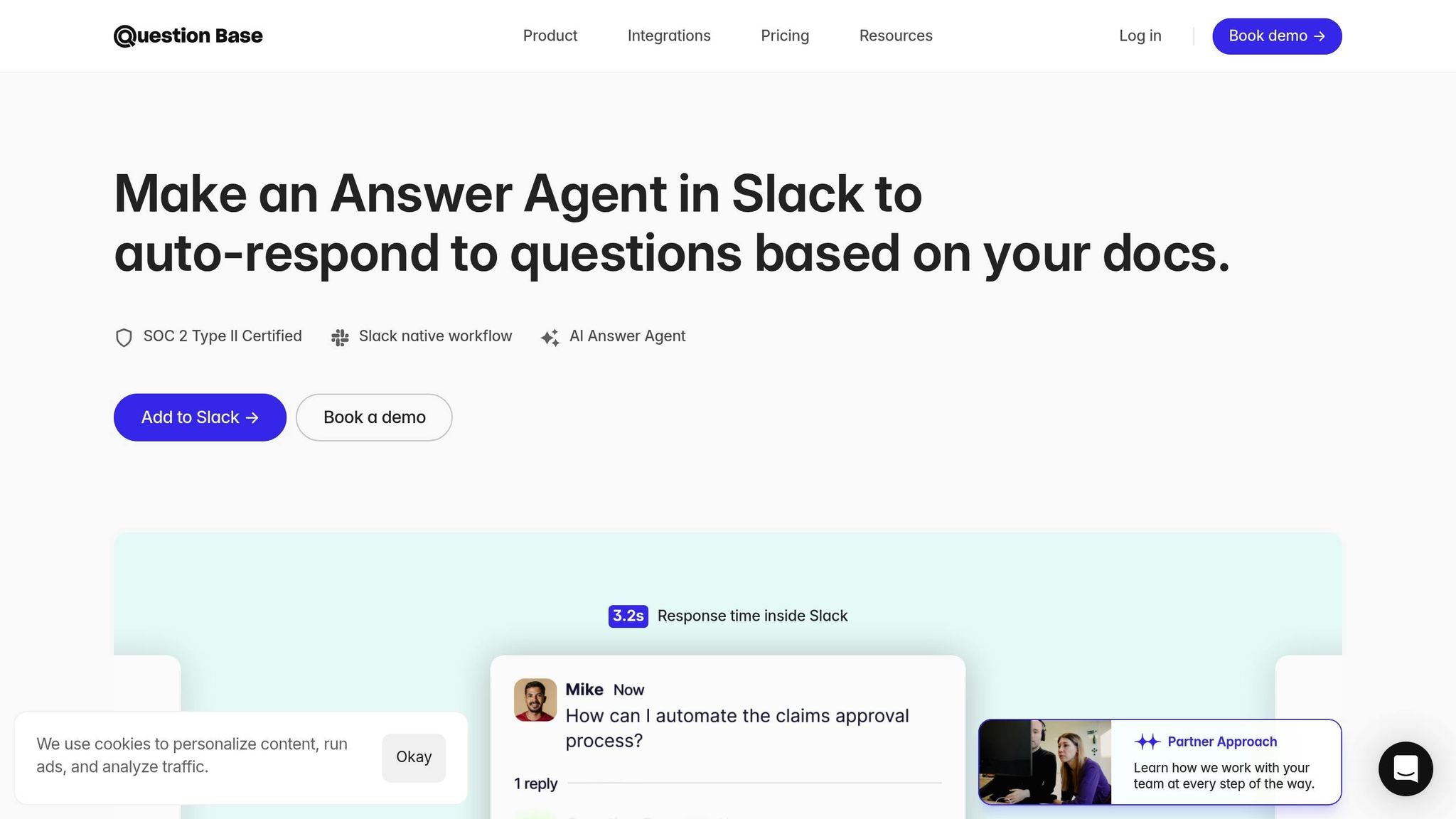
Enterprises have worked hard to address security concerns, data fragmentation, and user adoption challenges. Now, they’re looking for AI tools that actually deliver results without creating new complications. For organizations relying on Slack as their central communication hub, embedding AI directly into Slack offers a practical solution to issues like scattered data and low adoption rates.
Why Slack-Native AI Tools Make Sense
Slack-native AI tools bring tangible benefits by simplifying everyday tasks. When AI is integrated directly into Slack, employees can access the information they need without leaving the platform. This reduces the constant back-and-forth between apps, saving time and energy. With instant answers available in Slack, employees avoid multiple logins and repetitive searches.
This integration turns Slack into more than just a chat tool - it becomes an organized, searchable knowledge hub. Conversations and answers don’t get lost in endless threads; instead, they’re stored for future use. The result? Faster decisions, less time spent juggling tools, and minimal training since employees are already familiar with Slack.
For enterprises, embedding AI into existing workflows means lower costs and quicker results compared to standalone solutions that require learning new systems. It also helps overcome employee resistance, a common hurdle when introducing new technology.
How Question Base Makes AI Integration Effortless
Question Base simplifies the process with a plug-and-play setup that doesn’t require engineering expertise. Teams can install the app from the Slack App Marketplace, invite the bot to active channels using /invite @questionbase, and connect their existing documentation tools.
The platform supports pre-built connectors for popular enterprise systems like Notion, Confluence, Google Drive, Zendesk, Intercom, Salesforce, and Dropbox. By bringing information from multiple sources into a single Slack interface, employees can get verified answers without needing to know where the data is stored.
Here’s how it works: when someone asks a question in Slack, Question Base searches all connected sources simultaneously. It translates formats, reconciles data, and delivers accurate, verified responses - all without requiring employees to sift through different tools. This approach bridges the gap that generic AI tools often struggle with, ensuring the system adapts to the specific needs of the enterprise. Plus, with a dynamic FAQ that evolves as new questions arise, Question Base stays in sync with changing workflows.
The no-code design makes it easy for non-technical administrators to install, configure, and manage the system. Teams can customize AI behavior through simple settings, ensuring the platform aligns with the organization’s unique needs and practices.
Key Features Tailored for Enterprises
Question Base offers a range of features designed to meet the demands of enterprise users:
Instant, Context-Aware Answers: The platform pulls verified answers from connected knowledge sources directly into Slack. Teams can review, edit, and refine AI responses, ensuring accuracy and maintaining control over shared information. This review process builds trust by addressing concerns about transparency and bias.
Knowledge Capture from Slack Conversations: With just one click, valuable insights from Slack threads are transformed into structured, searchable documentation. Thread summarization automatically creates FAQs from long discussions, ensuring important information doesn’t get buried in chat history.
Performance Analytics: Dashboards track automation rates, resolution times, and knowledge gaps. By logging unanswered or escalated questions, managers can identify areas where documentation needs improvement, helping align content updates with business priorities.
Customizable AI Behavior: Enterprises can define the AI’s tone, style, and scope to reflect company values and policies. They also control which content sources the AI accesses, ensuring decisions are based on accurate, trusted information. Sensitive queries can be routed to human reviewers for added accountability.
Enterprise-Grade Security: Question Base is SOC 2 Type II certified, with encryption for data at rest and in transit. For organizations with stricter requirements, the platform even supports optional on-premise deployment. Granular settings allow different AI behaviors for various departments, protecting sensitive information.
Phased Deployment: Enterprises can start small by connecting a single data source or piloting with one team. This step-by-step approach minimizes risks, builds momentum, and allows teams to fine-tune processes before scaling up.
Conclusion: Successfully Mapping Workflows to AI
Aligning workflows with AI involves navigating a mix of technical and organizational challenges. It’s not just about the tools or infrastructure - it’s about ensuring data quality and fostering human adoption. Statistics reveal that many AI pilots fail, with only a small percentage of enterprises managing to fully implement AI workflows[2][3][6].
To succeed, businesses need to address both sides of the equation. On the technical front, they must tackle issues like outdated systems, fragmented data sources, and stringent security requirements. At the same time, they can’t ignore organizational hurdles such as resistance from employees, gaps in skills, and unclear governance structures. Focusing on just one side - technical or cultural - won’t lead to long-term success.
A phased approach using specialized tools has proven to be the most effective strategy. Starting small, with targeted use cases, allows teams to show tangible results, refine their processes, and pinpoint integration challenges before scaling up to larger deployments[5]. This step-by-step method not only minimizes risks but also delivers quick wins that help build momentum and secure internal support.
Platforms like Question Base streamline this process by offering ready-to-deploy solutions that eliminate the need for extensive custom development. By embedding AI into tools employees already rely on - such as Slack - and seamlessly connecting to existing documentation systems, these platforms reduce technical obstacles and make adoption easier. This holistic approach is key to transforming pilot projects into scalable, impactful AI solutions.
The way forward requires a careful balance of ambition and practicality. Enterprises should focus on building strong data governance frameworks and creating unified data pipelines as foundational steps. Equally important is prioritizing change management alongside technical execution and selecting AI tools that ensure transparency and maintain human oversight. Treating AI integration as purely a tech problem will only lead to more struggles. Instead, organizations that modernize their systems while evolving their workplace culture will be best positioned for lasting success with AI.
FAQs
How can businesses address employee resistance to AI and ensure successful adoption?
To help employees embrace AI, businesses need to prioritize open communication, proper training, and showcasing tangible benefits. Begin by clearly outlining how AI can make their workday easier - whether it’s cutting down on repetitive tasks or offering quicker access to essential information. Involve teams from the start, actively seeking their input and addressing any concerns they might have.
Offer hands-on training sessions to help employees get comfortable with AI tools, ensuring these tools fit seamlessly into their current workflows. Share examples of early successes or small wins to build trust and show the real-world value of these tools. Finally, create a collaborative environment by involving employees in decisions about how AI is rolled out, helping them feel connected to and invested in its success.
How can businesses integrate AI tools with legacy systems without causing major disruptions?
Integrating AI tools into legacy systems can be a complex task, but with thoughtful preparation, it becomes much more manageable. Start by assessing compatibility between the AI solution and your current infrastructure. This means carefully reviewing APIs, data formats, and existing workflows to ensure the new tool can communicate effectively with your systems.
Take a gradual approach to implementation to avoid major disruptions. Begin with a pilot program, focusing on smaller, less critical workflows. This allows you to test the AI tool in a controlled environment, identify any potential issues, and make necessary adjustments before rolling it out on a larger scale.
Finally, equip your team for the transition. Offer training on how to use the AI tool and set up clear support channels to handle questions or problems during the rollout. This step ensures your team feels confident with the new technology, helping you maintain smooth operations while unlocking the advantages AI can bring.
How can enterprises address security and compliance challenges when adopting AI at scale?
Enterprises looking to tackle security and compliance challenges can benefit from tools like Question Base, which offers robust security measures tailored for enterprise needs. These include SOC 2 Type II compliance, encryption for both data at rest and in transit, and the option for on-premise deployment for added control.
On top of that, Question Base empowers organizations to maintain complete oversight of accessible content, AI behavior, and escalation workflows. This ensures alignment with internal policies and industry regulations while enabling seamless AI integration across various operations.