∙
Cooper
∙
Reading time:
10 min

Repetitive questions drain productivity. If your team uses Slack, you’ve likely experienced the frustration of answering the same internal queries over and over. While Slack AI helps with productivity by summarizing chats and pulling insights from message history, it falls short when addressing large-scale, repetitive internal questions.
Enter Question Base. Unlike Slack AI, which relies on chat history, Question Base connects directly to verified documentation platforms like Notion, Confluence, and Salesforce. It delivers accurate, expert-reviewed answers in seconds, automates up to 90% of repetitive questions, and provides enterprise-grade tools like case tracking and content gap identification.
Key Takeaways:
Slack AI: Best for summarizing conversations and enhancing Slack navigation. Limited to chat history for answers.
Question Base: Built for HR, IT, and operations teams managing repetitive internal queries. Pulls from verified sources, ensuring accurate answers and scalable knowledge management.
Quick Comparison:
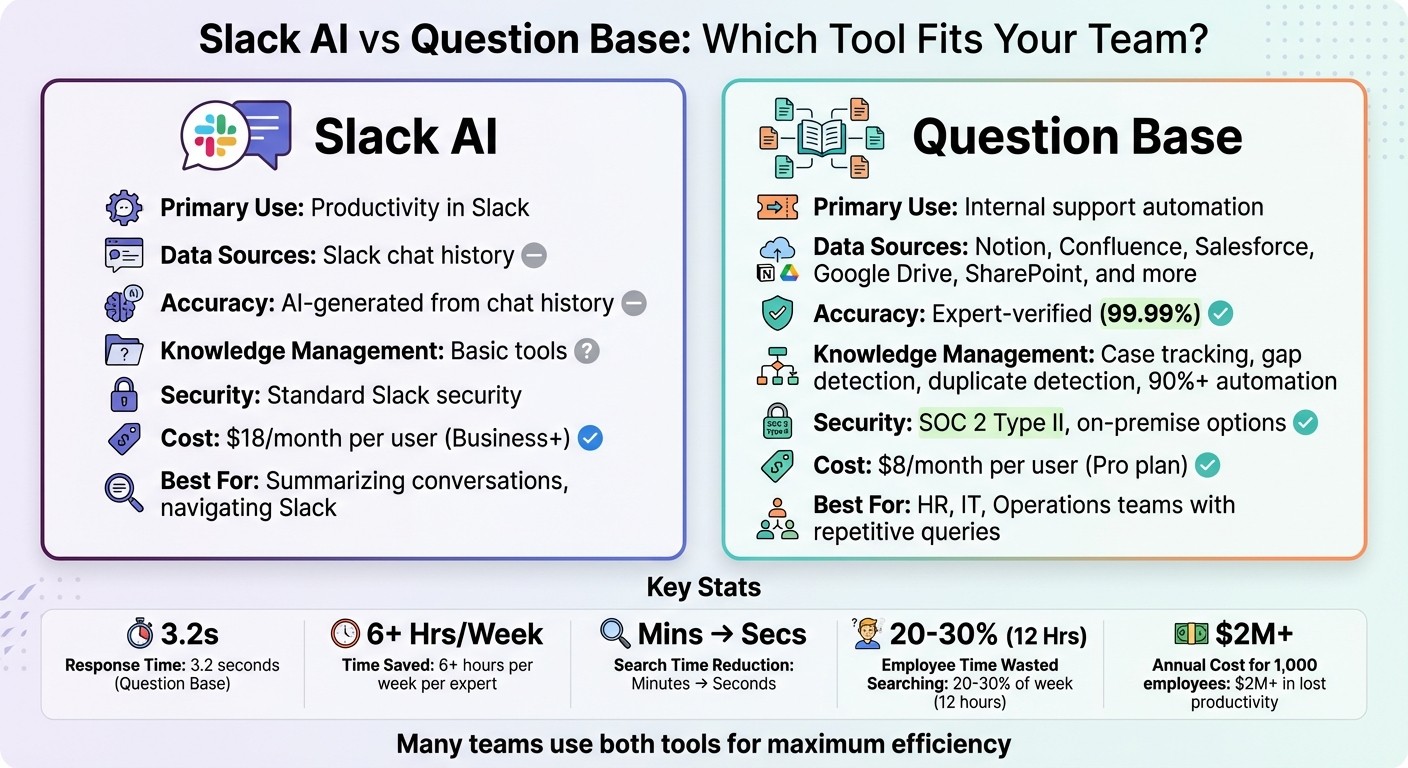
Feature | Slack AI | Question Base |
|---|---|---|
Primary Use | Productivity in Slack | Internal support automation |
Data Sources | Slack chat history | Notion, Confluence, Salesforce |
Accuracy | AI-generated from chat history | Expert-verified (99.99%) |
Knowledge Management | Basic tools | Case tracking, gap detection |
Security | Standard Slack security | SOC 2 Type II, on-premise |
Cost Per User | $18/month (Business+) | $8/month (Pro plan) |
If your team’s main challenge is navigating Slack, Slack AI is a good choice. But if repetitive questions and knowledge gaps are slowing you down, Question Base is the smarter option. Many teams combine both tools for maximum efficiency.
Slack AI vs Question Base: Feature Comparison for Internal Support Teams
I Made AI Agent for Slack in 5 minutes - Step-by-Step Tutorial
1. Slack AI
Slack AI is built directly into Slack, offering tools to summarize conversations, draft messages, and answer questions. For instance, if you ask Slack AI, "What did we decide about the new PTO policy?", it scans your chat history and files to deliver a concise response based on the information you’re authorized to access [5]. Below, we’ll explore how Slack AI performs in terms of accuracy, data integration, and enterprise-focused features.
Accuracy
Slack AI relies on analyzing chat history to generate answers rather than pulling from verified documents. While this can be helpful for quick, informal queries, it might miss important details stored outside of Slack. Its accuracy hinges on how well your team documents information within Slack itself. For organizations that use tools like Notion, Confluence, or Salesforce to store critical data, Slack AI won’t access those sources unless you’re using Business or Enterprise plans [1][2].
Data Integration
Slack AI is designed to pull insights primarily from within Slack - covering messages, threads, and files uploaded to your workspace. However, its ability to integrate with external platforms is limited [1][2]. If your team relies on external systems like Notion, Confluence, or Salesforce to manage knowledge, Slack AI won’t automatically access that information. This limitation can create challenges for organizations that spread their institutional knowledge across multiple tools.
Enterprise Features
For businesses on the Business+ or Enterprise plans, Slack AI offers advanced tools like Channel Expert, an AI agent powered by Agentforce [1][3]. It also includes AI-powered search functionality, which allows users to explore Slack history and, on higher-tier plans, search within some external tools. While these features enhance Slack’s internal knowledge retrieval, they don’t support the creation of long-term, curated knowledge bases. Features like ownership tracking, approval workflows, or enterprise-level service-desk tools are absent, making it less suitable for managing verified, long-term knowledge. Alternative solutions may better address these gaps.
2. Question Base
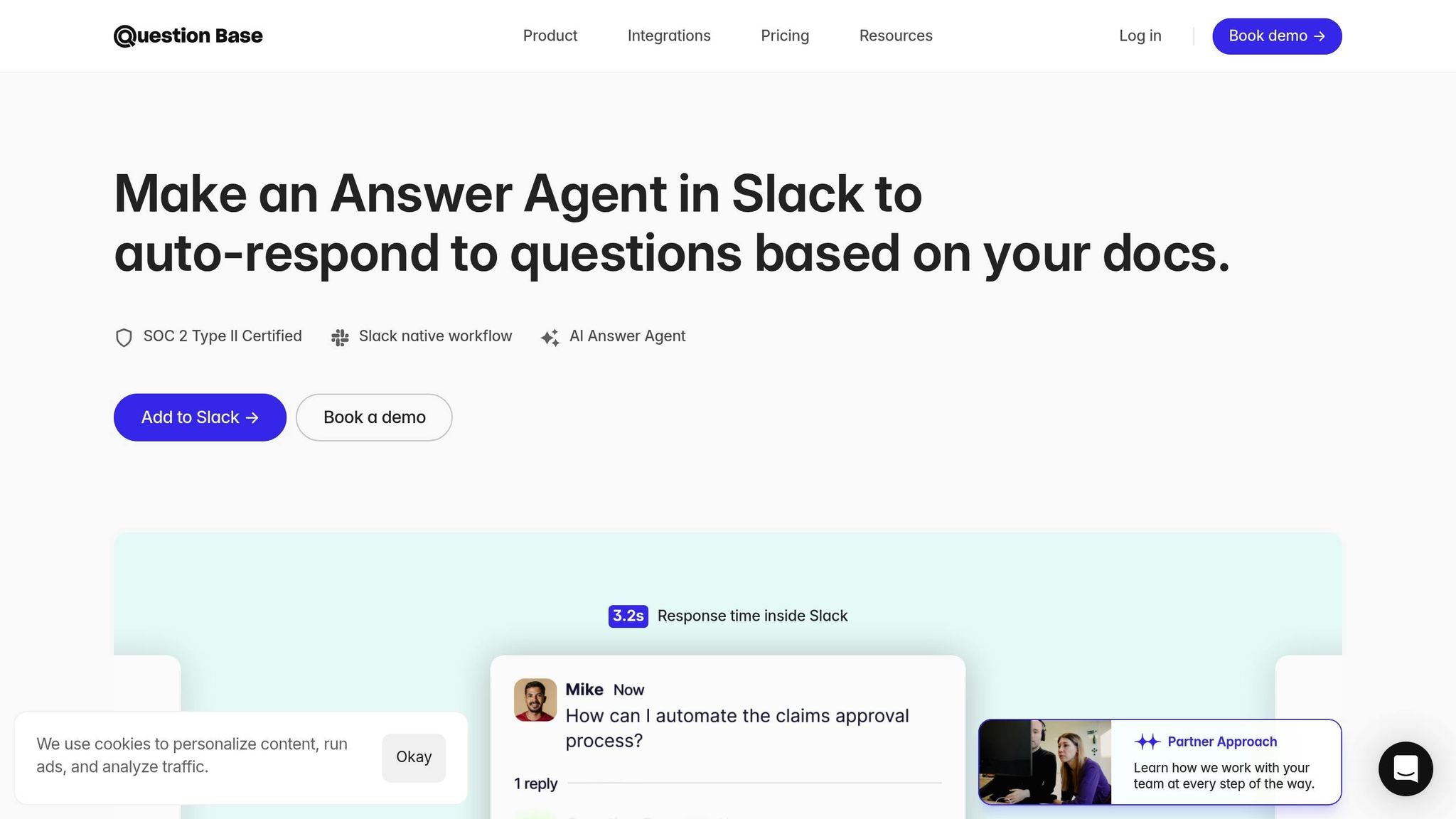
Question Base is designed for internal support teams like HR, IT, and operations that need reliable answers delivered at scale. Unlike tools that depend on chat history, Question Base taps into verified content from platforms such as Notion, Confluence, and Salesforce [1]. This ensures that when someone asks a question in Slack, the response comes from expert-approved sources rather than recycled conversations. Below, we’ll dive into how its accuracy, integration capabilities, knowledge management tools, and enterprise-level features address the shortcomings of chat-based AI solutions.
Accuracy
While Slack AI relies heavily on chat history, Question Base stands out by delivering 99.99% accuracy on expert-verified answers [4]. It achieves this through a process where internal experts review AI-generated responses before they are shared [2]. This ensures compliance with quality standards without sacrificing speed, with an average response time of just 3.2 seconds [1].
Data Integration
Slack AI’s external access is limited, but Question Base seamlessly integrates with a wide range of enterprise tools, including Google Drive, Confluence, Zendesk, Intercom, Notion, Salesforce, Dropbox, Freshdesk, HubSpot, OneDrive, Jira, and SharePoint [1]. This allows teams to quickly access institutional knowledge no matter where it’s stored. For example, Ticketbutler reported a dramatic reduction in search time, going from minutes to seconds, enabling instant answers in Slack [1].
Knowledge Management
Unlike Slack AI, which lacks robust knowledge management features, Question Base offers tools like case tracking, per-channel customization, duplicate detection, and AI refinement based on knowledge gaps. Organizations using the platform have achieved over 90% automation of frequently asked questions, with internal experts saving more than 6 hours per week by automating repetitive queries [2]. The platform also identifies unanswered questions, helping managers pinpoint and resolve content gaps.
"Since we started using QB we haven't used our Google support docs. And if I go on vacation or sick leave, I feel comfortable that QB will just take over."
– Linn Stokke, Online Events & Marketing Specialist, Ticketbutler [1]
Enterprise Features
While Slack AI takes a one-size-fits-all approach, Question Base is built with enterprise needs in mind. It offers SOC 2 Type II certification, a 99.9% uptime SLA, role-based access, and Slack single sign-on [2]. The platform also supports multi-workspace functionality and is scalable for teams with over 1,000 employees. Additionally, teams can fine-tune the AI’s tone, behavior, and escalation workflows on a per-channel basis, ensuring it meets the unique needs of each department. For organizations handling sensitive data, the platform provides strict data integration controls and even offers optional on-premise deployment, adding an extra layer of security.
Pros and Cons
Both Slack AI and Question Base bring unique strengths to the table, catering to different needs within enterprise workflows. Slack AI focuses on enhancing overall productivity by summarizing conversations and keeping users informed about missed updates. Its seamless integration into Slack means teams can immediately benefit without extra configuration[6]. This makes it a great choice for businesses looking for quick gains in communication efficiency.
On the other hand, Question Base is designed for teams dealing with high volumes of repetitive internal queries. By connecting to trusted documentation sources like Notion, Confluence, and Salesforce, it provides answers with an impressive 99.99% accuracy rate[4]. Companies using Question Base report automating over 90% of their FAQs[2], thanks to its advanced features like case tracking and duplicate detection - capabilities that Slack AI does not offer.
To better understand the strengths of each tool, here’s a side-by-side comparison:
Feature | Slack AI | Question Base |
|---|---|---|
Primary Strength | Chat-based summaries and productivity | Enterprise features with verified accuracy |
Best For | General chat productivity | Internal support automation (HR, IT, Ops) |
Data Sources | Slack chat history (external tools on higher tiers) | Slack, Salesforce, Confluence, Notion, OneDrive, etc. |
Accuracy Method | AI-generated from chat history | AI-generated with human verification |
Knowledge Management | Basic AI agent (Channel Expert) | Case tracking, duplicate detection, knowledge capture |
Security | Standard Slack security | SOC 2 Type II, on-premise deployment options |
Cost Per User | $18/month (Business+) | $8/month (Pro plan) |
In addition to its lower per-user cost ($8/month compared to Slack AI’s $18/month), Question Base offers expert-verified answers, making it particularly appealing for regulated industries and teams with tight budgets[2]. The platform also addresses a major pain point: the time employees waste searching for information. With workers spending 20–30% of their week (around 12 hours) looking for answers in Slack[1], the productivity loss for a company with 1,000 employees can exceed $2 million annually[1]. Question Base cuts search times down to an average of 3.2 seconds, significantly reducing these inefficiencies[1].
For lightweight productivity improvements, Slack AI is a solid choice. But for teams needing scalable, reliable knowledge management, Question Base stands out as the smarter investment.
Conclusion
Deciding between Slack AI and Question Base comes down to identifying the specific challenges your team is facing. Slack AI is designed to boost general productivity - helping users summarize conversations, catch up on missed threads, and stay on top of daily Slack activity. It’s particularly well-suited for smaller teams that need quick, efficient ways to manage Slack discussions without the need for a dedicated support system.
On the other hand, Question Base is tailored for enterprise teams dealing with repetitive internal questions across departments like HR, IT, and operations. Rather than relying solely on Slack’s chat history, Question Base integrates directly with your trusted documentation platforms - such as Notion, Confluence, Salesforce, and SharePoint. It also includes expert verification to ensure compliance, making it especially valuable for industries like healthcare and finance where accuracy and regulation are critical.
Ultimately, the choice depends on your team’s priorities and long-term goals. If your main challenge is keeping up with Slack messages, Slack AI’s summaries offer an immediate solution. But if repetitive questions or onboarding inefficiencies are slowing your team down, Question Base offers a scalable approach to knowledge management. Many enterprises even combine the two - using Slack AI for individual productivity and Question Base to handle organization-wide knowledge sharing.
To explore the potential of these solutions, consider running a 30-day pilot in a high-impact department like HR or IT support. Connect your current documentation tools, have subject matter experts review AI-generated answers, and monitor the automation rate to measure success.
FAQs
How does Question Base deliver accurate answers?
Question Base prioritizes precision by providing answers verified by experts. When a query comes in, the platform retrieves data straight from reliable sources such as Notion, Confluence, Salesforce, and OneDrive. Before the response is shared in Slack, it undergoes review and confirmation by subject-matter experts, ensuring accuracy. Each answer also includes citations linking back to the original documents for transparency.
This verification process, paired with analytics that monitor resolution rates and identify ineffective responses, helps enterprise teams maintain a dependable and high-quality support system.
Does Question Base work with tools outside of Slack for managing knowledge?
Yes, Question Base works seamlessly with a range of enterprise tools in addition to Slack. It integrates with trusted platforms like Notion, Confluence, Salesforce, Google Drive, OneDrive, and others, pulling in accurate, expert-approved answers directly from these sources.
This means your team can tap into dependable information from the tools they already rely on, all without leaving Slack or sifting through endless chat threads.
Why is Question Base a better fit for enterprise teams compared to Slack AI?
Question Base is built with enterprise teams in mind, delivering expert-verified answers from trusted platforms like Notion, Confluence, Salesforce, and OneDrive. While Slack AI primarily pulls from Slack chat history, Question Base takes it a step further by prioritizing accuracy and auditability - a critical advantage for teams operating in regulated or high-stakes environments.
Beyond its precision, Question Base offers enterprise-grade features that cater to complex organizational needs. These include case tracking, duplicate question detection, per-channel configuration, and detailed analytics to monitor resolution rates and spot trends. It’s also SOC 2 compliant and supports on-premise deployment, ensuring robust security for organizations with strict data protection requirements - making it a seamless fit for large-scale teams.
For companies seeking dependable, governed access to institutional knowledge across various systems, Question Base provides a tailored and scalable solution, standing out against Slack AI’s more general-purpose functionality.