∙
Cooper
∙
Reading time:
11 min

Slack AI and third-party tools like Question Base serve different purposes for managing information in Slack. Slack AI focuses on speed and convenience, summarizing conversations and retrieving past messages. It’s great for catching up on threads or finding updates quickly. However, its reliance on chat history limits its accuracy and use for enterprise knowledge management.
Question Base, on the other hand, delivers precise answers from trusted sources like Notion, Confluence, and Salesforce. It ensures responses are verified, tracks unanswered questions, and provides analytics to improve documentation. This makes it ideal for HR, IT, and operations teams needing reliable, structured knowledge.
Quick Comparison
Feature | Slack AI | Question Base |
|---|---|---|
Data Source | Slack chat history | Trusted documentation platforms |
Accuracy | Based on past conversations | Verified answers from official docs |
Customization | Limited | Per-channel tone and behavior |
Analytics | Basic usage stats | Tracks gaps, resolution rates |
Escalation | Not available | Routes unanswered questions |
Best For | Individual productivity | Enterprise knowledge management |
Slack AI is best for quick searches and summaries, while Question Base excels in delivering reliable answers and improving team knowledge at scale.
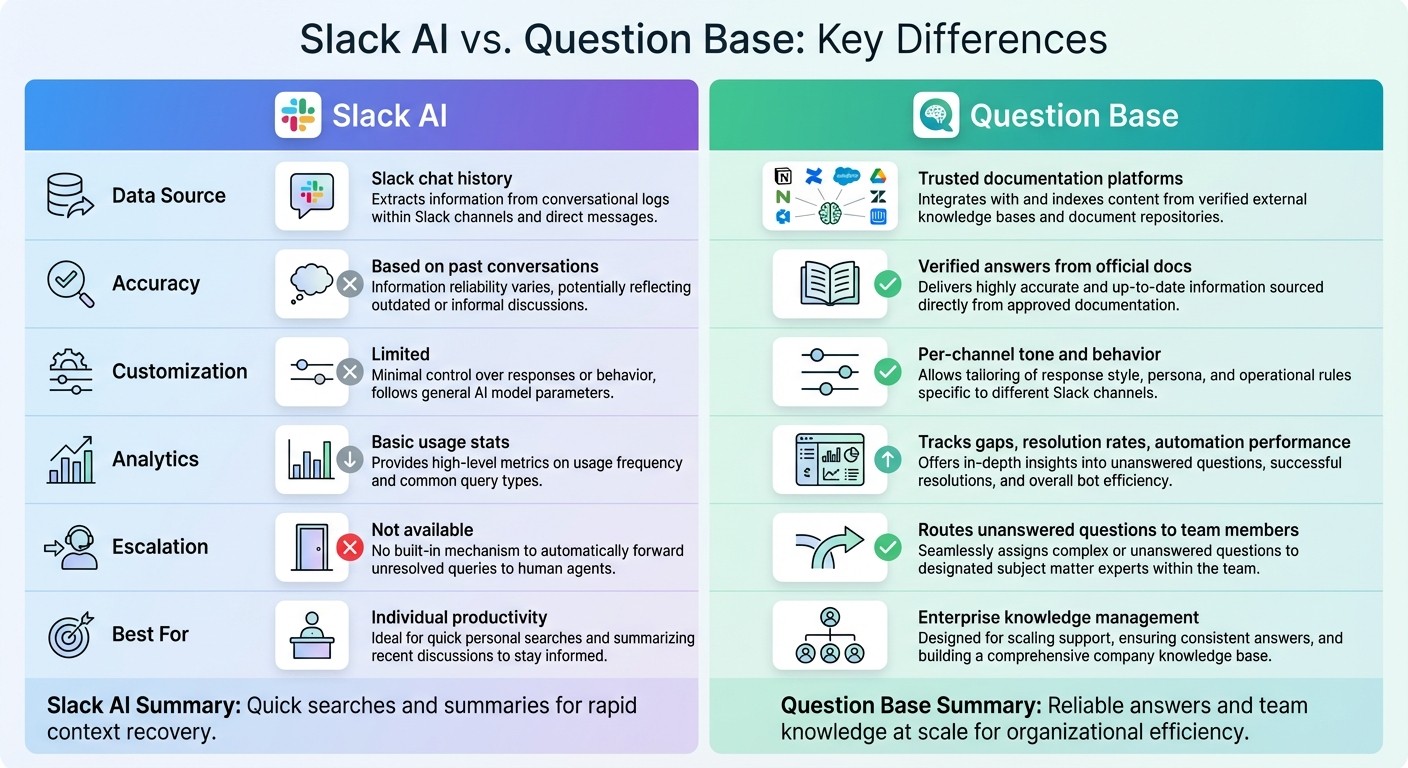
Slack AI vs Question Base Feature Comparison
Slack AI: Features and Limitations

What Slack AI Can Do
Slack AI introduces tools designed to boost productivity, including conversation summaries, thread recaps, and personalized search results that pull key information from Slack’s message history. For enterprise users, its capabilities expand through Enterprise Search, which links Slack to external platforms like Google Drive, GitHub, Asana, Box, Jira, and Salesforce [1][3].
According to Slack, these features save users an average of 97 minutes per week. Additionally, Slack AI operates on Slack's secure infrastructure, ensuring that customer data stays within the platform and is not used to train large-language models [2][4].
Best Use Cases for Slack AI
Slack AI shines in scenarios where quick access to existing information is critical. It’s particularly helpful for catching up on missed conversations, finding details buried in chat history, or getting concise updates. Sales teams, for instance, can use it to check on deal statuses, and managers can rely on it to quickly understand project progress without wading through long threads. Essentially, Slack AI works best when the needed information already exists in the workspace or connected systems but requires faster retrieval. However, its strengths are limited to straightforward information access, making it less effective for managing complex or verified knowledge.
Where Slack AI Falls Short for Knowledge Teams
For HR, IT, and operations teams tasked with managing verified knowledge, Slack AI has clear limitations. It cannot handle tasks like updating help desk tickets, pulling customer data from CRMs, or triggering workflows in external tools [5]. Customization is also restricted - users can’t adjust the AI’s tone for specific channels or team members. And once activated at $10 per user per month (available for Pro and Business+ plans), it becomes accessible to everyone in the workspace, whether they need it or not [5].
Another major drawback is its approach to accuracy and verification. Even when integrated with external systems through Enterprise Search, Slack AI focuses on interpreting information rather than delivering responses that have been vetted by experts. It lacks features critical for robust knowledge management, such as tracking unanswered questions, identifying gaps in knowledge, or analyzing how quickly issues are resolved. These missing capabilities can hinder teams that depend on precision, accountability, and structured knowledge ownership.
For organizations where accuracy and auditability are non-negotiable, these shortcomings often lead them to explore dedicated solutions like Question Base, which specializes in providing verified, expert-approved answers.
Question Base: Built for Enterprise Knowledge Management
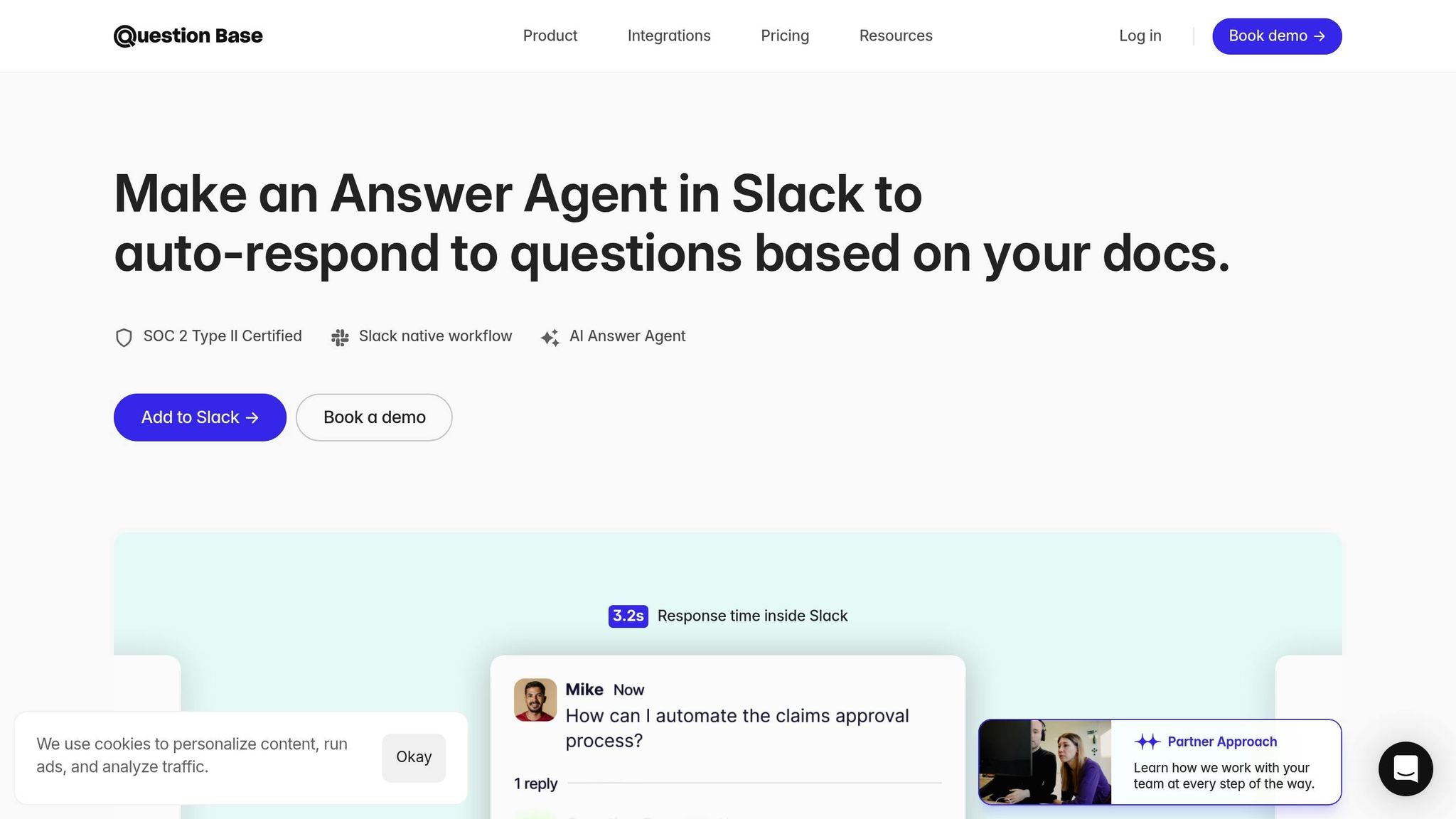
How Question Base Works
Question Base directly integrates with your existing documentation platforms - like Notion, Confluence, Google Drive, Salesforce, Zendesk, and Intercom - and delivers verified answers straight into Slack. While Slack AI relies on chat history, Question Base ensures every response is grounded in your organization's vetted knowledge by pulling directly from trusted sources.
Getting started is simple: install Question Base from the Slack App Marketplace, connect your documentation tools, and you're ready to go. Employees can ask questions in Slack as they normally would, and Question Base responds with accurate information sourced from your official documents.
What sets it apart is its ability to capture valuable insights shared in Slack threads. These informal conversations are turned into permanent, searchable knowledge, enriching your documentation over time. This seamless integration gives you unmatched security and the flexibility to customize how the tool behaves.
Security, Compliance, and Customization
Speed and accuracy are important, but enterprise teams also need robust security and control. Question Base is built with these priorities in mind. It supports SOC 2 Type II compliance, encrypts data both at rest and in transit, and even offers on-premise deployment for organizations with strict data residency policies. You decide exactly what content the AI can access, how it responds, and when it should escalate issues to human support.
Customization extends beyond content access. Teams can fine-tune the AI's tone and behavior for different Slack channels or departments, ensuring responses reflect your company’s communication style. Additionally, analytics dashboards provide insights into resolution rates, automation usage, and knowledge gaps. These tools help leaders identify areas for improvement and align documentation updates with sprint cycles or quarterly goals, keeping your knowledge base agile as business needs shift.
Reducing Repeated Questions and Saving Time
For HR, IT, and operations teams, answering the same questions repeatedly can be a major drain on productivity. Question Base tackles this by maintaining a living FAQ that evolves as new questions arise. Whether employees need details about benefits, software access, or internal processes, they get instant answers without waiting for a human response.
The platform also tracks unanswered questions, highlighting gaps in your documentation so you can prioritize updates where they’re most needed. If the AI can’t find a verified answer, it escalates the query to the appropriate team member, ensuring no question goes unresolved. This process not only saves time but also meets enterprise standards for reliable and auditable knowledge management. By automating responses and organizing knowledge, Question Base turns Slack into a powerful internal knowledge assistant that grows with your team.
Side-by-Side Comparison
Feature Comparison
When choosing between tools, it's essential to focus on their data sources and how they verify information, rather than just comparing features. While both Slack AI and Question Base operate within Slack, they serve very different purposes. Slack AI is tailored to help individuals streamline their daily tasks - offering features like thread summaries, retrieving past conversations, and improving overall productivity. Question Base, however, is designed specifically for teams that require accurate, verified knowledge at scale.
The distinction lies in how they source and ensure accuracy. Slack AI relies on your Slack chat history, interpreting messages from channels and direct messages. In contrast, Question Base integrates directly with trusted documentation platforms like Notion, Confluence, Google Drive, Salesforce, Zendesk, and Intercom. This ensures that every response is based on vetted, reliable sources, not an AI's interpretation of casual Slack conversations.
Here’s a detailed breakdown of how the two tools compare in knowledge management:
Feature | Question Base | Slack AI |
|---|---|---|
Accuracy | Answers verified from trusted sources | Generated from Slack chat history |
Data Sources | Integrates with Notion, Confluence, Salesforce, Google Drive, Zendesk, Intercom, and more | Primarily Slack messages; limited additional sources on enterprise plans |
Knowledge Management | Features include case tracking, per-channel settings, duplicate detection, and AI learning from gaps | Not available |
Analytics | Tracks resolution rates, unhelpful answers, automation stats, and content gaps | Basic usage statistics |
Enterprise Focus | Tailored for HR, IT, and operations with SOC 2 Type II compliance and customizable responses | General-purpose AI tool |
Escalation Flows | Routes unanswered questions to the appropriate team members | Not supported |
Question Base offers tools to track unanswered questions, identify gaps in documentation, and provide analytics on resolution and automation performance. These insights help team leaders continuously improve their knowledge bases and align updates with sprint cycles or quarterly plans. Slack AI, while useful for quick individual searches, lacks these capabilities, as it is not designed for organizational knowledge management.
These differences highlight when each tool is most effective.
When to Use Each Tool
Based on their features, here’s how to decide which tool fits your organization’s needs.
Choose Slack AI if your team is looking for general productivity improvements. It’s great for summarizing long Slack threads, quickly finding past discussions, or catching up on projects where you weren’t directly involved. For example, engineers can use it to revisit key decisions, and sales teams can review customer conversations more efficiently.
Choose Question Base when precision, accountability, and ownership of knowledge are critical. HR teams addressing benefits questions need verified answers, not an AI-generated guess based on an old Slack thread. IT support teams managing software access requests require responses that reflect current policies. Operations teams overseeing internal processes need evolving documentation, with analytics showing where employees encounter the most roadblocks.
The distinction becomes especially clear in high-stakes situations. For instance, if an employee asks about parental leave policies or data security protocols, you need responses grounded in official documentation - not a summary of potentially outdated Slack messages. Question Base ensures every answer is backed by authoritative sources and includes escalation options for human experts when needed. While Slack AI enhances individual productivity, Question Base ensures organizational consistency and alignment.
Choosing the Right Tool
Main Differences
When deciding between tools, it's essential to match their strengths to your team's specific requirements. Slack AI functions as a broad enterprise search tool, pulling insights from chat history to streamline access to past conversations. On the other hand, Question Base is purpose-built for internal support, delivering verified answers directly from trusted documentation sources like Notion, Confluence, Salesforce, Google Drive, and Zendesk. This distinction is especially critical for compliance-sensitive areas where precision and traceability are paramount.
Question Base also stands out with its advanced customization and security options, such as tone control and escalation workflows. These features highlight its focus on delivering reliable, structured support, as outlined in the earlier feature breakdown.
Making Your Decision
Each tool addresses unique needs, so your choice hinges on your team's priorities. If your goal is to quickly retrieve past discussions, summarize long threads, or enhance individual productivity in day-to-day tasks, Slack AI’s enterprise search functionality is a strong fit.
However, if your focus is on scaling internal support with verified, accurate answers, Question Base tackles a different challenge altogether. For example, HR teams managing benefits queries, IT teams handling access requests, or operations teams updating policies all need responses grounded in current, official documentation. Question Base turns Slack into more than a chat platform - it becomes a proactive knowledge assistant. With features like analytics to track resolution rates, automation performance, and content gaps, it helps you refine your knowledge base and align updates with sprint cycles or quarterly goals.
Ultimately, your decision should reflect whether your priority is boosting individual productivity or ensuring enterprise-level knowledge management. While Slack AI excels at enhancing personal workflows, Question Base delivers structured, verified support at scale. For some teams, using both tools might provide the best of both worlds.
Work with AI and Agents in Slack to Transform Your Success | Innovations | Slack
FAQs
How does Question Base deliver more accurate answers compared to Slack AI?
Question Base delivers accurate, source-backed answers by pulling information directly from trusted tools your organization already relies on, like Notion, Confluence, Salesforce, and Google Drive. This approach ensures every response is grounded in your documented knowledge, making it both dependable and easy to trace back to its original source.
On the other hand, Slack AI relies heavily on historical chat data to generate responses. While convenient, this method can reflect informal or incomplete details shared in conversations, which may not always be reliable. By prioritizing curated, document-based knowledge over chat history, Question Base provides answers that are not only precise but also auditable - perfectly suited for the demands of enterprise environments.
What makes Question Base a valuable tool for enterprise knowledge management?
Question Base transforms knowledge management for enterprises by delivering precise, reliable answers directly within Slack. Unlike broad tools like Slack AI, it integrates seamlessly with trusted documentation platforms such as Notion, Confluence, Google Drive, and Salesforce. This ensures every response is grounded in verified, current information.
Designed with HR, IT, and operations teams in mind, Question Base offers full customization. You can tailor the AI’s tone, define what content it accesses, and set up escalation workflows to fit your team’s needs. With SOC 2 Type II compliance and optional on-premise deployment, it’s a secure and scalable solution for organizations that prioritize data protection.
By turning Slack into an intelligent knowledge assistant, Question Base cuts down on repetitive questions, saves valuable time, and keeps teams aligned - all with minimal setup or technical complexity.
When is Slack AI a better choice than Question Base?
Slack AI shines when you need fast, built-in support directly within Slack - no extra setup or integrations required. It’s particularly handy for summarizing conversations, delivering daily recaps, and quickly locating recent messages, files, or links already shared in your workspace. This makes it a great fit for individuals or smaller teams seeking a straightforward, ready-to-use productivity tool.
When it comes to tasks like drafting messages, creating briefs, or reviewing reports, Slack AI offers real-time suggestions that simplify these everyday activities. If your main goal is quick access to recent Slack content or easy-to-use tools for routine tasks, Slack AI is a practical option.