∙
Cooper
∙
Reading time:
17 min

Repetitive questions and scattered tools waste time. Slack integrations, combined with AI-powered solutions, can transform how enterprises handle communication, support, and productivity.
Key insights:
Slack integrations deliver up to 296% ROI for teams by reducing ticket handling times, escalations, and costs while boosting revenue.
Employees lose 20–30% of their week searching for information. Tools like Slack AI and Question Base save hours by automating workflows and providing instant answers.
Slack AI focuses on workflow automation and conversation analysis, while Question Base connects directly to trusted documentation for verified answers.
Costs: Slack AI is $18/user/month, while Question Base is $8/user/month.
Quick takeaway: Slack AI is ideal for automating processes, while Question Base excels at managing internal knowledge. Together, they can maximize productivity and ROI.
How Salesforce Uses Slack Agents to Scale Internal Support | Dreamforce 2025
1. Slack AI
Slack AI serves as a productivity powerhouse within the Slack ecosystem, designed to help users navigate conversations, summarize discussions, and search through their workspace with ease. Acting as an AI assistant for routine tasks, it integrates seamlessly into the familiar Slack interface, making it a natural fit for enterprises already invested in the platform.
ROI Impact
Organizations leveraging Slack integrations have reported impressive financial returns. Service and sales teams, for example, have seen 294–296% ROI over three years, driven by improvements such as reduced ticket handling times (10.7%), fewer escalations (17.4%), and lower costs per ticket (15.1%)[5][9]. These efficiencies translate into revenue increases of $967,300 for service teams and $2.6 million for sales teams, alongside total cost savings of $2.6 million from fewer customer service tickets[5][9].
Teams adopting Slack AI automations for tasks like project creation, CRM updates, and meeting highlights have experienced even stronger results: a 27% increase in revenue, a 21% reduction in operating costs, a 35% boost in customer satisfaction, and a 31% jump in employee efficiency[6]. On average, workers save 3.5 hours per week through these automations, directly reducing labor costs[7].
Collaboration across teams has also seen a major boost, improving by 82%[4], while decision-making speeds up and meeting times drop by 33%[4]. A SaaS company integrating Slack with Salesforce reduced its average sales cycle by 25%, thanks to real-time deal stage updates. Meanwhile, an e-commerce retailer improved first-response times by 40% through collaborative problem-solving in Slack channels[3].
Beyond these measurable benefits, Slack AI’s ability to manage and summarize conversation history significantly enhances operational workflows.
Knowledge Management Capabilities
Slack AI simplifies operations by tapping into historical chat data, offering AI-powered search across Slack’s archives. For users on the Business Plan and Enterprise tiers, this functionality extends to "other tools" as well, broadening the scope of its search capabilities[1][2]. It can also generate summaries of channel threads and Huddles, allowing users to catch up on discussions without combing through every message.
The Channel Expert feature, a pre-built AI agent powered by Agentforce, is available on Business+ and Enterprise plans. It provides automated assistance within specific channels, further streamlining workflows[1][2]. However, Slack AI’s focus is primarily on analyzing chat history rather than directly connecting to verified knowledge sources like documentation repositories or help centers.
While this approach works well for summarizing past conversations and navigating Slack workspaces, it differs significantly from specialized knowledge management systems. Slack AI interprets conversational data rather than retrieving verified answers from authoritative sources. This distinction is critical for teams where accuracy is paramount, such as HR addressing policy questions, IT managing technical documentation, or operations maintaining process guides. On average, experts spend six hours weekly answering repetitive questions, with up to 40% of internal queries being duplicates[1].
Integration Depth
Slack boasts an extensive integration ecosystem, with 94% of paid business users utilizing apps and integrations, and 65% of teams creating custom solutions[10]. The platform connects seamlessly with major enterprise systems like Salesforce, Service Cloud, Marketing Cloud, Revenue Cloud, and Customer 360[3].
Service Cloud: Enables instant case updates and collaborative problem-solving through Service Swarming[3].
Marketing Cloud: Provides real-time tracking of campaign performance[3].
Revenue Cloud: Keeps finance and sales teams updated on contract approvals and billing[3].
These integrations eliminate manual processes and reduce errors tied to data entry. For example, a cloud computing company using Slack’s Workflow Builder transitioned from traditional IT ticketing to an automated system, achieving 34% faster ticket resolution[7]. Similarly, a software development company leveraging automated Slack notifications reduced mean time to resolution by a staggering 88.5%, with most issues detected within minutes instead of hours[7].
However, it’s worth noting that Slack AI’s extended search capabilities across "other tools" are available only on Business Plan and Enterprise tiers[1][2]. The depth of these integrations - whether they are read-only, support write-back functionality, or include advanced features - varies depending on the tool and subscription level.
These integrations, coupled with Slack AI’s robust security framework, make it a strong contender for enterprise use.
Enterprise Readiness
Slack delivers enterprise-grade security and compliance features, making it suitable for large-scale deployments. It supports SOC 2 Type II compliance, encryption both at rest and in transit, and optional on-premise deployment for organizations with stringent data residency requirements[8].
The Business+ tier includes features like SAML SSO, SCIM provisioning for identity management, a 99.99% uptime SLA, 24/7 support, and basic compliance capabilities, including HIPAA with BAA for healthcare organizations[8]. For larger enterprises managing multiple workspaces, the Enterprise Grid plan offers advanced security enhancements and customization options[8].
Slack AI itself is priced at an additional $18 per user per month[1][2], on top of the base subscription. This cost underscores the need for organizations to carefully assess whether the tool aligns with their specific knowledge management needs.
The platform’s architecture ensures that organizations retain control over data access and escalation flows[8]. This safeguards compliance, particularly for industries handling sensitive customer information, ensuring that AI automation doesn’t compromise security or regulatory standards.
2. Question Base
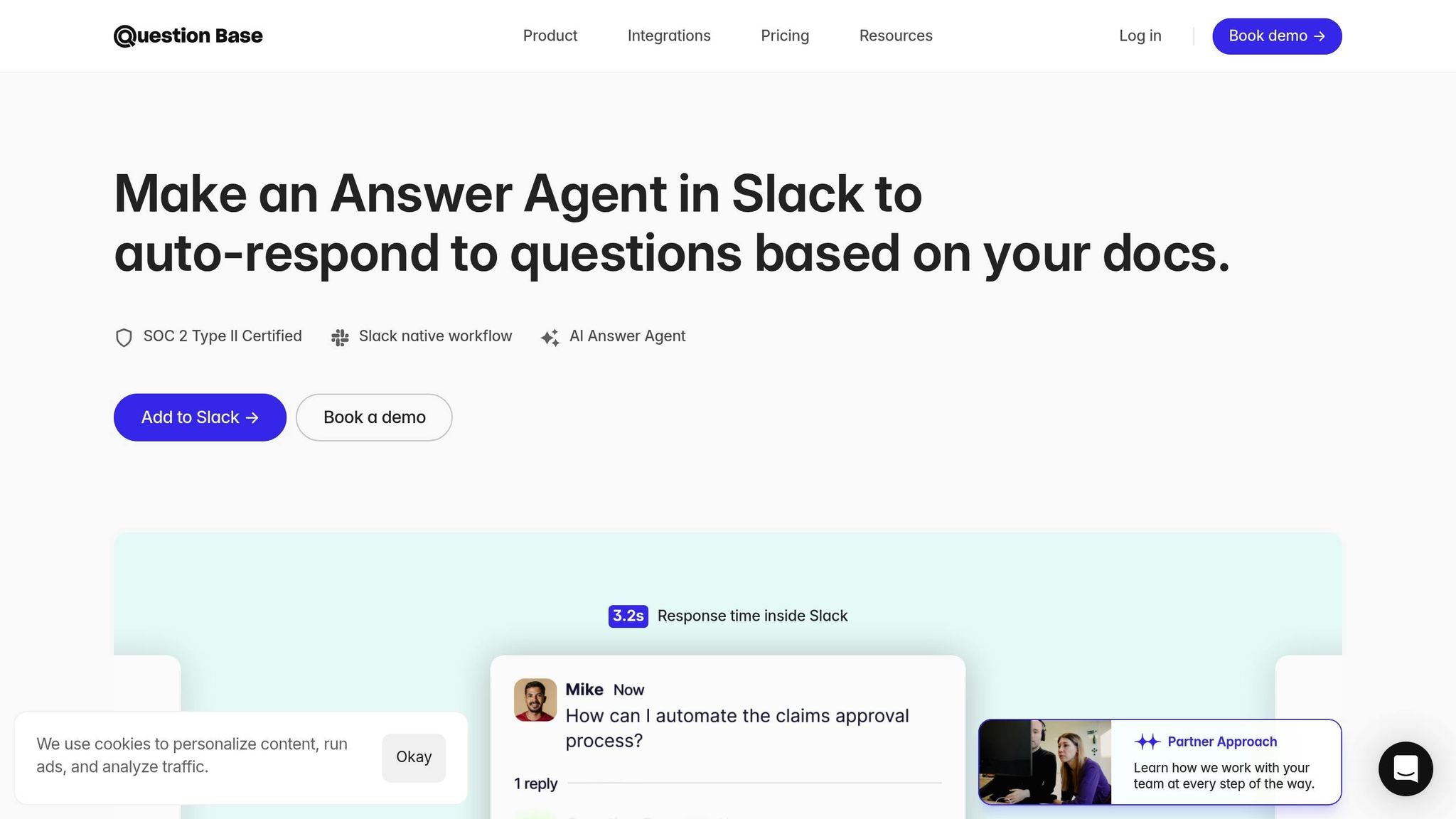
Question Base takes a fresh approach to managing knowledge within Slack. Instead of summarizing past conversations, it directly connects to your organization’s trusted documentation. This transforms Slack into a powerful knowledge assistant. For enterprises where precision, accountability, and verified information are paramount, this approach ensures reliable answers while delivering measurable ROI.
ROI Impact
On average, employees lose 20–30% of their workweek searching for information across tools like Slack - equivalent to an entire day wasted every week [1]. Question Base tackles this inefficiency by automating responses to repetitive questions. It can handle 35% of recurring queries in just 3.2 seconds, saving internal experts over 6 hours each week [1].
Monica Limanto, CEO of Petsy, shared how her team benefited:
"We implemented Question Base to eliminate repetitive questions and to collate answers and information in one place for a growing team. Question Base has exceeded our expectations - it's easy to use, intuitive and a massive time saver. We now have a reliable and useful knowledge base, making it easy to share knowledge across the team. We no longer have staff waiting on busy managers for an answer, Question Base is there in seconds, plus it's easy to verify answers as new questions come along."
These efficiency gains align with broader Slack integration benchmarks. Enterprises using Slack integrations report an average ROI of 338%, with mid-sized companies saving $2.1 million in productivity and seeing payback within six months [13].
Knowledge Management Capabilities
Question Base stands out by prioritizing accuracy and effective knowledge governance. Unlike Slack AI, which depends on chat history, Question Base pulls verified answers directly from trusted documentation. This ensures responses are accurate and reliable. While Slack AI interprets conversational data, Question Base combines AI-generated responses with human-verified content sourced from established documents. It also evolves with your organization, maintaining a dynamic FAQ that adapts as new questions arise and workflows shift.
When a query comes through Slack, Question Base instantly retrieves answers from connected documentation. If it can’t resolve the question, it escalates the inquiry to human experts and logs it for future reference - ensuring continuous improvement [1].
Additionally, the platform offers granular control over its AI behavior. Teams can customize tone, response style, and content access on a per-channel basis. Features like case tracking for unanswered questions, duplicate detection, and automation analytics help knowledge managers identify gaps and prioritize updates. This approach ensures a high level of accuracy, reflected in a 4.8 answer score maintained through regular human oversight [1].
Maria Jensen, UX Lead & Scrum Master at Ticketbutler, described the impact on her team:
"Since we started using Question Base we don't spend any time looking up our procedures in a support manual. Before, we could easily spend 5-10 minutes searching in a very long document for the exact support case and procedure plus involving several colleagues in trying to find the correct answer. Now, QB finds the relevant answers in a few seconds, and if not we can easily add a new answer that will be used the next time."
Integration Depth
Beyond its ROI benefits, Question Base simplifies workflows with deep integration into existing tools. It connects seamlessly with platforms like Notion, Google Drive, Confluence, Zendesk, Intercom, Salesforce, and Dropbox. This means there’s no need to migrate content - Question Base taps into your current knowledge repositories. Setup is straightforward: install the app from the Slack App Marketplace, invite the bot to active channels using the command /invite @questionbase, and link your documentation sources. Once connected, answers start flowing directly in Slack, eliminating the need for context switching.
The platform also captures key insights shared in Slack threads with a single click, turning fleeting conversations into structured, searchable documentation [1].
Linn Stokke, Online Events & Marketing Specialist at Ticketbutler, shared her perspective:
"Since we started using QB we haven't used our Google support docs. And if I go on vacation or sick leave, I feel comfortable that QB will just take over."
Enterprise Readiness
Designed with enterprise-level security in mind, Question Base is SOC 2 Type II compliant, featuring encryption both at rest and in transit. For organizations with strict data residency requirements, it also offers optional on-premise deployment. Beyond security, the platform provides extensive customization options, including control over accessible content, AI tone and behavior, and escalation workflows to human support - critical for compliance in regulated industries.
For businesses managing complex structures, a custom tier is available. This includes on-premise deployment, white-labeling, multi-workspace support, and tailored upgrades. At $8 per user per month - less than half the price of Slack AI - Question Base is purpose-built for enterprise support teams in HR, IT, and operations, offering specialized knowledge management at an accessible cost.
Strengths and Weaknesses
This section highlights the contrasting strengths and limitations of Slack AI and Question Base, offering insights to guide organizations in shaping their knowledge management strategies.
Slack AI's Core Strengths
Slack AI shines in automation and operational efficiency, helping businesses boost revenue, cut costs, and improve employee productivity. It automates workflows across areas like project management, CRM systems, and meeting documentation. For HR, it simplifies tasks such as checking balances or requesting time off. By creating a centralized workspace - a "single pane of glass" - Slack AI enables quicker decisions and smoother business processes [11].
Slack AI's Limitations
Despite its automation capabilities, Slack AI falls short as a comprehensive knowledge management tool. While its conversational interface is intuitive, it doesn’t naturally structure chat content into searchable documentation [11]. This makes it better suited for task automation rather than organizing FAQs, conducting content audits, or tracking knowledge gaps.
Another challenge is knowledge retention. Without proper documentation infrastructure, valuable insights can get lost in conversation threads. Slack AI also relies heavily on seamless data integration; without proper connections to tools like documentation platforms, it may struggle to provide complete answers to employee queries [14]. These gaps highlight the need for complementary tools like Question Base to address specific knowledge management challenges.
Question Base's Core Strengths
Question Base, in contrast, focuses on internal knowledge organization and verification. It transforms chat-based insights into structured, searchable documentation, reducing repeated questions and saving employees time. The platform maintains a dynamic FAQ that evolves with new inquiries and changing workflows.
It also empowers teams with tools like content gap reporting and audit capabilities, which align well with sprint cycles or quarterly planning. With enterprise-grade security - including SOC 2 Type II compliance, encryption for data in transit and at rest, and optional on-premise deployment - it meets the strict security needs of modern businesses.
Additionally, Question Base offers detailed analytics on metrics like automation success, resolution rates, and unhelpful responses. Unlike Slack AI, its integrations with tools like Notion, Google Drive, Confluence, Zendesk, and Salesforce are seamless and require no engineering effort for deployment.
Question Base's Limitations
However, Question Base operates within a narrower scope compared to Slack AI. While it excels at documentation and answering employee questions, it doesn’t handle complex business process automation, such as managing projects or updating CRM systems [6].
Its performance hinges on the quality of connected documentation. If tools like Notion or Confluence lack comprehensive content, Question Base cannot deliver accurate answers. Organizations must also invest time upfront in organizing their existing knowledge base to unlock its full potential. Lastly, it is tailored for internal employee support rather than customer-facing tasks or broader business process automation.
Side-by-Side Comparison
Here’s a summary of how Slack AI and Question Base stack up against each other:
Feature | Slack AI | Question Base |
|---|---|---|
Primary Strength | Automation and workflow orchestration | Knowledge organization and verified answers |
Accuracy Approach | AI-generated from Slack messages | AI-generated → Human-verified content |
Data Sources | Primarily Slack chat; others limited to enterprise plans | Notion, Confluence, Salesforce, Google Drive, Zendesk, and more |
Knowledge Management | Channel Expert (pre-built AI agent) | Content audits, gap tracking, duplicate detection, and adaptive FAQs |
Analytics | Basic usage metrics | Resolution rates, unhelpful answer tracking, and content gap reports |
Cost | $18 per user per month | $8 per user per month |
Best For | Automating workflows and processes | Streamlining internal knowledge and reducing queries |
Security | Enterprise-grade (Business+ and Enterprise plans) | SOC 2 Type II compliant, encryption, and optional on-premise deployment |
Setup Complexity | Requires workflow redesign and system integration | Simple setup via Slack App Marketplace |
ROI Generation Approaches
Slack AI drives ROI by automating repetitive tasks, reducing manual effort, and speeding up decision-making. Its impact is broad, touching revenue, cost savings, and productivity [6][11].
On the other hand, Question Base enhances ROI by improving access to knowledge and reducing time wasted searching for answers. It minimizes redundant queries, boosting employee efficiency. While Slack AI focuses on automating processes, Question Base ensures employees can quickly find accurate information. Slack AI’s ROI requires more significant workflow changes, whereas Question Base offers quicker implementation with targeted benefits.
For organizations seeking a comprehensive solution, combining Slack AI's automation with Question Base's knowledge management can unlock greater productivity and maximize ROI [6][12].
Conclusion
Slack AI and Question Base address different enterprise challenges, making them valuable tools for informed decision-making.
Slack AI focuses on operational automation and enhancing cross-functional productivity. By streamlining workflows across project management, CRM platforms, and meeting documentation, it creates a centralized workspace that speeds up decision-making and drives measurable improvements. This broad functionality sets it apart from the more specialized knowledge management capabilities of Question Base.
Question Base, priced at $8 per user per month compared to Slack AI's $18, is designed to retrieve verified answers quickly from trusted sources like Notion, Confluence, and Salesforce. With an average response time of just 3.2 seconds, it reduces repetitive questions and organizes institutional knowledge without requiring additional engineering resources.
For enterprises prioritizing general productivity, Slack AI delivers broad operational benefits across functions like sales and customer service. According to Forrester research, companies using Slack AI have reported returns on investment between 294% and 296% over three years, alongside benefits such as a 10.7% reduction in ticket resolution times[5][9].
On the other hand, organizations looking to improve knowledge access and support efficiency will find Question Base indispensable. While Slack AI automates workflows across teams, Question Base transforms Slack into a powerful knowledge hub. Features like content gap reporting, duplicate detection, and an adaptive FAQ system are particularly helpful for teams handling large volumes of documentation, frequent support tickets, or complex onboarding processes.
By leveraging the unique strengths of both tools, enterprises can achieve even greater efficiency. Slack AI can manage operational workflows, while Question Base ensures the knowledge layer supporting those workflows is robust and accessible. For example, a customer service team might use Slack AI to automate ticket routing while relying on Question Base for instant access to policies and historical resolutions. Similarly, HR teams can integrate Slack with Workday for self-service tasks while using Question Base to handle benefits inquiries and onboarding needs.
To decide which solution best fits your organization, consider your primary challenge. If improving automation and fostering collaboration is the goal, Slack AI is the right choice. If your team struggles with time-consuming searches and repetitive questions, Question Base is the better fit. For many enterprises, deploying both solutions together offers the best of both worlds, streamlining operations and boosting employee productivity.
FAQs
How does integrating Slack with enterprise tools impact ROI compared to other communication platforms?
Integrating Slack with enterprise tools like project management platforms or knowledge systems can make a noticeable difference in efficiency and returns. By connecting Slack with tools such as Notion, Confluence, or Salesforce, teams can centralize their knowledge, cut down on time spent hunting for information, and automate repetitive workflows. This streamlining not only improves collaboration but also delivers measurable time and cost savings.
For enterprises focused on sharing accurate and verified knowledge at scale, Question Base takes Slack’s capabilities to the next level. Acting as a smart knowledge assistant, Question Base ensures employees receive instant, trustworthy answers directly within Slack. This eliminates delays, minimizes operational slowdowns, and keeps teams aligned. The result? A more productive workforce and a stronger return on investment from Slack integrations.
How does Question Base compare to Slack AI for managing knowledge effectively?
While Slack AI emphasizes summarizing conversations and drawing insights from chat history, Question Base takes a different approach, focusing on delivering precise, enterprise-level knowledge management. It integrates directly with trusted platforms like Notion, Confluence, and Salesforce, ensuring responses are based on verified sources rather than just Slack’s message history.
In addition, Question Base offers advanced features such as case tracking, customizable settings for individual channels, and AI capabilities to identify and address content gaps - capabilities that Slack AI does not provide. For teams prioritizing accuracy, audit trails, and seamless alignment with their existing documentation systems, Question Base emerges as the clear choice.
What should enterprises evaluate when choosing between Slack AI and Question Base for internal support and knowledge management?
When deciding between Slack AI and Question Base, it's important for enterprises to assess their specific priorities around accuracy, integration, and scalability. Slack AI works well for general productivity tasks like summarizing conversations or searching through chat history. On the other hand, Question Base focuses on delivering verified, dependable answers at scale by integrating seamlessly with trusted tools such as Notion, Confluence, and Salesforce.
For teams that prioritize accuracy, auditability, and control over knowledge, Question Base offers advanced capabilities like expert-verified answers, case tracking, and analytics to pinpoint content gaps. Unlike Slack AI, which leans heavily on chat history, Question Base ensures access to well-structured, trustworthy documentation. This makes it an excellent choice for HR, IT, and operations teams that rely on precise and reliable workflows.