∙
Cooper
∙
Reading time:
44 min

Repetitive tool-switching slows agile teams. Integrating Slack with task management, documentation, and collaboration tools centralizes workflows, reduces delays, and keeps teams aligned. Here are 10 Slack integrations that streamline agile practices, from task tracking to instant knowledge access:
Question Base: AI-powered answers in Slack, pulling from tools like Confluence, Notion, and Google Drive.
Jira Cloud: Manage tickets, updates, and sprint boards without leaving Slack.
Trello: Visual task management with real-time Slack updates.
Asana: Turn Slack messages into tasks, track progress, and manage dependencies.
GitHub: Link pull requests, commits, and issues directly to team discussions.
Confluence Cloud: Share and edit documentation seamlessly in Slack.
Google Drive: Share, preview, and manage permissions for files instantly.
Zoom: Launch meetings and share recordings directly in Slack.
Miro: Collaborate on visual boards for sprint planning and retrospectives.
Slack Workflow Builder: Automate repetitive tasks like standups and approvals.
Quick Comparison
Integration | Purpose | Best For | Key Feature |
|---|---|---|---|
Question Base | Knowledge retrieval | Teams needing instant answers | AI-backed, document-sourced responses |
Jira Cloud | Task tracking | Software development teams | Real-time issue updates and Slack commands |
Trello | Visual task management | Marketing, design, and lightweight tasks | Kanban-style workflows |
Asana | Task and dependency management | Cross-functional teams | Turn Slack messages into tasks |
GitHub | Code collaboration | Development teams | Monitor pull requests and commits |
Confluence Cloud | Documentation sharing | Teams relying on detailed specs | Slack previews and updates |
Google Drive | File sharing | Teams using Google Workspace | Auto-preview and permission management |
Zoom | Video collaboration | Remote and hybrid teams | Instant meeting launches and recordings in Slack |
Miro | Visual collaboration | Teams needing brainstorming tools | Agile templates and board updates in Slack |
Slack Workflow Builder | Task automation | Teams automating repetitive processes | No-code workflows for Slack-based triggers |
These integrations reduce tool-switching, simplify agile ceremonies, and keep teams focused. Start with tools like Jira or Trello for task tracking and pair them with Question Base for instant knowledge access. Tailor your setup to fit your team’s needs and ensure Slack remains a productive hub for agile workflows.
Slack Workflows: No-code Automation in Slack
1. Question Base
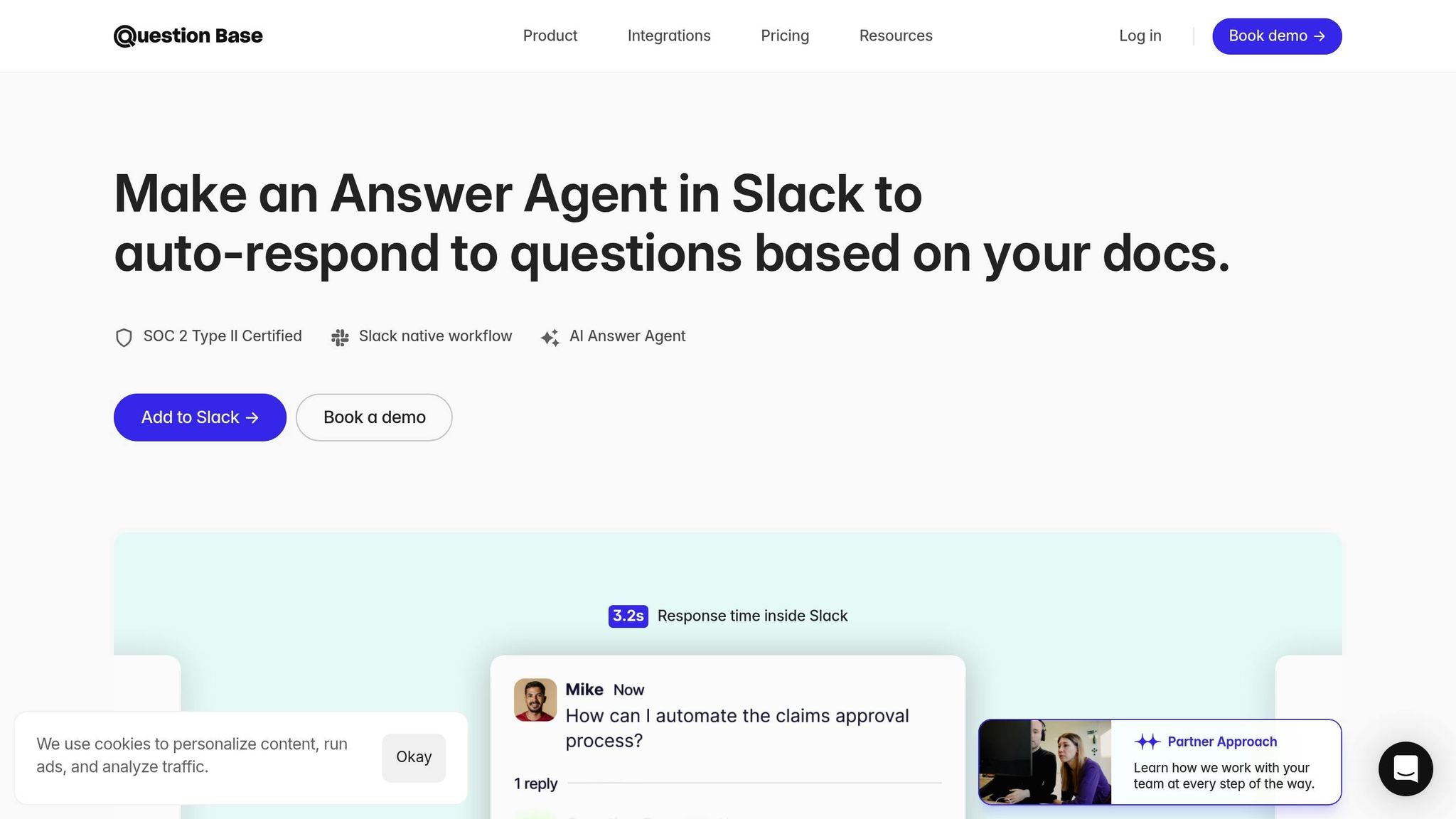
Question Base is an AI-driven tool designed to live directly within Slack, offering instant, verified answers right where teams are already collaborating. Instead of digging through Confluence pages, scrolling endlessly through old Slack threads, or waiting for a subject-matter expert to reply, team members can simply ask a question in natural language and get a precise answer in seconds - complete with links back to the original source material.
While Slack AI is great for general productivity, Question Base goes a step further by delivering document-backed responses. It connects seamlessly to trusted platforms like Notion, Confluence, Google Drive, Zendesk, Intercom, Salesforce, and Dropbox, ensuring the information it provides is both accurate and actionable. This integration doesn’t just make knowledge accessible - it keeps teams moving efficiently.
Streamlines Agile Workflows
Agile teams thrive on speed, and time spent searching for answers can derail progress. Question Base eliminates this bottleneck by pulling information directly from your documentation tools and delivering it in Slack channels where work is already happening. For instance, if a developer or product manager needs clarity on an SLA or a retrospective process, Question Base delivers an answer in an average of 3.2 seconds[1], sourced from verified internal documents.
This quick access is especially valuable during sprint ceremonies. Standups can stay on track, focusing on progress and blockers instead of devolving into lengthy searches for information. Planning sessions move more smoothly as technical constraints, past sprint outcomes, or user research insights are clarified in real time. Even retrospectives benefit, as teams can instantly retrieve past discussions about incidents, hotfixes, or scope changes, making the sessions more actionable.
Over time, Question Base evolves alongside your team by building a living FAQ. Frequently asked questions - like deployment steps or customer workflow details - are automatically captured, and content owners can update the source material in tools like Confluence or Notion. These updates are reflected instantly in the bot’s responses, ensuring that documentation remains useful and aligned with the team’s current processes.
Supports Task Management and Collaboration
Question Base works hand-in-hand with tools like Jira, Asana, and Trello by providing context for the tasks those platforms track. For example, when a teammate shares a Jira link in Slack, others can ask follow-up questions like, “What’s blocking this issue?” or “What’s the latest spec for this epic?” and receive concise, accurate answers drawn from linked documentation and historical Slack conversations. This helps clarify dependencies and simplifies coordination.
For distributed teams, this asynchronous access to context is a game-changer. A West Coast engineer starting their day doesn’t have to wait for an East Coast product owner to answer a question about acceptance criteria - they can ask Question Base and keep moving. Similarly, customer success managers can prep for client calls by asking, “What did we deliver for this client last quarter?” and get a quick summary based on release notes and past communications, enabling more informed and efficient conversations.
Integrates Seamlessly with Slack
Getting started with Question Base is simple. Install it from the Slack App Marketplace, invite the bot (/invite @questionbase), and connect your documentation tools through its dashboard. No custom development is required. Plus, it respects Slack’s existing permissions and channel structures, ensuring smooth integration.
Admins have the flexibility to configure per-channel settings, tailoring the bot’s behavior to specific needs. For instance, an engineering channel might prioritize technical runbooks and architecture documents, while a customer support channel might pull from help articles and incident reports. Admins can also set escalation paths for unresolved questions, routing them to human experts or internal help channels. Additionally, analytics dashboards provide insights into automation performance, highlighting recurring questions and documentation gaps. All of this is backed by SOC 2 Type II–level security, with encryption for data in transit and at rest, plus optional on-premise deployment for added control.
Enhances Team Communication and Documentation
Question Base transforms Slack conversations into a structured knowledge base. A helpful answer shared in a thread can be captured with one click and added to the system for future use. This reduces repetitive questions, freeing senior engineers or product owners from answering the same queries over and over, and keeps sprint ceremonies focused on progress.
The tool’s analytics also identify recurring questions and gaps in documentation. Scrum Masters and agile coaches can use these insights to prioritize updates during sprint planning or quarterly reviews, ensuring that the knowledge base stays aligned with the team’s evolving workflows. For instance, if unanswered questions about a new microservice or customer workflow are logged frequently, the team knows it’s time to create or update the relevant Confluence page.
Access controls are built to mirror the permissions in tools like Google Drive and Confluence. This ensures sensitive materials - such as incident postmortems or client contracts - remain secure. With this combination of strong security and permission-aware responses, even teams in regulated industries like fintech, healthcare, or enterprise SaaS can benefit from faster knowledge retrieval without compromising governance.
2. Jira Cloud for Slack
Jira Cloud for Slack is an official integration from Atlassian designed to streamline team workflows by allowing users to create, update, and transition Jira issues directly within Slack. This capability is especially valuable during standups, sprint planning, and incident response - moments when quick updates and collaboration are critical.
The integration ensures teams stay aligned by sending real-time notifications to designated Slack channels whenever issues are created, assigned, commented on, or moved. For example, when a developer marks a task as "Done" or a QA engineer flags a bug as critical, the update appears instantly in the relevant channel. This immediate visibility supports agile workflows, keeping everyone informed without the need for extra manual updates or repeated check-ins.
Simplifies Agile Workflows
Jira Cloud for Slack minimizes the need to switch between tools during agile ceremonies. Team members can use simple slash commands to search for issues, share previews, and update statuses directly in Slack. For example, typing /jira [issue key] brings up a quick preview showing key details like status, assignee, priority, and summary - enough context for fast decision-making without opening a browser.
Additionally, Slack messages can be converted into Jira issues with a single click. This is particularly useful during discussions about bugs, feature requests, or technical debt. For instance, in the middle of a conversation about a production incident, a team member can turn a message into a Jira issue, complete with an assignee and due date. This ensures action items aren’t lost in the shuffle and links the original discussion to the issue for easy reference.
For distributed teams working across time zones, the integration helps centralize conversations and decisions around work items. A developer in Berlin can easily see what a product owner in San Francisco discussed about acceptance criteria, without waiting for overlapping hours or scheduling extra meetings. These real-time updates improve collaboration and task tracking, no matter where team members are located.
Boosts Task Management and Collaboration
With granular notification controls, teams can fine-tune which updates appear in specific Slack channels. For example, an engineering channel might only receive notifications for high-priority bugs and stories transitioning to "In Review", while a product channel monitors new feature requests and epic updates. During sprint planning or release periods, teams can temporarily increase notification levels, then scale back during regular work cycles to focus on critical tasks. This approach ensures channels remain focused and avoid being overloaded with unnecessary updates.
The integration supports both Scrum and Kanban workflows, making it versatile for engineering teams. Dedicated Slack channels can be tied to specific Jira boards - whether by squad or product area - serving as the central hub for daily work. Backlogs, story points, and dependencies can all be discussed within Slack during sprint planning, with Jira automatically reflecting updates. This seamless connection helps teams maintain a synchronized workflow.
When it’s time for retrospectives, reviewing the Jira activity stream in Slack can reveal bottlenecks. For instance, if several issues lingered in "In Review" or "Blocked" throughout the sprint, the team can identify these patterns and adjust their processes or work-in-progress limits to improve efficiency.
Works Flawlessly with Slack
Installing Jira Cloud for Slack is simple and can be done through the Slack App Directory. There are no extra fees for Jira Cloud subscribers, though it’s important to note that the integration doesn’t support Jira Server or Data Center, which may impact enterprise rollout plans.
The integration becomes even more effective when paired with other tools in the same Slack workspace, like GitHub or CI/CD platforms. Teams can link code changes or deployments to Jira issues discussed in Slack, creating a complete record from initial request to final release.
Improves Communication and Documentation
By integrating Jira updates into Slack, teams ensure that project progress is visible in the spaces where they already communicate, such as during daily standups or incident response. Instead of relying on manual status meetings, updates like issue transitions, comments, and assignments are automatically posted to relevant channels. This shift to asynchronous updates reduces interruptions, giving team members more time to focus on development work.
For enterprises adopting the integration, a phased rollout is recommended. Start with one or two squads, refine notification settings based on feedback, document best practices for channel setups and commands, and expand gradually. This approach helps prevent notification overload while maximizing the integration’s benefits.
Compared to lighter tools like Trello, Jira Cloud for Slack is better suited for complex workflows that involve detailed issue types, custom fields, and release tracking. While Asana offers Slack integration for general task management, Jira’s integration is tailored to software delivery, emphasizing bug tracking, sprint boards, and engineering-focused reporting - features critical to larger development teams.
3. Trello for Slack
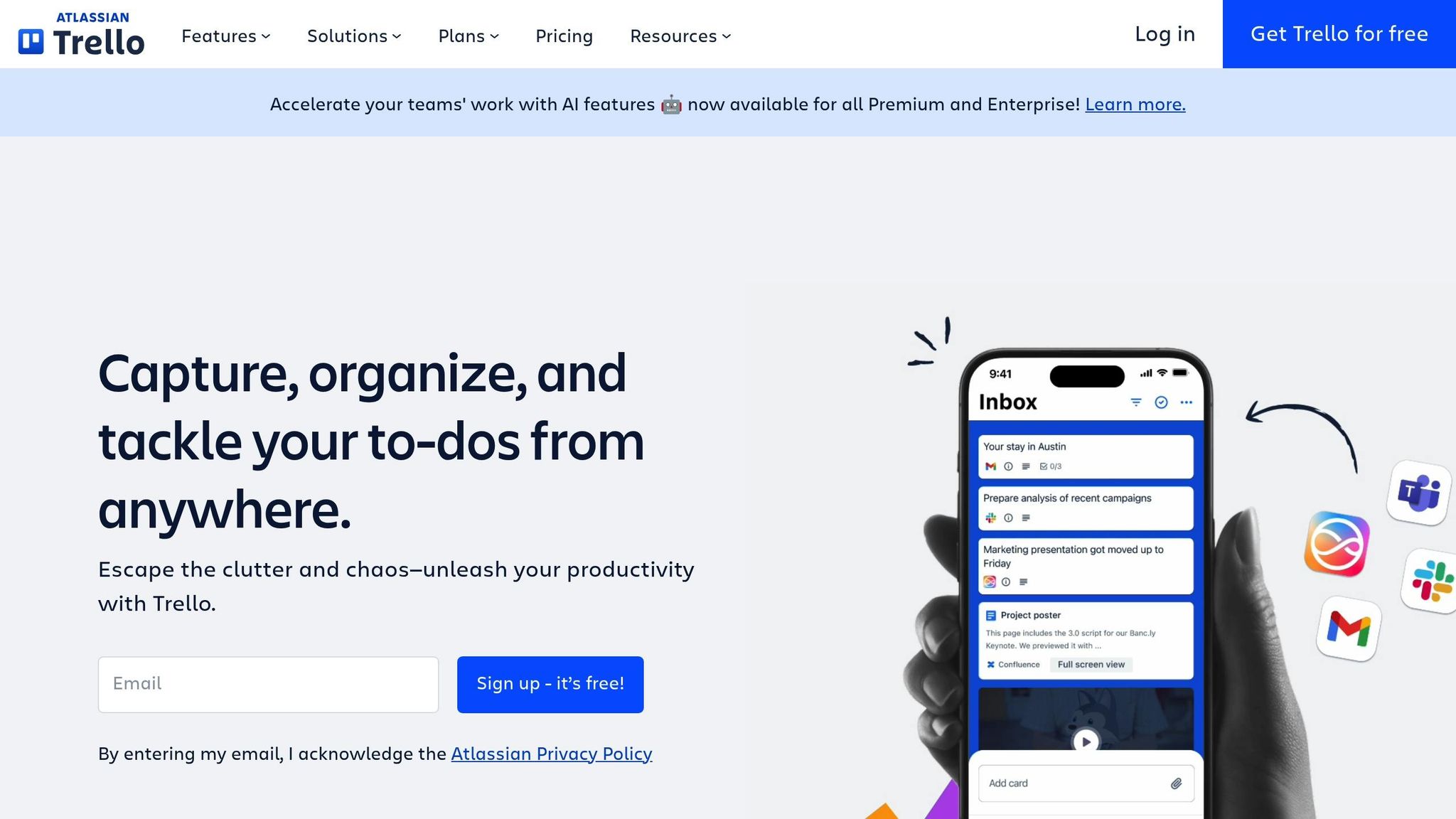
Trello for Slack brings the power of visual task management directly into team conversations by connecting Trello boards with Slack. This integration is perfect for teams using agile workflows who want a straightforward way to track tasks without the complexity of larger project management tools. While Jira is tailored for software development cycles, Trello’s card-based system is versatile enough to handle marketing campaigns, content calendars, design sprints, or even operational checklists.
With this integration, team members can create Trello cards straight from Slack messages, link cards to discussions, and stay updated with notifications when cards move between lists or deadlines approach. For teams managing multiple small projects - like marketing teams juggling social media, blog content, and event planning - Trello’s visual boards provide clarity, while Slack facilitates real-time collaboration.
Simplifies Agile Workflows
Trello for Slack minimizes the need to switch between platforms during agile sprints by allowing teams to update boards directly from Slack. Kanban-style workflows, for instance, can be managed effortlessly. A simple board with "To Do", "In Progress", and "Done" columns can be fully maintained through Slack, with automatic notifications whenever a card moves stages. This real-time visibility ensures distributed teams stay aligned without constantly checking the Trello board. For example, if a designer moves a card from "In Progress" to "Ready for Review", the relevant Slack channel gets an update, prompting the next team member to take action.
The integration also enhances agile ceremonies, like standups. Instead of screen-sharing a Trello board, team members can reference cards directly in Slack threads, discuss blockers, and even update due dates during the meeting. This keeps discussions focused and ensures tasks are logged properly, avoiding the risk of forgotten action items.
Boosts Task Management and Collaboration
Trello’s card previews in Slack make task management even smoother. When someone shares a Trello card link in a Slack channel, it automatically unfurls to show key details like the card title, description, due date, assigned members, and labels. This quick snapshot helps team members decide whether to take immediate action or simply acknowledge the update.
For cross-functional projects, Trello cards can be shared across multiple Slack channels while keeping a single source of truth. For instance, a product launch card might appear in both the marketing and engineering channels, allowing each team to add relevant comments or attachments. These updates sync back to the Trello card, creating a comprehensive record of progress and decisions across departments.
Recurring tasks are also easier to manage. Teams can set up Trello cards with checklists and due dates, and Slack will send reminders as deadlines approach. For example, a content team might have a weekly card for newsletter preparation, with checklist items for drafting, reviewing, and scheduling. Slack notifications ensure no steps are missed, even during hectic weeks.
Works Seamlessly with Slack
Setting up Trello for Slack is straightforward. After installing the app from the Slack App Directory, teams can connect their Trello workspace and decide which boards should send notifications to specific Slack channels. Notifications can be customized per board to avoid overwhelming team members. For instance, a high-priority project board might notify the channel for every card update, while a long-term planning board might only send updates when tasks are completed.
This integration plays well with other Slack apps. Teams using Google Drive for Slack can attach files to Trello cards during Slack conversations, while those using Zoom for Slack can link meeting recordings to relevant cards. This interconnected workflow ensures all project assets and discussions are accessible in one place. Plus, Trello’s mobile app keeps everything synced in real time across devices.
Improves Communication and Documentation
By linking Trello cards to Slack conversations, teams create a natural bridge between discussions and task execution. If questions arise about a decision, team members can trace Slack threads back to the original Trello card to review comments, attachments, and updates. This documentation trail is invaluable during retrospectives or when onboarding new team members who need to understand how projects evolved.
The integration also reduces the need for frequent status meetings. Team members in different time zones can check Slack channels to see overnight progress, eliminating the need to coordinate overlapping schedules just to share updates. This asynchronous visibility is especially useful for globally distributed teams where real-time collaboration isn’t always feasible.
Trello’s visual simplicity, combined with Slack’s communication power, makes it an excellent tool for agile workflows. While Jira is ideal for detailed issue tracking in software development, Trello for Slack shines in scenarios where quick task creation, visual organization, and straightforward collaboration are more critical. Whether it’s HR managing onboarding checklists or operations coordinating facility maintenance, Trello’s flexibility and ease of use make it a practical choice for a variety of teams.
4. Asana for Slack
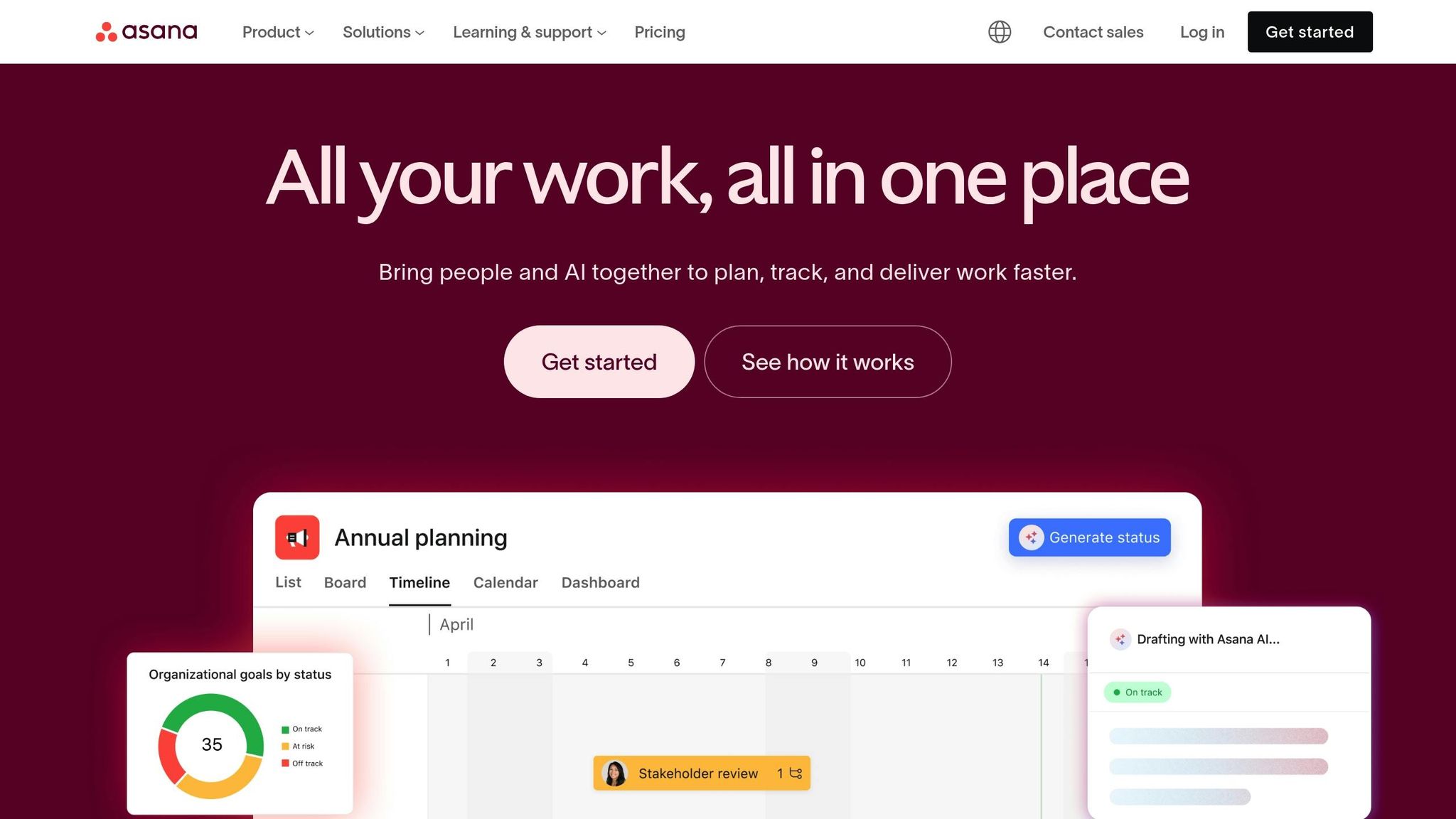
Asana for Slack bridges project management with real-time communication, making it easier for agile teams to capture tasks and track progress during sprints. While Trello shines with its simple, visual approach, Asana stands out for its ability to handle complex workflows, dependencies, and cross-functional projects. This integration ensures teams can stay updated asynchronously, no matter where they’re working.
Simplifying Agile Workflows
With Asana for Slack, teams can cut down on context switching by turning Slack messages into actionable Asana tasks during standups or reviews. Imagine this: someone flags a bug in a channel like #sprint-march or #bug-triage. With just a few clicks, that message becomes a task in Asana, keeping the sprint backlog aligned with real-time conversations. This way, standups focus on decisions, not tedious follow-ups.
Teams can link specific Asana projects or boards to Slack channels, ensuring only the most relevant updates - like tasks moving to "Ready for Review" or priority shifts - trigger notifications. By filtering out minor changes, such as comment edits, team members avoid notification overload while staying informed on critical updates.
During standups, sprint boards can be pinned in Slack for quick reference, and any discussion points can be converted into tasks on the spot. For planning or retrospective meetings, coaches and leads can easily pull up existing Asana tasks, share links in Slack, and create new tasks for next steps - all while keeping everything organized in one place.
Task Management Meets Collaboration
Delegating work is straightforward with this integration. Slack messages can be turned into detailed Asana tasks that include assignments and deadlines, ensuring smooth follow-ups. Asana notifications - like status updates or comments - appear directly in Slack, allowing team members to discuss and resolve issues without switching between tools.
For cross-functional projects, a single Asana task can be shared across multiple Slack channels, ensuring teams like marketing, design, and engineering stay aligned on shared goals. This integration is particularly helpful for product managers, scrum masters, and tech leads, who can monitor multiple squads from Slack, quickly identifying blockers or overdue tasks without digging through various boards. It’s a game-changer for hybrid or distributed teams, where asynchronous updates ensure everyone stays on the same page.
Easy Integration with Slack
Getting started with Asana for Slack is simple. After installing the app from the Slack App Directory, teams can connect their Asana workspace and map key projects - like the product backlog or current sprint - to specific channels, such as #product-sprint or #support. To make the most of the integration, teams should adopt a few habits: convert actionable Slack messages into tasks, keep work discussions threaded and linked to tasks, and rely on Asana as the central source for task status. These practices ensure the integration enhances, rather than complicates, agile workflows.
Since many teams already use Asana for project management, adding the Slack integration builds on familiar processes without introducing an entirely new tool. Most actions - like creating tasks, assigning owners, or reacting to notifications - are handled through simple Slack commands and buttons, making adoption quick and easy.
The integration also plays nicely with other Slack apps. For example, teams using Google Drive for Slack can attach files to Asana tasks during conversations, and those using Zoom for Slack can link meeting recordings to relevant tasks. This interconnected system keeps all project assets and discussions in one place, creating a centralized workspace.
Boosts Communication and Documentation
Linking Asana tasks to Slack threads creates a dynamic record that pairs structured task data in Asana with the context of Slack discussions. This setup not only tracks progress but also explains why certain decisions were made - whether it’s adjusting priorities or shifting timelines. Slack’s channel history effectively becomes lightweight documentation, useful for onboarding new team members or reviewing past sprints during retrospectives.
For teams that rely on process documents, sprint guidelines, or product specs stored in tools like Notion, Confluence, or Google Drive, adding a tool like Question Base to Slack can complement Asana. Question Base provides instant answers to workflow questions by pulling directly from trusted documents, allowing teams to execute tasks faster without leaving Slack. While Slack AI is great for summarizing conversations, Question Base connects to resources like Notion, Salesforce, and Confluence to provide verified answers, ensuring teams stay aligned on both the “how” and the “why.”
Asana for Slack is included in Asana's paid plans, starting at $7.99 per user per month (billed annually). A free plan is also available with basic integration features. For agile teams seeking structured task management paired with real-time communication, this integration strikes a balance between Trello’s simplicity and Jira’s depth for development-focused workflows.
5. GitHub for Slack
GitHub for Slack seamlessly integrates code repositories with team conversations, allowing agile teams to monitor development progress without switching platforms. For engineering teams working in sprints, this tool brings pull requests, issues, commits, and deployments directly into Slack, where daily discussions and code reviews already happen. Unlike generic integrations, GitHub for Slack is tailored specifically for development workflows, ensuring code updates remain visible and actionable within the context of team collaboration.
Simplifies Agile Workflows
This integration ensures repository activity is shared in Slack channels in real time, keeping teams updated as work progresses. For instance, when a developer opens a pull request or resolves an issue, the update is automatically posted in the relevant channel. This is especially helpful during sprint cycles, where immediate visibility into feature readiness or bug fixes is critical.
Teams can configure Slack channels to follow specific repositories or branches, keeping discussions focused on relevant code changes. For example, a #team-payments channel might track updates to the payments microservice, while #svc-checkout focuses on the checkout service. This targeted approach minimizes delays in code reviews, deployment coordination, and incident response by ensuring everyone stays informed about the updates that matter most to their work.
Another effective practice is setting up environment-specific channels like #deploy-staging or #deploy-prod. Deployment and release events from GitHub are sent directly to these channels, enabling quick coordination during release windows or incident response. If a deployment fails or a hotfix is applied, the entire on-call team is notified instantly, reducing the time needed to resolve issues.
During standups, channels configured to display key GitHub activity - such as merged pull requests or resolved issues - provide an objective snapshot of progress and blockers. This eliminates the need for manual status updates, helping teams identify bottlenecks faster. For sprint reviews and retrospectives, scrolling through the channel history offers a clear view of code changes and related discussions, aiding in root-cause analysis and more accurate assessments of development timelines. By connecting development activity with task planning, this integration complements other agile tools to streamline workflows.
Boosts Task Management and Collaboration
In addition to tracking updates, GitHub for Slack makes it easier to create and manage tasks directly from Slack conversations. Team members can quickly turn Slack messages into GitHub issues, link existing issues or pull requests to discussions, and add comments or reviews - all without leaving Slack. This functionality helps engineers, product managers, and QA teams collaborate asynchronously on priorities, acceptance criteria, and code feedback while maintaining a record in GitHub for audit purposes and sprint reporting.
When a pull request is opened or updated, Slack notifications include detailed summaries, allowing reviewers to respond with comments or approvals quickly. This shortens feedback cycles and helps teams stay on track with sprint goals. During critical incidents or high-stakes releases, real-time notifications about failed checks, reverted commits, or hotfix pull requests keep on-call engineers aligned and informed about the code's current status.
For teams using additional tools like Jira or Trello, GitHub events can be linked by referencing issue keys in pull request titles. This creates a cohesive workflow, offering visibility from planning stages to deployment.
Smooth Slack Integration
Connecting GitHub with Slack is straightforward, with channels subscribing only to relevant repositories and events. Notifications are concise and actionable, enabling quick responses - like assigning reviewers or updating statuses - without cluttering the channel.
Slash commands and message shortcuts further simplify collaboration. Teams can search for issues or link pull requests directly within Slack, making it easy to reference work during discussions or planning sessions. GitHub Actions also integrates seamlessly, sending notifications about workflow runs, such as successes, failures, or pending approvals. This is particularly useful for teams running agile CI/CD pipelines.
To avoid notification fatigue, teams can fine-tune subscriptions to focus on high-priority events, such as opened or merged pull requests, failed checks, or closed issues. Broad, low-priority updates can be routed to dedicated channels like #github-feed, while core team channels remain focused on actionable updates tied to active sprints.
The GitHub for Slack app is available in the Slack App Directory at no extra cost, with overall expenses tied to a team's existing GitHub and Slack plans.
Improves Communication and Documentation
By linking code changes and issues directly to Slack conversations, teams create a dynamic record of decisions and technical context. This pairing of GitHub's structured task data with Slack's discussion history supports better audit trails for agile teams. For example, if a team needs to revisit why a feature was implemented in a specific way or why priorities shifted mid-sprint, they can easily trace these decisions through Slack conversations linked to the relevant pull requests or issues.
Monitoring trends like pull request cadence or reopened issues provides a quick overview of team throughput. Combined with incident-related GitHub updates in Slack, these insights help product owners and engineering leads identify patterns - such as longer review times or frequent hotfixes - that can inform sprint planning and process adjustments.
For teams that rely on internal documentation alongside GitHub updates, integrating Question Base into Slack adds another layer of efficiency. During a GitHub-powered discussion, team members can query internal resources like Confluence, Salesforce, or Google Drive directly from Slack. This reduces context switching and speeds up resolution times. While Slack AI can summarize past conversations, Question Base ensures access to verified, up-to-date information, keeping teams aligned on both code updates and the processes behind them.
GitHub for Slack becomes even more powerful when paired with other agile tools like Jira or Asana. Teams can manage sprint goals, track code changes, and handle production incidents - all within the same Slack workspace. This interconnected approach ensures that whether you're planning, coding, or troubleshooting, all the information you need is just a Slack channel away.
6. Confluence Cloud for Slack
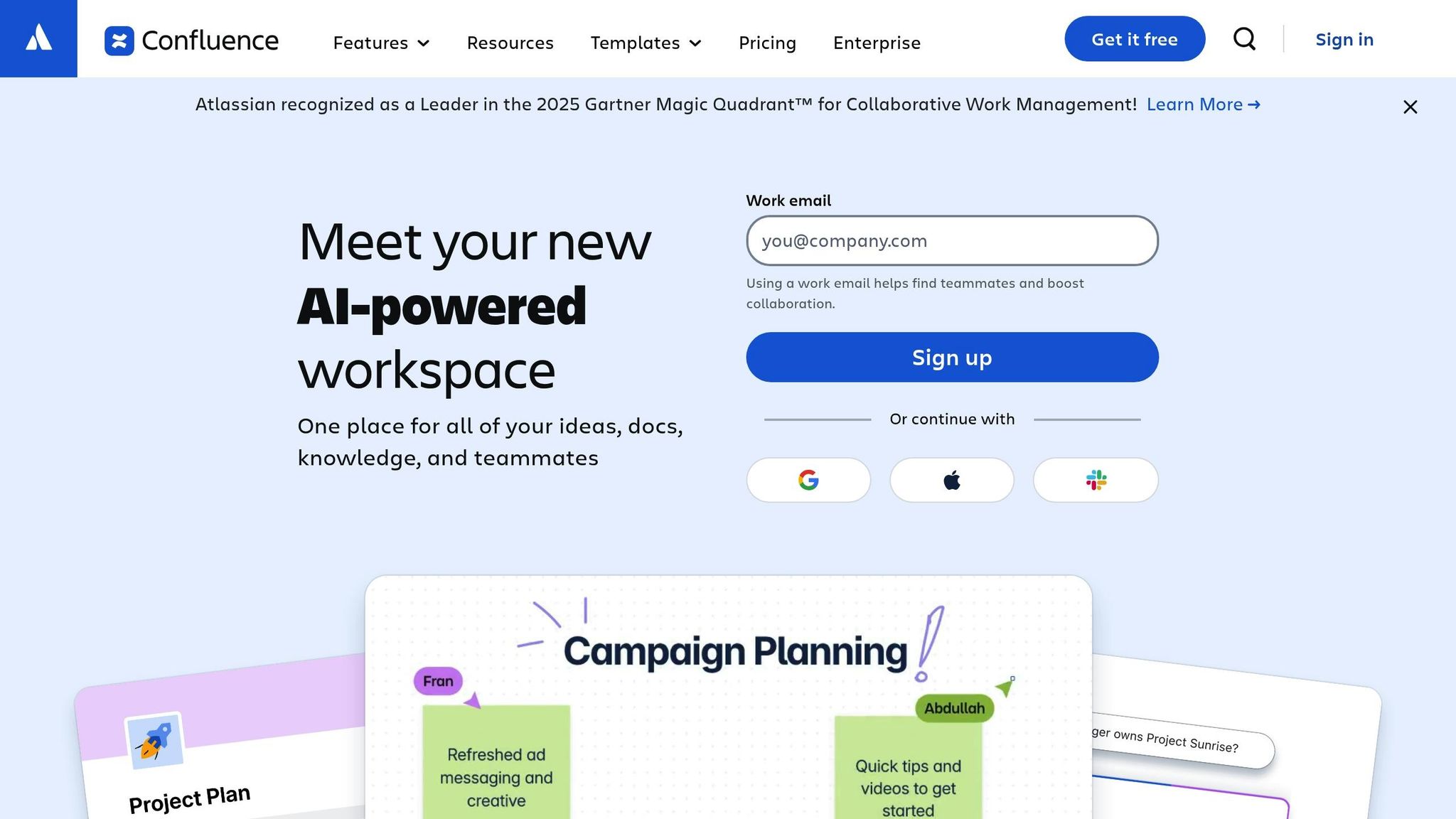
Confluence Cloud for Slack bridges the gap between your team’s documentation and their daily Slack interactions. For agile teams, this integration ensures that vital information stored in Confluence - whether it’s sprint plans, product requirements, or technical documentation - is always within reach during work discussions.
Simplifies Agile Workflows
This integration allows teams to preview, search, and share Confluence pages directly within Slack channels. When a Confluence link is shared, Slack generates an automatic preview, showing the page title and a short excerpt. This feature provides enough context for discussions during sprint planning or daily standups without needing to switch platforms.
Dedicated Slack channels, such as #sprint-docs or #product-specs, can be set up to receive updates whenever a Confluence page is edited. For example, if a product manager updates a feature spec or a tech lead revises an architecture decision, the team gets notified instantly. This keeps everyone aligned, even as project details evolve.
During retrospectives, users can quickly reference Confluence pages to review sprint goals, blockers, or lessons learned. Instead of digging through Confluence or relying on memory, Slack’s search function makes it easy to locate previously shared documentation, creating a helpful audit trail for continuous improvement.
For distributed teams, asynchronous collaboration becomes much easier. A team member in one time zone can share a Confluence page with a proposed solution, allowing colleagues in other regions to review and comment before the next meeting. This flexibility ensures that no one is left out of the loop.
Boosts Collaboration and Task Management
Confluence for Slack isn’t just about passive sharing - it actively supports real-time collaboration. When a conversation uncovers missing documentation or requires a decision to be documented, team members can quickly locate and share the appropriate Confluence page. This ensures that key insights and decisions are captured in the team’s knowledge base.
For teams juggling multiple projects, organizing updates by Slack channel - such as #team-mobile or #team-backend - mirrors the structure of agile workflows. This makes it easier to find the right information when it’s needed most, keeping everyone on the same page.
Easy Integration with Slack
Getting started with Confluence Cloud for Slack is simple. The app is available in the Slack App Directory, and once installed, users can connect their Confluence workspace and begin sharing pages immediately. Basic slash commands like /confluence search make finding and sharing documentation quick and intuitive.
The integration respects Confluence’s existing permission settings, ensuring that only authorized users can access shared content. Customizable notifications help filter out minor updates, so only the most important changes are sent to designated channels, keeping distractions to a minimum.
Enhances Communication and Keeps Documentation Dynamic
This integration transforms Confluence from a static repository into an active part of your team’s workflow. By linking documentation with Slack conversations, teams create a knowledge base that evolves alongside their projects. When a question comes up in Slack, sharing a relevant Confluence page can prompt updates to the documentation, keeping it accurate and useful over time.
For teams that rely on multiple tools, Question Base offers a powerful complement to Confluence. Instead of manually searching through Confluence, Google Drive, Salesforce, or other systems, team members can ask Question Base directly in Slack and receive verified answers from trusted sources. Unlike Slack AI, which mainly summarizes past conversations, Question Base pulls directly from established documents to provide accurate, expert-approved answers. It also highlights gaps in existing documentation, helping teams refine and improve their knowledge base.
Confluence Cloud for Slack is included at no extra cost with your existing Confluence and Slack subscriptions. For teams already using Atlassian tools, this integration reduces the friction between documentation and collaboration. When combined with Jira for task management and Question Base for intelligent knowledge retrieval, Confluence for Slack becomes an essential part of a streamlined, productive agile workflow.
7. Google Drive for Slack
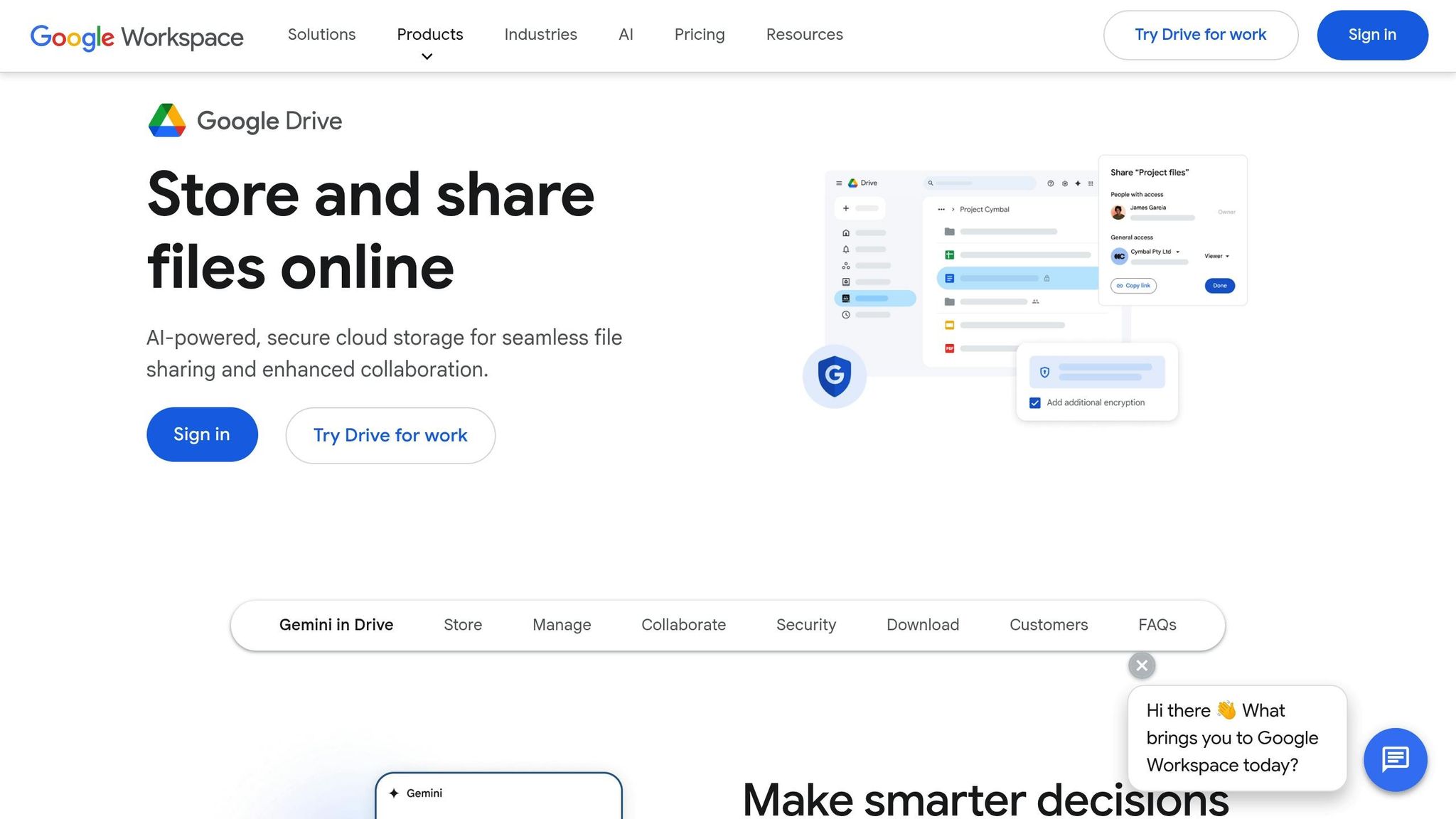
Google Drive for Slack brings your documents, spreadsheets, and presentations directly into Slack channels, making it easier for teams using Google Workspace to stay on the same page. By reducing the need to switch between tools, this integration keeps everyone aligned on the latest specs, backlogs, and sprint documentation.
Simplifies Agile Workflows
When a Google Drive link is shared in Slack, the integration automatically generates a preview showing the file’s title, owner, and last-modified date. This quick context ensures that product managers, developers, and stakeholders are looking at the correct document during sprint planning or daily standups.
The integration also checks file permissions instantly. If someone doesn’t have access to a shared file, Slack prompts the sender to adjust the sharing settings right away. This feature eliminates the common delays caused by "request access" notifications, keeping agile ceremonies and cross-functional collaboration running smoothly.
Drive notifications in Slack further streamline workflows by alerting teams to document changes without requiring them to leave Slack. For distributed teams working across time zones, this reduces the risk of missing updates and minimizes reliance on email threads. For example, a U.S.-based SaaS team might keep their sprint backlog in a shared Google Sheet linked in #sprint-planning. Team members can then discuss priority changes in Slack threads while the Sheet updates in real time, ensuring that conversations and documentation remain tightly connected.
Boosts Task Management and Collaboration
With this integration, Google Drive files can be attached directly to tasks and user stories in Slack. This ensures that discussions about tasks are always linked to the most current document or design asset. For instance, when a QA engineer comments on a test plan in a Google Doc or a designer updates a Slides presentation, those notifications appear in Slack. This allows developers, product managers, and stakeholders to address comments, clarify criteria, and update documents collaboratively - all within the same context.
During sprint retrospectives, teams can pin a Google Doc in the #retro channel, enabling everyone to share feedback in Slack while the facilitator tracks themes, action items, and metrics in the shared document. This approach keeps communication and documentation aligned, creating a dynamic record that evolves with the team’s workflow.
For teams relying on spreadsheet-based backlogs, document-based specifications, and presentation-based updates, Google Drive’s integration with Slack offers a smoother experience. It supports live editing, comment workflows, and precise permissions - all while reducing confusion over versions and duplicate files.
Easy Integration with Slack
Setting up Google Drive in Slack is simple. A workspace admin installs the app from the Slack App Directory, connects a Google account, and users can immediately start sharing Drive links with automatic previews and sharing options. There’s no additional cost for the integration beyond existing Slack and Google Workspace subscriptions.
Users can search for links, adjust sharing settings, and enjoy a consistent experience across devices. This ease of setup makes it simple to integrate documents and tasks into Slack workflows.
A practical way to organize files is to mirror team or sprint structures in both Drive and Slack. For example, create Drive folders named by team and sprint - like "Team Apollo / Sprint 24" - and link them to corresponding Slack channels such as #team-apollo or #sprint-24. Standardizing file names (e.g., "Sprint-24-Backlog", "Sprint-24-Retrospective", "Release-Notes-v1.3") and using Slack bookmarks for key Drive links helps teams quickly find what they need during time-sensitive work.
Improves Team Communication and Documentation
Google Drive doesn’t just store files; it enhances collaboration by connecting documentation with Slack conversations. When a question arises in Slack, sharing a relevant Drive document can lead to updates that keep the file accurate and useful over time.
Research shows that Slack and Google Workspace are two of the most widely used collaboration platforms globally, with many organizations leveraging both to manage daily tasks. Studies indicate that integrating communication and document tools leads to higher productivity [3].
By integrating Question Base with Drive, teams can take this a step further. Question Base pulls answers directly from Drive documents like product specs, runbooks, and FAQs, delivering them in Slack. Instead of searching through folders or channels, engineers and product managers get instant answers without leaving Slack.
"Employees spend an average of 20–30% of their week searching for information in tools like Slack." [1]
Question Base transforms Slack into a self-service knowledge hub. With Google Drive storing key documents and Question Base enabling quick retrieval, repetitive questions during sprints are reduced, and new team members onboard faster. Unlike Slack AI, which focuses on summarizing past conversations, Question Base provides accurate answers by pulling from trusted documents in Drive, Confluence, Notion, and similar sources.
For agile teams already using Google Workspace, integrating Drive with Slack - and optionally adding Question Base - creates a unified environment where collaboration, documentation, and information retrieval happen seamlessly. This reduces context switching, keeps teams aligned, and ensures the right information is always available when it’s needed most.
8. Zoom for Slack
Zoom for Slack simplifies agile workflows by integrating video conferencing directly into Slack. With the /zoom command, teams can instantly launch meetings from any channel or direct message, keeping daily standups, sprint reviews, and retrospectives running smoothly without the need to switch between apps.
Keeps Agile Workflows on Track
This integration automatically shares meeting details - such as join links, dial-in numbers, and participant information - right in Slack. It also posts notifications for meeting start times, endings, and recording availability, ensuring everyone stays informed, even across time zones. Research shows that teams using integrated tools like Slack combined with video conferencing experience significantly less context switching, which directly supports higher productivity in distributed agile teams [2].
For agile teams working remotely, Zoom for Slack brings asynchronous and real-time communication together in one place. Slack handles tasks like backlog updates and code review comments, while Zoom enables live collaboration for planning sessions and incident responses. A practical use case is to reserve Zoom meetings for time-sensitive ceremonies - like standups or sprint planning - while keeping follow-up discussions and decisions in Slack threads. This approach ensures that your team can move seamlessly between asynchronous updates and live conversations without disrupting workflow.
Facilitates Collaboration and Task Management
While Zoom for Slack is primarily focused on real-time collaboration, it works well alongside task management tools like Jira, Trello, and Asana, which can also integrate into Slack. Before a meeting, facilitators can share agenda links, project boards, or other resources directly in the Slack channel, giving participants everything they need in one place. After the meeting, decisions and action items can be summarized in the same channel, creating a clear and accessible record.
For organizations in the U.S. handling sensitive data during agile ceremonies, both Zoom and Slack offer enterprise-grade security features, including single sign-on and compliance controls, ensuring secure collaboration.
Easy Integration with Slack
Getting started with Zoom for Slack is straightforward. Install the app from the Slack App Directory and link it to your Zoom account. From there, you can launch meetings using simple slash commands without any extra costs beyond your existing Zoom and Slack subscriptions.
You can also set up channel-specific notifications so that meeting recordings - like sprint reviews or postmortem discussions - are automatically shared in the relevant Slack channels. This setup allows team members in different time zones to catch up asynchronously, maintaining transparency without requiring everyone to join live meetings. Many agile teams establish conventions, like using a 🎥 emoji to mark Zoom meeting threads, to keep discussions organized and easy to follow.
Improves Communication and Documentation
Zoom's calendar features integrate with tools like Google Calendar and Outlook, sending Slack notifications when scheduled ceremonies are about to begin. This helps reduce tardiness and ensures team members are always prepared. Meeting recordings and summaries are automatically shared in Slack channels, keeping absent teammates informed and aligned.
Surveys of remote and hybrid workers consistently highlight the importance of video meetings for maintaining team cohesion. Most respondents prefer tools that integrate directly with their chat platforms, as opposed to standalone scheduling systems [2].
Question Base enhances this setup by connecting Slack to documentation tools like Notion and Confluence. It provides verified answers within Slack, going beyond simple meeting summaries. This is especially helpful during sprints when new team members need quick context or when engineers need to reference architectural decisions without breaking their flow. By tracking what information is most useful and identifying gaps, Question Base helps teams improve their knowledge-sharing processes over time.
9. Miro for Slack

Miro for Slack brings the power of visual collaboration straight into your workspace, giving teams the ability to create, share, and update whiteboards without leaving Slack. This integration reshapes how distributed teams handle sprint planning, retrospectives, and backlog grooming by keeping visual workflows right where the conversation happens.
Simplifies Agile Workflows
With Miro for Slack, teams can cut down on switching between tools during agile ceremonies. You can create new boards, update existing ones, and stay updated with real-time notifications about board changes - all directly in Slack channels. Miro supports agile frameworks like Scrum and Kanban with pre-built templates, making it easier to align workflows across teams. For instance, during sprint planning, a product owner can share a Kanban board in the team channel, making user stories and dependencies easily accessible - perfect for remote teams.
For daily standups, shared Miro boards in Slack threads allow team members to visually update their progress and flag blockers. This setup works especially well for asynchronous standups, enabling team members in different time zones to provide updates throughout the day while keeping the sprint's progress visible.
This visual-first approach naturally leads to better task management and collaboration within Slack.
Boosts Task Management and Collaboration
Miro's real-time collaboration tools integrate smoothly with Slack's communication flow. Team members can leave comments on board elements, vote on ideas during retrospectives, and add sticky notes during brainstorming - all without leaving Slack. Action items can be assigned directly on Miro boards, with progress tracked over the course of the sprint. For example, facilitators can use the voting feature during retrospectives to prioritize key improvement areas and quickly turn them into follow-up tasks, ensuring no action items fall through the cracks.
Miro's agile templates also help teams stay consistent across sprints. A team could, for example, adopt a standard retrospective template shared in their Slack channel, building a library of previous retrospectives that serves as a record of their progress and growth.
Easy Integration with Slack
Setting up Miro for Slack is quick and user-friendly. In just a few minutes, you can install the app via the Slack App Directory. Once connected, users can share boards and invite teammates directly from Slack. The integration even posts board previews in Slack channels, giving teams a quick visual snapshot before diving into the details.
Miro offers a free plan with basic features, while paid plans start at $7.99 per user per month (billed annually) for those needing advanced functionality. The integration works across all plan tiers, and for enterprise teams managing sensitive information, Miro ensures data encryption both at rest and in transit, along with other compliance measures.
Improves Team Communication and Documentation
Miro for Slack helps teams build a visual knowledge base that evolves with their agile practices. Each session generates a board that becomes a searchable artifact, accessible directly within Slack. This makes it easy to revisit past decisions or review approaches from earlier sprints.
The integration also bridges the gap between synchronous and asynchronous work. For example, when a team member updates a planning board at the end of their workday, colleagues in different time zones can see the changes via Slack notifications the next morning, keeping everyone aligned.
Miro's visual collaboration pairs well with tools like Question Base, which extracts verified answers from your documentation. Together, these tools ensure that teams can access the knowledge they need without switching apps. By identifying frequently asked questions and uncovering documentation gaps, Question Base helps teams refine their knowledge-sharing practices while staying focused on their agile goals.
10. Slack Workflow Builder
Slack Workflow Builder is a game-changer for automating repetitive tasks directly within Slack. Designed as a no-code tool, it empowers teams to create custom workflows triggered by events like new messages or emoji reactions. Unlike external automation platforms, Workflow Builder operates natively in Slack, making it accessible to everyone - even those without technical expertise - while streamlining routine work.[5]
For agile teams, Workflow Builder bridges Slack conversations with project management tools like Jira, Asana, or Trello. For instance, a bug report posted in Slack can automatically create a Jira ticket and notify the right team members. Similarly, an emoji reaction on a feature request can trigger a workflow to add it to the product backlog. This keeps teams focused on meaningful tasks without getting bogged down by manual updates between platforms.[5][4]
Streamlines Agile Workflows
Workflow Builder simplifies recurring agile processes, making them more efficient. Teams can automate daily standups by setting up workflows that post structured prompts at specific times, collect responses throughout the day, and summarize them for the scrum master. Sprint retrospectives can follow a similar process, where workflows post feedback forms at the end of the sprint and compile responses in a dedicated channel. This asynchronous approach is particularly helpful for distributed teams working across multiple U.S. time zones, allowing everyone to contribute without needing to be online simultaneously.[5]
The tool also tackles intake processes that can slow down agile teams. Requests for IT support, access permissions, or incident reports can be standardized through forms that gather all necessary details upfront and route them to the appropriate channel or person. This reduces unnecessary back-and-forth communication, making workflows smoother and more traceable. In this way, Slack becomes a lightweight operations hub for managing cross-functional tasks.[5]
Supports Task Management and Collaboration
Workflow Builder integrates Slack events with task management systems, enabling seamless collaboration. Workflows can automatically create tasks in Jira or Asana based on specific triggers, update task statuses as work progresses, and even manage approvals through structured routing. For example, when a customer support team member posts a bug report, a workflow can generate a Jira issue, assign it, and confirm the ticket number directly in the same Slack thread.[5][4]
Branching workflows add flexibility by routing requests based on criteria like urgency. This means teams can handle both routine and critical tasks without needing engineering support, treating workflows as adaptable tools that evolve alongside sprint practices.[5] Studies show that frequent switching between tools can waste hours each week, but Workflow Builder reduces this by consolidating actions within Slack. For agile teams juggling multiple platforms, this translates to quicker responses and fewer missed tasks.[2][3]
Integrates Seamlessly with Slack
Since Workflow Builder is built directly into Slack, it’s ready to use without requiring extra installation or configuration. These advanced automation features are included in Slack's paid plans, bundled with other enterprise tools and admin options.[5]
Compared to third-party platforms like Zapier or Make, Workflow Builder focuses specifically on Slack-based events, making it ideal for common agile tasks like structured check-ins, approvals, and task creation. Its native integration ensures a smoother experience, especially for non-technical team members who may find external platforms overwhelming.[2][5]
This integration not only minimizes the need to switch between tools but also enhances communication workflows. For teams that rely heavily on agile project management software, Workflow Builder doesn’t replace those tools but complements them. It enables Slack-first triggers and notifications that keep discussions and actions aligned, making it even more effective when paired with the integrations discussed earlier in this article.[3][4]
Enhances Team Communication and Documentation
Workflow Builder helps teams organize and retain information that might otherwise get lost in Slack threads. For recurring questions, workflows can provide automatic responses with links to relevant documentation or escalate queries to a team member.
For enterprises handling sensitive data, Workflow Builder upholds Slack’s security standards. Workspace admins and power users can configure workflows while maintaining governance and consistency across teams. This ensures that automated processes align with organizational policies and meet audit requirements.[5]
Workflow Builder becomes even more powerful when combined with knowledge management tools. For example, a workflow routing a question to a specific channel can leverage AI answer agents like Question Base to deliver verified responses from connected documentation sources such as Notion, Confluence, or Google Drive. While Workflow Builder handles the structure and routing, Question Base ensures responses are accurate and up-to-date, rather than relying solely on past Slack messages.
As agile practices evolve, teams can treat workflows as living tools, updating triggers, fields, and steps regularly - whether quarterly or with each release cycle. This keeps automation aligned with current needs, addressing new challenges without becoming outdated.[3][5]
Paired with tools like Jira, GitHub, and Question Base, Workflow Builder contributes to creating a unified, agile workspace within Slack.
Conclusion
These 10 integrations bring agile planning, execution, and continuous improvement directly into Slack. By linking tools like Jira, Trello, and Asana to Slack, teams can seamlessly create tasks from messages, monitor progress in real time, and keep conversations tied to specific work items. GitHub integrates code and pull requests into discussions, while Confluence and Google Drive provide quick access to documentation when it's most needed. Zoom and Miro simplify standups, sprint reviews, and retrospectives, while Slack Workflow Builder automates routine updates and approvals, cutting down on delays.
Real-time notifications ensure everyone stays on the same page about blockers and progress, while asynchronous tools like Miro boards and Confluence pages allow team members to contribute at their own pace. This setup reduces missed handoffs, speeds up feedback loops, and helps teams focus on delivering user stories rather than wasting time searching for information. Together, these integrations create a workflow that aligns with agile principles, paving the way for deeper insights through tools like Question Base.
Question Base elevates Slack's functionality by providing verified, document-backed answers in real time, pulling from sources like Notion and Confluence. Unlike Slack AI’s chat-based responses, it ensures accuracy and reduces interruptions for subject-matter experts, reinforcing agile goals of rapid learning and ongoing improvement.
To get started, focus on one or two integrations that address your team’s biggest pain points. For example, use Jira or Trello for ticket tracking and deploy Question Base for quick, accurate answers. Once you see the benefits, expand to a full "agile toolkit" across teams, and document basic usage guidelines to ensure consistent adoption.
Measure the impact by tracking metrics like response times for questions, time spent in status meetings, and how quickly tasks move from "in progress" to "done." During retrospectives, gather feedback on cognitive load and meeting efficiency. Use this input to fine-tune notification settings and channel structures, keeping Slack organized and productive. At the end of each sprint or quarter, review your integrations - keep the ones that help achieve sprint goals and remove any that add unnecessary noise.
The right tools will vary by team. Startups might prefer lightweight options like Trello, Google Drive, Zoom, and Miro, paired with Question Base for efficient knowledge sharing. Larger enterprises may lean toward Jira, Confluence, GitHub, and enterprise-ready solutions like Question Base with SOC 2 compliance or on-premise deployment, aligning with governance and security needs while leveraging Workflow Builder to streamline collaboration across teams.
The key is to prioritize purpose over quantity. Enable only the integrations that directly support your agile processes, and configure them to send notifications to the appropriate channels - like #squad-backend for GitHub updates or #incidents for Jira alerts. Use dedicated channels for tool updates to keep Slack focused and free from unnecessary distractions. When these integrations are thoughtfully implemented, Slack transforms into a hub for agile teamwork, driving efficiency and continuous improvement.
FAQs
How does Question Base improve Slack for agile teams compared to Slack AI?
Question Base is built to keep agile teams on the same page by delivering verified answers straight from trusted platforms like Notion, Confluence, and Salesforce. Unlike Slack AI, which primarily depends on chat history, Question Base integrates directly with your documentation tools to ensure responses are accurate and dependable.
It also comes with features designed specifically for enterprise needs, including customizable settings, audit trails, and analytics to monitor performance. While Slack AI excels at summarizing conversations, Question Base is all about turning knowledge into action - keeping teams unblocked and workflows running efficiently.
What are the benefits of integrating task management tools like Jira or Trello with Slack for agile workflows?
Integrating task management tools such as Jira or Trello with Slack can significantly improve agile workflows by simplifying communication and minimizing the need to switch between platforms. These integrations enable teams to stay updated on task progress, deadlines, and changes directly within Slack channels, eliminating the constant back-and-forth of checking external tools.
Beyond just notifications, these integrations let users create, assign, and update tasks right from Slack. This not only saves time but also boosts productivity by keeping everything in one place. With notifications and actions centralized, teams can focus more on collaboration and decision-making, leading to smoother sprint cycles and quicker project turnarounds.
How does Slack Workflow Builder help agile teams automate tasks and boost efficiency?
Slack Workflow Builder makes handling repetitive tasks easier by automating them, freeing up time for agile teams to focus on what really matters. With its no-code interface, you can design tailored workflows to handle tasks like sending stand-up reminders, assigning tasks, or managing onboarding checklists. This automation not only boosts efficiency but also helps teams collaborate more effectively and keep up with the fast pace of agile work environments.