∙
Cooper
∙
Reading time:
15 min

Repetitive questions, scattered knowledge, and lost information can overwhelm Slack as companies grow past 1,000 employees. Channels multiply, support teams get bogged down, and institutional knowledge disappears when employees leave. This costs time, money, and productivity.
Key challenges:
Information overload: Employees waste 12 hours per week searching for answers.
Repetitive questions: HR and IT teams spend 30–50% of their time answering the same queries.
Knowledge loss: Slack’s format buries or deletes critical information over time.
Solution: AI tools like Question Base integrate with trusted platforms (e.g., Notion, Confluence, Salesforce) to deliver verified answers directly in Slack. Unlike Slack AI, which summarizes past conversations, Question Base automates responses using up-to-date documentation, cutting repetitive questions by up to 70% and saving teams over six hours weekly.
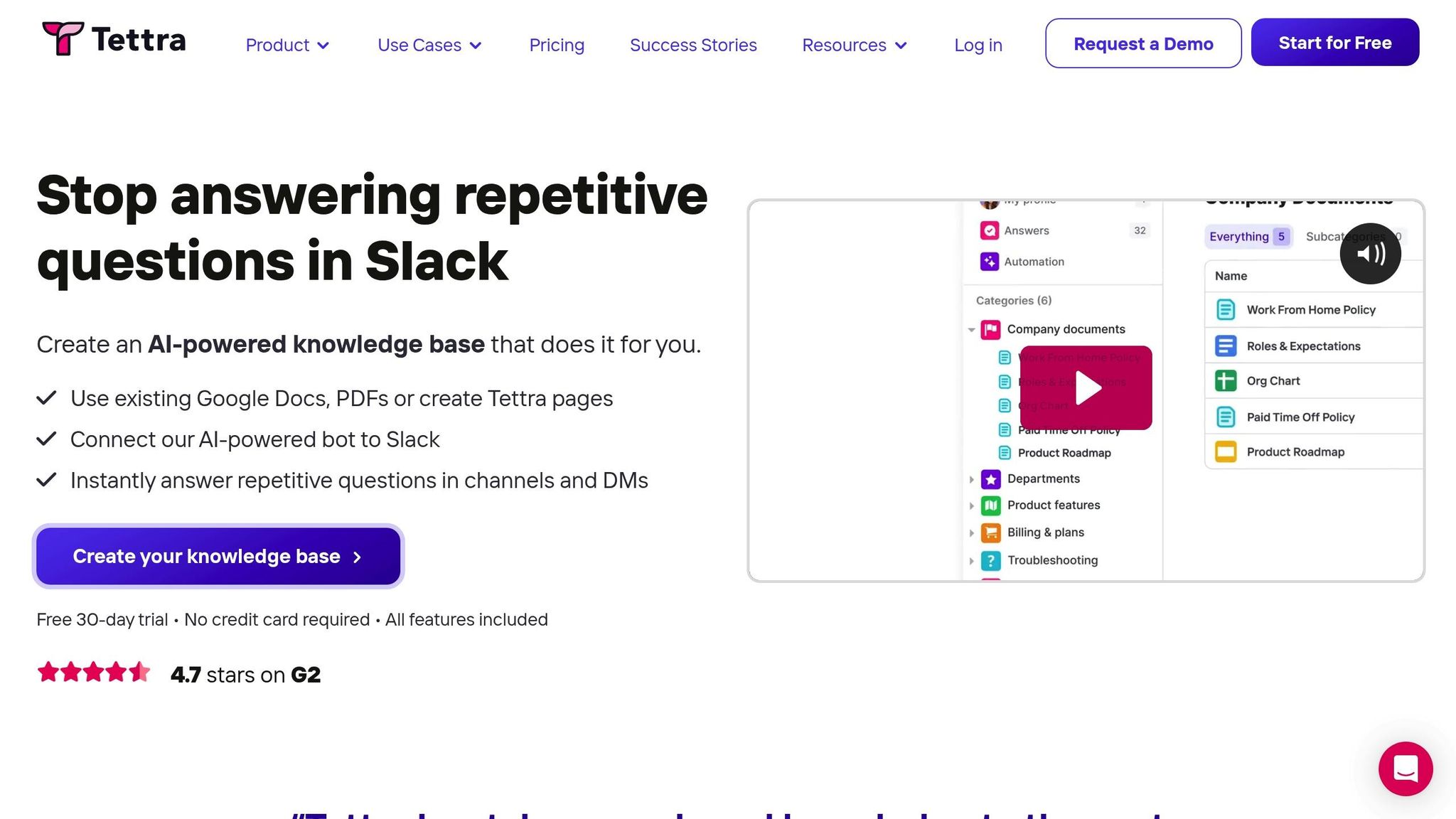
Tettra Slack Integration: AI Knowledge Base
Why Slack Breaks at 1,000+ Employees
Once a company crosses the 1,000-employee mark, Slack undergoes a transformation that its co-founder, Stewart Butterfield, described as "profoundly different." The platform faces mounting challenges, from managing the complexity of operations to juggling over 100 app integrations [3]. What works seamlessly for teams of 50 or even 500 often crumbles under the weight of larger organizations. These growing pains highlight the need for solutions that go beyond Slack’s standard chat features.
Information Gets Trapped in Channels
In organizations with over 1,000 employees, Slack workspaces balloon into hundreds - or even thousands - of channels. This sprawling network of conversations makes it nearly impossible to maintain a clear, centralized knowledge base. Critical information scatters across channels, leaving employees frustrated as they waste hours searching for answers. In fact, workers lose an average of 12 hours each week trying to locate hidden information [1]. Worse, 40% of questions asked are repeats of ones already answered [1]. This fragmentation underscores the need for a smarter, more centralized way to manage knowledge.
Support Teams Drown in Repetitive Questions
As companies scale, HR, IT, and support teams face an avalanche of repetitive questions that Slack alone cannot handle efficiently. Queries like "How do I reset my password?", "What’s the PTO policy?", or "Where can I find the onboarding document?" pop up daily across multiple channels. These redundant requests consume 30–50% of support teams’ time, creating bottlenecks and inefficiencies. Without a centralized system to surface answers, these teams are stuck in a loop of responding manually.
Organizations that implement AI-driven knowledge solutions report that answers can surface in seconds, cutting down the 5–10 minutes typically spent searching for each response. For large enterprises, this wasted time translates into significant hidden costs that extend far beyond Slack subscription fees. Outdated chat histories only add to the problem, making it harder to locate relevant information and further straining support teams.
Knowledge Disappears Over Time
Slack’s chat-based format isn’t built to preserve institutional knowledge. Messages quickly get buried under new conversations, and on the free plan, anything older than a year - or exceeding 10,000 messages - simply disappears [2][4]. Even paid Enterprise+ plans often enforce 90-day retention policies for storage management, making older updates inaccessible.
When employees leave, their expertise often leaves with them. Unlike wikis or dedicated knowledge bases, Slack threads fail to capture and maintain context effectively. Answers are scattered across conversations, forcing employees to rely on specific keywords or channel names to retrieve information. At enterprise scale, this can lead to the permanent loss of critical knowledge. This is precisely where AI-powered tools like Question Base step in, ensuring that knowledge is captured and accessible when it’s needed most.
How AI Fixes Slack's Scaling Problems
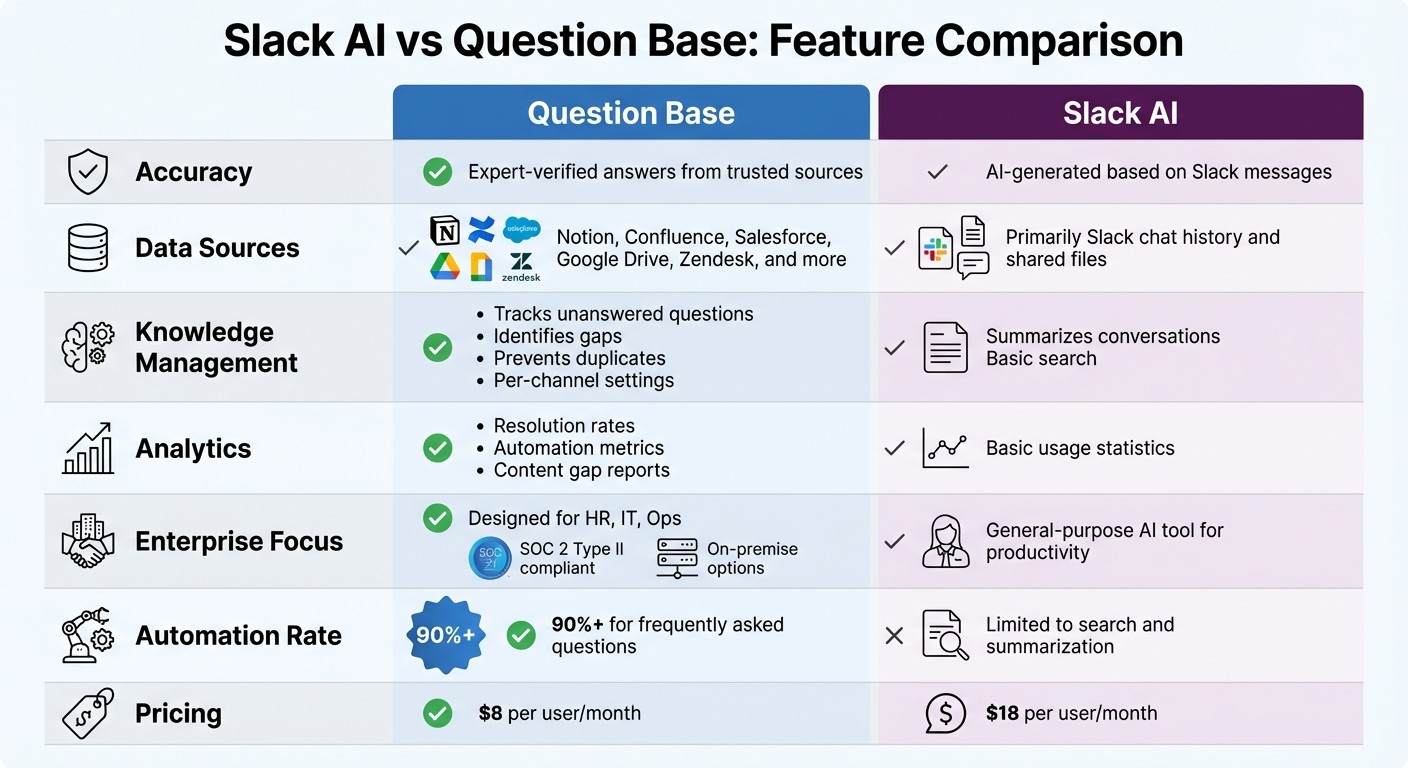
Slack AI vs Question Base Feature Comparison for Enterprise Teams
AI-powered tools step in to address the gaps left by Slack's native features by automating responses and organizing verified knowledge. Instead of having support teams repeatedly answer the same questions, AI can instantly provide accurate answers, pulling directly from your organization's existing documentation. This shift from manual responses to automation highlights the differences between how Slack AI and Question Base tackle these challenges.
The main distinction lies in where the AI sources its information. Enterprise-specific tools, like Question Base, integrate directly with trusted platforms - such as Notion, Confluence, Salesforce, and Google Drive. This ensures that answers come from official, up-to-date documentation rather than outdated or incomplete chat logs.
Slack AI vs. Question Base
Slack AI focuses on summarizing conversations, searching chat history, and providing quick recaps for users who need to catch up. It’s part of Slack’s Enterprise+ plans and is designed to boost individual productivity by pulling insights from Slack itself.
Question Base, on the other hand, is built with internal support teams in mind. Whether it's HR, IT, or operations, these teams require precise, verified answers at scale. Unlike Slack AI, which primarily learns from chat history, Question Base connects directly to your official documentation. For example, when someone asks about the PTO policy or expense submission process, they receive the exact, approved answer straight from your knowledge base - not an AI-generated guess based on past conversations.
This difference is critical when accuracy and accountability are essential. Question Base employs a "human-in-the-loop" system, where experts verify AI-generated answers before they are added to the knowledge base. This safeguards against the spread of incorrect or outdated information, which can occur when AI relies solely on unverified chat logs.
Feature Comparison
Feature | Question Base | Slack AI |
|---|---|---|
Accuracy | Expert-verified answers from trusted sources | AI-generated based on Slack messages |
Data Sources | Notion, Confluence, Salesforce, Google Drive, Zendesk, and more | Primarily Slack chat history and shared files |
Knowledge Management | Tracks unanswered questions, identifies gaps, prevents duplicates, per-channel settings | Summarizes conversations, basic search |
Analytics | Resolution rates, automation metrics, content gap reports | Basic usage statistics |
Enterprise Focus | Designed for HR, IT, Ops - SOC 2 Type II compliant, on-premise options | General-purpose AI tool for productivity |
Automation Rate | 90%+ for frequently asked questions | Limited to search and summarization |
Next, we'll explore how direct integration with trusted knowledge sources improves response accuracy.
Connecting to Trusted Knowledge Sources
Question Base integrates seamlessly with the tools your organization already uses to store official information. By connecting platforms like Notion, Confluence, or Salesforce, the AI indexes your verified documentation and provides precise answers directly in Slack threads. For instance, if an employee asks, "What’s our remote work policy?" they’ll receive the exact section from your HR Confluence page - complete with a link to the source - rather than a vague summary based on an old Slack conversation.
For organizations with over 1,000 employees, this method can cut repetitive questions to support teams by as much as 70%. This allows experts to focus on more complex issues that genuinely require human expertise.
Finding and Fixing Knowledge Gaps
Repetitive questions and misplaced information are common operational hurdles, but Question Base tackles these issues head-on by tracking questions it cannot answer. When the AI encounters a query without documentation, it logs the gap and notifies administrators. Over time, these insights reveal patterns - if a significant number of failed queries relate to onboarding, for example, you’ll know exactly where your knowledge base needs improvement.
This creates a self-improving system that strengthens your organization’s knowledge base over time. Instead of waiting for employees to flag missing information, you gain actionable recommendations like "Add a Confluence page for the updated expense submission process" or "Revise the PTO policy in Notion." Question Base doesn’t just answer questions - it helps build a more reliable and efficient knowledge system for your entire team.
Why Question Base Works for Large Organizations
Designed to Meet Enterprise Demands
Question Base addresses the unique challenges of Slack in enterprise settings by delivering enterprise-grade security and seamless integration. The platform is SOC 2 Type II compliant, meeting stringent security and privacy standards crucial for regulated industries. For healthcare organizations, it ensures HIPAA-compliant operations, safeguarding sensitive patient data shared within Slack. Additionally, it integrates with data loss prevention (DLP) tools and offers enterprise key management, allowing full control over institutional knowledge.
The platform connects with over 100 enterprise tools, such as Workday, BambooHR, and ServiceNow, to automate tasks like onboarding, ticket resolution, and schedule access. For example:
HR teams can automate responses to onboarding questions.
IT departments can handle password resets through automatic ticket creation.
Operations teams can retrieve shift schedules directly within Slack.
Custom workflows further enhance efficiency by streamlining query routing and approvals, cutting manual interventions by up to 70% in large organizations.
Unlike Slack AI, Question Base is designed specifically for enterprises with demanding requirements. It guarantees reliability with a 99.9% uptime SLA, ensuring uninterrupted support operations. Starting at $6,000 annually, the Enterprise tier includes hands-on setup, a dedicated implementation partner, and support across multiple workspaces for organizations using Slack's Enterprise Grid.
Scaling to Handle High Volumes of Questions
Question Base excels at managing large-scale question volumes, automatically resolving 80-90% of repetitive queries and delivering verified answers in an average of 3.2 seconds. By doing so, it saves experts over six hours each week and reduces support ticket volumes by 60%. The AI continuously learns from interactions, refining its accuracy and ensuring only complex issues are routed to human experts.
For organizations using Slack's Enterprise Grid, Question Base supports multi-workspace federation, ensuring consistent knowledge access for thousands of users without compromising performance.
"We went from answering the same questions over and over, to setting it up once and it answers the same questions over and over for us :)" - Brandon Horvatic
These improvements translate into measurable cost savings and enhanced service quality.
Proven Results Across Industries
The technical strengths of Question Base drive real-world results across a variety of industries:
A 2,500-employee healthcare network slashed HR query resolution time from 4 hours to just 5 minutes, achieving an 85% deflection rate while maintaining HIPAA compliance. This eliminated knowledge silos in high-pressure environments where accuracy is paramount.
A Fortune 500 insurer with 1,200 employees reduced IT ticket volumes by 65% through instant, precise responses. The platform helped capture knowledge from retiring staff, cutting onboarding time by 40%.
A mid-sized bank with 1,500 users saw a 75% reduction in repetitive finance operations queries, with custom workflows ensuring regulatory-compliant answers. This saved approximately $250,000 annually in labor costs.
A university with 1,100 staff and faculty improved response times by 80% for high-volume queries on policies and IT setups. By integrating with their learning management system, the platform provided accurate, real-time information across departments, freeing operations teams to focus on strategic priorities.
These examples showcase how Question Base delivers measurable efficiency and cost savings, making it a practical solution for large organizations.
How to Deploy Question Base in Slack
Setup and Installation
Getting Question Base up and running in Slack is quick and straightforward. For most Slack workspaces, the installation process takes less than five minutes. Begin by logging into your Slack workspace as an admin or owner. Head to the Slack App Directory, search for "Question Base", and click "Add to Slack." Review the permissions the app requires - such as reading public channel messages, posting responses, and viewing user profiles - to ensure it can provide accurate answers and capture knowledge effectively.
Once authorized, use the /invite @questionbase command to bring the app into your busiest channels, like #it-help, #hr-questions, or #ask-ops. From there, access the admin dashboard to connect your trusted knowledge sources, such as Google Drive, Confluence, Notion, or SharePoint. You can integrate these platforms using API keys, OAuth, or batch uploads, helping to unify scattered information and eliminate silos.
Next, fine-tune the app by selecting specific channels to monitor, setting response triggers (like phrases such as "how to" or "what is"), and customizing the bot’s tone to match your company culture. You can also enable fallback routing for tougher questions and define daily query limits for users. While the basic setup takes just 15–30 minutes, larger enterprise deployments with custom workflows and multi-workspace setups may take 1–2 weeks to roll out across departments in phases.
Once deployed, Question Base quickly starts making an impact on your team’s support operations.
What to Expect After Implementation
Right after the setup, Question Base begins answering repetitive questions automatically, pulling from trusted sources to provide accurate, cited responses. This can reduce support team @mentions by 50%, freeing up experts to handle more complex issues. Employees receive threaded replies with links to original documentation, which not only resolves their queries faster but also builds confidence in the system. Companies with over 1,000 employees have seen a 40–70% drop in repetitive questions within the first month, saving support teams 20+ hours per week that were previously spent answering the same inquiries.
The AI also improves over time. It learns from every interaction, refining its responses as it captures new knowledge from Slack conversations and integrated sources. This leads to benefits like 30% faster onboarding, as new hires can instantly access the answers they need. For instance, one organization with 2,500 employees managed to automate 65% of HR and IT queries in just a few weeks. This cut down support tickets by 1,200 per month, resulting in annual savings of $50,000 in labor costs. Employees have also reported receiving answers 80% faster, which directly boosts productivity across all Slack channels.
To maintain high performance, regularly audit your knowledge sources, use the analytics dashboard to spot gaps, and gather user feedback through the /questionbase command. These steps ensure the system continues to deliver over 90% accuracy in its responses.
Conclusion
Scaling Slack within a growing organization requires more than just adding users - it demands a strategic, integrated approach to manage knowledge effectively. While Slack excels as a collaboration tool, challenges such as fragmented information, repetitive support questions, and the erosion of institutional knowledge often arise when teams surpass 1,000 employees.
This is where Question Base steps in, elevating Slack from a simple chat platform to a robust knowledge system. By integrating with trusted tools like Notion, Confluence, and Salesforce, Question Base delivers verified answers directly in Slack threads. It automates over 90% of frequently asked questions, freeing up internal experts and saving them more than six hours a week. Unlike Slack AI, which primarily depends on past conversations, Question Base continuously updates and maintains a repository of verified knowledge.
With enterprise-focused features like SOC 2 Type II compliance, on-premise deployment options, and competitive pricing at $8 per user per month - significantly lower than Slack AI's $18 - Question Base is a practical solution for large-scale organizations.
"Question Base has become our single source of truth. The expert verification process gives us confidence that every answer meets our compliance standards." – Monica Limanto, CEO, Petsy
For enterprises, adopting Question Base ensures that Slack evolves from a communication tool into a structured, enterprise-ready knowledge system - turning everyday Slack conversations into corporate memory and a reliable knowledge base.
FAQs
How does Question Base work with tools like Notion and Confluence?
Question Base integrates seamlessly with trusted platforms like Notion, Confluence, Salesforce, Google Drive, Zendesk, and SharePoint. By pulling verified, up-to-date information directly from these sources into Slack, it ensures teams have instant access to accurate answers - all without needing to switch between tools.
While Slack AI primarily focuses on Slack messages and offers limited external integrations, Question Base takes a more comprehensive approach. It connects directly to your organization's documentation, bridging knowledge gaps and breaking down information silos. This keeps knowledge centralized, supports compliance with enterprise standards, and empowers teams to manage institutional knowledge effectively - all within their existing Slack workflows.
How does Question Base compare to Slack AI for managing repetitive questions?
Question Base and Slack AI tackle repetitive questions in distinct ways, each tailored to different needs. Slack AI is designed to summarize conversations and pull insights from Slack’s chat history. While this can be useful for quick searches, the answers may sometimes lack verification or completeness, which could be a concern for teams relying on precise information.
Question Base, however, is specifically crafted for enterprise teams. It integrates directly with trusted platforms like Notion, Confluence, and Salesforce to deliver expert-verified answers that are accurate, traceable, and consistently updated. Beyond that, it offers advanced features like duplicate detection, knowledge gap tracking, and customizable workflows. These tools make it particularly effective for HR, IT, and operations teams that need dependable and scalable internal support.
If your focus is on verified knowledge and operational efficiency at scale, Question Base is built to handle those demands. On the other hand, Slack AI shines when it comes to general productivity and quick conversational summaries.
How does Question Base provide accurate and reliable answers?
Question Base ensures accurate and reliable answers by tapping directly into trusted enterprise knowledge sources such as Notion, Confluence, Salesforce, and others. This approach guarantees that responses are always expert-approved, current, and traceable, bypassing the limitations of Slack chat history or AI-only interpretations.
To uphold these high standards, Question Base identifies knowledge gaps, flags duplicate content, and keeps its database continuously refreshed. These capabilities make it a trusted choice for large organizations, particularly in industries where compliance and precision are non-negotiable.