∙
Cooper
∙
Reading time:
16 min

Choosing between Agentforce and a custom-built AI solution comes down to cost, time, and long-term success rates. Here’s the key takeaway: Agentforce offers a faster, more predictable, and lower-risk option for most teams, while custom builds are costly, time-intensive, and often fail to deliver results.
Agentforce: Starts at $2 per conversation with no upfront costs. It’s ready in days or weeks and has a 67% success rate.
Custom Build: Costs $50,000–$200,000 upfront, takes 3–6 months to deploy, and has a 22% success rate. Maintenance adds 15–30% annually to costs, plus ongoing cloud and engineering expenses.
Quick Comparison
Criteria | Agentforce | Custom Build |
|---|---|---|
Upfront Cost | $0 | $50,000–$200,000 |
Deployment Time | Days to weeks | 3–6 months |
Success Rate | 67% | 22% |
Annual Maintenance | Included | 15–30% of initial cost |
Cost per Conversation | $2 | Variable (cloud + infra fees) |
Specialized Staff Needed | No (Admin-level setup) | Yes (AI engineers, $120k+/yr) |
Bottom line: Agentforce is ideal for teams needing quick, scalable solutions without heavy upfront investments. Custom builds might fit highly specialized needs but come with high costs, longer timelines, and greater risks as enterprises turn AI hype into operational reality.
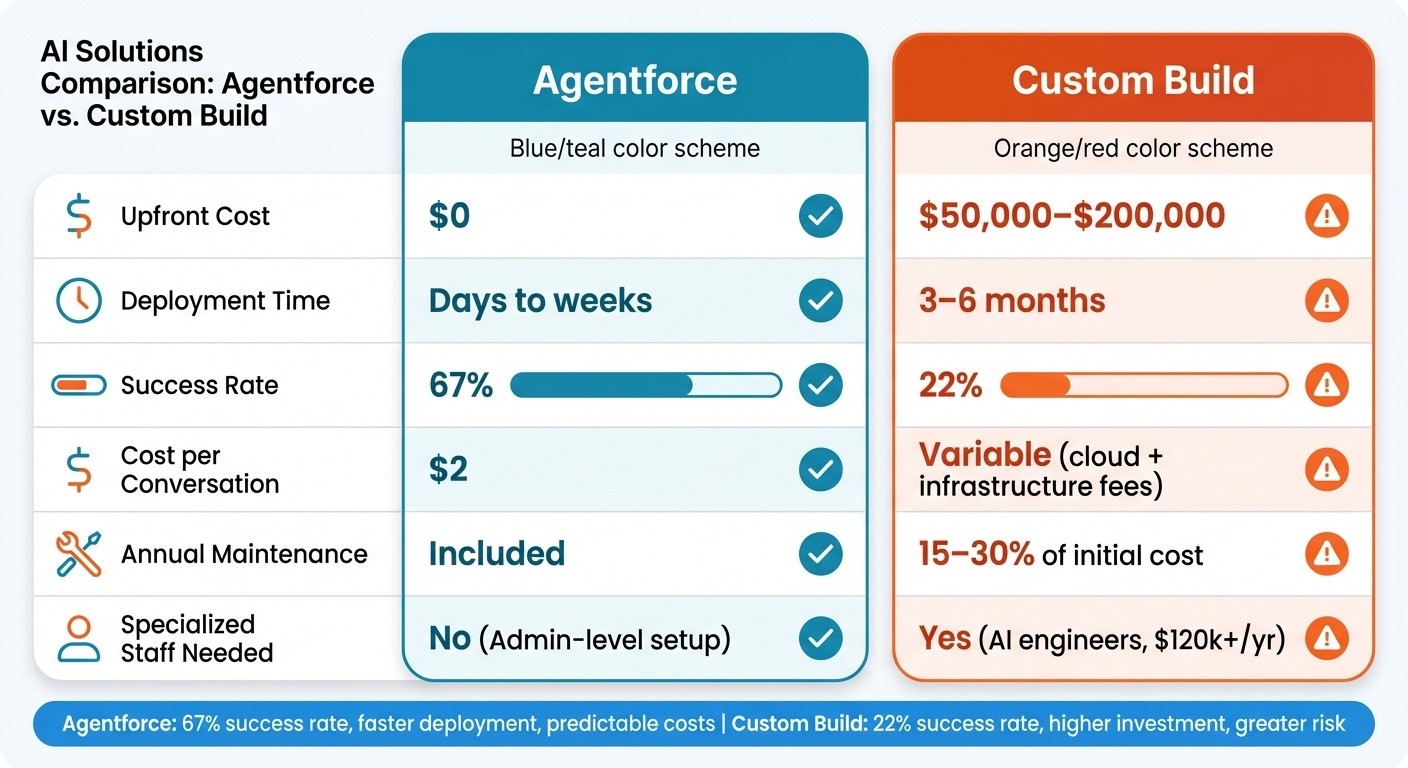
Agentforce vs Custom Build AI Solution Cost and Performance Comparison
Agentforce Pricing Model
Agentforce uses a consumption-based pricing structure that combines pay-as-you-go charges with optional per-user subscriptions. The base rate is $2 per conversation or lead [1][4], allowing costs to scale based on usage. This model is designed to help streamline internal support with AI-driven workflows. For teams just starting, Salesforce Foundations offers a free tier for any Salesforce cloud not already in use [4]. As needs grow, teams can transition to paid plans. Below, we break down the key components of Agentforce's pricing: variable costs, user-based charges, and enterprise options.
Flex Credits and Variable Costs
At the heart of Agentforce's pricing are Flex Credits, which cost $500 for 100,000 credits - equivalent to about $0.10 per action. This setup is ideal for teams with fluctuating support demands, as you only pay for what you use. However, it’s wise to keep an eye on credit usage, especially during periods of high traffic, to avoid unexpected expenses. Let’s now look at the fixed costs tied to users and add-ons.
Per-User and Add-On Costs
For dedicated Sales or Service teams, add-on subscriptions cost $125 per user, per month. These charges grow proportionally with team size. For instance, a 50-person support team would pay $6,250 monthly in addition to any conversation-based fees. It’s also worth noting that employees using Slack but without a Salesforce account will need a provisional Salesforce license to access Agentforce features [5], which could increase the overall cost.
Enterprise Plans and Customizations
For larger organizations, enterprise editions are available at $550 per user, per month [4]. These plans offer more flexibility and include access to the Agentforce 360 Platform, which integrates with existing Salesforce tools like Flows, Apex, and MuleSoft APIs to connect agents with external systems [4]. For businesses seeking fully customized solutions, professional services range from $50,000 to $200,000, with deployment timelines spanning 3 to 6 months [1]. These advanced pricing tiers will play a role in the broader cost comparison between Agentforce and custom-built solutions, which we’ll explore later.
Custom Build Cost Breakdown
Creating an AI answer agent involves three main expense categories: initial development, ongoing maintenance, and cloud infrastructure. Over a five-year period, the total cost of ownership often exceeds $320,000[2] - and that’s assuming the project is successful. Here’s a closer look at where the money goes.
Initial Development Costs
Getting a custom AI solution off the ground requires a significant upfront investment, typically ranging from $50,000 to $200,000 over a 3 to 6-month period[1]. These costs cover critical elements like engineering (with salaries exceeding $120,000 per year per engineer[2]), data integration, model tuning, security compliance, and infrastructure setup. However, it’s worth noting that in-house builds tend to have lower success rates[1].
In one case from 2025, a mid-sized e-commerce company spent $180,000 over five months to build a custom AI support agent. Despite the investment, the project faced integration challenges and high monthly token fees, prompting the company to switch to a no-code platform that improved accuracy in just two weeks[1][2].
Even after the initial build, keeping the system running smoothly comes with additional costs.
Ongoing Maintenance Expenses
Maintenance typically costs 15–30% of the initial development expense annually[2]. For a project costing $50,000–$200,000 to develop, this translates to $7,500 to $60,000 per year. These funds cover tasks like prompt tuning, monitoring for hallucinations, addressing performance issues, conducting security audits, and fixing bugs[1]. Unlike no-code platforms that offer built-in tools for observability, custom builds require dedicated engineering resources to maintain accuracy and compliance. Over time, these recurring costs significantly contribute to the overall cost of ownership.
"Custom AI projects routinely cost $20,000 to over $300,000, with no guarantee of success." - AgentiveAIQ[2]
Infrastructure and Scaling Costs
Cloud hosting introduces another layer of expense, with monthly LLM token fees ranging from $1,000 to $5,000 for a mid-sized agent handling around 1,000 daily users[1]. For example, AWS can be 15–22% more expensive than GCP for AI workloads, while Azure reserved instances may reduce costs by up to 42%[1]. Beyond hosting, integration costs - such as syncing with CRMs or internal knowledge bases - can add $8,000 or more during the first quarter alone[6]. As usage grows, inefficient prompt designs can drive token costs even higher, with some teams reporting monthly expenses reaching $7,500[1].
Custom builds, while seemingly tailored, often come with hidden costs that can spiral as the project scales.
Direct Cost Comparison: Agentforce vs. Custom Build
When comparing costs, custom AI solutions demand an upfront investment ranging from $50,000 to $200,000, plus an additional 15–30% annually for maintenance. In contrast, Agentforce offers a no-cost entry for Salesforce customers, with a simple pricing structure of $2 per conversation[2][4]. This comparison highlights the financial and operational trade-offs, with Agentforce's subscription model offering faster deployment and predictable costs - ideal for teams managing moderate conversation volumes.
Comparison Table: One-Time vs. Recurring Costs
Cost Category | Agentforce (Salesforce) | Custom Build Solution |
|---|---|---|
One-Time Dev Cost | $0 (Low-code/Foundations)[4] | $20,000 – $300,000+[2] |
Deployment Time | Days to Weeks[4] | 3 – 12 Months[2] |
Annual Maintenance | Included in platform updates[4] | 15% – 30% of initial cost[2] |
Specialized Staff | Admin/Business User | AI Engineers ($120k+/yr)[2] |
Variable Cost | $2 per conversation[4] | Cloud/Infrastructure fees[2] |
This table makes it clear how fixed and variable costs factor into total expenditures, setting the stage for the breakeven analysis below.
Breakeven Analysis
For teams handling 120,000 conversations annually, Agentforce costs approximately $240,000 per year. A custom solution with a $200,000 upfront investment, combined with recurring maintenance fees, also totals $240,000 in the first year - achieving cost parity around the 12-month mark[2]. However, at lower volumes, the financial advantage of Agentforce becomes apparent. For instance, at 50,000 conversations per year, Agentforce costs about $100,000, making it a far more economical choice than a custom build.
Deployment speed further tilts the scales. Agentforce can be up and running in just days or weeks[4], while custom builds typically take 3 to 12 months[2]. For a company with 1,000 employees, delays in deployment could result in over $2 million in lost productivity annually[3]. This makes custom solutions not only slower but also riskier and significantly more expensive in the long run.
Time-to-Value and Hidden Costs
Deployment Timelines
Agentforce stands out for its rapid deployment, often taking under 5 to 10 minutes thanks to pre-configured templates tailored for common roles like Employee Help or Customer Insights [2][6][5]. In contrast, building custom AI solutions can stretch timelines significantly. Most in-house projects require 3 to 6 months, with some extending up to 12 months [1][2]. The difference in success rates is equally stark: Agentforce boasts a 67% success rate, while custom builds only succeed 22% of the time [1]. Moreover, custom projects often encounter a 95% pilot failure rate, largely due to integration challenges and insufficient operational readiness [1].
For enterprise teams, these extended timelines translate to months of lost productivity, as engineering teams are diverted from critical business initiatives to focus on infrastructure development. Beyond these delays, custom solutions also come with a host of hidden costs that can strain budgets and resources.
Hidden Costs and Opportunity Impact
While deployment speed is a key factor, the hidden costs of custom builds can have an equally significant impact. In just the first quarter, teams may spend over $8,000 refining prompts and syncing data. Beyond this, they face ongoing "Agent Ops" responsibilities, including tasks like prompt tuning, monitoring for hallucinations, managing agent drift, and maintaining data integrations [6][1]. These operational demands often require dedicated AI engineering resources, which can cost more than $120,000 annually, driving up total costs by 15–30% per year [2].
Compliance and security add another layer of expense for custom solutions. Teams must manage SOC 2 certification, conduct security audits, and maintain ongoing compliance monitoring - services that platforms like Agentforce handle as part of their package [4][3]. For a company with 1,000 employees, the opportunity cost of inefficient information retrieval and repeated tasks can surpass $2 million annually [3].
Infrastructure costs also present a challenge. Variable fees for LLM tokens can range from $1,000 to $5,000 per month [1]. These unpredictable expenses complicate budgeting and can escalate rapidly as usage grows, adding yet another layer of financial uncertainty to custom projects.
Resource and Operational Requirements
Engineering Resource Requirements
The level of engineering effort required varies significantly between custom-built solutions and pre-configured platforms. Custom builds demand ongoing developer involvement for tasks like fine-tuning prompts, monitoring for issues such as hallucinations or latency, maintaining middleware for data integration, and retraining models regularly to avoid "agent drift", where performance deteriorates over time [1]. These tasks often necessitate hiring specialized AI engineers, with salaries typically exceeding $120,000 annually [2].
Agentforce takes a completely different approach by emphasizing a "clicks, not code" configuration model [8]. Salesforce administrators can deploy and manage agents using familiar tools like Flows, Apex, and natural language instructions - eliminating the need for dedicated AI engineering expertise. Instead of technical engineering tasks, maintenance becomes more administrative, involving updates to agent profiles, prompt adjustments, and managing access directly within Salesforce or Slack [5]. This shift significantly reduces engineering overhead, enabling faster implementation and lower ongoing costs, which strengthens Agentforce's appeal when compared to custom-built solutions.
When Salesforce introduced its Techforce Agent in 2024 to support over 28,000 employees, Director Neil Cummins highlighted the operational benefits:
"The real power of the agent is that it gives people the exact piece of information they need without the back-and-forth" [9].
This implementation now handles more than 64,000 conversations annually, saving an impressive 16,800 hours of work [9]. While reducing engineering involvement is a major advantage, maintaining long-term stability remains an essential consideration.
Scalability and Maintenance Considerations
Sustaining performance over time is a critical challenge, especially for custom-built solutions. "Day 2" maintenance introduces ongoing issues, including API drift caused by changes in backend data structures, model obsolescence such as tokenizer mismatches, and the need for manual re-indexing when embedding models are upgraded [7].
Agentforce simplifies these challenges by operating as a managed service. It includes a model adapter that automates tasks like LLM migrations, prompt recompilation, and tokenizer alignment - processes that would otherwise demand extensive engineering hours [7]. Additionally, Agentforce leverages MuleSoft as a connective layer, insulating agents from disruptions caused by changes in backend systems. By contrast, custom builds often rely on fragile direct API connections, which are prone to breaking when downstream schemas are updated [7].
The efficiency difference is striking: Agentforce implementations are 16 times faster than custom-built solutions, achieving productive accuracy in just 4.8 months compared to 75.5 months for DIY projects [8]. Fine-tuning with Agentforce typically takes 1.6 months to reach 91% accuracy, whereas custom approaches can take up to 24 months to achieve only 52% accuracy [8]. Senior Director Ajay Kumar Kambadkone Suresh emphasized the complexity of these issues:
"The sheer technical depth of these 'Day 2' maintenance problems makes it clear that building a solution from scratch is not just an engineering project - it's a commitment to building and maintaining a complex internal platform for years to come" [7].
Decision Framework for Enterprise Teams
Building on the insights about costs and resources discussed earlier, this framework helps enterprise teams decide which option aligns best with their goals.
When to Choose Agentforce
Agentforce is the go-to option for quick deployment and predictable costs. With a low-code setup, it can be operational in just a few days, and its consumption-based pricing at $2 per conversation makes budgeting straightforward [4]. For teams aiming to avoid the hefty upfront investment of $50,000–$200,000+ required for custom development, Agentforce provides a scalable alternative [1].
Statistics show that purchased AI tools succeed at a rate of 67%, compared to just 22% for in-house builds [1]. This higher success rate stems from addressing operational challenges that often derail custom projects. For example, Agentforce includes built-in safeguards like the Einstein Trust Layer, which automatically handles security and compliance, eliminating the need for teams to build and audit these systems themselves [4].
For teams lacking AI engineering expertise, Agentforce’s "clicks, not code" design is a major advantage. Instead of hiring AI engineers with salaries exceeding $120,000 annually [2], Salesforce administrators can configure agents using familiar tools like Flows and Apex [4]. Additionally, the platform takes care of ongoing maintenance tasks, such as model migrations, prompt updates, and tokenizer alignment - responsibilities that could otherwise consume 15–30% of the initial build cost annually [2].
When to Opt for a Custom Build
A custom build is only worth considering when your needs go beyond what Agentforce can deliver. This option is better suited for highly specialized requirements that cannot be met through Agentforce’s extensible platform or the 20+ partner solutions available on AgentExchange [4]. For organizations with proprietary infrastructure that isn’t compatible with tools like MuleSoft API connectors or low-code solutions, a custom approach might be necessary [2][4].
However, custom builds come with significant risks and costs. Beyond the initial $50,000–$200,000+ development expense [1], they require ongoing investments in data engineering, model adjustments, and infrastructure upkeep. Teams should also account for recurring expenses, such as $1,000–$5,000 in LLM fees per month [1]. This path demands strong technical expertise and should start with narrowly defined use cases to test and validate ROI before scaling [1].
Conclusion
To wrap up the cost comparison: Agentforce provides predictable pricing, while custom builds offer more tailored control. Agentforce operates on a straightforward model - $2 per conversation with quick deployment - whereas custom builds demand a hefty upfront investment of $50,000 to $200,000 or more, along with 3 to 6 months of development time before going live [1][2]. Furthermore, purchased AI tools have a success rate of 67%, compared to just 22% for in-house builds [1].
Custom builds come with ongoing expenses, including operational fees, fluctuating cloud costs, and the salaries of specialized engineers. In contrast, Agentforce simplifies this by including updates, security, and scaling within its subscription, eliminating the need for additional engineering resources.
"Building AI from scratch is a capital-intensive gamble. For 95% of businesses, it's simply not worth the cost, time, or risk." - AgentiveAIQ [2]
Speed matters. While custom builds take months of engineering effort to produce results, Agentforce can be up and running in just days, thanks to low-code configuration tools that Salesforce admins are already familiar with [4]. This rapid deployment directly impacts business outcomes, especially since 95% of AI pilots fail due to integration hurdles rather than model limitations [1].
The decision is clear: Agentforce is the better choice for predictable costs, fast deployment, and proven success rates. Custom builds should only be considered for highly specialized needs that can't be met by Agentforce's flexible platform or the 20+ partner solutions available on AgentExchange [4]. For teams focused on budget certainty and operational efficiency, Agentforce consistently delivers better results with less risk.
This analysis underscores why Agentforce is the optimal solution for the majority of enterprise AI needs, aligning perfectly with the broader conversation on effective AI deployment.
FAQs
How does Agentforce’s pricing compare to building a custom AI solution?
Agentforce uses a subscription-based pricing model, starting at around $750 per user per month for its enterprise-grade editions. This fee covers everything - platform access, hosting, security, and regular updates - offering a straightforward and predictable cost structure.
In contrast, developing a custom AI solution in-house comes with a hefty upfront investment, typically ranging from $20,000 to over $300,000, along with 15–30% annually for maintenance. For more advanced projects, additional operational costs like cloud infrastructure and compliance can easily exceed $25,000 per month.
Agentforce’s subscription approach provides a consistent and manageable expense, while custom-built solutions often involve steep initial costs and unpredictable ongoing expenses. For enterprises, this makes Agentforce a more practical and budget-friendly option.
How does Agentforce’s success rate compare to building a custom AI solution?
Purchased AI platforms, such as Agentforce, consistently outperform custom-built solutions when it comes to success rates. Research indicates that in-house AI projects succeed only 22% of the time, whereas ready-made platforms like Agentforce boast success rates nearing 67%.
This gap can be explained by the inherent difficulties of custom builds. These include complex integration processes, the constant need for maintenance, and the significant time investment required to make them fully operational. Pre-built solutions, on the other hand, are specifically designed to tackle these challenges. They offer quicker deployment, reliable scalability, and a track record of dependability that enterprise teams can trust.
What should teams consider when choosing between Agentforce and building a custom AI solution?
When weighing Agentforce against a custom-built AI solution, it's crucial to examine costs, deployment time, and available features to make an informed decision.
Agentforce operates on a simple SaaS pricing model at $750 per user per month. This fee includes infrastructure, regular updates, and security measures. On the other hand, building a custom AI solution demands a substantial upfront investment, often ranging from $20,000 to $300,000 or more. Beyond the initial cost, ongoing maintenance typically adds 15–30% annually, and additional expenses such as LLM usage and system integration can quickly escalate to thousands of dollars each month.
Deployment speed is another critical consideration. With Agentforce, you can integrate it into your existing systems and see results within weeks. In contrast, custom solutions often require 3–6 months for development and testing. This timeline comes with a higher risk of delays or even project failures. For teams that require enterprise-grade features like SOC-2 compliance, expert-verified answers, and seamless cross-system integration, Agentforce delivers these capabilities right out of the box. Achieving similar functionality with a custom solution would demand significant engineering resources and time.
Ultimately, evaluating costs, time-to-deployment, and built-in enterprise features will help you decide whether Agentforce or a custom AI solution aligns better with your team's needs.