∙
Cooper
∙
Reading time:
9 min

Repetitive questions waste time and money. Teams spend hours searching for answers buried in traditional knowledge management tools or Slack threads. AI-powered bots solve this by delivering instant, accurate responses directly in Slack, saving companies millions annually.
Here’s a quick breakdown of three popular options:
Question Base: Integrates with tools like Notion and Salesforce to deliver 99.99% accurate, verified answers in 3.2 seconds. Starts at $8/user/month.
Slack AI: Summarizes conversations and retrieves past chats. External tool integration is limited to premium plans. Costs $18/user/month.
Guru: Uses "Knowledge Cards" vetted by experts for reliable answers. Integrates with 150+ tools. Starts at $15/user/month.
Each bot addresses common workplace inefficiencies, but their features, pricing, and accuracy vary.
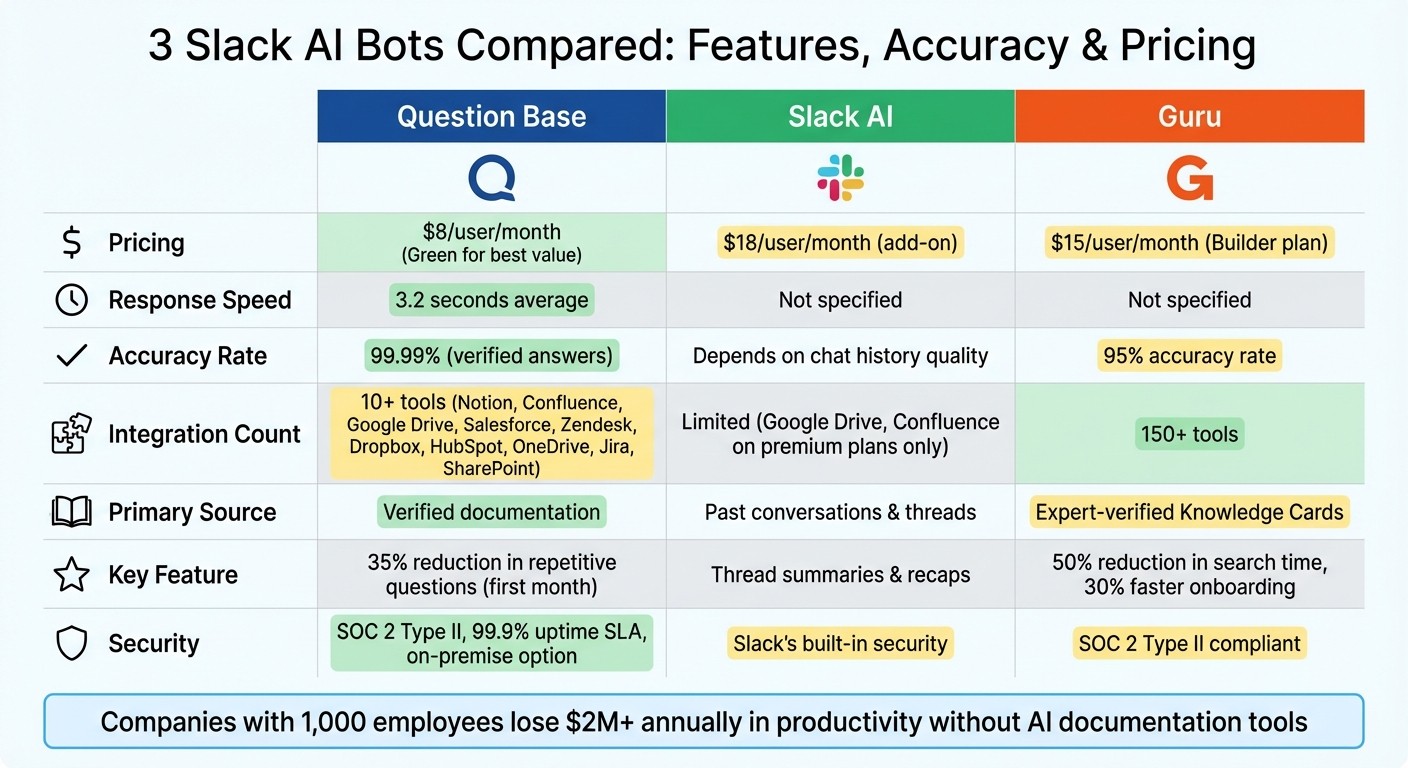
Slack AI Bot Comparison: Question Base vs Slack AI vs Guru Features and Pricing
Build a No-Code AI Knowledge Base in Slack 🚀
1. Question Base
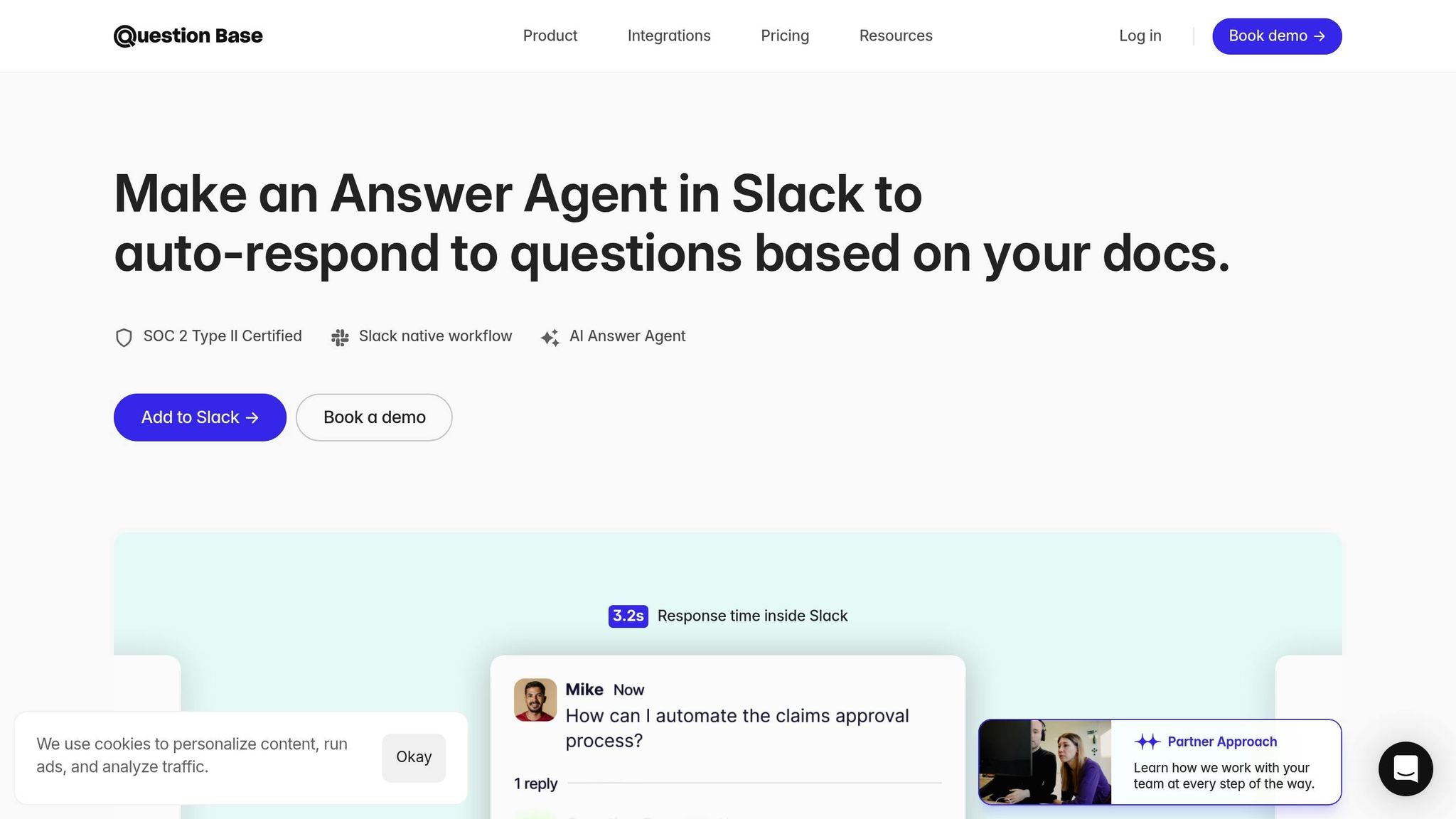
Question Base is an AI-powered Slack agent designed for enterprise teams that need precise answers sourced directly from trusted documentation - not just generic chat summaries. By connecting seamlessly with your knowledge repositories, it delivers responses in an impressive 3.2 seconds on average [1].
Integrations with Documentation Tools
Question Base integrates with a wide range of tools, including Notion, Confluence, Google Drive, Salesforce, Zendesk, Dropbox, HubSpot, OneDrive, Jira, and SharePoint. It even captures new insights from Slack threads. These integrations ensure that answers are pulled from reliable sources, boosting both accuracy and operational efficiency.
Accuracy of Answers
Thanks to its deep integrations and expert-verified approach, Question Base delivers highly reliable answers. The platform boasts a 99.99% accuracy rate for verified responses and can handle 35% of repetitive questions automatically within the first month of use [1].
"Since we started using Question Base, we don't spend any time looking up our procedures in a support manual... Now, QB finds the relevant answers in a few seconds."
– Maria Jensen, UX Lead & Scrum Master, Ticketbutler [1]
Security and Compliance Features
To meet enterprise-grade standards, Question Base holds a SOC 2 Type II certification and guarantees a 99.9% uptime SLA. It also offers robust security measures like Role-Based Access Control (RBAC) and Slack Single Sign-On for controlled access. For organizations with stringent data requirements, on-premise deployment options are available.
Knowledge Management Capabilities
The platform goes beyond answering questions by offering tools for better knowledge management. Features include per-channel AI customization, duplicate question detection, and case tracking to monitor resolution rates and automation performance. Its analytics dashboards provide insights into questions asked, resolution success, and areas where answers need improvement - helping teams refine their knowledge base over time.
Pricing: $8 per user per month.
2. Slack AI
Slack AI simplifies the Slack experience by summarizing conversations and providing thread recaps. This helps teams stay updated without having to sift through a flood of messages.
Integrations with Documentation Tools
For those on higher-tier plans like Business+ and Enterprise, Slack AI offers integration with external documentation tools such as Google Drive and Confluence. This functionality is delivered through the "Channel Expert" feature, powered by Agentforce [2][3]. However, this integration is exclusive to these premium plans. Teams on lower-tier plans have to rely solely on Slack's internal message history. Additionally, Slack AI is available as an add-on at a cost of $18 per user per month [2][3].
Accuracy of Answers
Slack AI primarily draws from past conversations to generate responses. While this can be helpful, it also means that its answers depend on the quality and recency of those chats. This reliance on informal communication can sometimes result in outdated or inconsistent responses, which might not be ideal for critical decision-making that requires verified information.
Knowledge Management Capabilities
Slack AI includes some basic tools for managing knowledge, such as thread summaries and the ability to tailor response styles for individual channels [6]. It adheres to Slack's existing permission settings, ensuring users only access information they're authorized to see [5]. That said, it lacks more advanced capabilities like case tracking, duplicate detection, and in-depth analytics. Up next, we’ll explore another tool designed to address the challenges of managing company documentation.
3. Guru

Guru simplifies internal documentation by converting it into easy-to-digest "Knowledge Cards", which are vetted by experts and readily available in Slack.
Integrations with Documentation Tools
Guru integrates with more than 150 tools, including Confluence, Notion, Google Drive, Salesforce, and Zendesk [2]. This allows teams to consolidate information from various sources into one accessible hub. Within Slack, employees can use Guru’s AI-powered search to find answers or deploy custom Knowledge Agents that handle inquiries based on preset permissions. Pricing begins at $15 per user per month for the Builder plan, with a free Starter tier available for up to 10 users.
Accuracy of Answers
Thanks to its extensive integrations and rigorous quality controls, Guru delivers highly reliable answers. Expert approval processes and automated reminders for content updates help maintain a 95% accuracy rate. The AI-powered search not only retrieves answers but also cites original sources, giving users the option to rate responses or flag unresolved questions for follow-up.
Knowledge Management Capabilities
Guru doesn’t just focus on accuracy - it also improves how teams manage and update their knowledge. Features like version control, role-based permissions, and "Trending Topics" help knowledge managers identify popular Slack discussions and pinpoint areas needing new documentation. Teams using Guru have reported 30% faster onboarding and a 50% reduction in time spent searching for information. Additionally, Guru extracts insights from Slack conversations, cross-checking them with existing documentation to turn informal discussions into structured, searchable data.
The platform is SOC 2 Type II compliant, ensuring robust data security, and allows for detailed governance by assigning ownership of specific information categories - such as IT runbooks or HR policies. By combining expert validation with dynamic tools for managing and updating knowledge, Guru provides an effective solution for keeping internal knowledge bases accurate and up-to-date.
Feature Comparison
When it comes to Slack bots, integrations, accuracy, and knowledge management set them apart. Question Base stands out by sourcing answers from trusted platforms like Notion, Confluence, and Salesforce. This ensures responses are pulled directly from verified documents rather than relying on chat history. In contrast, Slack AI primarily searches messages and threads, with access to external tools restricted to higher-tier plans starting at $18 per user/month. Meanwhile, Guru delivers answers through pre-verified Knowledge Cards. Let’s break down how these platforms compare in terms of accuracy, knowledge management, and security.
Accuracy is a key factor. Question Base incorporates a human-in-the-loop system, where experts validate AI-generated answers. This approach achieves an impressive 99.99% accuracy rate, with an average answer score of 4.8 [1][4]. On the other hand, Slack AI relies on past conversations to generate answers, which can lead to outdated or incomplete information.
In knowledge management, Question Base offers advanced tools such as case tracking for unanswered questions, per-channel customization, and an AI-powered "Smart Capture" feature. This feature automatically logs important information from Slack threads, eliminating the need for manual documentation [5]. These capabilities can reduce repetitive queries by up to 35% within the first month, significantly boosting efficiency. In comparison, Slack AI offers basic summarization features but lacks structured knowledge management tools. Guru, on the other hand, focuses on delivering pre-verified knowledge content but doesn’t provide the same level of automation or adaptability.
When it comes to security, all three platforms meet enterprise-grade standards. Question Base is SOC 2 Type II compliant and provides optional on-premise deployment and white-labeling for large organizations. Slack AI leverages Slack’s built-in security infrastructure. For context, in a company with 1,000 employees, the cost of lost productivity can exceed $2 million annually [1]. This highlights the value of investing in a purpose-built answer agent to streamline workflows and reduce inefficiencies.
Conclusion
Every bot mentioned here addresses a common workplace challenge: the time employees waste searching for answers already tucked away in company documentation. Question Base stands out by delivering precise, verified responses directly from trusted platforms like Notion, Confluence, and Salesforce. This makes it a perfect fit for HR, IT, and operations teams, where accuracy and traceability are non-negotiable. On the other hand, Slack AI focuses on enhancing daily work conversations, offering tools like conversation summaries and access to past chat history.
While Slack AI excels at simplifying conversation recaps, its method of sourcing answers differs significantly from tools designed specifically for knowledge management. Meanwhile, Guru takes a different route, offering pre-verified, card-based knowledge snippets - ideal for teams that value concise, curated information.
Bringing documentation directly into Slack has proven to boost efficiency, as employees naturally gravitate toward asking questions in chat rather than combing through a wiki [1].
"We went from answering the same questions over and over, to setting it up once and it answers the same questions over and over for us :)" - Brandon Horvatic [1]
This real-world example underscores the power of integrated knowledge tools.
Without these systems, companies risk staggering productivity losses - estimated at over $2 million annually [1]. Whether you lean toward Question Base for its verified accuracy, Slack AI for its streamlined recaps, or Guru for its curated snippets, the goal remains the same: transform Slack into a central hub for fast, dependable answers that keep teams aligned and efficient.
FAQs
How does Question Base ensure its answers are accurate and reliable?
Question Base delivers reliable answers by sourcing information directly from your organization's trusted internal tools like Notion, Confluence, and Salesforce. To maintain accuracy, all responses are carefully reviewed and approved by your team's knowledge experts, ensuring they align with the latest and most dependable data. Each answer also comes with a clear source citation, giving users confidence in the information and the ability to verify it easily.
How is Question Base different from Slack AI?
Question Base and Slack AI both operate within Slack but cater to different needs. Question Base is designed for enterprise teams like HR, IT, and operations, offering verified answers from trusted sources such as Notion, Confluence, and Salesforce. On the other hand, Slack AI focuses on summarizing conversations and retrieving information from Slack's chat history.
Here’s how they differ:
Accuracy: Question Base provides expert-verified, citation-backed answers, ensuring reliability. Slack AI, however, pulls responses from past messages, which may not always be verified.
Data Sources: Question Base connects with external tools like Salesforce and Dropbox, expanding its knowledge base. Slack AI is confined to Slack's internal ecosystem.
Enterprise Features: Question Base includes advanced features like case tracking, analytics, and compliance tools, making it well-suited for large teams that need structured and scalable knowledge management.
While Slack AI works well for quick, chat-based assistance, Question Base stands out for delivering reliable, document-driven answers tailored to enterprise environments.
Can Guru's Knowledge Cards work with other tools?
There’s no clear indication that Guru's Knowledge Cards work with other tools. For teams that need smooth integrations with platforms such as Notion, Confluence, Salesforce, and others, Question Base provides strong connectivity tailored specifically for enterprise needs.