∙
Cooper
∙
Reading time:
10 min

Repetitive questions and scattered information cost large enterprises an average of $47 million annually. Tools like Question Base and Slack AI aim to solve this by improving knowledge management within Slack. While both enhance productivity, they serve different purposes:
Question Base: Focuses on verified, structured knowledge management by pulling accurate answers from trusted sources like Notion and Confluence. It costs $8/user/month and reduces operating costs by 21%.
Slack AI: Summarizes and organizes past Slack conversations to save time. It costs $18/user/month but lacks advanced knowledge management features.
Key takeaway: If precise, scalable knowledge sharing is your priority, Question Base is the better choice. For quick conversation summaries, Slack AI works well. Both tools offer unique ways to streamline workflows and improve efficiency. You can also customize Slack workflows to further automate these processes.
Keynote Lunch: Activating Enterprise Intelligence in the Age of AI
1. Question Base
Question Base integrates directly with trusted documentation platforms like Notion, Confluence, Salesforce, Google Drive, and Zendesk to deliver verified answers within Slack. Unlike general-purpose AI tools that rely on interpreting chat history, Question Base pulls exclusively from expert-maintained content, ensuring responses are both accurate and auditable. This seamless connection transforms how teams capture and manage knowledge.
Integration Capabilities
Installing Question Base is effortless, thanks to its availability in the Slack App Marketplace - no engineering resources are needed. Once connected, it integrates with your existing documentation systems, making extensive resources like HR policies, IT runbooks, and sales playbooks instantly accessible without leaving Slack. The platform’s one-click thread capture feature converts Slack conversations into searchable, lasting knowledge, ensuring that valuable information doesn’t get buried in chat history.
Streamlining Knowledge Management
Question Base addresses the common issue of inaccessible, undocumented knowledge. Teams can review and refine automated responses to maintain control, while the platform tracks recurring questions to highlight documentation gaps. This transforms Slack into a dynamic FAQ system that evolves alongside your team’s workflows. By turning fleeting conversations into structured, searchable content, organizations can retain and build upon institutional knowledge that might otherwise be lost.
Analytics and Insights
Beyond delivering answers, Question Base provides actionable insights to help teams continuously improve. The analytics dashboard tracks key metrics such as automation rate, resolution rate, average response time, and content gap reports, giving leaders a clear view of ROI. Weekly reviews of unanswered questions help prioritize new documentation efforts, while department-specific breakdowns (e.g., HR vs. IT) reveal where self-service is thriving and where additional support is needed. These insights make it easy to demonstrate the time and cost savings achieved through better knowledge management.
Enterprise-Grade Security
Security is a top priority for Question Base. The platform is SOC 2 Type II compliant and employs encryption both at rest and in transit. Built on enterprise-grade infrastructure, it adheres to strict data retention and security protocols. For organizations with advanced needs, features like on-premise deployment, white-labeling, and multi-workspace support are available - ideal for managing sensitive operational knowledge across distributed teams.
2. Slack AI
Slack AI focuses on summarizing and organizing past conversations, setting it apart from dedicated knowledge platforms that meticulously verify content sources. Unlike specialized systems like Question Base, which are designed for structured knowledge management, Slack AI emphasizes enhancing productivity within Slack itself. It helps streamline individual workflows by summarizing chats, highlighting relevant messages, and keeping users updated on missed activity in channels. On average, Slack AI saves users 97 minutes per week by simplifying how they sift through and absorb information from their Slack history [3]. For teams prioritizing personal productivity and conversation management, these time savings can make a noticeable difference.
Integration Capabilities
Slack’s enterprise search integrates with popular third-party apps such as Google Drive, Asana, and GitHub, creating a centralized hub for retrieving information [2]. This functionality is available to users subscribed to the Enterprise Grid plan who opt for the Slack AI add-on [3]. While these integrations enable broad search capabilities, they mainly focus on fetching information rather than providing expert-verified answers from curated documentation systems.
Knowledge Management Efficiency
Slack AI relies on conversational data and file interpretation within Slack to generate responses, rather than drawing from well-organized documentation. This works effectively for revisiting past discussions but doesn’t resolve the issue that 47% of employees avoid traditional knowledge bases due to disorganized content and ineffective search tools [2]. Moreover, Slack AI lacks advanced features like thread capture, detecting repeated questions, or tools to turn fleeting chat messages into structured, reusable documentation. These gaps highlight its limitations in offering more robust knowledge management and analytics capabilities.
Analytics and Insights
The analytics offered by Slack AI are fairly basic, providing usage statistics that show how often the tool is utilized across the workspace. While it supports general productivity tracking, it doesn’t include deeper insights such as automation rates, resolution times, content gaps, or departmental performance metrics - critical data points for organizations looking to measure the ROI of their knowledge management efforts.
Enterprise Security
Slack AI is designed with enterprise-grade security protocols, ensuring the safe handling of sensitive information. For organizations using the Enterprise Grid plan, the platform provides a solid security framework to deploy AI features across distributed teams. However, it lacks options like on-premise deployment or white-labeling, which are often necessary for organizations operating in highly regulated industries.
Pros and Cons
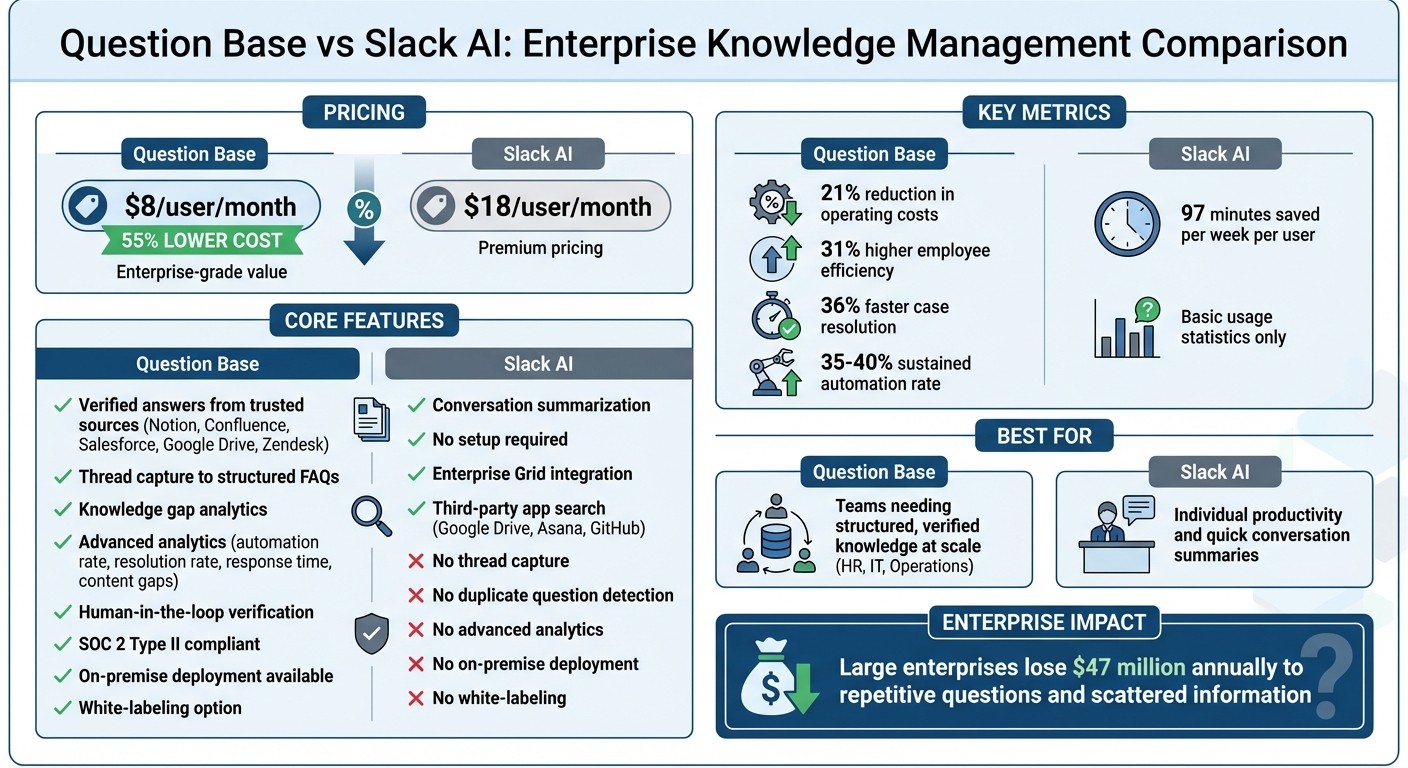
Question Base vs Slack AI: Features, Pricing, and ROI Comparison
Let’s break down the strengths and weaknesses of each tool, highlighting how they align with enterprise needs. Question Base and Slack AI each bring unique capabilities to the table, acting as Slack knowledge agents, but their trade-offs depend on what your organization values most.
Question Base stands out for its reliable accuracy, pulling verified information directly from trusted sources like Notion, Confluence, and Salesforce. On the other hand, Slack AI impresses with its effortless setup, making it ideal for summarizing conversations without additional configuration. Below is a side-by-side comparison to help you weigh the options.
Tool | Pros | Cons |
|---|---|---|
Question Base | • Delivers verified information from trusted sources | • Requires initial integration with external tools |
Slack AI | • No setup needed - fully integrated into Slack | • May generate inaccurate results from unverified chat data |
The table highlights how each tool fulfills different priorities, making it easier to choose based on your enterprise’s goals.
When it comes to costs, Question Base offers a 55% lower per-user fee than Slack AI, which can significantly boost ROI for large teams. Early adopters of Question Base have reported 31% higher employee efficiency and a 21% reduction in operating costs [1], proving its value extends beyond mere time savings.
For teams that depend on precise, vetted knowledge management, Question Base’s human-in-the-loop verification and knowledge gap analytics tackle a major pain point: inefficient knowledge sharing, which costs large enterprises an average of $47 million annually [3]. Meanwhile, Slack AI excels at improving individual productivity, helping users catch up on missed conversations. However, it lacks the structured knowledge controls that ensure long-term accuracy and accountability - essential for support teams managing complex workflows.
Conclusion
Slack AI and Question Base cater to different enterprise priorities, each offering distinct strengths. Slack AI focuses on keeping individuals productive by providing quick summaries of long threads, helping users catch up on missed conversations, and cutting through the noise in busy channels. With its seamless integration into Slack and no setup required, it’s a handy tool for instant recaps.
On the other hand, Question Base is designed for teams that need structured, verified knowledge at scale. Instead of relying on chat-based data, it delivers expert-approved answers, which is a game-changer for HR, IT, and operations teams where precision and accountability are non-negotiable.
At $8 per user per month, Question Base not only reduces operating costs by 21% but also improves efficiency by 31% [1]. Its automated contextual tagging feature ensures your knowledge base stays updated as new content is added [2]. For example, a major client reported resolving cases 36% faster with the platform [2]. These results highlight its potential for strategic deployment.
By continuously updating and refreshing your organization’s knowledge base, Question Base acts as a dynamic memory system for your enterprise. For businesses that value measurable ROI from contextual tagging, this solution stands out. It transforms Slack into a powerful knowledge assistant, identifying gaps, capturing institutional memory, and scaling operations effectively. A practical starting point could be a 12-month pilot in a single department, such as HR or IT, to gather metrics and validate a 35–40% sustained automation rate before expanding across the organization [4].
If your focus is on operationalizing knowledge rather than simply summarizing it, Question Base provides the structure, security, and scalability to turn contextual tagging into a long-term asset.
FAQs
How does Question Base enhance knowledge management compared to Slack AI?
Question Base takes Slack to the next level, transforming it from a basic chat platform into a reliable knowledge hub. While Slack AI relies on past conversations to provide answers, Question Base connects directly to trusted documentation platforms like Notion, Confluence, Salesforce, and Google Drive. This means your team gets accurate, expert-approved answers that are always current.
What sets Question Base apart is its advanced tools for managing knowledge. It automatically organizes insights from Slack, detects duplicate content, and offers analytics to monitor resolution rates and refine answers over time. With features like customizable settings, human-in-the-loop escalation, and detailed performance metrics, it enables enterprises to create a dynamic FAQ system that evolves with business needs - delivering far more than Slack AI’s chat-focused capabilities.
What are the cost savings of using Question Base for large teams?
Question Base delivers real savings for large teams by cutting down on repetitive questions and boosting overall efficiency. Priced at just $5 per user per month, a 500-person organization would spend $2,500 monthly while gaining powerful enterprise features. These include advanced analytics and verified answers, seamlessly integrated with tools like Notion, Confluence, and Salesforce.
By automating answers to routine queries, Question Base frees up valuable time for both employees and experts. For instance, eliminating 5-minute repetitive questions - each costing about $3 - can save a senior team member as much as $30,000 annually in regained focus. On a larger scale, a 20-person team reclaiming 1.5 hours daily (at $25/hour) could save around $195,000 per year, delivering an ROI that easily surpasses 1,000%.
With its predictable pricing model and clear, measurable benefits, Question Base not only reduces support tickets and speeds up onboarding but also ensures experts can focus on high-priority tasks. It’s a smart, cost-efficient solution for growing teams looking to scale effectively.
What security measures does Question Base offer for enterprises?
Question Base prioritizes enterprise-level security by offering SOC 2 Type II compliance, robust encryption to safeguard data both at rest and in transit, and the option for on-premise deployment for organizations that need extra control over their data.
These measures are tailored to meet the stringent security demands of enterprises, keeping your internal knowledge secure while ensuring it remains easily accessible to your teams.