∙
Cooper
∙
Reading time:
13 min

AI is transforming Slack from a chat tool into a centralized knowledge hub, helping enterprises address productivity challenges caused by scattered information and repetitive questions. By integrating Slack with systems like Notion, Confluence, and Salesforce, AI-driven synchronization provides instant, secure access to verified knowledge. This reduces time spent searching for information, minimizes errors, and streamlines workflows.
Key advancements include:
Real-Time Search (RTS) API and Model Context Protocol (MCP) for secure, permission-aware data access.
Retrieval-Augmented Generation (RAG) for accurate, policy-aligned responses.
Autonomous AI agents that automate tasks like updating CRM records or scheduling meetings.
Why it matters:
47% of digital workers struggle to find the information they need.
Fortune 500 companies lose $31.5 billion annually due to inefficiencies.
Enterprises using AI synchronization save 97 minutes per user weekly.
For enterprises, tools like Question Base go beyond Slack AI by pulling from trusted documentation, offering analytics, and ensuring compliance with security standards like SOC 2 Type II. Whether in healthcare, finance, or education, AI-driven Slack synchronization enables faster decision-making and preserves institutional knowledge.
Future Trends in AI-Driven Slack Synchronization
Decentralized AI Models for Slack
Decentralized AI models are reshaping how Slack data is accessed and used by relying on on-demand data queries instead of bulk downloads or external storage. The Model Context Protocol (MCP) acts as a unified communication layer, allowing AI models to connect directly to data sources while adhering to user permissions. This eliminates the need for complicated integrations. Similarly, the Real-Time Search (RTS) API enables secure, query-based access to Slack data without storing it externally.
"The Slack MCP server streamlines how large language models and AI agents access Slack data... reducing the need for complex, service-specific integrations." - Slack [2]
This decentralized system is particularly effective for enterprises managing millions of messages across multiple Slack workspaces. It ensures scalability while maintaining robust security, something centralized systems often struggle with. By leveraging this approach, transient Slack interactions can be transformed into permanent and searchable knowledge.
Turning Slack Conversations into Searchable Knowledge
AI is revolutionizing Slack by converting fleeting conversations into searchable knowledge bases. A significant challenge for digital workers - 47% report difficulty finding the information they need - is exacerbated by traditional keyword-based searches that often lack context [1].
Retrieval-Augmented Generation (RAG) is a solution that grounds AI responses in proprietary data without storing customer information, ensuring both accuracy and privacy. When combined with decentralized retrieval, RAG creates a highly efficient and searchable repository. This technology supports real-time search and thread summarization, helping teams save an average of 97 minutes per user each week [1].
"The ability to pull live Slack context directly into our AI workflows allows our teams to search company knowledge more effectively." - Trivago [2]
By turning scattered conversations into well-organized documentation, AI-driven synchronization reduces repetitive questions and ensures that institutional knowledge remains available, even when team members change roles or leave the organization.
Automated and Personalized Responses in Slack
The next frontier is using autonomous AI agents to automate and personalize responses within Slack, building on the structured knowledge created from Slack data. According to Gartner, by 2028, 33% of enterprise software applications will include agentic AI capabilities, with 15% of work decisions being made autonomously by these systems [2].
While structured knowledge reduces repeated queries, agentic AI takes things further by acting autonomously. These advanced AI agents can update CRM records, schedule meetings, and even coordinate fixes - all directly within Slack channels. For instance, Question Base integrates with trusted platforms like Notion, Confluence, and Salesforce to deliver personalized AI responses in Slack, going beyond simple chat history retrieval. This level of precision and auditability is crucial for enterprises.
"The future of work is not in tabs and forms, but in people and AI agents working together in the flow of conversation." - Slack [5]
A lack of real-time awareness has led to incorrect decisions for 32% of digital workers [1]. By embedding verified knowledge into Slack workflows, companies can reduce errors, speed up decision-making, and allow experts to focus on more strategic tasks.
The ULTIMATE AI Slack Chatbot Tutorial! (n8n, AWS, Amazon Bedrock, Claude, Regex, JavaScript)
Question Base vs Slack AI: A Comparison for Enterprises

Question Base vs Slack AI: Enterprise Feature Comparison
As enterprises strive for efficient communication and reliable knowledge management, comparing these AI tools highlights their distinct strengths in optimizing support workflows.
What Slack AI Does Well
Slack AI excels at boosting general productivity. It helps teams summarize conversations, catch up on missed discussions, and surface relevant information from chat history. Fully integrated into Slack, it allows users to generate recaps, search past messages, and distill key points from lengthy threads with ease.
This tool is particularly effective for teams that rely heavily on Slack as their central communication platform. It shines when individuals need to quickly get context on missed conversations or revisit earlier discussions. Slack AI operates entirely within Slack's ecosystem, offering SOC 2 and FedRAMP Moderate compliance while ensuring data stays within Slack's Virtual Private Cloud (VPC).
Next, let’s explore why Question Base is better suited for enterprise support and knowledge management.
Why Question Base Works Better for Enterprise Support
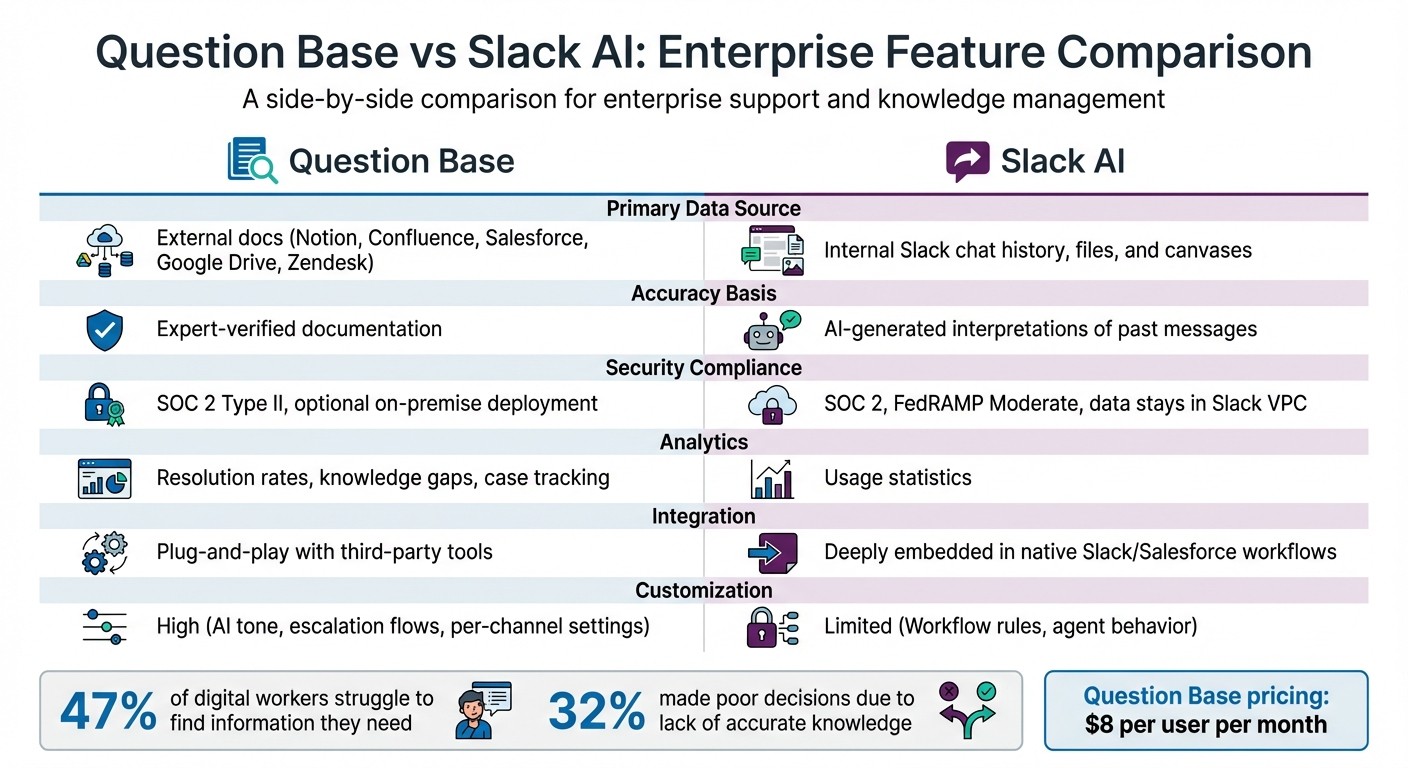
While Slack AI focuses on summarizing past chats, Question Base transforms conversations into actionable knowledge by bridging the gap between chat and formal documentation. The critical difference lies in the source of answers. Slack AI generates responses by interpreting past Slack messages, whereas Question Base pulls directly from expert-verified documentation stored in trusted systems like Notion, Confluence, Salesforce, Google Drive, and Zendesk.
"Agents need more data and real relevance in their answers and actions, and that's going to come from context, and that context, frankly, comes from conversations that happen within an enterprise." - Rob Seaman, Chief Product Officer, Slack [6]
For enterprise teams managing complex or sensitive tasks - like HR handling benefits inquiries, IT addressing security protocols, or operations ensuring compliance - this distinction is vital. Question Base ensures responses are grounded in official policies and verified knowledge, not just informal chat history. It’s designed for large-scale internal support scenarios where accuracy, auditability, and ownership of knowledge are non-negotiable.
Beyond offering precise answers, Question Base provides advanced analytics. It tracks resolution rates, identifies knowledge gaps, and offers case tracking to help organizations refine their knowledge base over time. Teams can audit unanswered questions, spot missing documentation, and align updates with sprint cycles or quarterly reviews.
With a simple setup process - installing via the Slack App Marketplace, connecting documentation tools, and inviting the bot using /invite @questionbase - there’s no need for engineering support. Enterprises retain full control over accessible content, AI behavior, and escalation workflows. For teams handling sensitive data, Question Base offers SOC 2 Type II compliance and optional on-premise deployment.
Feature Comparison Table: Question Base vs Slack AI
Here’s a side-by-side look at how Question Base and Slack AI differ:
Feature | Question Base | Slack AI |
|---|---|---|
Primary Data Source | External docs (Notion, Confluence, Salesforce, etc.) | Internal Slack chat history, files, and canvases |
Accuracy Basis | Expert-verified documentation | AI-generated interpretations of past messages |
Security Compliance | SOC 2 Type II, optional on-premise deployment | SOC 2, FedRAMP Moderate, data stays in Slack VPC |
Analytics | Resolution rates, knowledge gaps, case tracking | Usage statistics |
Integration | Plug-and-play with third-party tools | Deeply embedded in native Slack/Salesforce workflows |
Customization | High: AI tone, escalation flows, per-channel settings | Limited: Workflow rules, agent behavior |
Choosing between these tools depends on your needs. If your goal is to summarize yesterday’s meeting or catch up on Slack threads, Slack AI is a great fit. But for enterprise teams where 47% of digital workers struggle to locate information and 32% have made poor decisions due to lack of accurate knowledge [1], Question Base stands out. It turns Slack into a dynamic internal knowledge assistant, ensuring critical information is delivered to the right people at the right time - all without requiring additional engineering resources.
How Enterprises Use AI-Driven Slack Synchronization
AI-driven Slack synchronization is changing the way businesses operate in industries where precision, compliance, and speed are non-negotiable. Sectors like healthcare, finance, and education are leveraging these tools to connect scattered documentation with teams that need quick, reliable access to verified information. This isn’t just about convenience - it’s about reducing risks, ensuring compliance, and enabling experts to focus on high-value work.
Healthcare: Quick Access to Protocols and Compliance
Imagine a nurse needing updated infection control protocols or a billing specialist verifying insurance procedures. They don’t have time to dig through outdated Slack threads or wait for a manager’s input.
AI synchronization tools solve this by linking Slack to trusted systems like Confluence, Salesforce, or internal compliance databases. When a team member searches for a protocol, the system retrieves expert-verified documentation rather than relying on informal conversations. This ensures responses align with regulatory standards and organizational policies. For healthcare organizations managing sensitive patient data, platforms offering SOC 2 Type II compliance and encryption at rest and in transit provide a solid security framework.
These tools save organizations an average of 97 minutes per user weekly, enabling clinical and administrative teams to devote more time to patient care. The same need for speed and accuracy applies to the finance sector, where immediate, verified insights are essential for navigating regulatory complexities.
Finance: Ensuring Accuracy in a Regulated Industry
Financial institutions face high stakes when it comes to information accuracy. Whether it’s a compliance officer confirming reporting standards or a customer service representative explaining account policies, answers must be both authoritative and traceable.
Here, Retrieval-Augmented Generation (RAG) architecture makes a difference. Unlike tools that rely solely on past conversations, RAG pulls answers directly from a company’s proprietary knowledge base, such as policy documents, regulatory guidelines, or approved procedures stored in platforms like Notion, Google Drive, or Zendesk. This approach ensures AI-generated responses are grounded in official documentation, not informal chats. Teams using these tools report 37% faster decision-making[3], a critical advantage in a fast-paced, high-stakes environment.
Education: Supporting Staff and Students More Effectively
Educational institutions, like healthcare and finance, benefit from streamlined access to verified knowledge. Universities face operational complexities across HR, IT, student services, and academic administration. Staff often deal with repetitive questions about enrollment, benefits, or IT troubleshooting - issues that pull focus away from strategic educational goals.
AI-driven Slack tools automate these routine queries. For instance, when a faculty member asks about resetting a password or a staff member inquires about leave policies, the system retrieves accurate answers from trusted documentation.
"Question Base has exceeded our expectations - it's easy to use, intuitive and a massive time saver. We now have a reliable and useful knowledge base... We no longer have staff waiting on busy managers for an answer" - Monica Limanto, CEO, Petsy[2]
Educational institutions are also exploring personalized learning support through AI companions.
"An AI-powered learning companion that helps users master topics through personalised study paths, tailored explanations and progress tracking, making learning more efficient and adaptable to individual goals" - Slack[5]
This marks a shift from static knowledge repositories to interactive, conversational learning tools, fundamentally changing how educational organizations manage and deliver knowledge.
For institutions handling verified protocols and standard operating procedures, tools like Question Base - priced at $8 per user per month - offer a practical alternative to generic AI solutions that only summarize chat history without connecting to verified sources.
These examples highlight how AI-powered Slack synchronization transforms Slack into a centralized, secure knowledge hub tailored to the unique needs of enterprises.
Conclusion: Getting Ready for AI-Driven Slack Synchronization
What Enterprises Should Keep in Mind
AI-driven Slack synchronization isn't about replacing human expertise - it’s about making that expertise instantly accessible when needed. By leveraging decentralized architectures, Slack can connect directly to trusted sources like Notion and Confluence, ensuring responses are based on verified documentation. This is especially critical in regulated industries such as healthcare and finance, where precision and compliance are non-negotiable. Tools built on Retrieval-Augmented Generation (RAG) architecture offer the level of security and auditability required to meet the demands of enterprise-scale operations.
Another key factor is customization and control. Enterprises need tools that provide robust security while enabling features like auditing knowledge gaps, tracking unanswered queries, and syncing documentation updates with sprint cycles. These capabilities can transform Slack from a simple communication platform into a dynamic knowledge hub that evolves alongside the organization. Balancing security with accessibility is what allows Slack to take on this expanded role effectively.
Why Now Is the Time to Invest in AI-Driven Slack Tools
The cost of poor knowledge sharing is too high to ignore. Fortune 500 companies lose an estimated $31.5 billion annually due to inefficiencies in knowledge transfer, and nearly 40% of tacit knowledge vanishes within six months of employee turnover[4]. Investing in AI-driven tools now can help capture and preserve institutional knowledge while preparing for the rise of agentic AI, which will automate routine decisions. By 2028, 33% of enterprise software applications are projected to include agentic AI features[1].
The financial benefits are compelling: improving data accessibility by just 10% can generate over $65 million in additional net income for Fortune 1000 companies[3]. Solutions like Question Base, priced at $8 per user per month, offer an affordable way for enterprises to create scalable, secure knowledge systems without the need for costly custom development. Early adopters of these tools gain a tangible edge - accelerated onboarding, fewer support delays, and teams that spend less time searching for answers and more time driving results.
FAQs
How does AI keep Slack answers permission-safe?
AI keeps Slack answers secure by relying on trusted sources and enforcing strict access controls. It employs enterprise-level security measures such as SOC 2 Type II compliance, encryption (both at rest and in transit), and customizable content access settings to safeguard sensitive data. These features ensure that responses are both accurate and permission-safe.
What is RAG, and why does it improve answer accuracy?
RAG (Retrieval-Augmented Generation) is an AI framework designed to improve the accuracy of responses. It works by pulling in relevant external data and integrating it into the process of generating answers. This approach ensures responses are not only precise but also current, offering users a dependable and trustworthy experience.
How can I connect Slack to verified documents without engineering?
Question Base streamlines the process of linking Slack to your verified documents - no engineering required. Simply install the app from the Slack App Marketplace, then connect it to your trusted platforms like Notion, Confluence, Salesforce, or Google Drive. With these connections in place, Question Base provides verified answers directly in Slack, offering secure, enterprise-level access to your knowledge base without the need for custom development or technical expertise.