∙
Cooper
∙
Reading time:
11 min

Repetitive questions bog down teams. If you're using Slack daily, you've likely experienced the chaos of scattered threads and lost conversations. Salesforce's revamped Slackbot, launched on January 13, 2026, aims to fix this by introducing a smarter, AI-powered assistant. But how does it compare to specialized tools like Question Base?
Here’s the quick takeaway:
Slackbot: Focuses on summarizing conversations, drafting emails, and integrating with Salesforce CRM. Best for sales teams needing quick updates.
Question Base: Designed for structured knowledge management, offering verified answers, gap tracking, and escalation workflows. Ideal for HR, IT, and operations teams.
Key Differences:
Slackbot excels in real-time productivity but lacks depth for managing complex knowledge workflows.
Question Base prioritizes accuracy with expert-reviewed answers and analytics to improve internal support processes.
For teams drowning in repetitive Slack queries, choosing the right tool depends on your goals: faster CRM updates or trustworthy knowledge management. Let’s break it down further.
1. Salesforce Slackbot
Core Features
Salesforce's updated Slackbot, introduced on January 13, 2026[4], has evolved from a basic notification tool into a more sophisticated, context-aware AI agent. Powered by Anthropic's Claude, it focuses on three main functions: summarization, drafting, and semantic search. The bot can summarize missed conversations, identify action items in threads, and create first drafts for emails, project plans, or meeting agendas - all by leveraging real-time workspace data. These enhancements have been well-received within Salesforce's internal teams.
Integration Capabilities
Through the Model Context Protocol (MCP), the Slackbot works seamlessly across platforms like Anthropic, OpenAI, Salesforce CRM, Google Drive, Box, and Confluence. It enables semantic search across these tools, pulling together data from multiple sources while respecting user access permissions. Salesforce envisions Slack as the central hub for collaboration in what it calls the "Agentic Enterprise", where both humans and AI agents operate in a unified workspace to drive productivity. Early results from their Agentforce for HR Service, integrated with Slack, showed that 96% of inquiries were resolved without human involvement during its initial rollout[6]. These integrations are backed by robust security measures to ensure reliability.
Enterprise Security
Security and compliance have been a top priority in this rebuild. The Slackbot is certified under FedRAMP Moderate standards, meeting U.S. federal requirements. Importantly, Salesforce avoids training its language models on customer data, ensuring that the bot only retrieves information users are authorized to access. Parker Harris, Salesforce's CTO, highlighted the importance of these safeguards:
"AI models inherently lack security layers. If we trained it on some confidential conversation that you and I have... there is no way for me to say you get to see the answer, but Carolyn doesn't"[3].
Luis Madrigal, CIO of Beast Industries, emphasized that these security protocols made it easier for his team to approve the bot's deployment quickly[3]. Additionally, these AI-driven features are included at no extra cost for Business+ (priced at $15 per user/month, billed annually) and Enterprise+ plans[3][5].
Knowledge Management
While Salesforce's Slackbot is effective for real-time productivity tasks, Slack isn’t a knowledge base by default and lacks the depth required for structured knowledge management. It can summarize past conversations and draft content, but it does not offer features like case tracking, per-channel customization, duplicate detection, or analytics to assess resolution rates or content gaps. Its responses are primarily based on Slack chat history and connected files, which works well for general use but falls short for teams needing verified, expert-reviewed answers or detailed audit trails. This limitation highlights the gap between Salesforce's Slackbot and purpose-built tools like Question Base, which are designed for more comprehensive knowledge management needs.
2. Question Base
Core Features
Question Base addresses the challenges of managing knowledge in enterprise environments by delivering verified, expert-reviewed answers. Unlike generic AI tools, it prioritizes accuracy by pulling information directly from trusted sources like Notion, Confluence, Google Drive, and Salesforce. This ensures that responses are based on well-maintained, reliable documentation rather than unstructured chat logs.
Its human-in-the-loop system adds an extra layer of validation, particularly valuable for departments where compliance is critical, such as HR and IT. With confidence scoring - typically set at 90% - the system determines whether an answer is reliable enough to be shared automatically or escalated to a human expert for review.
One standout feature is Smart Capture, which transforms useful insights from Slack conversations into structured FAQ entries. Instead of losing valuable information in Slack’s fleeting chat threads, teams can save it with just one click. Additionally, the system flags unanswered questions, helping knowledge managers identify and address documentation gaps - something Salesforce’s Slackbot doesn’t offer.
Integration Capabilities
Question Base seamlessly integrates with a wide range of tools, including documentation platforms like Notion, Confluence, and SharePoint; file storage services such as Google Drive, OneDrive, and Dropbox; CRM systems like Salesforce and HubSpot; and support tools like Zendesk, Intercom, Freshdesk, and Jira.
Getting started is simple: install the app from the Slack App Marketplace, invite the bot to your channels using /invite @questionbase, and link your preferred documentation sources. The Pro plan - priced at $8 per user per month - includes these integrations and allows up to 200 pages of connected documentation per user.
Knowledge Management
Question Base stands out from Salesforce’s Slackbot by offering structured tools specifically designed for enterprise knowledge management. It includes case tracking to monitor how questions are resolved, per-channel customization to tailor the bot’s behavior for different teams, and duplicate detection to eliminate redundant answers.
Its analytics dashboards provide actionable data, such as resolution rates, automation percentages, and content gaps, giving teams insight into their knowledge workflows. The system’s living FAQ evolves continuously, capturing new information to better handle high volumes of internal queries. Unlike Salesforce’s Slackbot, which relies on general chat data, Question Base offers a more structured, data-driven approach tailored to the needs of HR, IT, and operations teams.
How Does Slack AI Work | Slack Review
Strengths and Weaknesses
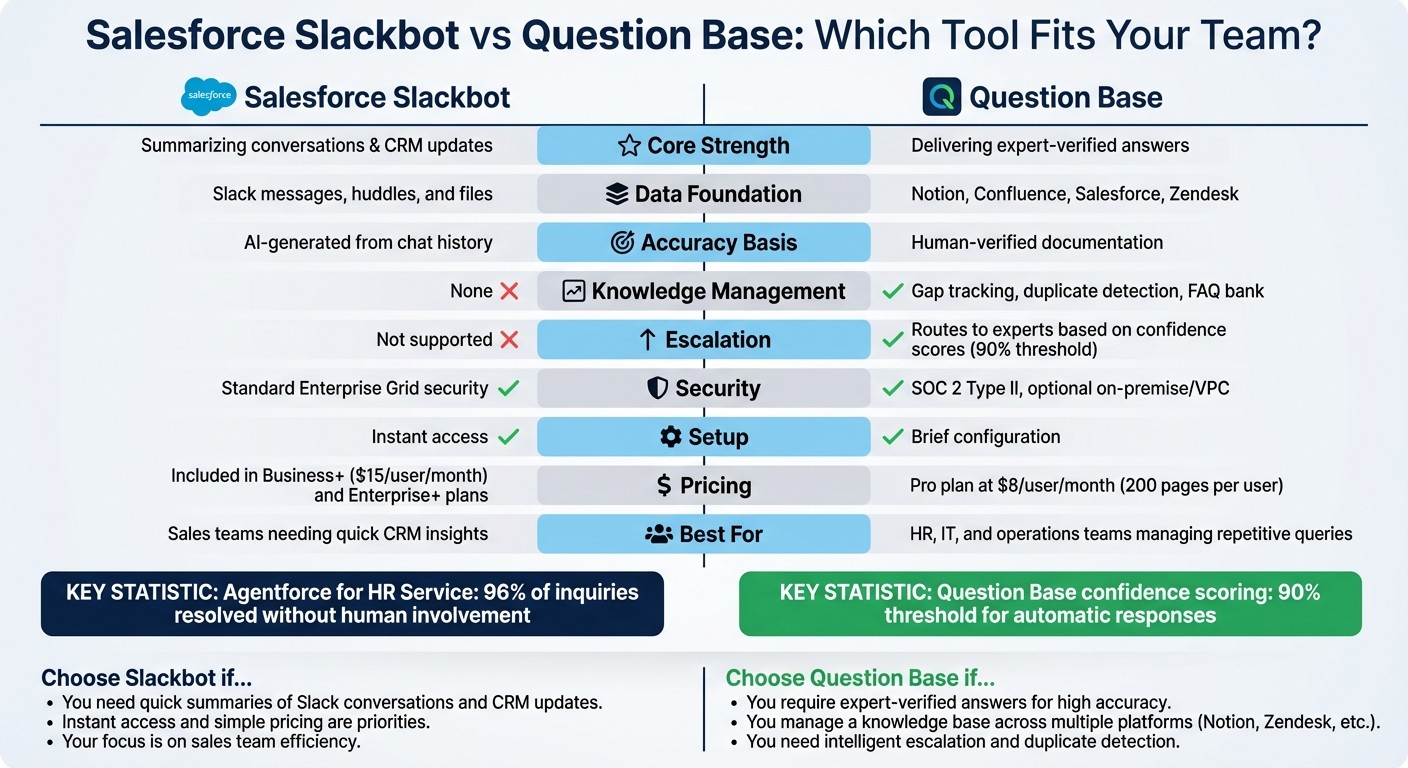
Salesforce Slackbot vs Question Base: Feature Comparison for Enterprise Teams
Every tool has its particular niche, catering to different enterprise needs. Salesforce's Slackbot shines when it comes to summarizing conversations and providing CRM updates. This makes it a great fit for sales teams who need quick insights into client discussions or deal progress. Since it’s natively integrated with Slack's Enterprise Grid, it’s immediately available, offering a plug-and-play solution for general productivity.
On the other hand, Question Base focuses on scalable knowledge management. It connects directly to expert-reviewed documentation, ensuring the answers it provides are accurate and reliable - not just pulled from chat history. This is especially critical for HR, IT, and operations teams where precision is non-negotiable. Features like confidence scoring and human escalation ensure that uncertain queries are routed to the right expert, something Salesforce's Slackbot does not offer. Let’s dive into a side-by-side comparison to highlight their key differences:
Feature | Salesforce Slackbot | Question Base |
|---|---|---|
Core Strength | Summarizing conversations & CRM updates | Delivering expert-verified answers |
Data Foundation | Slack messages, huddles, and files | Notion, Confluence, Salesforce, Zendesk |
Accuracy Basis | AI-generated from chat history | Human-verified documentation |
Knowledge Management | None | Gap tracking, duplicate detection, FAQ bank |
Escalation | Not supported | Routes to experts based on confidence scores |
Security | Standard Enterprise Grid security | SOC 2 Type II, optional on-premise/VPC |
Setup | Instant access | Brief configuration |
While Salesforce's Slackbot offers immediate usability, it lacks advanced knowledge management capabilities. In contrast, Question Base requires minimal setup but delivers powerful features like analytics dashboards, case tracking, and content gap identification. These tools enable teams to refine their internal support processes over time. For organizations dealing with a high volume of repetitive queries - whether it’s HR policies, IT troubleshooting, or operational workflows - Question Base’s structured approach delivers measurable benefits, such as faster response times and increased automation efficiency.
Conclusion
Is Salesforce's Slackbot a bold leap forward or just an effort to keep pace? The answer depends on what you’re measuring. From a technical standpoint, Salesforce is pushing boundaries. By utilizing the Model Context Protocol (MCP), it enables multi-agent collaboration and positions Slackbot as a hub for enterprise workflows [2]. As Parker Harris, Salesforce's Co-Founder and CTO, explained:
"Slackbot isn't just another copilot or AI assistant. It's the front door to the agentic enterprise, powered by Salesforce" [3].
This vision aligns well with companies deeply integrated into the Salesforce ecosystem. But when it comes to knowledge management and internal support, the Slackbot reveals some limitations.
For knowledge-heavy workflows, Salesforce's Slackbot doesn’t match the depth offered by tools like Question Base. Features such as gap tracking, duplicate detection, and human escalation - all essential for maintaining structured, validated knowledge - are absent. Slackbot focuses on real-time updates and conversation summaries but falls short in supporting expert-reviewed documentation or creating robust knowledge bases.
On the other hand, sales teams seeking CRM updates and quick conversation summaries will find Salesforce's Slackbot highly useful. For HR, IT, and operations teams handling repetitive questions, Question Base provides a more structured solution. It integrates seamlessly with knowledge management platforms like Notion and Confluence, ensuring information is both accurate and accessible. However, before adopting either tool, organizations should carefully review their permission settings to avoid exposing sensitive data while improving accessibility [1].
Ultimately, the right choice depends on your team’s priorities. If CRM integration and general productivity are at the top of your list, Salesforce's Slackbot is a solid option. But if your focus is on scalable, trustworthy knowledge management with advanced analytics and escalation workflows, Question Base is purpose-built to meet those needs.
FAQs
How does Salesforce's new Slackbot compare to Question Base in boosting team productivity?
Salesforce’s revamped Slackbot boosts efficiency by serving as a context-aware AI assistant that seamlessly integrates with tools like Salesforce CRM, Google Drive, and OneDrive. It handles tasks such as summarizing conversations, creating meeting notes, and updating records, allowing employees to reclaim valuable time. By pulling live data from connected apps, it simplifies workflows and reduces the need to jump between platforms.
On the other hand, Question Base focuses on enterprise knowledge management. It connects directly to trusted documentation tools like Notion, Confluence, and Salesforce to deliver verified, expert-approved answers. Unlike Slackbot, which emphasizes chat-based insights, Question Base offers specialized features such as duplicate detection, knowledge gap tracking, and detailed analytics. These capabilities make it a go-to solution for HR, IT, and operations teams that prioritize accuracy, compliance, and scalability.
While Salesforce’s Slackbot shines in automating tasks and providing real-time data, Question Base stands out by ensuring teams have access to structured, dependable answers from their organization’s knowledge base, keeping everyone aligned and well-informed.
What security features does Salesforce's Slackbot offer for enterprises?
Salesforce's Slackbot prioritizes security at an enterprise level. It functions entirely within Slack's trusted framework and complies with stringent standards like SOC 2, ensuring strong data protection. The bot respects user roles, permissions, and access controls, ensuring that only authorized users can view specific information. Sensitive spaces like private channels and direct messages remain off-limits to unauthorized individuals.
On top of that, Salesforce integrates with Single Sign-On (SSO) solutions such as Okta and Azure AD, streamlining authentication and improving access management. These safeguards protect sensitive data while enabling secure automation and AI-driven support for enterprise teams.
Why might a team prefer Question Base over Salesforce's Slackbot for managing knowledge?
Teams often lean toward Question Base over Salesforce's Slackbot because it’s specifically designed for enterprise-level knowledge management and internal support. While Slackbot primarily retrieves information from Slack chat history and focuses on summarizing conversations, Question Base connects directly to trusted sources like Notion, Confluence, Salesforce, and Google Drive. This integration ensures that responses are verified and expert-approved, making them both accurate and dependable.
What sets Question Base apart are its specialized features, including duplicate detection, knowledge gap tracking, and advanced analytics. These tools help organizations build a scalable, well-organized knowledge base. Tailored for HR, IT, and operations teams, it emphasizes security, compliance (SOC2), and customization - key priorities for enterprises that require reliable and auditable systems. On the other hand, Salesforce’s Slackbot excels in general productivity and quick lookups but may fall short for larger, more complex organizations that demand a more robust solution.